
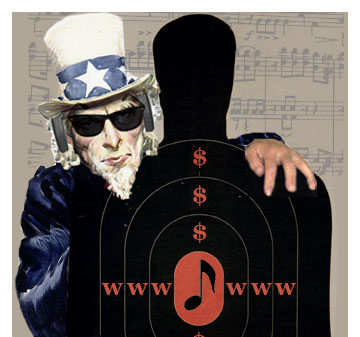

It was the best of times, it was the worst of times for independent musicians, music labels and their fans earlier this month in Washington.
In two distinct rulings, one by the Federal Communications Commission, and the other by the Library of Congress’ Copyright Royalty Board, the U.S. government took a firm stand in favor of small artists and music labels — and local programming over media conglomerates — even as it drove a regulatory stake through the heart of a fast-growing and popular medium for niche and independent music: Internet radio.
The two rulings set off a flurry of media coverage and online debate of the proper role of government in promoting diversity on the airwaves. They also painted a picture of a federal government at odds with itself about how to balance the rights of the public with those of artists, copyright holders and media conglomerates. But with music fans and artists increasingly disenchanted with the status quo and newly empowered by technology, the squabbling over royalties and copyright may already be causing a paradigm shift that will transform the music industry.
First, the good news. After years of public and private complaints about payola, or “pay for play” practices, the FCC is close to levying multimillion-dollar fines against some of the nation’s largest radio conglomerates, including Clear Channel Communications, CBS Radio, Entercom Communications and Citadel Broadcasting, for using cash, gifts of travel and other perks to get an inside track at major commercial radio stations.
The FCC hasn’t finalized its decision, but a source familiar with the negotiations confirmed the accuracy of published reports that named fines in the neighborhood of $12 million for infringers. FCC chairman Kevin Martin also assured a skeptical Congress last week that the investigation is ongoing and that other broadcasters could also be called to account.
Some of the participating companies are already talking, too. Andy Levin, executive vice president and chief legal officer of Clear Channel Communications, said in a statement that his company agreed to settle the long-standing payola investigation with the FCC so that it could “close the door on (the) ongoing inquiry and move forward,” though the company admitted no wrongdoing.
The FCC investigation and settlement follow years of official inaction despite appeals from artists and artists groups about what many said was a rampant payola system that channeled money from well-off music labels to commercial stations through so-called independent promoters.
The proposed FCC settlement and a related agreement between broadcasters and the American Association of Independent Music, a trade association that represents independent record labels, might make breaking onto commercial airwaves a little easier for bands that have been shut out of commercial broadcasts.
According to reports, the deal will open up 8,400 half-hour blocks of commercial radio time to artists from independent and small labels like those that belong to A2IM. Clear Channel would not comment on the details of the deal with A2IM, but said in a statement that it is “reaffirming our commitment to new and emerging artists by committing a significant amount of airtime to music performed by unsigned artists.”
That kind of commercial radio access would counter what many consider the corrupting influence of pay for play and the homogenizing effects of radio industry consolidation under the Telecommunications Act of 1996. Since the passage of that act, diversity on the airwaves has plummeted, according to a study released by the Future of Music Coalition in December.
Today, just 15 programming formats make up three-quarters of all commercial programming, with stations serving up “urban,” “oldies” and endless variations of “adult contemporary” music and pushing out niche music formats like classical, jazz, bluegrass, independent rock and folk, FMC found.
The lack of variety and the prevalence of pay for play has made life difficult for up-and-coming bands like Evoka of Winston-Salem, N.C., said drummer Bryan Ledbetter. After an Evoka EP, “Stranger Than Fiction,” generated buzz a few years back, the band hired a radio promotions team to tour the country. While some program directors gave the band a fair hearing and added Evoka’s music to their playlist, band members also encountered blatant corruption. “One programmer said, ‘Come up with this amount and you’re on.’ It was vacation packages, whatever they want. It was all money. Push and shove,” Ledbetter said.
But the devil will be in the details of the A2IM decision. Most of the parties involved in the negotiations with the A2IM aren’t talking about how they plan to work unsigned artists and independent labels into their rotations, or even what music formats will or won’t qualify. FMC said that it is “cautiously optimistic” that the deal with A2iM will signal to programmers and disc jockeys that commercial radio is open to independent radio, said Jenny Toomey, executive director of FMC, in a statement.
But even as it gave to independent musicians with one hand, federal regulators were taking with the other. A ruling on March 2 from the Copyright Royalty Board, an arm of the Library of Congress, imposed strict new terms on the licensing of copyrighted songs for Internet broadcast that may doom even the best-run, best-funded webcasting operations.
In a hearing last week by the House Subcommittee on Telecommunications and the Internet in Washington, chairman Ed Markey, D-Mass., called the CRB ruling a “body blow to many nascent Internet radio broadcasters” and said that that the decision would hurt “fledgling entrepreneurs” as well as public broadcasters and smaller stations.
The CRB ruling determines the rates that Internet broadcasters must use to reimburse copyright owners and performing artists for the right to play their music over the Internet. To the disappointment of webcasters big and small, the new schedule set an aggressive schedule of per song royalty hikes, with proceeds paid to SoundExchange, an artists’ group set up to manage and distribute digital performance royalties.
From $.0007 (.07 cents) per performance in 2005, royalties would rise to $.0008 per performance, retroactive to Jan. 1, 2006, and keep rising yearly until 2010, when the per performance royalty would cap out at $.0019 per performance. No provisions were made for small commercial webcasters who lobbied for an alternative royalty system based on a percentage of their streaming-related revenue.
The situation isn’t much better for noncommercial webcasters like National Public Radio and religious broadcasters. They’ll pay a fee of $500 per channel for the first 160,000 hours of aggregate streaming per month. That may satisfy small college stations and other noncommercial outfits. However, it doesn’t come close to covering traffic to the Web sites of popular public stations like KCRW in Santa Monica, Calif., or other well trafficked webcasters who offer multiple streams to many thousands of listeners each day. After exceeding their threshold, those webcasters would have to pay the commercial rate.
In response, NPR petitioned CRB to reconsider its decision last week. Major public radio stations also signalled their support for a revisiting of the royalty schedule. “The CRB decision is truly egregious in that it treats successful non-commercial online music webcasters as if they were commercial stations,” said general manager Ruth Seymour of KCRW, which has long promoted independent artists.
Changes wrought by the 1998 Digital Millennium Copyright Act were at the heart of the dispute over webcasting royalties. According to that act, digital performance royalties for webcasters must “clearly represent the rates and terms that would have been negotiated in the marketplace between a willing buyer and a willing seller.” That standard is far different from those applied to the calculation of royalty payments for digital cable providers and satellite radio networks, which consider the public benefit of such services as well as the relative contribution of the broadcaster, according to David Oxenford, a partner at Davis Wright Tremaine, which represented small webcasters in the recent negotiations with the CRB.
The CRB decision landed with a dull thud on the desk of Tim Westergren, CEO of the Music Genome Project and Pandora, a fledgling Internet radio station that lets users create stations based on particular artists or songs, then automatically populates them with like-minded music based on the Music Genome Project’s analysis of the characteristics and attributions of those songs.
Even at the new rate of $.0008 per performance, applied retroactively to 2006, Pandora is on the hook for “millions and millions” of dollars in royalty payments to SoundExchange, Westergren told Salon — far more than the company took in as revenue.
Kurt Hanson, president of Web broadcaster AccuRadio, found himself and his webcasting service in a similar boat. AccuRadio streams 320 channels of niche music formats like Celtic, jazz and Broadway tunes. It tracked about 1 million unique visits in February 2007. Hanson’s firm paid royalties as a percentage of that revenue: 6 percent to composers’ organizations like ASCAP and BMI and 12 percent to SoundExchange for the digital performance royalties. In all, AccuRadio took in around $400,000 in 2006 after promotions that include rotating banner advertisements, audio advertisements in-stream, and video commercials before the launch of each radio stream. However, under the new CRB rates for 2006, AccuRadio is facing a bill to SoundExchange in the neighborhood of $600,000, or $200,000 more than AccuRadio’s revenues for all of 2006, Hanson said.
Hanson, who had been party to the talks with CRB, testified in favor of any formula for royalty payments that would allow small webcasters, many of whom see little or no profit from their operations, to continue to do business. But those arguments fell on deaf ears at the CRB. “Apparently the judges interpreted their assignment as figuring out the rate in a hypothetical world, so they looked to economic theorists rather than real-world examples from the 2006 advertising market,” he said.
John Simson, executive director of SoundExchange, said that his organization is sympathetic to the challenges faced by “small guys” like Hanson and Westergren, who face big increases in the per-song costs of streaming. However, he stood by the CRB’s ruling and the “willing buyer/willing seller” formula, which he characterized as an attempt to reproduce the market conditions webcasters would encounter were they to strike individual licensing deals with record labels or artists for streaming, rather than getting a blanket license from SoundExchange.
But others argue that the tortuous legal process that led to the CRB ruling was costly enough to force out all but the largest and most well-heeled parties. The effort to set digital performance royalties for webcasters included 48 days of testimony, 13,288 pages of transcripts, 192 exhibits and 475 entries of pleadings, motions and orders, on top of written direct statements and rebuttals from the parties involved, according to the CRB. “It’s impossible for smaller parties to participate in these proceedings in any economic fashion,” Oxenford said.
In the meantime, independent artists who have found a new platform for their music in services like Pandora admit to mixed feelings about the ruling. “To shutter services like Pandora seems strange. Won’t another pop up in its place?” wrote Stephanie Casey, a Portland, Ore., guitarist who performs under the name Fall of Snow, in an e-mail interview. On the other hand, Casey, whose music is streamed on Pandora and available for sale on iTunes, said that independent musicians face tough times with or without Internet radio.
“Unless you are Fall Out Boy or Björk or Sheryl Crow, that .04 cents per play or whatever on Internet radio isn’t gonna add up to much more than buying you a latte once a week,” she wrote. “I know so many people who LOVE music and still don’t think twice about trading entire iTunes libraries with their friends. There is no consciousness that you are hurting the artist by not contributing to them financially.”
The CRB decision has already stoked animosity in the recording industry and media establishment. Westergren, Hanson and others are mounting grassroots opposition to the new rates, including petition and e-mail campaigns to key members of Congress. More than 38,000 people have signed an online petition in support of independent webcasters last week. A number of Web pages protesting the CRB decision, like SaveTheStreams.org and Save Net Radio, have sprung up in protest to the March 2 ruling. Ultimately, artists and fans may already be far ahead of the music establishment in embracing the new model, said Casey.
Postings to in online forums like Techdirt widely interpreted the CRB ruling as a call to arms to reject artists that use copyright altogether in favor of alternative online music services that trade in royalty-free music.
Magnatune, in Berkeley, Calif., is one such response. Launched in April 2003, Magnatune is a cross between a music label and an online radio station. It obtains its songs by negotiating directly with musicians to license their music. The service then allows Internet users to listen to streamed versions of any songs from its catalog for free online. Listeners who want copies of the music buy them directly from Magnatune as digital downloads, or as CDs.
In contrast to iTunes, Magnatune’s albums are free of digital rights management controls, and pricing is variable — listeners can choose to pay as little as $5 for an album, or more if they want. Half of the sales price goes directly to the artist. Top artists on the service make “several thousands of dollars a year” through sales, said CEO John Buckman, and the relationship with Magnatune is nonexclusive, meaning they’re free to pursue other channels to sell their work, according to the Mantaunes Web site.
The service was a reaction to the changing business practices of the major labels, which Buckman felt were strangling experimentation and innovation in music. Decisions like the CRB ruling just reinforce the notion that doing business with traditional copyright holders is an expensive and uncertain route, he said.
“The CRB ruling is part of the major labels’ death wish, and I see it as a general trend of cluelessness that does nothing but drive the music public to a new regime,” said Buckman.
Still, accumulating licenses requires lots of legwork and negotiation. Buckman claims to have spent $1 million building Magnatune to its current size, and he spent last week at the South by Southwest music festival in search of new artists. “Online licensing is a great idea, but it takes a lot of traditional effort and sweat to get people interested in your music and paying you licensing money for it,” he said.
But the punishment-reward equation is changing as the copyright owners bear down, noted Oxenford, who represented webcasters in the CRB negotiations. The whole purpose behind the Digital Millennium Copyright Act, he explained, “was to set up a statuatory royalty because Congress recognized how hard it would be for any Internet radio operation to negotiate with every copyright holder for a piece of music. Now, with the royalties, the only way to operate is to do what Congress thought they couldn’t do — go after every major independent unsigned band.”
Even Simson acknowledged that consumer behavior is shifting from buying CDs to consuming music online, a change that makes streaming more valuable in and of itself. “These companies have had increasing audience over last few years,” he said. “If streaming really helped sell CDs, we’d know. But CD sales are decreasing. A lot of people consume music by listening to niche genres on niche channels. We may need to tinker with the way things are going but there’s got to be balance on both sides.”
But with groups like SoundExchange and the RIAA increasingly fearful of losing control of copyrighted material and hostile to broadcasters that want to help promote their artists, Buckman said his job at Magnatume is actually getting easier, even as he expressed sympathy for fellow travelers like Westergren of Pandora, who choose to work with established players.
“Pandora is a great service, but they’re at the mercy of some spectacularly nasty, greedy and clueless people in the music industry and government. I wouldn’t want to be in their shoes,” Buckman said. “With new restrictions, subject to the whims of the major labels or the government officials, an entrepreneur’s needs don’t factor highly in these decisions. Guess who has the most lobbyists? The major labels, not Pandora.”
In contrast, Magnatune and similar outfits, such as ccMixter and Jamendo, which are insulated from the industry, are starting to look better and better to entrepreneurial artists and fed-up fans alike, Buckman said.
The dispute over webcasting royalties isn’t over. Appeals of the royalty schedule have already been filed with the CRB and will be considered during a 60-day review period. The process also allows for arguments before a federal appeals court after the new rate schedule has been finalized, and there’s always the possibility for a grand compromise between webcasters and SoundExchange that will remove the most onerous elements of the CRB’s decision, experts say.
Should the CRB, SoundExchange and webcasters fail to agree on a compromise, the CRB’s ruling may be remembered as a kind of Pyrrhic victory in which SoundExchange won the battle over webcasting royalties, but lost the war for the next generation of music listeners by snuffing out Internet radio. And there’s another danger for artists and even SoundExchange itself, said Oxenford: “If you end up pushing out all the folks who are legally operating Internet radio because it’s not an effective business model for ad-supported music, then the only ad-supported Internet radio that will exist will be the pirates. And they don’t pay royalties.”
