
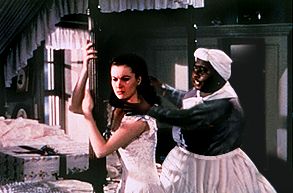

The day after Mississippi voters elected to keep their current state flag, which includes the Confederate battle cross, rather than adopt a new design, U.S. District Judge Charles A. Pannell Jr. presided over a hearing in which the trust that owns the copyright to Margaret Mitchell’s “Gone With the Wind” sought to prevent the publication of Alice Randall’s novel “The Wind Done Gone.” However categorically different the two matters — an election and a dispute over copyright — might seem, they’re both fingers pressed to the same pulse, the slow, steady, stubborn beating of a nostalgia that just won’t die. And apparently, it’s impossible to talk about symbols of the Confederacy without touching upon “Gone With the Wind” — history professor Robert S. McElvaine got only a little past halfway through his New York Times op-ed on the Mississippi flag before mentioning Gerald O’Hara, Scarlett’s father.
Meanwhile, in the Atlanta courtroom, Judge Pannell was considering a statement from the novelist and Nobel laureate Toni Morrison, who asked, “Who controls how history is imagined? Who gets to say what slavery was like for the slaves?” An expert witness for the defense, Morrison was treating Randall’s novel — which depicts some of the story of “Gone With the Wind” from the perspective of the slaves at Tara — in much the same way McElvaine used “Gone With the Wind”: as an idea about Southern history so powerful that it might as well be history itself. Judge Pannell would have none of it. “The question before the court,” he wrote in his order, “is not who gets to write history, but rather whether Ms. Randall can permeate most of her new critical work with the copyrighted characters, plot, and scenes from ‘Gone With the Wind’ in order to correct the ‘pain, humiliation and outrage’ of the ‘a-historical representation’ of the previous work, while simultaneously criticizing the antebellum and more recent South.”
It was a nice try on the judge’s part to seem above the sway of Mitchell’s epic novel, but by page 48 of his order, he’d tipped his hand: “When the reader of ‘Gone With the Wind’ turns over the last page, he may well wonder what becomes of Ms. Mitchell’s beloved characters and their romantic, but tragic, world.” Indeed, he well may. (It’s worth pointing out here that Judge Pannell is a son of the South, born in DeKalb County, Ga., and educated at the University of Georgia.) To Northerners, who tend to see “Gone With the Wind” as a ripe slice of well-aged kitsch, that bit about “their romantic, but tragic, world” sounds a jarringly earnest note (true Mitchell devotees probably winced at the “Ms.”); Scarlett O’Hara, flouncing around in her hoop skirts and stamping her pretty slippered feet at the roguish remarks of the impossibly dashing Rhett Butler — tragic? It’s enough to make a Yankee feel as baffled as the New York radio show host who recently grilled a Southern guest about white Southerners’ attachment to Confederate emblems like the battle cross. People insist that these symbols stand for something more than just the defense of slavery, he complained, but they never say precisely what that something is.
A few callers rang up and offered the usual vague explanations: It’s “heritage,” it’s “tradition.” But what that something really is, I suspect, is a story — a glorious, enthralling and absolutely essential story, a story so grand that in its shadow actual history and mere reality shrivel up and die. That story has taken many forms, but none more successful or potent than “Gone With the Wind.”
And if Mitchell’s novel reigns supreme in the South, its influence extends much further. Within a year of its publication in 1936, there were 10 million copies of “Gone With the Wind” in print. With over 25 million copies sold, it’s among the five best-selling novels of all time, quite possible the second or third. And then there’s the movie …
Alice Randall herself succumbed to the spell of Mitchell’s opus. Before her legal tussle with the Mitchell Trust compelled her to speak incessantly of “The Wind Done Gone” as a “parody” of “Gone With the Wind” and to harshly characterize the earlier novel as “a book that has damaged generations of African-Americans and white readers,” she confessed to having first read the novel at age 12 and having “loved” it. That’s a remarkable testimony to the hypnotic charm of “Gone With the Wind,” a novel so jampacked with the most ludicrous stereotypes of African-Americans, and so profoundly delusional about slavery itself, that no one could blame black readers for throwing it at the wall in disgust. According to an author interview included in the uncorrected proofs of “The Wind Done Gone,” what finally provoked Randall to write her own version of the story was the question “Where are the mulattos on Tara?” (Randall herself is reputedly descended from a Confederate general.)
“The Wind Done Gone” presents itself as the diary of Cynara, the illegitimate daughter of the slave known only as Mammy in “Gone With the Wind” and Planter, the plantation’s owner. Although Randall has changed the names of various key characters from Mitchell’s novel, the correspondence is thuddingly obvious, from “Garlic,” the valet known as “Pork” in “Gone With the Wind,” to “Mealy Mouth,” a decidedly less saintly portrayal of Mitchell’s self-sacrificing Melanie Wilkes. In Randall’s recasting of the earlier book, Cynara pines for the love Mammy lavished on Scarlett (known only as “Other” in “The Wind Done Gone”), but ultimately gains possession of both Rhett (“R.”) and Tara (“Tata” — yes, it’s really that unimaginative). I won’t disclose too much of the ending, but given the Oprah-esque imperatives of this kind of work, you can probably guess how satisfied Cynara remains with either.
The dispute between Randall’s publisher, Houghton Mifflin, and the Mitchell trust boiled down to an argument over whether “The Wind Done Gone” is a parody or an unauthorized, unlicensed (and therefore illegal) sequel. It’s permissible to use some copyrighted material under “fair use” provisions of the copyright law in certain cases, parody being one of them. Determining fair use is always a tricky, fuzzy process, but finally Judge Pannell decided that “The Wind Done Gone” doesn’t qualify as parody because a parody seeks only to criticize the original work and “does not gain the protection of the fair use doctrine if it merely uses the protected work as a means to ridicule another object,” i.e., “other general concepts and ideas about the way black Americans have been and are treated in the South.” He also determined that Randall’s novel “merely encapsulates the same story while adding new twists” and that in seeking to correct Mitchell’s version of Southern history, it “uses too much copyrighted material in doing so.”
In other words, “The Wind Done Gone” is simultaneously not enough about “Gone With the Wind” and too much like it. Randall and her publisher can be forgiven for finding Judge Pannell’s order maddening, but a reading of “The Wind Done Gone” explains the judge’s tortuous and cranky interpretation. Randall’s novel feels like a former lover’s obsessively detailed and exhaustive catalog of her ex’s faults; it has neither the giddy, lofty scorn of true parody nor the independence of the “brilliant rejoinder” its flap copy professes it to be.
In “The Wind Done Gone,” every humiliating incident in “Gone With the Wind” is painstakingly reworked to portray the slaves and former slaves as covertly pulling the strings at Tata. Pork was won by Gerald O’Hara at a poker game in “Gone With the Wind.” Garlic rigs the poker game to transfer himself to Planter’s service in “The Wind Done Gone” and then fixes another poker game to win Planter the deed to Tata. The slaves engineer the deaths of Planter’s male children in order to maintain their control of the plantation. And the moronic Prissy in Mitchell’s novel becomes the fiendishly dissembling Miss Priss in Randall’s, feigning idiocy in order to surreptitiously kill off the woman (Mealy Mouth) who ordered Miss Priss’ brother beaten to death for revealing his homosexual affair with “the Dreamy Gentleman” (Randall’s version of Ashley Wilkes).
Instead of giving her characters their own, separate lives — a strategy that would truly provide a “rejoinder” to the degrading depictions of blacks in “Gone With the Wind” — Randall has them infiltrate and usurp the lives of Mitchell’s characters. The apogee of this strategy is Cynara’s sexual rivalry with Other, and Randall’s need to prove that Cynara can steal the headily eroticized romantic hero of “Gone With the Wind” from Mitchell’s legendary belle of five counties. That’s what Judge Pannell is getting at when he counters Randall’s argument that the white characters in “The Wind Done Gone” are “flat” and “one-dimensional.” (Randall’s point is that her in-depth treatment of black characters, and superficial treatment of white ones, is the reverse of Mitchell’s, and that her work is therefore a parody.) “On the contrary,” he retorts, “Other’s role in ‘The Wind Done Gone,’ just like Scarlett in ‘Gone With the Wind,’ does not cause the reader to ignore her but, rather, demands that the reader pay attention to her and how her life impacts other people around her.” In other words, the only real alternative to “Gone With the Wind” is a story in which Scarlett isn’t the main event. And, hey, best of luck to anyone who wants to try pulling that off.
Judge Pannell seems less sensible when he says that the “extensive copying” in “The Wind Done Gone” “usurps the original’s right to create its own sequel.” While this assertion has a narrow legal validity — there are several commercial reasons for the Mitchell trust to squelch unauthorized “sequels” to “Gone With the Wind” (most notably a contract with St. Martin’s Press allowing for the publication of an authorized sequel to be told from the perspective of Rhett Butler) — no one who loves Mitchell’s novel is likely to take any pleasure from Randall’s. “Gone With the Wind” is a preposterous, cliché-ridden but highly enjoyable soap opera. “The Wind Done Gone” is a turgid, pretentious, self-consciously “lyrical” attempt at literary fiction. Randall is a songwriter, which may explain why her prose so often degenerates into incoherent blather:
He strides about in black silk and velvet and looks like the ghost of the Confederacy, a sauntering relic haunting the place. Like the evil Godmother at the baby’s christening. Why do I write that? I feel like the princess who is cursed at birth. And they try to change the curse, try to move her to safety. Why does R. look like the evil Godmother? Who looks like the prince? Who does R. look like?
If Randall had any competence as a novelist, if she could tell an even modestly engaging story, would her “revision” have found an enthusiastic audience among “Gone With the Wind” fans? Probably not. For, as Judge Pannell’s order suggests, if there’s a force mightier than Mitchell’s storytelling, it’s the South’s desire to see its past as a lost Golden Age. Reading “Gone With the Wind” for the first time, I was struck by how poorly Judge Pannell’s description of the “romantic, but tragic, world” jibes with Scarlett’s own understanding of her fate — or, for that matter, with Rhett’s. It’s Ashley Wilkes — the elegant but ineffectual son of the Old South on whom Scarlett wastes years of unrequited love — who sees their world as tragic and romantic. He mopes through Mitchell’s novel, pining for life before the war in classic Southern fashion: “There was a glamor to it, a perfection and a completeness and a symmetry to it like Grecian art.”
Ashley calls his own time “a dusk of the gods,” and that’s when Scarlett replies, “For Heaven’s sake, Ashley Wilkes! Don’t stand there talking nonsense at me.” To patch a crack in the attic, she commandeers a bit of worthless Confederate money on which someone has written a moony, patriotic poem, and when Melanie protests over the misuse of this “pledge of a nation that’s passed away,” she snaps “Oh, Melly, don’t be sentimental!” Mitchell (disapprovingly) tells us that Scarlett “had never stood starry eyed when the Stars and Bars ran up a pole or felt cold chills when ‘Dixie’ sounded.” Without Scarlett’s ruthless practicality and her almost total lack of redeeming qualities, “Gone With the Wind” would be unreadable. Mitchell is said to have considered Melanie to be the heroine of her novel, so it’s not quite clear whether she ever realized that the only stroke of genius that could ever be attributed to her was her decision to write a historical romance with an entirely unromantic antiheroine at its center.
One of the finest evaluations of Mitchell ever written is Claudia Roth Pierpont’s biographical essay in “Passionate Minds: Women Rewriting the World.” In it, Pierpont astutely points out that the only slave on Tara who isn’t pointedly described as “shining black” is a woman we’re told is part Indian. Randall rightly complains that “Gone With the Wind” casts an enormous fact of plantation life — the race-mixing brought about by white masters’ rape of female slaves — into obscurity. (The Mitchell Trust has cemented this blindness by prohibiting depictions of miscegenation in all authorized sequels.) And yet, as Pierpont observes, the use of pretty stories to paper over ugly truths was a tradition in the South long before Margaret Mitchell ever put pen to paper.
Pierpont writes that even before the Civil War, the Waverly novels of Sir Walter Scott, as well as his “Ivanhoe,” offered Southerners “a blueprint and a benediction for a society already divided into landed fiefdoms and fully regulated by caste” in the doomed Scottish clans of Scott’s phenomenally popular sagas. Taking Scott’s “idyll of sentimental feudalism” as their inspiration, Southerners reimagined their society to “transform the surface appearance of a brutal and retarded economic system into a fancy dress theatrical.” (Even the burning of crosses was lifted from the Scott novel “The Lady of the Lake.”) In fact, the very habit of lamenting a long-lost and far more gracious way of life actually predated the war. “Southerners who were so inclined yearned for the brighter paradise before the Revolution,” Pierpoint writes.
So if the “twilight of a nobility” nostalgia detectable in Judge Pannell’s order has been picked up from the likes of Ashley Wilkes, Ashley himself learned it before the Confederacy even existed. No wonder many of America’s best writers have come from the South — it’s our most literary region, a place where books have profoundly shaped people’s sense of both who they are and what their lives mean for centuries. A book about the South, “Uncle Tom’s Cabin,” helped to trigger the Civil War, and in 1936 “Gone With the Wind,” as one wag put it, won the peace — and in many cases has replaced actual history in its readers’ minds. Considering this, the claims of copyright law seem dwarfed by the imperative of historical truth. “Mitchell’s characters long ago burst through the restraints of their form and, like folk- or fairy-tale figures, passed directly into mainstream consciousness,” writes Pierpont. No wonder, then, that Randall was shocked to learn that she hadn’t the right to pen a variation on Mitchell’s yarn in the venerable tradition of folklorists worldwide.
Practically, we can side with law professor Lawrence Lessig, who in an April 30 editorial in the New York Times, urged Congress to stop its practice of extending copyright protection long past the death of a work’s author. It’s true that, whatever the letter of the law, “Gone With the Wind” is more than just a work of fiction and that, whatever Judge Pannell says, Mitchell’s novel has become a kind of history, in accord with the deeply mythologized sense the South has of itself. That doesn’t mean that “The Wind Done Gone” will find much of an audience even if Randall’s publisher ends up being allowed to freely distribute it. Randall’s book may be righteous, and it may have the truth on its side, but when it comes to the South, it’s always the best story that wins.
