
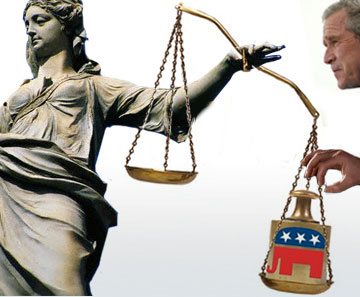

The current U.S. attorneys scandal shows that the Bush administration was mistaken in its belief that it could politicize the nation’s top federal law enforcement agency, the Department of Justice, with impunity. The attorney general‘s chief of staff and the director of the Executive Office of U.S. Attorneys have both had to leave their jobs, and Congress has begun grilling DOJ leadership. But having decimated another entire sector of the DOJ in plain sight for six years with little consequence, is it any wonder the Bush White House figured nobody would miss a few prosecutors?
Since George Bush took office, his administration has been not so quietly dismantling the DOJ’s Civil Rights Division, which is responsible for enforcing the nation’s civil rights laws, and doing it for the same reason the eight federal prosecutors were fired: to use the enforcement power of the federal government for Republican gain. Instead of attending to the Civil Rights Division’s historic mission, addressing the legacy of slavery by enforcing anti-discrimination laws, the Bush administration has employed the division to advance the political agenda of a key GOP constituency, the Christian right and also, quite literally, to get Republicans elected.
Accomplishing these goals required a drastic change in personnel, which necessitated dismantling the hiring system, forcing out or silencing career (nonpolitical) staff, and replacing them with people without civil rights expertise but with demonstrated ideological and partisan loyalties. It was a project that took years to execute because several checks on such a scenario had long been in place, checks that earlier administrations of both parties had respected.
As it was happening, current and former employees tried to alert the outside world, with little success. But with the spotlight on the department and its attorney general, momentum may finally be building. Last week, a House Judiciary subcommittee held oversight hearings on the Civil Rights Division, and witnesses testified to the changes the Bush administration had effected there.
A principal witness at Thursday’s hearings was Joe Rich, a 37-year veteran of the division and former chief of the Voting Rights Section, who left in 2005. In his testimony, Rich charged that under the Bush administration, “the essential work of the division to protect the civil rights of all Americans is not getting done.” He also said that the connection between the current prosecutors scandal and what happened to the division should not be minimized, telling senators, “The political decision-making process that led to the questionable dismissal of eight United States attorneys was standard practice in the Civil Rights Division years before these recent revelations.”
The Civil Rights Division was established in 1957 by an act of Congress, with the mandate to enforce the nation’s few federal civil rights statutes. With the passage of the 1964 Civil Rights Act and 1965 Voting Rights Act, the division suddenly had a lot more work to do. Since 1957 and before the election of George W. Bush, there had been four Democratic and four Republican presidential administrations (counting Nixon-Ford as one).
The division is composed of 11 “sections,” eight of which do litigation: Housing and Civil Enforcement, Employment, Education, Disability, Special Litigation, Criminal, Appellate and Voting Rights. The division’s 700 employees, half of them lawyers, are spread out across several buildings in Washington. Long gone are the days when the whole Department of Justice and the FBI could fit into the art deco building on Pennsylvania Avenue known as Main Justice.
The leadership of the division — known as the Front Office — has always been appointed by the president. Most of those appointees have not been experts in civil rights law, says Brian K. Landsberg, a former division section chief and the author of “Enforcing Civil Rights: Race Discrimination and the Department of Justice.” That lack of expertise was compensated for by the core of the division, its career attorneys who have the sophisticated understanding of the law that civil rights enforcement requires, says Landsberg, now a law professor at the University of the Pacific. “Even if the political appointees did have that expertise, there aren’t enough of them to do the background work.” In addition to career attorneys providing the political appointees the expertise they might lack, the dialogue, partnership and mutual respect between the two have been credited with keeping the division above the partisan fray.
The Bush administration’s actions over the past six years seem almost prima facie evidence that it does view civil rights enforcement — which had traditionally been on behalf of African-Americans, women and other racial, ethnic and religious minorities — as a partisan matter. In perhaps a case of projection, it seems to have also expected career people to abuse their power on behalf of partisan goals.
Thus the administration sought to recast the division in its own image, by minimizing outside input, getting rid of career people and hiring loyal Bushies. Simply choosing John Ashcroft, a religious fundamentalist and political conservative, as the attorney general immediately indicated that Bush’s promises to heal and unite the nation after the 2000 election did not translate into Cabinet choices that would reflect the divided political mood of the country.
In an e-mail to his 125,000 employees on his first day on the job, Ashcroft promised to guarantee “rights for the advancement of all Americans.” But actions were soon speaking louder than words. Regular meetings of the division’s section chiefs and the political leadership were virtually discontinued. In a tradition dating to the 1950s, presidents have asked an American Bar Association committee to provide a confidential rating of the qualifications of judicial candidates before the nominations are sent to the Senate for confirmation. Ashcroft and then White House counsel Alberto Gonzales met with the ABA and then terminated the ABA’s advisory role. Once Ashcroft began hiring his own choices, career attorneys noticed that many of the new hires were members of the Federalist Society, a conservative legal group. Ashcroft himself was called an active supporter of the Federalist Society, and several of the top legal positions throughout the administration were all held by Federalist Society members.
Then, much the way some companies go green, DOJ under Ashcroft went Pentecostal. In correspondence, use of the word “pride” was forbidden because the Bible calls pride a sin; employees were also asked to never use the phrase “no higher calling than public service.” Ashcroft instituted prayer meetings, leading a Bible study at 8 a.m. sharp each day, some days even in his office, on others in a conference room at Main Justice. All department employees, regardless of their religious affiliation, were invited to attend, but in reality few did.
Against this backdrop, in the fall of 2001, the first real showdown between the Front Office and the division as a whole took place, over a little-known lawsuit against the Southeastern Pennsylvania Transportation Authority, which runs metropolitan Philadelphia’s mass transit system. For four years the division’s Employment Litigation Section had been pursuing charges that SEPTA’s hiring practices discriminated again women applicants by requiring results on a physical performance test that the division argued had little relevance to what was required by the job. Without talking to anyone involved with the case, the Front Office jettisoned it, citing a need to divert resources to the war on terrorism.
Though the Employment Section voiced objections, it carried out orders and withdrew from the case. But in what came to be seen as retaliation for voicing that dissent, the Front Office stripped the section chief, her deputy and the lead counsel of their duties and exiled them to a newly created task force in the Civil Division with no real responsibilities. The retaliation was so unprecedented that the other section chiefs, out of fear, stopped their informal monthly meetings, which they had long used to keep the components of the far-flung division connected.
In the past, disagreement between career attorneys and the Front Office, whether under a Democratic or Republican administration, was not unexpected. Dialogue between the permanent staff and the political appointees served as a check and balance between the political goals of any one administration and a goal that was not regarded as political — the enforcement of federal civil rights laws. By the end of 2001, it was clear that the old give-and-take between the staffers and their politically appointed bosses was now viewed as unforgivable insubordination.
Career staffers began to leave. As their ranks thinned, and as the survivors were effectively neutralized, the Bush administration, in its effort to minimize any resistance to its agenda for the DOJ, sought to replenish the division with loyal hires.
Hiring decisions had always been subject to political staff’s approval, but the judgment of the career core of the division had historically been trusted. The Front Office stopped consulting the careerists. Résumés had once flowed up from the sections to the Front Office; now the flow was reversed. The divisions, starting under Ashcroft and continuing under Alberto Gonzales, were told whom they could hire and whom they could promote.
The numbers show what has happened to the division’s staff since 2001. A Freedom of Information Act request in the summer of 2006 by the Boston Globe for the résumés of successful applicants since 2003 also showed that among the new hires were people who had worked for prominent conservatives, belonged to the Republican National Lawyers Association, had volunteered for the Bush-Cheney campaigns, and had limited civil rights experience. The résumés showed that only 42 percent of lawyers hired since 2003 have civil rights experience, compared to 77 percent in the two years prior, when career attorneys were primarily responsible for hiring. Almost half of those new hires with “civil rights experience” had gained it by either defending employers against discrimination suits or by fighting against affirmative action policies.
Career lawyers say the new hires are increasingly white males with Federalist Society or Christian Legal Society credentials, even though many of them are shocked to find themselves in the Civil Rights Division. Richard Ugelow, a former employment deputy chief who now teaches at American University, says his students who ranked other divisions in the Department of Justice as their preferred choices for placement found themselves called to interview in the Civil Rights Division. One thing about those students’ résumés stood out: They were members of the Federalist Society.
What was this newly conservative incarnation of the Civil Rights Division being asked to do? From the beginning, part of the Bush administration’s purpose was advancing the Christian right’s agenda, and one element of that agenda was the erosion of the wall between church and state. At the same time, in a five-year period beginning in 2001, the division brought no voting cases on behalf of African-Americans and only one employment case on behalf of African-Americans.
John Ashcroft, devout son of a Pentecostal minister, became infamous for demanding modesty of a statue in the Main Justice building. The attorney general spent $8,000 in taxpayers’ money on a dark velvet curtain to completely hide the naked marble breasts of the “Spirit of Justice.” (After 9/11, the DOJ staff also received copies of the lyrics to a jingoistic song that Ashcroft had penned himself, “Let the Eagle Soar.” He asked staff to sing it at the beginning of the work day at his prayer meetings.)
But less overtly, the administration was harnessing the power of the division’s Appellate Section on behalf of certain religious groups, under a doctrine developed by the Front Office called “Viewpoint Discrimination.” One career attorney in the section, speaking anonymously, describes the doctrine as intended to “defend the rights of Christian Evangelicals to proselytize in public forums, like school.”
A former deputy section chief, also speaking on condition of anonymity, says that the administration has a very specific litigation strategy, and that is to “try to lower the wall of separation between church and state.” The former deputy section chief says, “These aren’t discrimination cases. These are free speech cases, at the end of day. They want to be able to wear T-shirts with religious messages and hand out fliers about church meetings at schools.” Under the Bush administration, the DOJ was suddenly suggesting a moral equivalence between protecting minorities from discrimination and enabling nonminorities to proselytize in public forums.
Meanwhile career lawyers in Appellate were blocked from working on civil rights cases. Instead, attorneys were given dockets with deportation orders of illegal immigrants to occupy their time. When they did write a civil rights brief, they were told to weaken their arguments by citing the opinions of conservative judges, even when those opinions were dissenting opinions, and by ignoring authoritative Supreme Court precedents.
“Instead of legal briefs,” says one current employee, “they want to file policy papers.”
Promoting the Christian agenda was meant to help the GOP at the ballot box. Often, however, the division was used to help Republicans win elections more directly. It was in the Voting Rights Section, which Joe Rich had headed from 1999 to 2005, that the Bush administration clearly saw a valuable tool for partisan gain. In his testimony last week, Rich charged that “the priority, indeed obsession, of this administration was not to protect the rights of American voters but with … politically charged pursuit[s].”
After each census, voting districts are redrawn to account for population changes. In the case of states with a history of voter discrimination, those states must submit their redistricting plans to the Voting Rights Section of the division, as per Section 5 of the Voting Rights Act. Given the nation’s history of racial discrimination at the ballot box, the question the section must consider in deciding whether to “pre-clear” any plan is, will this harm black voters?
First in Mississippi and then in Texas, the Front Office facilitated or directly approved redistricting plans that created net gains for GOP candidates, patently disregarding the recommendations of the analysts and lawyers of the Voting Rights Section. Though in both instances they counseled the Front Office that the law required the opposite actions, they carried out the Front Office’s orders.
Then, after Rich’s departure from the division, and under new Attorney General Alberto Gonzales, the section’s power was again used to the advantage of Republicans. A new law in Georgia required voters to present a government-issued picture ID in order to vote at the polls on Election Day. Staff had prepared a detailed and comprehensive memo analyzing the information provided by the state and other interested parties, and had concluded that the change would have a discriminatory effect on minority voters — they recommended that the law not be pre-cleared. The next day, the Front Office ordered pre-clearance of the Georgia law. After that case, the Front Office barred the Voting Rights Section’s staff attorneys from offering any recommendations on any cases.
Later it was exposed that a political hire in the Voting Rights Section, Hans von Spakovsky, who played a central role in approving the controversial Georgia voter identification program and who had been in charge of setting the section’s substantive priorities, had anonymously authored a law review article that endorsed the kind of system Georgia sought to enact. His attempts to hide his views may turn out to have violated Justice Department guidelines. Von Spakovsky left the division for the Federal Election Commission as a recess appointment. Similarly, the person who had been named as the senior counsel for voting rights in the section was a defeated Republican candidate for Congress.
In the past two years, as reporters for both Salon and the Washington bureau of McClatchy Newspapers have noted, the DOJ has dispatched ideologues from the Civil Rights Division to become U.S. attorneys. Alex Acosta, the current U.S. attorney for the Southern District of Miami, left the Civil Rights Division after serving as its assistant attorney general. Another former political appointee in the office of the assistant attorney general for civil rights, Matt Dummermuth, was nominated to be U.S. attorney in Cedar Rapids, Iowa, last December.
Most notably, Gonzales, as attorney general, appointed Brad Schlozman, former principal deputy assistant attorney general for civil rights, as interim U.S. attorney for the Western District of Missouri late in 2006. While deputy head of the Civil Rights Division, Schlozman had overseen the redistricting of Texas and Mississippi. He had also personally reversed the career staff’s recommendation that the Georgia voter ID law be challenged. In fact, he had penned an opinion piece for the Atlanta Journal Constitution supporting the law.
As U.S. attorney in Missouri last fall, Schlozman brought voter fraud indictments a week before the midterm elections against four individuals associated with a group registering poor and minority voters in Kansas City. Such timing contradicted Justice’s policy, Joe Rich told Salon in an interview, of waiting till after an election to bring indictments, lest an investigation unnecessarily affect the outcome of the vote. It was perhaps not irrelevant, though, that Nov. 7, 2006, promised to be hard on Republicans, and that the Republican senator, Jim Talent, was in a close race, and that Kansas City was full of Democratic voters.
Talent lost his seat to Democrat Claire McCaskill on Nov. 7, and the Democrats took control of the House and the Senate. Not long thereafter, the Bush administration finally lost its free pass to politicize the U.S. attorneys, the Civil Rights Division and the rest of the Department of Justice. The decision to fire eight federal prosecutors, most of them highly rated for their performance, attracted the attention of the new Congress. Six years into the Bush era, investigations have, at last, ensued.
History books will likely not be kind to the Bush administration. The consequences of the administration’s actions, however, extend far beyond the fate of any one elected official.
Optimists believe that once this administration’s term comes to an end in 2008, the division may once again be able to enforce the nation’s civil rights laws without regard to partisan motives. Others, like Joe Rich, are more pessimistic. “They can try to put Humpty-Dumpty back together again,” Rich told Salon, “but you’ve lost career people with the institutional memory to do that.” In his testimony on Capitol Hill, Rich asserted that only “vigilant oversight” would restore the Civil Rights Division and the Department of Justice to their historic role of leading the enforcement of civil rights and protection of equal justice under the law.
Similarly, if the Bush administration is not penalized by the voters or their elected representatives for treating the Department of Justice as a political tool, there is nothing to stop successive administrations — whether Republican or Democrat — from doing the same when it’s their turn in power.
