
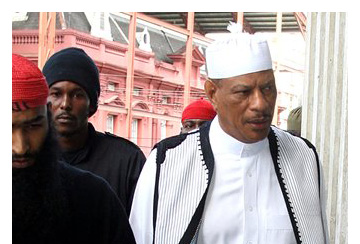

For Yasin Abu Bakr, the 65-year-old leader of the Muslim sect Jamaat al Muslimeen in Trinidad and Tobago, the timing couldn’t have been worse. On Monday, June 11, Bakr headed to the Hall of Justice in Port-of-Spain, the capital of the Caribbean island nation, to start his trial on sedition charges stemming from a sermon he gave in 2005. That same day three men accused of plotting to sabotage New York’s JFK International Airport and arrested in Trinidad appeared at an extradition hearing a block away from the Hall of Justice in Magistrate’s Court. Ever since the U.S. indictment of the three alleged JFK plotters mentioned that one of the accused had met with Bakr to discuss the plan, the imam hasn’t been able to shake the association. In print, on TV, in sidewalk conversations spanning the Caribbean, Bakr and the plotters were linked. And now their court dates were shadowing each other. Bakr’s lawyers were left to fulminate in open court that the media circus had made a fair trial impossible.
Even the black-robed presiding judge at Bakr’s trial, Justice Mark Mohammad, a round-faced man with a close-shaven head, was sympathetic. From his perch at the front of the wood-and-cloth-paneled courtroom, Mohammad chastised the media. He warned the scrum of print and electronic reporters in attendance that they could be held in contempt of court for linking the two cases in their stories, a crime under Trinidad’s British-based code of law. Yet the next day defense lawyers in very British black robes and stiff white collars with ribbons contemplated whether Mohammad himself should be removed for penning a prior legal opinion regarding yet another Bakr matter.
Mohammad remained, and the trial was delayed. Everyone in this country of 1.3 million has an opinion about Bakr, the man who once launched the only violent Muslim uprising in the history of the Western Hemisphere. So does America’s Federal Bureau of Investigation, which has been monitoring him at least since 2001. No court order can change that.
Trinidad and its much smaller sister island of Tobago, which lie just off the coast of Venezuela, comprise the second-largest (and southernmost) of the English-speaking Caribbean nations. Thanks to oil and gas revenues from wells and refineries, the predominantly black and Indian population enjoys a better standard of living than most of their neighbors. Port-of-Spain, on the northwest coast of Trinidad, is a slightly grittier version of Miami, a bustling, low-rise tropical metropolis of 130,000, teeming with cars and people rushing to office buildings and Indian restaurants. Construction cranes dot the horizon. Three daily newspapers make for a well-informed public. And nobody has dominated the headlines of those papers more than Yasin Abu Bakr.
It’s not just his reputation that stands out. Bakr cuts a striking figure as he strides to the Hall of Justice every morning. Most days he’s dressed in a vest, white ankle-length jilab (or gown) and white pleated kofi hat. At well over 6 feet tall with café-au-lait skin, he looms above the Jamaat bodyguards in fatigues, combat boots and knit caps who surround him. He has long limbs, elegant fingers and a trim mustache, and he carries himself with a regal calm, which both belies and augments his image as the feared leader of a violent group. During pretrial hearings he sits in the wooden defendant’s box alone, alert and upright, sometimes rubbing his furrowed brow as if the barrister’s arguments tired him. Three women in head scarves, identified by a local reporter as three of his four wives, sit in the courtroom to his right.
“Maybe when all this is over, we can talk,” Bakr explains apologetically outside the courtroom after his guards, standing stiffly and wearing sunglasses even though they’re inside, reluctantly permit access to him during the break in the proceedings. He is seated on a bench in the polished stone rotunda of the courthouse, considering whether to give his side of the story to the American public. “But I can’t necessarily trust what you say,” he says. He pauses a beat, smiles and adds, “It’s not personal. Things get taken out of context all the time.”
His reticence is understandable given the judge’s harangue to the press, and the fact that Bakr’s own words are what landed him in court. He is charged with sedition, terrorism and incitement, for threatening violence against rich Trinidadian Muslims who wouldn’t pay him zakaat, religious contributions to help the poor. He faces up to 25 years in prison for warning, according to the indictment, of “a war in which lives may be lost.” Yet the Jamaat’s fiery leader and orator has never been known for keeping his mouth shut. Now, though, it’s not just Trinis who can hear him. To the north the U.S. government is paying close attention. Bakr may sense his ability to bully local authorities has reached its limits.
From a U.S. perspective Jamaat’s potential role in global terrorism has been a concern for nearly 20 years — ever since Bakr and his followers tried to take over Trinidad. In 1990, it attacked government and media buildings and took hostages in a failed coup attempt. (It subsequently negotiated a pardon.) Its members are widely reported to have received some military training in Libya.
The group took on greater significance after Sept. 11, 2001. In 2002 Maj. Gen. Gary Speer, acting commander of the U.S. Southern Command, listed Jamaat al Muslimeen alongside Peru’s Sendero Luminoso terrorist group as regional threats, capable of striking U.S. interests in their respective countries, during testimony before the House Appropriations Committee. In 2004 the Institute for Analysis of Global Security focused on Jamaat in a report pointing out that Trinidad and Tobago supply the U.S. with up to 80 percent of our natural gas, much of it shipped on tankers in liquid form, which are vulnerable to terrorist attacks. But the consensus had been that Jamaat’s reach was limited, and Bakr’s ambitions parochial.
The group officially graduated to the level of international problem on June 1, the day of the U.S. indictment in the JFK plot. It stated that in May, a Guyanese citizen named Abdel Nur visited Bakr at his mosque and briefed the imam about the plot to blow up the airport’s fuel lines, and that Bakr instructed him to come back in a few days to go over the details.
“I know nothing of these matters,” Bakr told Trinidadian journalist Tony Fraser, writing for the Associated Press. It was Bakr’s sole public comment on the matter.
Jamaat officials acknowledge that two of those accused in the JFK plot visited their mosque, but they have tried to distance themselves from the group’s past reputation for violence. Kala Akii-Bua told reporters gathered at the compound for a June 9 press conference that the group had evolved over the years and “turned not one, but many corners.”
Most Trinidadians still scoff at the idea of Bakr as a jihadist willing to wage war on the U.S., largely because they don’t see how he would profit from it. To them, he is a gang leader out for money and power. They see him as too comfortable in his white mansion perched in the hills above Port-of-Spain. And he is too public a figure, always in the headlines. In 2005 alone, he was tried and acquitted for conspiracy to murder two ex-Jamaat members, he was detained for questioning after a series of bombings in Port-of-Spain, and he gave the controversial zakaat sermon.
Then again, that same year a Jamaat member was convicted of trying to buy crates of rifles and machine guns in Florida for shipment to Trinidad. Although Jamaat denied the guns were meant for the group, it was a reminder that just 17 years ago, Yasin Abu Bakr had tried to take over a country.
Establishing an Islamic state in Trinidad and Tobago doesn’t seem likely. This is the land of Carnival, steel drum bands and calypso and the birthplace of V.S. Naipaul. Muslims make up only about 7 percent of the population and are mostly of Indian descent. Most observers assumed the wealthy Muslims Bakr was threatening were Indo-Trinidadians. The Afro-Caribbean Muslims in Jamaat are relatively new converts and are inspired by the black nationalist movement. Bakr, who began life as Lennox Phillip and was once a Trinidadian policeman, himself converted to Islam after studying in Canada.
What was meant to be Bakr’s sedition trial has for the time being devolved into a series of hearings about the press and its behavior. Bakr puts the blame for his bad publicity on the government. “It’s not the press,” Bakr says almost apologetically during a lunch break. It’s the Trinidadian officials who talk to the press, he says. “The attorney general [John Jeremie] said some very wrong things about me.” A scowl flickers across his face. A woman in a head scarf comes over and whispers in his ear. “Really, they don’t want me to talk right now.” He smiles graciously and steps away.
On Park Street, around the corner from the Hall of Justice, is the four-story building where Jones P. Madeira, the advisor/manager of communications for Trinidad’s Ministry of Health, has his office. There was a time when Madeira, a former member of the media, talked to the imam often.
“Oh yes, I’ve seen Bakr quite a few times,” Madeira says. “He’s always very cordial when he greets me. He’s even invited me to have dinner with him.” So far, Madeira, a former broadcast journalist with neatly trimmed white hair, has politely declined. He has no desire to catch up on old times.
Madeira was working at the national television station TTTV in 1990. On the afternoon of July 27 he had holed up in an editing suite to work on a couple of reports when he heard a commotion, what sounded like a gunshot, then a tap on the door’s glass window. “I turned around and saw a gun pointed straight at my head,” Madeira recounts. “I saw the guy’s eyes because he was staring right down the barrel at me, and he was screaming.” Madeira eventually summoned the courage to open the door.
What he stepped into was a nightmare world of men shouldering automatic rifles, shooting into the air and marching his staff around. But he didn’t fully comprehend what was going on until he heard the shouts of ‘Allahu Akhbar!’ “That’s when it hit me,” Madeira recalls. “‘Jesus, it’s the Jamaat.'”
Bakr’s attack was motivated by a land dispute, according to “Society Under Siege,” a book by Ramesh Deosaran, a sociology professor in Trinidad. In 1978, as Deosaran tells it, Bakr’s group had taken over an eight-acre parcel that had been given to the island’s Islamic Missionary Guild in 1969 by the government but never developed. The Jamaat built several buildings, including a mosque and school, without permits. Then it tried to expand to outlying acreage. The government pushed it back and put up a fence. This was, apparently, an unpardonable affront to Bakr.
As gunmen marched Madeira down the hallway, Bakr emerged in a “flowing white robe” from the main studio, where a children’s show had been taping. “Abu Bakr’s eyes catch mine and he comes up to me: ‘Mr. Madeira, you know I don’t want to hurt anybody. You must take over and get everybody calm.'” Madeira took his new role to heart. His first act was to ask Bakr to release two German visitors and any women and children in the building. Bakr agreed.
At that point Madeira had no idea of the scope of Bakr’s plan. One hundred and fourteen of Bakr’s followers had launched a coordinated attack aimed at paralyzing the country. The Jamaat guerrillas stormed the ornate Parliament building on St. Vincent Street, known as the Red House, shooting the then prime minister of Trinidad, Arthur Robinson, in the leg before taking him hostage. Across the street a Jamaat member used a tactic then unheard of in the Western Hemisphere — suicide bombing. He drove a car laden with explosives up to the police station, shot the guard at the gate, then rammed the building. The ensuing explosion nearly leveled the structure.
Two miles away at the TV station, on-air and at gunpoint, Bakr ordered Madeira to announce to the nation that the government had fallen. Later Bakr made his own on-air proclamation, telling viewers that Prime Minister Robinson had been arrested and he, Bakr, was now in charge. He warned against looting, appealed for calm, then added a bit of prosaic populism for good measure. The value-added tax, 15 percent added to the sale of goods, was abolished.
Then a tape of the animated Disney film “The Little Mermaid” played over and over.
A weeklong ordeal ensued, in which the Trinidadian army surrounded both buildings. Madeira says he saw a mostly unarmed Bakr in complete control. “I think I saw him with a revolver maybe once,” he says. “He has a very commanding voice, and was very authoritative without having to shout or be belligerent.”
Hours after a second broadcast, the imam grew impatient and told Madeira the army must have blocked the signal. “He told me, ‘Mr. Madeira, they’re trying to prevent me from making my transmission. The people need to hear me because by now they should be at the station lifting me on their shoulders.”
And that is when Madeira realized that Bakr probably didn’t have a plan or exit strategy beyond the attack. “I really think he thought the people would rise up and support him.”
The people didn’t rise up. Before it was over, the seven-day siege was punctuated by two intense shootouts at the TV station. Bakr finally made some demands, among them that he be proclaimed minister of national defense and that Prime Minister Robinson resign. Both demands were rejected. Finally, on Aug. 2, the interim prime minister agreed to sign a pardon for the Jamaat if the group would release the hostages and surrender its arms. Bakr accepted the deal, and the ordeal was over. Afterward, the army held the Jamaat guerrillas prisoner while the government tried to renege on its bargain, but Trinidad’s highest court sustained the pardon. Twenty-four people had died in the coup and the siege that followed, but the Jamaat went free.
The pardon is still an open wound in Trinidad. The man responsible for the most violent event in the nation’s modern history walked away a free man. It made the government look impotent, and it emboldened Bakr. He sued the government for destroying some Jamaat buildings during the coup, won and received a $2.1 million settlement. (The government won its own civil suit against Jamaat for damage caused to government buildings during the coup, but the group has simply not paid.)
In the years since, Bakr has tried to refashion his organization into a more mainstream political force by offering to recruit votes from the poor Afro-Caribbean community for whichever political party would reward him. In 1995 Bakr was the first visitor to call on newly elected Prime Minister Basdeo Panday of the United National Congress, according to Fraser, the Trinidadian journalist. In 2002, when the opposing People’s National Movement candidate Patrick Manning won the election for prime minister, Bakr and about a dozen of his men showed up at PNM headquarters during the victory celebration, also attended by Fraser. “They had on their long gowns and their hats,” Fraser recalled, as he sipped a mixture of beer and ginger ale, called a shandy, at a small Port-of-Spain bar. “And they kept to themselves.” But the message was clear: We helped you get here; now we want what is ours.
Devant Maharaj, a Hindu and the president of the Global Organization of People of Indian Origin, was campaigning against Manning’s PNM party in 2001. “I met people who had been threatened by Jamaat with guns and told not to vote,” he asserts. “So I know firsthand the terror Jamaat visited upon the people.”
The Jamaat became closely identified with a PNM initiative called the Unemployment Relief Program, which put the jobless to work. Jamaat’s members allegedly swelled the ranks. A program foreman and Jamaat lieutenant, Mark Guerra, was murdered in 2003.
Meanwhile, an increasingly violent crime wave swept the nation, including a spike in kidnappings for ransom. This is unusual in an oil-rich country with a growing economy and a relatively low 7 percent unemployment rate. Bakr became the No. 1 boogeyman in the popular imagination. His pardon was seen as the defining moment when law and order were defeated. Maharaj says his group did a study showing that the majority of the kidnap victims are Indian business owners, and that in the Indian community there is a strong perception Jamaat is involved. Maharaj has petitioned the government to outlaw the group.
But Bakr has said this association with crime is unfair. In 2005, while standing trial yet again, this time on charges he conspired to have two ex-Jamaat members assassinated, Bakr explained in court that part of his mission was to reach out to society’s cast-offs, often young men involved in crime. When some of his recruits inevitably rejected the religious regimen and returned to their outlaw lifestyles, his group’s image was unfairly tarnished. “I cannot say to them … I can’t help you because you are a criminal,” Bakr said on the witness stand, according to the Trinidad Guardian newspaper. (After two trials, he was acquitted of the charges.)
The U.S. has monitored Jamaat al Muslimeen keenly since 9/11. But in 2005 the FBI opened a permanent office in Trinidad. Agents were brought to Port-of-Spain largely to help try to solve the bombings about which Bakr had been questioned. The bombings remain unsolved.
Steve McKean, a Florida-based undercover agent with the Bureau of Alcohol, Tobacco, Firearms and Explosives, is not surprised to see the Jamaat in headlines again two years later. Several years ago he set up a weapons deal with a “high-ranking” Jamaat member in Trinidad named Clive Lancelot Small. Posing as a drug dealer, McKean spent more than a year negotiating over the phone to sell Small 70 semiautomatic MAK-90 rifles (imitation AK-47s) and 10 MAC-10 machine pistols with silencers.
“He told me he was going to sell some and keep some for the group,” McKean recalls. “It was obvious what they were for.” The Jamaat planned to use them for its criminal activities, he says, and because “they were having trouble with the government.”
The ATF recruited a Jamaat member imprisoned in the U.S. as a confidential informant in the case. The informant introduced McKean to Small, and helped maintain the cover story. Talking to the informant, McKean says he learned that the group smuggled heroin and cocaine into the U.S., mostly in Brooklyn, N.Y., home to tens of thousands of Trinidadian immigrants and a community of the Jamaat.
In 2001 Small sent Keith Andre Gaude to pick up the weapons from McKean. The ATF arrested Gaude, and he agreed to cooperate against Small, who was extradited from Trinidad and Tobago in 2005 and has since been convicted. Bakr was never directly implicated.
But terror and violence, it seems, can flow both ways. McKean never delivered any American firearms to anybody in Trinidad. America is, however, where Bakr’s arsenal originated in 1990. The ATF traced many of the guns used in the coup back to the Fort Lauderdale area, where several Jamaat members then lived.
– – – – – – – – – – – – – – – – –
After a few days of negotiation, Yasin Abu Bakr finally agrees to have a Jamaat member give a tour of the compound on Mucurapo Road that serves as the group’s headquarters. “Yes, we can do that,” he says outside the courtroom, then stretches a long finger toward a lean young man in wire-rimmed glasses and a moss-colored jacket. “You.” The anointed tour guide looks surprised. Away from the group he explains, “I have construction business and I won’t be here tomorrow. Maybe the next day?” He arranges to meet in court.
On the appointed day, however, he is nowhere to be found. This time a smiling, spritelike 75-year-old in a turban and khaki jilab is guarding access to Bakr. He gives his name as Mohammad, and delivers a complex dissertation on life and rebirth before addressing the issue of talking to Bakr about the promised mosque tour. “He has assigned someone. Our leader has spoken,” Mohammad says without moving, though Bakr is only 10 feet away, conferring with other robed figures. “We cannot bother him again.”
