
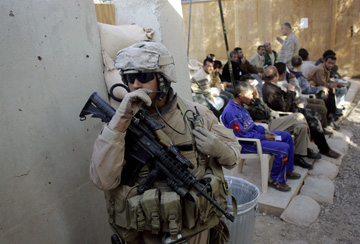

I’ve been traveling throughout western Iraq for almost a month now and what I’ve seen so far has been shocking, but not in the way you might expect: Against all logic and expectations, against practically everything I’ve learned about the military’s history of fighting insurgencies, parts of Iraq actually seem to be getting better. During the second week of August I spent five nights with a Marine platoon in downtown Fallujah, and after the typical harrowing Humvee ride in, wondering which pile of roadside trash might conceal the IED (improvised explosive device) that ended my life, I took off my body armor and didn’t put it back on for the better part of a week. The only sounds of battle I heard were overzealous Iraqi policemen shooting at dogs (and generally missing, I might add).
Fallujah, once the symbol of everything gone wrong with the American mission in Iraq, seems to be breathing again. About half the shops are open. Groups of children wave heartily at American convoys driving by. Marines send out for local kebabs and falafel almost every night. The Marines haven’t had anyone killed in action in over three months. According to Lt. Col. William Mullen III, the commander of the unit in charge of the city, the 2/6 (2nd Battalion, 6th Marines), “The enemy has not given up Fallujah, but he is on the ropes.”
It feels strange reporting good news about Iraq these days. When the battalion’s executive officer, Maj. George Benson, a lanky joke-a-minute officer from Virginia, first began telling me about the success story of the city — the long lines of locals waiting to volunteer for the U.S.-sponsored neighborhood watch program, the police precinct system the Marines have created — I was incredulous. My skepticism was hardly the major’s fault. The Bush administration and the senior military leadership in Iraq have obfuscated and dissembled for so long about so many things to so many people (even themselves) that it is difficult at first to believe any optimistic conclusions.
One of the great difficulties of assessing the war is overcoming what some officers call the “soda straw effect,” i.e., having a constricted view during travels but thinking that what you’re seeing somehow represents the entirety of the country. Practically every officer I spoke with in the Fallujah area admitted that the Marines have benefited from a near perfect storm of circumstances that has allowed them to pacify what was, in 2004, the deadliest city in the entire country. Although the senseless brutality of local Salafist insurgents dwindled after a bloody U.S. offensive here in 2004, it has never disappeared entirely. To give a more recent and particularly odious example, in May insurgents drove a car bomb into the funeral procession for a local policeman who had been loyal to the U.S., killing at least 20 civilians. Yet attacks like these, which have alienated the local populace, have been a catalyst for the recent Marine gains in the city. As Lt. Col. Mullen put it, “It’s as much about exploiting the enemy’s mistakes as it is about what the Marines are doing out there.”
In three trips to Iraq since 2004 I’ve learned that whatever the officers say, you have to listen to what the streets tell you as well. Night after night, as I heard the occasional Kalashnikov rifle shot rising from the boulevard beneath our position, I kept waiting for the fire to build, for the return shots and the firefight that would bring our idyll in the city to a bloody end. But they never came.
The surprising success in Fallujah hasn’t just fallen into the laps of the Marines, however. There is a relatively new operational strategy being worked out here, one that sees Iraq through a broader societal lens. Gone are the days of looking at the local populace merely as innocents caught in the crossfire. The new focus is on softer, less aggressive tactics against insurgents, including physically reconfiguring and walling off communities in an attempt to make them more secure (what some theorists have dubbed “the new military urbanism”), and employing local Iraqi security forces as proxies. The latter approach was used to great effect in Afghanistan after 9/11, where local militias were employed to fight the Taliban.
Discussing the evolution of the American strategy in Iraq, one officer told me, “2003 seems like a long time ago. We’ve had to change the way we do a lot of things over here.” As Maj. Benson put it, “Our attitude used to be, ‘We don’t do windows'” [meaning the Marines don’t do nation building]. On another occasion, as I stood looking into the heart of the city over a phalanx of concrete barriers — one of which had the word “kill” spray-painted on it by a previous unit — I asked Capt. Jeff McCormack, a company commander in 2/6 and a veteran of the November 2004 battle of Fallujah, if it had been difficult learning to see the city with new eyes. “Yeah,” he said, looking past the spray-painted barrier. “It’s been real hard.” He gestured down the main avenue of town. “Over there is the ‘hell house’ where [Navy Cross winner] 1st Sgt. [Bradley] Kasal was wounded.” Later, in the patrol base operations center, McCormack spoke almost regretfully about the Marine mind-set that dominated in the early stages of the war. “We used to bitch about having to do reports every time a local was killed. It was like, ‘He was digging a hole by the side of the road. He was an idiot. He deserved it.'”
Now McCormack and his men puzzle over a raft of municipal issues such as ensuring that locals have access to electricity, clean water and gasoline. Whereas in past deployments Marine units would brag about the large numbers of locals they had detained, now the emphasis is on thorough police work and ensuring that anyone who is detained is sent properly through the nascent Iraqi justice system.
As Lt. Col. Mullen admitted to me later, in preparing for this deployment to Iraq he and his staff mounted what he described as “an information operation” (military-speak for propaganda) on the younger enlisted Marines in the battalion to force them to change their thinking about how to fight this war. “It’s really not a kinetic [conventional military] fight. Having a squad basically go nuts like in Haditha — which I think is what that will turn out to have been — is extraordinarily destructive to our mission here.” (Members from the 3rd Battalion, 1st Marines stand accused of slaughtering 24 civilians in the western Anbar town of Haditha in 2005 in what some war critics view as the Marines’ own My Lai massacre.)
To be sure, Fallujah is not Baghdad, the Iraqi capital that in many ways now stands at the heart of the struggle to resolve the war. And there are reasons to be skeptical of the Bush administration’s hype that the “surge” strategy is working. The broader picture of Iraq turned ominous again last week when a quadruple truck bombing in towns near the Syrian border took the lives of hundreds and wounded hundreds more in the single deadliest insurgent attack since the U.S.-led invasion in 2003. On Monday, the governor of a southern Iraqi province was killed by a roadside bomb, the second provincial governor to be assassinated in August.
Indeed, in analyzing the war it is exceedingly difficult to generalize about anything, and at times it seems as if all knowledge gained here is contingent and, in some strange way, as tribal as the Iraqis themselves, bound by the geography. Tactics that work in one city almost never directly translate to another. The extent to which the lessons of Fallujah, a predominantly Sunni town, can be applied to the rest of the ethnically divided nation is unclear. It is also possible, as other officers indicated, that what I saw in Fallujah was that the insurgents have simply shifted their operations outside the city, as evidenced by the rise in insurgent attacks in the neighboring town of Karma and elsewhere.
But in the meantime, many fewer people are dying in Fallujah, and children are able to ride their brightly decorated bikes down the half-rubbled streets. Looking at the overall fact pattern, Fallujah and much of the rest of Anbar province begins to look a lot like Tal Afar in 2004, the first city to be successfully pacified in a well-publicized counterinsurgency campaign conducted by Army Col. H.R. McMaster, in which a dangerous, restive town was quickly won over by focusing on the needs of the local population. In a similar way as Tal Afar, Fallujah today seems at first to be an anomaly, an island of hope in a country gone to hell.
But such a characterization overlooks several key facts. Fallujah and the rest of Anbar are considerably larger than Tal Afar, encompassing the entire western third of Iraq and representing upward of 800,000 Iraqis. Only a year prior, Anbar was the deadliest province in all of Iraq, a fact that grants it a symbolic value in success that Tal Afar enjoyed on a lesser scale and only in retrospect. And Fallujah had been written off by some Marine intelligence officers as unredeemable.
Nevertheless, it’s a precarious peace that has taken hold. During a conversation with Lt. Col. Mullen in his quarters one afternoon, he worried about the unit scheduled to replace 2/6 in October, the 3rd Battalion, 5th Marines, current members of which have been implicated in the 2006 murder of an Iraqi man near the town of Hamdania. (I served in 3/5 myself a decade ago.) Mullen was concerned because 3/5 had fought in the battle of Fallujah and had a reputation for being very aggressive. “I don’t think there’s many veterans of the battle left in the battalion,” he said, his voice trailing off. He didn’t go on to say it, but I suspect we were both thinking the same thing: It would take only one IED attack and a gross overreaction by Marines to reverse all that has been achieved in Fallujah. A unit takes casualties and in response detains scores of innocent Iraqis who happen to be in the area, or perhaps even worse, and a year’s worth of local goodwill is squandered.
Another major concern for the future of Fallujah is the fledgling police force, which does the lion’s share of the security work for the city. In the past, the local police have acted as little more than a tribal posse with scant respect for the citizenry or for the rule of law. By arming and abetting the police in Fallujah, there is no guarantee that they will behave in a manner we might expect from an American police force. The Marines are well aware of this situation and the American advisory team that is assigned to train the Fallujah police force has a series of classes scheduled to address this. When I asked Lt. Col. Mullen about the long-term efficacy of the local police, he asserted, “Security is the precondition for everything in Iraq, so you’ve got to go with the resources you have in front of you in order for other areas to develop.”
However, it is this very issue of empowering groups of Sunnis that is reportedly a major point of contention between Iraqi Prime Minister Nouri al-Maliki (a Shiite) and Gen. David Petraeus, the commander of U.S. forces in Iraq and the man whose charge from President Bush is assessing the state of the war by mid-September. And for the long term, there seems to be little evidence that the various police forces scattered across Anbar, which enjoy good local credibility, will be able to integrate themselves into anything resembling a national law enforcement system.
The Marines here are not given to flights of optimism about Iraq as a whole. The idea of “fighting them over here so we don’t have to fight them in Pasadena” is like so much old rot to them, belonging like “weapons of mass destruction” to the lexicon of a bygone era. Absent as well is the high-octane “bringing peace and democracy” rhetoric that was so in vogue at the beginning of the Iraq adventure. What they have instead is a curiously restrained pride in the regional victory they have won — knowing full well that in this protracted war, so riddled with policy failures, their achievement could easily be fleeting.
