
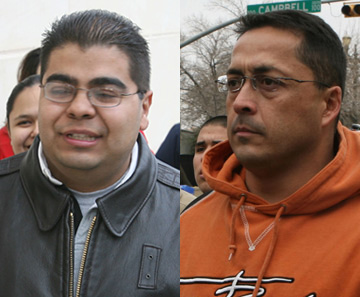

Two years ago, in the Texas desert southeast of El Paso, two U.S. Border Patrol agents fired 15 bullets at a suspected drug dealer who was fleeing on foot toward the border. The man, a Mexican national, was hit once in the buttocks but made it across the Rio Grande. The agents who fired their weapons, Ignacio Ramos and Jose Compean, were sentenced to more than a decade in prison for firing on an unarmed man and then trying to cover up the crime.
For the prosecutors and the jury, the shooting of Osvaldo Aldrete-Davila near Fabens, Texas, was a clearly unlawful use of force. But the conviction of Ramos and Compean was just the beginning of the agents’ story. Within months, they had become the center of a dubious political crusade that would energize the furthest reaches of the right, dominate one of CNN’s most popular news programs, and persuade a quarter of the U.S. House of Representatives — and one prominent Democratic senator — to reject the findings of a federal court.
With the help of reporters and activists promoting — and embellishing — the defense’s version of the case, the two convicted agents were transformed into martyrs for the battle against illegal immigration. Instead of rogue officers who shot a fleeing, unarmed suspect and then lied about it, they became stand-up cops who were forced to shoot an armed drug dealer and then sent to prison by a legal system run amok. After they went to prison in January 2007, they even became the tragic heroes of a country song called “Ramos and Compean.”
Nearly 400,000 people have signed a petition demanding a presidential pardon for the agents. There are two bills to pardon them pending in Congress, one with more than 100 cosponsors, including five Democrats.
How did Ramos and Compean get reinvented as right-wing heroes? The answer lies in the way Americans get their information, from a fragmented news media that makes it easier than ever to tune out opposing views and inconvenient truths. When people seek “facts” only from sources with which they agree, it’s possible for demonstrable untruths to enter the narrative and remain there unchallenged. The ballad of Ramos and Compean is a story that one side of America’s polarized culture has gotten all wrong and that much of the other side — and the rest of the country — has never even heard.
Federal prosecutions of law enforcement agents are not undertaken lightly. “No prosecutor ever wants to be in a position of prosecuting a cop or a federal agent,” says Johnny Sutton, U.S. attorney for the Western District of Texas, whose office prosecuted Ramos and Compean. “They’re our co-workers, they’re our friends, we represent them in court … But when one steps over the line and commits a serious crime, it’s very important that they be held accountable … [and] most agents would say what these guys did was outrageous.”
Prosecutors in Sutton’s office considered the conduct of Ramos and Compean outrageous enough that the two men were charged with seven and nine counts, respectively. Both were charged with assault with intent to commit murder. At trial, government prosecutors presented a case, supported by eyewitness testimony, that alleged the following: On Feb. 17, 2005, Aldrete-Davila led Border Patrol agents on a high-speed car chase that ended at a ditch about 120 yards from Mexico. Aldrete-Davila abandoned a van with 743 pounds of marijuana inside and made a dash for the border. Compean, on foot, intercepted Aldrete-Davila, who put his hands in the air to surrender.
At that point, according to trial testimony, Compean tried to hit Aldrete-Davila with the butt of his shotgun, missed, and fell into the 11-foot-deep ditch. Aldrete-Davila took off running. Compean climbed out of the ditch, shot at him 14 times and missed. Ramos, who had watched Compean fall, then fired once. The bullet entered Aldrete-Davila’s left buttock, severed his urethra and came to rest in his right thigh. He fell down, but got back up, escaping across the Rio Grande into Mexico. The two agents then covered up the incident. Compean hid some of the shell casings and asked a third agent returning to the scene later that day to dispose of the rest. Neither Ramos nor Compean ever reported the shooting. They were arrested a month later, and then only because America’s border with Mexico is like a very long and skinny small town. Aldrete-Davila’s mother is friends with the mother-in-law of Rene Sanchez, a Border Patrol agent in Arizona. After hearing about the incident from his mother-in-law, Sanchez sent a report to the Department of Homeland Security in Washington, which then dispatched a special agent to Texas to investigate.
At trial in the federal courthouse in El Paso, Border Patrol agents from the Fabens station took the stand to testify against Ramos and Compean. Fellow agents, including one who had observed the shooting, contradicted Compean’s story about where he was and how he was positioned when he fired his weapon. The agent who had helped Compean hide shell casings admitted it under oath. Prosecutors showed that Compean had repeatedly changed his story about the shooting and that it didn’t match Ramos’ account. They were also able to show that although Compean had discussed the shooting with other agents after it happened, it wasn’t until his arrest that he began claiming that Aldrete-Davila had had a gun.
The prosecution’s version of events was convincing enough for the jury, in March 2006, to find Ramos and Compean guilty of all but assault with intent to commit murder. Most media coverage of the case was local, and it comported with the jury’s verdict: a bad shooting, a coverup and damning testimony from fellow agents that led to an uncontroversial conviction. Seven months later, a judge sentenced Ramos and Compean to 11 and 12 years in prison, respectively.
But by the time of their sentencing, the right wing had discovered the agents and begun constructing a new narrative. Ramos and Compean’s newfound supporters soon settled on a radically different version of the shooting, cobbled together from speculation, rumors, misstatements of fact and various unproven assertions cherry-picked from the case the defense presented at trial.
In the right-wing version of the Aldrete-Davila case, the officers shot at the suspect because they feared for their safety. The agents’ supporters say the fleeing suspect may, in fact, have been armed. In their scenario, Compean fell to one knee after trying to restrain Aldrete-Davila with the shotgun, and the suspect ran away. Compean then chased Aldrete-Davila and tackled him. Aldrete-Davila got away again. As Aldrete-Davila ran toward the border, he extended a gun behind him as if to fire, and Compean started shooting in self-defense. Ramos saw Compean on the ground, heard the shots and, believing his fellow agent shot or in danger, fired the bullet that hit Aldrete-Davila. Once the case went to trial, federal prosecutors supposedly manipulated witnesses and covered up Aldrete-Davila’s misdeeds — actually quashing a sealed indictment for drug smuggling — in order to secure convictions of the two agents.
The story that Ramos and Compean’s supporters constructed was essentially unchallenged by the mainstream media — because the mainstream media wasn’t paying attention. When traditional news outlets did cover Ramos and Compean, it was to comment on the right’s fascination with the case, but not to examine or debunk the right’s reporting.
There are five major players in the transformation of Ramos and Compean from cops who tried to cover up a bad shooting into martyred heroes of the great conservative pushback against illegal immigration. The most important of them is Lou Dobbs, the host of CNN’s “Lou Dobbs Tonight.” Three other players — journalist Sara A. Carter, activist Andy Ramirez and union official T.J. Bonner — are previously obscure figures who appeared on Dobbs’ show. The fifth is Jerome Corsi, the conservative commentator who coauthored the book, “Unfit for Command,” that launched the Swift-boating of John Kerry. Corsi pushed the cause of Ramos and Compean on the Internet while Dobbs was pushing it on TV. All of them have served as megaphones for the right-wing’s counter-narrative of the case.
Lou Dobbs, whose show straddles the line between news and advocacy, has nearly doubled his ratings in the past two years by taking a strong stand against illegal immigration. Almost nightly, he includes an opinionated segment on immigration under such rubrics as “Border Betrayal” and “Busted Border.” As soon as he noticed the Ramos and Compean story in August 2006, he became the prime mover in its coverage. His program has so far featured more than 100 segments on the Ramos and Compean case, including interviews with both agents that have been clipped and rebroadcast in other episodes.
Dobbs set the tone for his approach to the Ramos and Compean case with his first segment about the agents, on Aug. 9, 2006. (CNN did not respond to a request for an interview with Dobbs.) He introduced a short interview with Ignacio Ramos by saying, “Support is flooding in from all across the country tonight for two Border Patrol agents in Texas who could be sentenced to 20 years in prison for shooting a Mexican drug smuggler. Amazingly, federal prosecutors allowed the smuggler to walk free.” The next day, Dobbs ended a second segment on the agents with one of his famous audience polls. The question for viewers was, “Do you believe the Justice Department should be giving immunity to illegal alien drug smugglers in order to prosecute U.S. Border Patrol agents for breaking administrative regulations? … Yes or no.”
Dobbs has been an unwavering champion of the agents ever since. But the reinvention of Ramos and Compean really begins with Andy Ramirez, without whom Lou Dobbs would never have known the agents’ names.
The California-based chairman of the Friends of the Border Patrol, a Minutemen-like organization, Ramirez is also affiliated with the far-right, anti-communist John Birch Society. Since April 2007, he has been listed by the JBS speakers’ bureau as a speaker for hire.
In an interview with Salon, Ramirez says he became a spokesman for the agents’ families soon after he was contacted by Ignacio Ramos’ aunt in the spring of 2005. In the summer of 2006, mere weeks before Ramos and Compean were due to be sentenced (the sentencing date was later changed), he found a mainstream media reporter willing to retell the shooting of Aldrete-Davila from the defense’s point of view.
Ramirez had long been a source for reporter Sara Carter, who then worked for an obscure daily paper on the fringes of the Los Angeles suburbs, the Ontario, Calif.-based Inland Valley Daily Bulletin. Carter had written several sympathetic stories about activists like the Minutemen and had begun quoting Ramirez on border issues in February 2005. (Carter, who now works for the Washington Times, did not respond to phone and e-mail requests for an interview.)
On Aug. 5, 2006, Carter published a 2,600-word article, headlined “Convicted Border Agent Tells His Story,” largely based on an interview with Ignacio Ramos. It is an uncritical, breathless rehearsal of the defense’s claims that says the agents’ conviction “appears to fly in the face of the Border Patrol’s own edicts.” It includes two important and exculpatory assertions that conflict with the testimony of other witnesses at trial.
At trial, the defense claimed that the agents had believed that Aldrete-Davila might have had a gun, though on the stand the agents identified the alleged object in the victim’s hand only as something “shiny.” The agents also offered conflicting testimony on whether Compean was on the ground when Ramos fired the shot that hit Aldrete-Davila. In the third sentence of her article, Carter writes, “Ramos’ fellow agent, Jose Alonso Compean, was lying on the ground behind him, banged up and bloody from a scuffle with the much-bigger smuggler moments earlier. Suddenly the smuggler turned toward the pursuing Ramos, gun in hand.”
If Compean had indeed been lying on the ground when Ramos fired, or if the fleeing suspect had been waving a gun, it’s not likely that either Border Patrol agent would be serving more than a decade in federal prison. David Klinger, an associate professor at the University of Missouri-St. Louis and an expert in officer-involved shootings, has not formed an opinion on the Ramos-Compean case. He points out, however, that the standard for judging a law enforcement officer’s use of deadly force is probable cause. The suspect doesn’t actually have to have a gun — all that matters is that the officer has, as the Supreme Court determined in Tennessee v. Garner (1985), “probable cause to believe that the suspect poses a significant threat of death or serious physical injury to the officer or others.” And, Klinger says, the scenario painted by Carter, with Compean on the ground, could have given Ramos probable cause to shoot if true.
Carter’s story had other problems as well. Notably, she described Ramos as “a former nominee for Border Patrol Agent of the Year.” That contention, which quickly became a talking point for backers of Ramos and Compean, is technically correct but disingenuous. A pre-sentencing investigation by the government showed that Ramos was nominated by a small group at the Fabens Border Patrol Station after his arrest for the shooting.
Within days after Carter’s story appeared in the Inland Valley Daily Bulletin, media attention snowballed, and Ramos and Compean were on their way to becoming a national right-wing cause célèbre. On Aug. 8, Carter appeared on Fox News’ “O’Reilly Factor”; on Aug. 9, CNN’s Lou Dobbs presented his first piece on it, and a day later Carter made her first appearance on his show. Dobbs then did a segment on the agents every day for a week. The version of the case that Dobbs would present his audience again and again over the next year was based on Carter’s article, not the facts that the jury had seen at trial in El Paso.
Carter did not appear on Dobbs’s show again but continued writing widely circulated stories on the case. Ramirez has been on Dobbs’ show five times and has been a frequent source for other media accounts of the case. He was a principal source for a long feature published in the official magazine of the John Birch Society, the New American, in September 2006, which influenced much ensuing coverage of Ramos and Compean.
Neither Andy Ramirez nor Sara Carter, however, have gotten the screen time of T.J. Bonner, the president of the National Border Patrol Council, a union that represents Border Patrol agents. Bonner, who was quoted in Carter’s initial article and in numerous other print accounts, has appeared or been quoted on Dobbs’ show 17 times.
Bonner and the NBPC have helped circulate the now-widespread claim that Aldrete-Davila, the victim of the shooting, was indicted for drug smuggling and that his indictment was subsequently tossed out in exchange for testimony friendly to the prosecution. Supporters of the agents have used the rumor of a “sealed indictment” to help convince the right that the prosecution of the agents was illegitimate.
Before he was shot by Ramos on Feb. 17, 2005, Aldrete-Davila had been driving a van full of marijuana. At the agents’ trial the defense had tried to question Aldrete-Davila about an alleged second drug-smuggling trip in October 2005, during which he allegedly brought another load of marijuana into the United States. The defense was barred from asking Aldrete-Davila or any other witness about this supposed second load, but after the agents were convicted, their backers began to see a connection between the alleged second load and the credibility of Aldrete-Davila’s testimony. They suspected that the U.S. attorneys’ office had cut a deal with Aldrete-Davila in exchange for his testimony, a deal that included overlooking the second drug run as well as the first.
The story of a second load may be credible. A defendant who this month pleaded guilty to distribution of marijuana in federal court told the DEA that Aldrete-Davila had delivered the load in question to his house in Texas. According to U.S. Attorney Johnny Sutton, the investigation into Aldrete-Davila’s involvement is ongoing, and no charges have been filed.
Rumors of a supposed “sealed indictment” against Aldrete-Davila, however, appear to be just that. Sutton denies there was any sealed indictment or any expungement, and those making the claim are apparently unaware that there is no law or procedure under which a federal court can expunge a federal indictment. Nevertheless, the tale has become widespread, gaining mention on Dobbs’ show and the popular conservative news sites WorldNetDaily.com, and CNSNews.com.
In January 2007, U.S. Attorney Sutton’s office issued a fact sheet about the Ramos and Compean case to counter many of the rumors, suspicions and claims that had begun swirling in certain sectors of the media. T.J. Bonner’s union, the NBPC, then released a rebuttal to Sutton’s fact sheet. The rebuttal asserts, “In October of 2005, Aldrete-Davila was indicted for smuggling about 1,000 pounds of marijuana. The sealed indictment was subsequently expunged.”
Bonner also referred to a sealed indictment on Dobbs’ show this January, and to the alleged expungement of that indictment in a CNSNews article the same month. In an interview with Salon, Bonner claimed, “It’s probable but not provable [that it happened]. A lot of stuff has disappeared or been covered up.” Bonner says he heard about the indictment and expungement from confidential sources he can’t disclose.
On air and in print, Bonner has also repeatedly impugned as false the testimony given by other Border Patrol personnel during the prosecution of Ramos and Compean. Their testimony corroborated the prosecution story of two agents who shot an unarmed, fleeing suspect and then covered it up. Speaking with Salon, Bonner stated that he is in fact alleging that the agents and their supervisors perjured themselves and that the U.S. Attorney’s office suborned their perjury. He went still further, claiming that investigators had tricked the agents into providing false statements, then used a threat of prosecution to force them to support the government’s theory of the case. Asked if he had any evidence for this, Bonner said he did not. “It’s just the way they work.”
Lou Dobbs garners more than 800,000 viewers nightly, and he and guests like Bonner have been primarily responsible for the right’s reshaping of the Ramos and Compean story. The case, however, has also been a focus of right-wing obsession on the Internet. Reporter Jerome Corsi has been instrumental in advancing the narrative on the Web. A reporter for WorldNetDaily, Corsi is best-known for his role in the Swift-boat movement. His latest book is “The Late Great USA: The Coming Merger With Mexico and Canada,” a long conspiracy theory in which he claims to expose secret plans for a “North American Union” that would combine the three countries into one.
Corsi’s most important contribution to the reworked conservative version of the Ramos and Compean case is to attempt to absolve the agents of a coverup. In reality, the incident was only discovered, and the agents prosecuted, because Border Patrol Agent Rene Sanchez, hundreds of miles away in Arizona, heard about it through his mother-in-law. In Corsi’s version, however, Ramos and Compean’s supervisors knew about the shooting as soon as it happened. Corsi relies on an early, ambiguous memo written by the Department of Homeland Security officer who investigated the shooting; the memo lists the agents’ two supervisors among the Border Patrol personnel who were either at the location, helped destroy evidence, “and/or knew/heard about the shooting.” The memo apparently refers to the known fact that the supervisors were at the scene of the shooting after it occurred but were not aware that it had occurred. At trial, the defense never tried to claim that the supervisors were present during the shooting, the investigator didn’t testify that the supervisors were present at the shooting or had knowledge of it, and the supervisors took the stand themselves to insist they’d had no knowledge of the shooting till after Ramos and Compean were arrested. Compean himself admitted at one internal Border Patrol disciplinary hearing that he didn’t report the shooting to his bosses because he didn’t want to get in trouble.
Corsi is implying that the supervisors perjured themselves at trial. Contacted by Salon, Corsi stood by his scenario.
More than a year after Lou Dobbs first adopted the cause as his own, the distorted narrative of the Ramos and Compean case crafted by Corsi, Dobbs and the others has solidified into conventional wisdom on the right. It took mere days, however, for Dobbs’ crusade to catch the attention of Congress. On Aug. 17, 2006, within a week of Dobbs’ first segment on the agents, Andy Ramirez appeared as a witness at a field hearing of the House Judiciary Committee in El Paso, Texas, and raised the issue of Ramos and Compean. Members of Congress then demanded an investigation. A year later, it’s clear that the information that legislators of both parties are using to make their decision about the case is still coming from the narrative fashioned by Dobbs and immigration-obsessed activists on the right.
Several of the main players in Dobbs’ many segments about Ramos and Compean have either testified before Congress or met with members of Congress or both. Both Bonner and Ramirez have testified in congressional hearings. Ramirez accompanied Rep. Walter Jones, R-N.C., to speak with a top Department of Justice official about the case, and he participated in a press conference on Capitol Hill that also featured such House members as Jones, Ted Poe, R-Texas; Duncan Hunter, R-Calif.; Tom Tancredo, R-Colo.; and Dana Rohrabacher, R-Calif. Ramirez says he’s been a key source for Congress about the case, passing along things he learned by virtue of his relationship with the agents’ families.
Some members of Congress freely acknowledge that their information on the case comes from Dobbs and the others. Jones told Salon that his involvement began because he “happened to be watching Lou Dobbs.” Jones sent a letter to Attorney General Alberto Gonzales on Aug. 11, 2006, two days after Dobbs’ initial segment on the controversy, in which he called the case “outrageous” and “strongly urge[d]” Gonzales to “halt this prosecution.” Jones also identified T.J. Bonner as one of his sources of information on the case. Rohrabacher posted Bonner’s rebuttal to Sutton, the one alleging the existence of a sealed indictment against Aldrete-Davila, on his official congressional Web site.
Members of Congress have often taken their received misinformation about the case and injected it into the debate, repeating talking points to the media, Congress and the Department of Justice.
For example, in a Sept. 21, 2006, letter to Gonzales, Rep. Rohrabacher echoes Carter’s assertion that Compean had been vulnerable. According to Rohrabacher, Ramos saw “his partner laying bloodied on the ground.” Rohrabacher called successfully for a congressional hearing into the possibility that the Mexican government had become involved in the prosecution.
Rohrabacher has also praised the records of Compean and Ramos, often discussing Ramos’ nomination as Border Patrol Agent of the Year and repeating the by-now widespread claim that both Compean and Ramos have, in Rohrabacher’s words, “unblemished records.” Compean does, in fact, have a clean record. But Ramos was once suspended from the Border Patrol for not reporting the second of three separate assault arrests. All assault charges were dropped, but his wife did obtain an emergency protection order against him.
Salon contacted some of the members of Congress who have been the most vocal about Ramos and Compean to see if they could square their various assertions with the facts of the case. Rohrabacher, for one, was happy to admit to engaging in unsupported speculation. Asked why, considering the government’s traditional reluctance to prosecute cops, he thought the U.S. Attorney would be so dogged in pursuing the agents, Rohrabacher blamed Mexico — without offering evidence.
“That’s a fine question, and we have not really delved into that. It could be just a very bad judgment call at the moment … Or there could be something much more sinister at play here … The president could well have made an agreement with the Mexican government at the Mexican border, something like, “Unless our guys are shot at, they’re not going to be able to shoot someone” … So that could be an explanation. I have no evidence that that is the case. If I had to speculate that, it’s possible, but we have yet to prove it.”
Rep. Steve King, R-Iowa, meanwhile, described himself to Salon as “not as knowledgeable on [the case] as some of the other members of Congress, but I suppose I’m in the second tier of knowledge.” King says he’s had his staff write memos for him based on media reports, trial transcripts and information from the staffs of other members of Congress. “Obviously, I can’t take the time to read 3,000 pages of [trial] transcript.”
However, if King, who is agitating for a new trial for the agents, is getting his knowledge about the case from staff memos, those memos have not been properly vetted. In describing the case, King said that “the supervisory officers who were on the scene, according to the reports I’m getting,” knew not just about the shooting but also about the disposal of the casings and were given immunity to testify. Those allegations appear to be entirely new, and they are contradicted by the earlier sworn testimony of multiple witnesses. King admitted that he could not cite a source for the allegations.
But it’s not just Republicans who’ve been pulled into the controversy and who find themselves making questionable statements. Of late, one of the agents’ more prominent allies in Congress has been Sen. Dianne Feinstein, D-Calif. She was calling for hearings on the case back in August 2006, but more recently she chaired a hearing — at which she was the only Democrat — of the Senate Judiciary Committee for the purpose of discussing the case.
At the hearing, Feinstein seemed to have some difficulty understanding when law enforcement officers may legally use deadly force against a suspect, apparently unaware that, per the Supreme Court, the suspect must pose a plausible “significant threat.” More than once, she expressed shock that it’s illegal to shoot a fleeing suspect. “Any drug dealer on the border who doesn’t obey a command and runs cannot be shot?” she asked one witness. “No wonder so much drugs are coming across the border. That’s amazing to me.”
There are now several measures under consideration to redress what has come to be seen as the wrong done to Ramos and Compean. After Congress returns from its August recess, King plans to introduce a bill that would grant Compean and Ramos a new trial, with a change of venue from Sutton’s jurisdiction to the Northern District of Texas.
Failing that, there is the possibility of presidential intervention. Before the agents reported to prison in January, Rohrabacher held a rally with Compean to call for a presidential pardon. Two pardon bills are pending in Congress, one of them with more than 100 cosponsors, including five Democrats. To date, President Bush has been reluctant to sign on. But if he won’t go for a full pardon, there is always the measure that saved Lewis Libby from jail: Feinstein has asked the president to commute the agents’ sentences. Should that happen, the rewriting of the ballad of Ramos and Compean will be complete.
