

A young woman sat on the subway and sobbed. Her mascara-stained cheeks were wet and blotchy. Her eyes were red. Her shoulders shook. She was hopeless, completely forlorn. When I got off the train, I stood on the platform, paralyzed by emotions. Hers. I’d taken them with me. I stood there, tears streaming down my cheeks. But I had no death in the family. No breakup. No terminal diagnosis. And I didn’t even know her or why she cried. But the emotional pain, her pain, now my pain, was as real as day.
Recent research in neurobiology would explain my response as the automatic reaction of a kind of brain cells known as mirror neurons. On Nov. 4, neuroscientists announced that mirror neurons had for the first time been directly identified in humans. Previously their existence had only been inferred from primate research and the observation of human brains through fMRIs (functional magnetic resonance imaging).
Enthusiasm among scientists has been spreading as growing evidence suggests that “mirrors” may explain the roots of human empathy and altruism as well as provide insight into such disorders as autism and even schizophrenia. But that’s not all. In the past few years, dozens of studies have linked mirror neurons to the emergence of language, abstract reasoning and even self-awareness or consciousness. “The self and the other are just two sides of the same coin. To understand myself, I must recognize myself in other people,” says Marco Iacoboni.
Sound like Marin County, Calif., Buddhism? Maybe so. But it’s also SoCal neurobiology. Iacoboni is a neuroscientist and professor of psychiatry at UCLA, where he directs the Ahmanson-Lovelace Brain Mapping Center. “We are hard-wired to feel what others experience as if it were happening to us,” he says. Down the road in San Diego, Vilayanur Ramachandran, director of the Center for Brain and Cognition at UCSD, offers, “We used to say, metaphorically, that ‘I can feel another’s pain.’ But now we know that my mirror neurons can literally feel your pain.”
Iacoboni’s “hard-wiring” is a network of ordinary-looking neurons distributed throughout the brain. Unlike other kinds of brain cells, such as motor neurons, which control muscles, mirror neurons fire both when a person is in action, and when he or she observes someone else engaged in the same action. Before the discovery of mirror neurons, cognitive scientists assumed that we gained access to the feelings of others by theorizing about them. Now we know that a direct experience is responsible for much of what we thought was computation, speculation, memory or inference. Through my mirror neurons, the young woman cries in the same part of my brain where I do.
Not all scientists believe that mirror neurons represent “a great leap forward,” as Ramachandran has written. Alison Gopnik, a developmental psychologist at U.C. Berkeley’s Institute of Cognitive and Brain Sciences, flatly labels mirror neurons a myth. But her voice is drowned out by an academic chorus of mirror hosannahs.
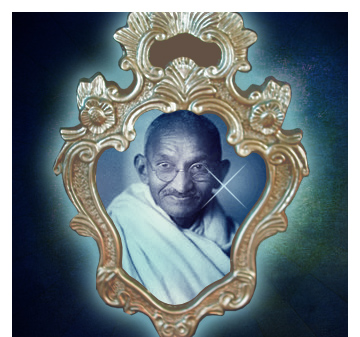
If Ramachandran, Iacoboni and hundreds of other neuroscientists now poring over mirror neurons are correct, directly sharing the experience of others is a key to who and what we are, how our brains and minds evolved, and how they develop from childhood. Compassion and empathy, feeling the experience of another, is not just something we’re capable of, it is woven into the fabric we are cut from. “Mirror neurons dissolve the barrier between you and someone else,” says Ramachandran. He calls them “Gandhi neurons.”
Along with dozens of studies in neuroscience journals, mirror neurons have also taken a place in the folk psychology battle over how to frame human nature. Alan Greenspan and the rugged individualists may love Ayn Rand’s libertarian vision of each person alone against the world, but another set prefers to think of humans as inextricably tied to one another, creating codependent realities and sharing inter-subjective space.
In fact, the problem of altruism has vexed biologists since Darwin. Why do people sacrifice their own self-interest, sometimes even their lives, in order to help others? Genes for such behavior should be selected against quickly and definitively. But if mirror neuron theorists are right, the advantages of directly understanding others may be so great that it blows the evolutionary cost of occasional self-sacrifice out of the water. What’s selected for might be the ability to imitate others, and to understand and feel what they are feeling. Self-sacrifice and altruism might be mere byproducts of mirroring and not themselves adaptive in a way selected for by evolution. In any case, “we are good,” says Iacoboni, “because our biology drives us to be good.”
Like many of science’s great accomplishments, mirror neurons were discovered by accident. In the early 1990s, neuroscientist Giacomo Rizzolatti and his research team at the University of Parma were studying motor neurons in the frontal cortex of macaques and had attached tiny electrodes to individual cells in the monkeys so they could watch how very specific hand movements were initiated in the brain. When a wired-up monkey picked up a peanut, the neuron fired. But to Rizzolatti’s surprise, the same motor neuron also fired when a perfectly still monkey was watching a lab assistant pick up the peanut.
Why would a motor neuron fire when there was no motor action? They not only fired when the macaques tore a piece of paper and saw a piece of paper torn by another macaque, but also when the monkeys merely heard the sound of paper being torn, without any visual stimulus at all. Many tests and retests later revealed the whole new class of brain cells, mirror neurons, located in the parts of the macaques’ brain that process both sensory information and kindle emotions.
When Rizzolatti’s work was published in Experimental Brain Research in 1992, the neuroscience community went ape looking for evidence of mirror neurons in other primates, notably humans. Because they couldn’t go fishing with electrodes in human brains, scientists had to search with other, less invasive tools. The fMRI revolution in neuroscience was under way, allowing scientists to observe accurate, high-resolution, three-dimensional images of brain activity in real time. Neurobiologists looked for mirrorlike brain activity in the same areas where the systems had been found in macaques. And they found evidence of them in far greater numbers and more elaborate formulations than in macaques or any other primates. “Humans are heavily wired with mirrors,” says Ramachandran.
Only recently, though, have scientists identified individual mirror neurons in humans. Iacoboni’s team at UCLA collaborated with Itzhak Fried, a neurosurgeon who was implanting electrodes into epileptic patients in an effort to find the origins of their seizures so they could be surgically treated. Once those electrodes were in place, and after patients gave permission, it was possible for Iacoboni to test individual human neurons for mirroring. He found mirror neurons in several parts of the human brain.
Evidence of the clinical importance of mirror neurons comes from the study of psychological disorders. Both Iacoboni and Ramachandran are looking at links to autism, which may result from a breakdown or suppression of the mirror system. People who suffer from autism are less empathic, worse at reading the emotional states of others, and less emotionally connected to those around them. Functional MRIs show they also appear to have significantly less mirror neuron activity, says Iacoboni. Strengthening mirror activity in autistic kids, through imitation and other simple exercise, seems to help them, says Iacoboni.
The evolutionary roots of human mirror neuron systems reach back millions of years, says Michael Arbib, director of the USC Brain Project, and author of “From Action to Language via the Mirror System.” The evolution of language appears to be connected to the mirror-neuron-rich area of the brain associated with movements of the hands, he says, while the evolution of our empathic mirroring capabilities seems to be associated with regions of the brain governing movements in the face.
Early mirroring must have enhanced our ancestors’ ability to learn by imitation — one primate can “practice” using tools in its head simply by watching another. These new capacities eventually led to the kind of “metaphorical” exercises employed in abstraction of all kinds, including the development of symbolic systems like language, says Ramachandran, whose lab at UCSD is currently investigating the connection between mirror neurons and the human ability to employ metaphor.
“Not just literary metaphors,” says Ramachandran in his deep, dramatic East Indian British accent, “but abstractions of all kinds. Once you understand the cross-modal computations that mirror neurons are doing, you can see why human beings are so good at all kinds of abstraction.”
A map, for example, is a kind of powerful metaphor for the terrain it is depicting. Using maps — and only humans can — requires cross-modal computation and abstraction. Imagine our forebears making a simple map in the dirt to help them plan a hunt; the twigs stand for hunters, the pebbles stand for prey, two lines for the river banks. The ability to understand how a twig can be a person — and in what ways it can’t — also boils down to mirror neuron systems, says Ramachandran.
Other primates engage in “cross-modal abstraction,” or metaphor, says Ramachandran, but humans are distinct even from the most speculative and metaphorical apes. Some millions of years ago, he says, the part of the mammalian brain in the left inferior parietal lobule mushroomed. This mirror-neuron-rich area, called the angular gyrus, which sits at the crossroads of the brain’s vision, hearing and touch centers, is far more developed in humans than in other primates. “And when the angular gyrus is damaged,” Ramachandran says, “people experience metaphor blindness.”
Being able to make abstractions, to go from recognition of a vertical limb, say, to the abstract notion of verticality, and then to assign it a word, “verticality,” or a mathematical symbol, conveys a clear evolutionary advantage that can be parlayed not only into better tree climbing, but also into making ladders, and elevators, and rocket ships, says Ramachandran.
Mirror neurons had an inconspicuous start, says Daniel Dennett, director of the Center for Cognitive Studies at Tufts University and the author of “Darwin’s Dangerous Idea,” and other books about evolution. “All evolutionary innovation begins with a mistake,” he says. Some genetic mutation may have led to a misfiring set of neurons that enhanced hand-eye coordination. This “programming bug,” as Dennett calls it, must have conveyed an advantage amplified by natural selection. And once simple mirror-neuron networks were established, he says, “they may well have played a big role in the evolution of empathy, and imitation, and social understanding.”
Ramachandran goes further, explaining that mirror neurons help us understand the evolution of the self, the mysterious narrator that provides continuity in each of our life stories. The self, which Ramachandran calls the Holy Grail of neuroscience, may be an evolutionary innovation adopted not first to give each person a conscious foreman, but as a way to model others. In this theory, the self started as a kind of little program — fed with data from the mirror system — for understanding other people, a kind of algorithm for generating a mini-you in me. Once it evolved, this program swung around and began to apply its algorithmic investigations also to its host, the brain in which it resided. Self-consciousness was born.
“It was almost certainly a two-way street,” Ramachandran adds, “with self-awareness and other-awareness enriching each other in an auto-catalytic cascade that culminated in the fully human sense of self. You say you are being ‘self-conscious’ when you really mean being conscious of someone else being conscious of you.”
To U.C. Berkeley critic Gopnik, the significance of mirror neurons “is blown way out of proportion.” She says their power to explain consciousness, language and empathy “is just a metaphor.” As a psychologist, Gopnik views behavior at a different resolution than the neurologists do. She bristles at the idea that science can find hard-wired explanations in the brain for complex behaviors. “You never get single neurons calculating anything,” she says. “What you’ve got are these enormous suites and interactions and computation among many different levels of neurons all calculating different things. And also changing what they calculate even from moment to moment.”
Even something as seemingly mundane as recognizing the edge of an object requires huge numbers of interacting neurons, Gopnik says. In the 1960s, perceptual psychologists thought they had found a kind of neuron that detected edges. There was a lot of hullabaloo over the discovery of so-called edge neurons. “But the truth turned out to be much more complex,” says Gopnik. “The idea that a kind of neuron alone could explain empathy or behavior or self-consciousness simply makes no sense.
“It’s just as likely that those neurons are mirroring because people are imitating each other and feeling empathy, not the other way around,” says Gopnik. Yet she is sympathetic to some of the conclusions of the mirror neuron researchers; her own work in developmental psychology also stresses what she calls the “distinctive human capacity to link the self to others,” as a key trait of evolution and something essentially human. But she is impatient with “the giant illogical leaps” that she says neurologists sometimes take in reaching overly broad conclusions. “Scientists have always been susceptible to the temptation of thinking that they’ve solved the secrets of the universe,” she says. “And neurologists are no different.”
Dennett agrees that it is rash to draw profound conclusions about the role of mirror neurons so soon. “Some mirror neuron enthusiasts are saying that these are some kind of magic bullet, a giant leap by evolution that made language and empathy possible. I think that is much too strong.”
Ramachandran and Dennett, who are friends, disagree on this point. Ramachandran thinks that mirror neurons will indeed bring about a revolution in the way we see the brain and the way we see ourselves and our relationship to one another. “Mirror neurons will do for psychology what the discovery of DNA did for biology,” he wrote several years ago.
Whether mirror neurons bring about a paradigm shift in our conception of ourselves remains to be seen. In the meantime, there seems to be near consensus that we are exquisitely tuned to one another’s experience and that mirror neurons help us to experience each other viscerally and directly. While that may explain the direct emotional impact the crying woman on the train had on me, it doesn’t explain why I did nothing to help her. We may be fundamentally interconnected, but we are individuals too. If the crying woman had been diagnosed with terminal cancer, I might have felt her emotional pain, but I wouldn’t have grown her tumor. So perhaps, as Gopnik says, the leap that connects the co-firing of neurons to the human condition is only metaphorical after all.
But then, Ramachandran points out, a good mirror-neuron-enabled metaphor is one of the most powerful things a human can have. Or share.
