

Flash forward to 2009. Eight people, two pilots and six civilians who have anted up $200,000 for tickets, settle into La-Z-Boy-style seats aboard Virgin Galactic‘s SpaceShipTwo for a two-hour suborbital space flight. To be sure, SpaceShipTwo’s planned jaunt to more than 68 miles above Earth’s surface will be the space-tourist version of a kiddie roller-coaster ride; passengers will experience only a few minutes of free-floating weightlessness and won’t be allowed to venture out on spacewalks. Still, Virgin’s maiden voyage seems poised to usher in the private space-travel era that basement rocket-builders have anticipated for decades. Company reps hope suborbital transit will prove a potent gateway drug, enabling Virgin and competitors like SpaceDev to expand their service to the moon. Dutch architect Hans-Jurgen Rombaut has already hatched plans for a four-star lunar hotel.
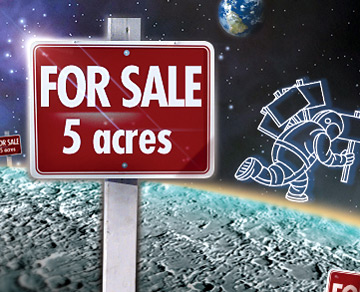
The prospect of large-scale commercial space travel is music to the ears of Dennis Hope, who has been anticipating this era for more than a quarter-century. The Nevada-based entrepreneur — who styles himself as a latter-day Columbus with Murdochian marketing aplomb — is the founder and self-proclaimed “Head Cheese” of Lunar Embassy, an online portal that parcels out moon land for less than it costs to stay overnight at a Motel 6. For $19.99, Hope’s pie-in-the-sky sales pitch promises that you too can snap up your very own one-acre lunar plot. And with the Earthbound real-estate market cratering, who can resist the growth potential? A split-level overlooking the Sea of Tranquility, a condo at the foot of the Archimedes mountain range — the possibilities are endless.
Until a couple of years ago, no one paid much attention to Hope and other space-plot peddlers like Lunar International and the Lunar Registry; they were widely regarded as a few planets short of a solar system. Besides, the idea of claiming land in outer space or exploiting its resources remained chiefly theoretical. These days, with Virgin et al. charging full speed ahead, private citizens could feasibly start taking regular jaunts to the moon by 2020 or so. But the real money is not in the pleasure rides. With crude oil nearing $100 a barrel, entrepreneurs focused on petroleum alternatives are looking at the green cheese in a whole new light — and that has lunar real estate agents envisioning asteroid showers of money raining down on them.
Lunar soil is rife with platinum group metals, which are exceedingly rare on Earth and are key to helping hydrogen fuel cells operate efficiently. Then there’s the real golden ticket: helium-3, deposited on the moon’s surface by radioactive solar winds. When combined with deuterium, an isotope of hydrogen, helium-3 can initiate fusion reactions so potent that scientists estimate a single space-shuttle load of the stuff could power all the homes and businesses in the United States for a year.
“The moon contains 10 times more energy in the form of helium-3 than all the fossil fuels on the Earth,” former Indian President Abdul Kalam told attendees at 2004’s International Conference on Exploration and Utilization of the Moon. Gerald Kulcinski, director of the University of Wisconsin’s Fusion Technology Institute, thinks helium-3 could potentially power future long-distance space travel, though it could take decades before a commercial helium-3 reactor becomes available.
Since the moon’s resources could fetch billions of dollars in the Earth marketplace, Hope says, it should be a no-brainer for shrewd real-estate buyers to set aside some petty cash and snag a piece of the action. Best of all, the entire scheme is perfectly aboveboard from a legal standpoint — if you take Hope’s word. The 1967 Outer Space Treaty, the most recent piece of widely ratified United Nations legislation on moon property ownership, states that territories beyond the Earth cannot be owned by national governments, but it does not specifically prevent private citizens from making land claims. The 1979 Moon Treaty attempted to close this loophole by forbidding ownership of any extraterrestrial property by any organization or person, but the treaty quickly died on the vine; only 13 U.N. member nations ever ratified it.
After the Moon Treaty tanked, Hope sent letters to the the U.N., the United States government and the Russian government, declaring his ownership of the moon. He has taken their lack of response as carte blanche to go ahead with his grandiose appropriation scheme. His plans include establishing the first helium-3 mining operations on the moon by 2011 (NASA, by contrast, won’t mount its next manned lunar landing until 2019) and forming a “democratic republic sovereign nation,” the Galactic Government, in which his property-owning customers will enjoy voting rights. If other nations infringe on the territory he has claimed, he will view their incursions as acts of war.
“The U.N. has had plenty of time to acknowledge our claims of ownership,” Hope says. “Who are they to tell us we can’t do this?” He cites first-claimant-takes-all precedents set during the homesteading era as justification for his planned land grab. “Look at the United States when it first became a country. Land acquisition was frequently done on a remote basis. We’re just going by the precepts of our forefathers.”
Unsurprisingly, most space law experts reject Hope’s claims. Ram Jakhu, a space lawyer at McGill University, thinks Hope made a mistake in assuming the Moon Treaty’s demise made his venture legitimate. In fact, the Outer Space Treaty, ratified by the United States and 97 other nations, already covers all the necessary bases because its prohibition against government space property ownership applies to individual citizens as well. “The Outer Space Treaty is public law, and as such, private citizens are subject to it,” Jakhu says. “It doesn’t matter if you go and put your own flag up there. The treaty is very clear and broad and denies the claims of any property owners.” Virgiliu Pop, a member of the International Institute of Space Law and author of “Unreal Estate: The Men Who Sold the Moon,” agrees. “People like Dennis Hope have no legitimate basis whatsoever for what they are doing. If states cannot appropriate extraterrestrial realms, neither can their nationals.” Hope fires back by dismissing their dismissals. “That has no credence. That’s just their opinion. We don’t need the recognition of the world.”
While many legal experts have written Hope off as a loon, Rosanna Sattler, chair of the space law group at Boston firm Posternak Blankstein & Lund, counters that regardless of whether his dubious venture passes international muster, it exposes some glaring omissions in existing space-property legislation. When the Outer Space Treaty was drafted more than 40 years ago, it’s unlikely the possibility of lunar commerce ever crossed legislators’ minds; all space exploration then took place under governmental auspices, and private space travel was as foreign a concept as portable personal computers. “I don’t think we want anyone up there unless there’s some more concrete framework in place,” Sattler says. “The $64,000 question is: Is the Outer Space Treaty flexible enough to allow commercial development, or are there gaps and holes, things that have to be done to amend it?”
The issue at the core of the debate is whether owning extraterrestrial land is a necessary prerequisite to culling its resources, and the aging Outer Space Treaty does little to clarify the matter. “If I’m an entrepreneur who goes to Wall Street and says, ‘Will you invest in my lunar mining company?’ Wall Street will say, ‘Wait a minute, the law is not clear here. You can’t appropriate that space,'” Sattler says. “It’s like if you drafted all this legislation about the tail of the elephant, and then you find out about the elephant itself and go, ‘Oh my God.'”
The international community’s failure to acknowledge the newly burgeoning commercial realm in space stems from a long-standing schism in the U.N. between established space powers and up-and-coming nations outside the extraterrestrial fray. While countries uninvolved in space exploration tend to favor laws, like the failed Moon Treaty, that explicitly forbid any ownership or private use of outer-space territory, space heavyweights like the United States, Russia and China, with an eye toward future commercial gain, have shied away from such blanket declarations. As a result of this stalemate, the moon retains many of the trappings of the wild frontier: It’s unspoiled, partially ungoverned, and flush with resources — the ultimate prize for opportunists like Dennis Hope.
To dispel some of the confusion, Jakhu says individual space-faring nations need to seize the initiative and place concrete limits on how businesses and private citizens can conduct themselves on lunar soil. “Anyone who wants to transmit video over the airwaves needs a license. People who want to conduct mining operations [on the moon] should have to get a license as well,” he says. “It’s in the best interest of the United States to direct the use of the moon in an organized manner.”
Sattler points to existing laws regarding use of the oceans as a blueprint for national governments to follow as they draft lunar legislation. The U.N.’s Convention on the Law of the Sea, for instance, established an International Seabed Authority that grants licenses to businesses that wish to conduct mining operations in deep-sea areas that do not belong to any country. A specialized tribunal handles any resource-allocation disputes that arise. “We need to say, ‘People can take moon resources, but you have to go through this procedure first.’ This shouldn’t be like the Gold Rush, where people just got on a horse and made a claim,” Sattler says.
Regardless of which way the legal winds end up blowing, Hope has posted profits of $10 million and growing since the Lunar Embassy set up shop in 1980. If the entire premise behind his venture — that his land claims are rightful and enforceable — turns out to be rotten, does that make him the author of one of the most remarkable scams in recent history? Perhaps so, Sattler says, but the reason Hope’s never gotten nailed on fraud-related charges is that the law expects consumers to maintain a healthy skepticism in dealings with hucksters like him.
“Someone might make an argument for a class-action claim on behalf of the buyers, under some sort of consumer protection act,” Sattler says. “But a fact finder might discover that buyers’ reliance on Hope’s representations was not reasonable given the preposterous circumstances.” In other words, legal authorities would regard buyers as having bought into an obviously absurd claim, and so when it comes to reclaiming their money, they would be out of luck. Hope has also avoided legal scrutiny by labeling his products “novel gifts,” though he maintains this does not affect the legitimacy of customers’ Lunar Embassy land deeds.
Of course, claims like Hope’s have long been regarded as preposterous because, short of teleportation, there was no physical means of enforcing them. But if Hope or any other like-minded “landowner” actually makes it to the moon in a Virgin Galactic-style craft and starts forklifting lunar dirt into barrels to be spirited back to Earth, the international legal community will no longer be able to brush lunar land claims aside.
Steve Durst, a Palo Alto-based space publisher who has purchased several “official” lunar land deeds from Hope and others since the 1970s, thinks whoever manages to set up the first drilling operations or prefab condos will hold sway over the lunar economy, despite Earth-based authorities’ objections. “You can be cynical and say it’s not a question of law, it’s a question of who actually gets there first. Possession will be nine-tenths of the law.” This view has some legal credence; Pop acknowledges that corpus possidendi — the ability to take physical possession of a claimed territory — has historically played a key role in establishing ownership.
In almost every scenario, Hope comes out looking a lot shrewder than his detractors admit. Ironically, the fact that his venture smacks of insanity works in his favor. If his bid to reach lunar soil somehow succeeds, he’ll have undeniable clout in determining how the moon and its resources are to be administered, particularly given the current lack of cut-and-dried international regulations. But even if his bid flops, the Lunar Embassy’s profits will continue to mount year after year, boosted by a never-ending stream of Internet buyers and legitimized by a legal system that’s inclined to give Hope a pass because of the seeming ridiculousness of his claims.
Naturally, Hope is pulling for the former outcome. In the meantime, he’s banking on an improbable scientific breakthrough that will catapult him and his landowning customers ahead of potential competitors — literally. “We’re working on a craft that will send 400 people to the moon in a half-hour,” he says. “I can’t tell you about it.” But Hope’s apparent lunacy is deceptive. Although he may not be able to get to the moon in less time than it takes to watch an “X-Files” rerun, that doesn’t mean he’ll never get there at all. “Theodore Roosevelt said to walk softly and carry a big stick,” he says. If Hope or one of his fellow entrepreneurs drills the first helium-3 mine or lays the first foundation near Tycho Crater, the global community will be forced to decide whether — and how — to strike back.
