
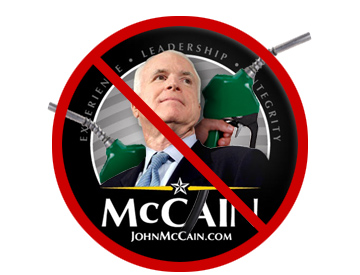

Last week, Sen. John McCain proposed that the nation take a gas tax holiday this summer. With oil topping $115 a barrel and gasoline prices hovering in the mid-$3-per-gallon range — shooting as high as $4 in some places like the San Francisco Bay Area — the Republican presidential candidate wants Congress to suspend the federal tax of 18 cents per gallon for gasoline and 24 cents per gallon for diesel from Memorial Day to Labor Day.
“The effect of this ‘gas tax holiday’ will be an immediate economic stimulus — taking a few dollars off the price of a tank of gas every time you fill up,” McCain wrote in a fundraising e-mail to campaign supporters on April 17. “And because the cost of gas affects the price of food, packaging and just about everything else, this immediate step will spread economic relief to every family in America.”
The federal gas tax has not budged since 1993, when the Clinton administration raised it by 4 cents to help reduce the federal budget deficit. Critics have raised questions about the efficacy of McCain’s proposed tax holiday, with some deriding it as a campaign gimmick. McCain’s holiday would cost the federal government about $9 billion, monies normally spent on roads, bridges and other infrastructure, while potentially increasing the already staggering federal deficit. Eliminating the federal gas tax would also amount to a government-sanctioned incentive to encourage driving, at a time when even President Bush is saying that we need to reduce our greenhouse gas emissions.
Christopher Knittel, professor of economics at the University of California at Davis, argues that federal fuel taxes shouldn’t be going on holiday this summer. In fact, he contends that the taxes should be hiked up 50 cents, or even a dollar, to help fight global warming, this summer and beyond. The professor, whose research is in energy, transportation and environmental economics, has studied gasoline markets and vehicle choice. His work shows that relatively high gas prices over the past four years have inspired some Americans to choose more fuel-efficient cars, which is beginning to reduce overall gasoline consumption.
Salon spoke with Knittel about why he thinks Americans need higher gas taxes, not lower ones, and why both Sen. Barack Obama and Sen. Hillary Clinton’s plans for a cap-and-trade system to limit greenhouse gas emissions would amount to a higher gas tax by another name.
What do you think of McCain’s proposal for a gas tax holiday this summer?
Politically it’s a great idea for McCain. It hits on two main issues: Gas prices are high and he’s also lowering taxes. For the economy and for society at large, it’s a terrible idea.
The U.S. is just now starting to get on board with the idea that we need to fight climate change, and this is just reversing that fight. Basically we’re going to reduce the price of gasoline, which means consumers are going to respond by either driving more in the short term or changing how they make vehicle purchases and buying less fuel-efficient cars, because fuel efficiency won’t be as important.
So, as a country, if we really believe in the need to fight global climate change, this is the exact opposite of what we should be doing.
The federal gas tax is 18 cents a gallon. Would subtracting that amount change drivers’ behavior?
It’s not likely to change our short-run behavior in terms of the number of miles we drive. It’s not like McCain suspends the gas tax and I say, “OK, now I’m going to drive to the grocery store,” where before I wasn’t. But what we are seeing now is that these higher gas prices are changing the vehicles people buy.
Is that because gas prices have been going up for a while?
We’ve moved away from thinking, “The price is high this month, but I expect it to be low next month” to “It’s high, and I expect it to be high, so what am I going to do about it?” So we’re seeing people shift from vehicles that are less efficient — pickups and SUVs and large cars — to compacts and midsize cars. In fact, even with midsize cars and SUVs, people are choosing the more fuel-efficient ones. So we’re seeing some pretty large changes in what people are buying.
But that’s likely to be reversed if the government tells everyone this gas tax break is a constant price reduction — the holiday being every year. If they just did it one year, and said, “OK, next year, the gas tax will be back on during these three months,” then consumers are likely to still worry about high gas prices.
What do you make of McCain’s argument that suspending the gas tax would provide an economic stimulus by putting extra bucks in drivers’ pockets?
That argument has weight if we believe that the government is misspending the revenues that it would be collecting from the tax. It hinges on the idea that consumers would spend the money more wisely than the government. Republicans will argue that consumers are better able to spend their money than the government, so we should have lower taxes. But it’s really no different from the traditional argument that we have about government spending money vs. citizens.
How does our gas tax compare with the gas tax in other countries?
We’re spoiled. In Europe, gas taxes are typically at least 100 percent of the base gas price. Gas prices in Europe are at least twice as large as they are here. Our federal gas tax is 5 percent when a gallon of gas is $3.60. State tax certainly increases that, and there is a lot of variation across states.
You’re saying the downside of the gas tax holiday is that it creates an incentive for people to buy larger cars?
I don’t want to overstate things. It’s going in the opposite direction of what the stated goals of the country are, which is to try to reduce our greenhouse gas emissions. It’s counterproductive.
Are you saying that cutting 18 cents a gallon for the three summer months is unlikely to affect the number of miles that people drive?
Yes. Just using the figures from my own research, the number of miles that people drive would increase by less than one-half a percent.
Isn’t there evidence that Americans are starting to consume less fuel, since gas prices have been relatively high for so long?
There is. In California, for example, this past quarter we had our first year-to-year reduction in gasoline consumption in 16 years, if you ignore the [Hurricane] Katrina event, which disrupted supply.
Does that mean that people are driving fewer miles, or they are buying more efficient cars?
It’s a combination of both. My research suggests that the effect on miles driven is pretty small, so it’s likely to be a shift to more fuel-efficient cars. To be fair, we are seeing increases in use of public transportation. In California, we’re seeing increases in Amtrak travel, and a lot of the major cities in the U.S. are seeing increases in subway ridership.
The reason why we’re seeing changes now is that we’ve seen prices high for close to four years now. In years past, even in the 1980s, there was a price spike, but then prices quickly fell. That didn’t give consumers enough time to change their driving habits or their vehicle purchase decisions.
Now that prices have been high for quite some time, they’re changing their vehicle purchases. And it’s giving consumers enough time to find carpool relationships or learn the subway system schedules.
We are seeing a larger change in driving habits than we did two years ago. But my own view is that the major reductions in our gasoline consumption are going to come from changes in the vehicle stock and land-use patterns. Consumers will now make different decisions as to where they purchase their home or where their job is located.
That takes more time?
Right, because those decisions don’t come up right away. We don’t buy a new car every month. If I believe the price is only going to be high for one month, it’s not going to give me enough time to change my decisions.
What do you think of the argument that we should be taxing gasoline more right now, not less, to encourage drivers to get that more fuel-efficient car or drive less in order to mitigate greenhouse gas pollution?
I’m actually a believer in that. If our goal is to reduce greenhouse gases, the most efficient way to do so is by having consumers face the true costs of their decisions. Greenhouse gases are expected to do damage to our own economy as well as the world economy, although those damages aren’t going to come for quite a number of years. Consumers should face the cost of those damages when they burn a gallon of gas.
How high would you like to see the federal gas tax go?
The best tax level is based on the damages that greenhouse gases create. There is a lot of uncertainty in that number. But I think a low figure for greenhouse gas damages would be $50 a metric ton. So, $50 for 2,200 pounds of carbon dioxide translates to a 50-cent gas tax. I think damages of greenhouse gases might even be nearer to $100 a metric ton, which conveniently enough translates to 100 cents, or $1.
Here, we have a major presidential candidate saying: “Eliminate the gas tax!” Is raising the gas tax just a political nonstarter?
Nobody ever got elected on a platform of raising gas taxes.
But both Obama and Clinton have said that they’re in favor of what’s called a cap-and-trade system for greenhouse gases. A cap-and-trade system effectively acts like a greenhouse gas tax. The difference is that you don’t levy an actual tax, but firms are required to buy permits for every unit of carbon dioxide that they create. So the price of that permit becomes a de facto tax.
That would be an indirect tax on drivers?
Just like a gas tax is actually collected from the industry, it’s collected from the gasoline station. The consumers don’t literally pay the tax, but they do through higher prices. This would have the same exact effect. A gallon of gas creates 20 pounds of carbon dioxide. If I’m a gasoline refinery or a gasoline station, depending on where they set the regulation, for every gallon of gas that I would sell, I would have to have enough permits to cover that 20 pounds of carbon dioxide.
That would obviously be passed on to the consumer.
Just as a tax would.
So Obama and Clinton are talking about raising the gas tax, but not doing so in an explicit way?
They are. And I believe that’s the right decision. I’m always afraid to tell people that’s what they’re effectively doing, because I think that politically they’re being smart in not calling it a tax but adopting a system that acts very similar to a tax.
But we don’t know how much it would be?
We don’t. In a cap-and-trade system, what drives the prices of the permit is what the cap is. The government comes in and says the entire U.S. is not going to emit more than X number of tons of greenhouse gases, and we’re going to give out and auction off permits that allow people to emit greenhouse gases. And you can only emit them if you have a permit. That requires people to go out and buy permits.
It’s going to depend on where they set the cap?
Yes. But they haven’t talked about that. They may be, effectively, pushing for a cap that’s so lenient that the permit price is near zero, in which case it doesn’t do anything, but it also doesn’t raise our prices. The devil is definitely in the details.
Opponents of gas taxes often argue that gas taxes are regressive, impacting lower-income people more. What do you think of that argument?
It’s likely true that lower-income consumers spend a larger percentage of their budget on fuel. My argument would be that if we increase gas taxes, we should also pass a rule that these revenues are tax neutral. Tax neutral means if you bring in an extra $100, you have to show that you’re taking in $100 less from other taxes. We would guarantee the revenue generated from these new gas taxes — or carbon taxes, more preferably — would be funded back to consumers. At which point, we can decide which consumers get the revenue.
By lowering other taxes?
Or by just refunding those revenues disproportionately to the poor. British Columbia recently passed a carbon tax, which starts at $10, and goes up until it hits $30 a ton, and which is tax-revenue neutral. Legislators have to show that all the money generated from that tax goes back to consumers. They’re basically sending lower-income consumers a check of $150 per adult per year, and something like $80 per child, and that would overcome that regressive factor of the tax.
Even if you don’t drive, you get the $150 check?
If you base it on driving, you reverse the incentive. You have to do it so that it’s not a function of how much you drive. But it could be a function of income, which is what we’re worried about when we say that a gas tax is regressive.
Is the price of oil and gas likely to stay high in the foreseeable future?
Luckily we have financial markets that make those exact predictions. On the Nymex, people trade what are called oil futures, which are basically the investors’ guesses as to what the price of oil is going to be in the future. Those trade out all the way to 2016. Oil out to 2016 is currently traded at above $105.
If you account for inflation it’s going to be a little lower because these are future prices. But certainly financial markets are predicting that prices are going to be at the $100 level for some time.
