
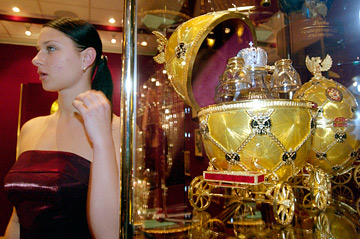

On a recent evening in London’s nightclub-of-the-moment, Movida, I’m at the sleek steel bar, surrounded by a gaggle of good-looking blondes. Taking in their gaudy Fendi clutch bags, their air of hard confidence and the dinky diamonds embedded in their BlackBerrys, I recognize the breed immediately: They are London’s New Russians, super spenders from the land of oligarchs and post-communist ostentation. They slice the air with black credit cards, beckoning for champagne, more champagne and Stolichnaya Elit, the finest potato juice known to man. As I struggle in vain to get the bartender’s attention, the lights dim, the crowd parts and a twangy Russian folk song starts blaring from the speakers — “Kalinka,” I think. Two strapping black-shirted young men are making their way across the dance floor, bearing an ornate sedan chair. Feeling a little like a slave in Pharaonic Egypt, I jostle over to get a look.
It turns out the precious cargo is a giant ice bowl holding several bottles of Cristal champagne, destined for a clique of New Russians holding court at a corner table. “It’s called a champagne chariot,” explains Ilya Taranto, the Russian-born, British-educated event producer whose job it is here to keep such clients sweet. “If you order over 15,000 pounds worth of champagne [about $30,000] it gets brought to you this way. The Russians love it.”
The scene is not surprising; it’s just one small moment in a five-year super-spending spree that has swept London. Nearly 100 years after the aristocrats of old Russia were rudely stripped of their decadence and forced to flee west, a new Russian elite has hit London with a lust to live like their long-lost tsars. They are the oil- and gas-rich plutocrats, oligarchs and multimillionaires who made a killing when communism fell and Soviet state assets were privatized. Twenty years ago they might have been scratching out tin in the Urals; now, at clubs like Movida, they drink cocktails flecked with flakes of 24-carat edible gold.
After Perestroika, the economic reforms in the 1980s Soviet Union that permitted private ownership of businesses, Russia’s economy spluttered and lurched as the old capitalist machine warmed up again after seven repressive decades of communism. These days, though, it is lubricated by a seemingly endless torrent of oil and natural gas, leaving the nation’s elite awash in money. (In the first three months of this year Russian oil production averaged 10 million barrels a day; with the soaring price of crude, calculating the profit potential quickly gets dizzying.) Under the stabilizing influence of a “managed democracy,” courtesy of Vladimir Putin’s reign as president, the new economy is booming.
The darker side of Russia’s new dawn has been well covered in the West, with reports of deep corruption, crackdowns on the free media, assassination attempts on the wealthy, and the prosecution of powerful men like Mikhail Khodorkovsky, the multibillionaire whose political ideas apparently didn’t sit well with the Kremlin, and who is now languishing in a Siberian labor camp. Putin’s authoritarian style and distaste for dissidence have led many rich Russians to seek security elsewhere.
Around 200,000 Russians now live in London (a sizable colony in a population of 7.5 million), and of these, around a tenth are those who would be considered super-wealthy. They come here in large part because of a lax tax law that allows “non-domiciled residents” to escape paying revenue on the mountains of money they bring into Britain. Much to the consternation of the upper-class old guard, they are just the latest wave of flashy, filthy-rich foreigners to crash into London, following in the wake of the oil-rich Saudis of the 1970s and ’80s and the Japanese businessmen of the ’90s. They have long drawn quiet sneers; lately, some socialites about town have been handing down harsher denouncements, and doing it very publicly.
But there is something refreshing and even distinctly appealing about these wealthy Russians, even if it is entirely lost on Britain’s old-guard elite. Although individual examples of astonishing extravagance may certainly seem distasteful, the Russians’ spending spree is in some sense redeemed as a long, noisy and joyful retort to decades of communist dictatorship.
Given their wealth and growing notoriety, the super-rich Russians may now try to duck attention as they flit from their mansions to their million-dollar Maybachs. But you know a Novi Russki when you see one: The “biznismeni” are built like bricks and tanned from a month on their yachts in St. Tropez (which, by the way, boast helipads and submarines, and make poor P. Diddy’s ride look like an old tin can). You’ll find them in London’s smartest restaurants, dark-suited and discreet in the corner, planning a new pipeline through Kazakhstan or plotting to float millions on the Micex, Moscow’s booming stock exchange.
Their wives and girlfriends follow the dress-down “Dynasty” school of fashion — the furs have been folded away for modesty’s sake (and the Moscow winters), but they still favor luxe silk shirts, crocodile skin handbags and a heavy dose of diamond frosting. “There is a lot of brand bashing going on,” admits Ilya Taranto. “We Russians just like nice things.”
You’re most likely to catch one of these gaudy butterflies at the high-class events that constitute English society’s summer season — Wimbledon, Henley Royal Regatta, Cartier Polo, Glorious Goodwood — where they’ll be dressed in the best Versace, Dolce and Gabbana or Cavalli, and causing a stir among the old guard. “Events like Henley and Goodwood are seen as epicenters of Englishness, so it’s seriously obvious when the Russians invade,” says Sophie Sharpe, a full-time socialite on the London scene and a veteran of the top events. “They’re pretty flash with their cash on the horses, on the alcohol — on everything really. They come along with these huge jeroboams of vodka and ludicrous amounts of caviar and it’s a bit in-your-face. It’s just a totally different attitude to what we’re used to.”
You can imagine the derision they attract in London’s elite epicenter, where the best money is still old money and snobbery is a sport. A friend was enjoying breakfast in one of London’s smartest hotels recently when she nearly choked on her eggs Benedict. There, at the next table, was a classic Novi Russki — resplendent in retina-rupturing red lipstick and, to match, the most eye-wateringly extravagant ruby necklace she had ever seen. “Rubies — at 8 a.m.! At breakfast!” my friend mock whispered in the tones snobby Brits reserve for the insufferably vulgar. Such brash flashiness is simply not done in London.
The legendary profligacy of the rich Russians has been raising eyebrows all over town. Taki Theodoracopulos, the famed socialite and professional snob, has for months been waging a high-profile campaign against the crowd he dubs the “Nouveau Russes,” calling them “crude, vicious, fat, vulgar, coarse, loud … uncouth, uncultivated, boorish and brutal,” and raging against their “humongous super-yachts, colossal houses [and] gargantuan egos.” According to Taki, the New Russians’ “obnoxious spending and lack of basic manners amount to a grotesque deformity.” Though few would dare to be so explicit, it’s not an uncommon attitude.
Some, however, have welcomed them with open arms. Indeed, many rich Russians come to London because it is a city supinely eager to cater to their whims.
A whole host of specialist services has sprung up to relieve the Russians of their rubles. Most of London’s top realtors now offer Russian-speaking agents, and offices in Moscow, to attract buyers in the ludicrously lucrative market. “The Russian impact has been hugely significant, especially in the 5 million pound-plus bracket” of properties, says Rupert des Forges, an agent with Knight Frank of Belgravia. “It’s the prevalent force in the high-end market now.”
According to des Forges, wealthy Russians often decide to buy on the spot and pay upfront (though not with cash-stuffed attaché cases, as some gossips would have it). It’s a market led by extravagant oligarchs like Roman Abramovich, the owner of Chelsea football club, who recently applied for planning permission to build a private residence that will be worth a whopping $300 million.
Once they’ve got their palace, the New Tsars need palatial furnishings. There’s been a massive increase in Russian interest in the art market in recent years, says William MacDougall, who in 2004 capitalized on the spending spree by establishing an auction house specializing in Russian art. “Last year we sold over $34 million worth of art — and 90 percent of our buyers were born in the former Soviet Union.”
In the auction rooms, the New Tsars stop at nothing to secure their spoils, loudly outbidding each other with little obeisance to auction etiquette. Their desire to augment their status with art has created a frenzied appetite for old imperial treasures and Soviet-era souvenirs, driving up the value of the Russian art market from $66 million in 2004 to over $260 million last year.
Alexis Gradar is another beneficiary of the Russian Ruble-ution. As founder of upmarket transportation company Avolus, he provides private jets, yachts, helicopters and limousines to the super-rich. Business is booming: “Russians account for about a third of our private jet hire at the moment,” he says. “They’re very discerning, always wanting the latest model, often insisting that the planes are no more than one or two years old. They like soothing light beige interiors and they want fresh sushi and fresh fruit ready for takeoff.”
Whatever the cost? Gradar laughs at the absurdity of the question: “Whatever the cost.”
The Russian invasion has caused sales of caviar, vintage champagne, jewelry and all manner of luxe loot to skyrocket. You can’t get much more indulgent than a full fleet of butlers, housekeepers, nannies, chauffeurs and chefs to service your home (or homes), but according to Jane Urquhart, director of the Greycoat Placements agency for domestic staff, such extravagance is par for the course these days: “There has been a marked increase in demand for Russian-speaking butlers and other servants in recent years, and many of our staff are willing to learn Russian to land the good jobs.” Incredibly, the number of butlers on Greycoat’s books has almost doubled in the past five years, as more and more Russian multimillionaires seek the ultimate accessory of the affluent classes.
While most of the English afford the rich Russians a filigree of courtesy, behind their backs there are plenty of sniggers. Most wealthy Russians are well aware of this quiet snobbery, says Ilya Taranto: “Basically, any friction comes down to an old-fashioned conflict between English traditional conservatism and Russian decadence.”
It’s a conflict that has repercussions far outside elite high society circles, argues the Russian ambassador to Britain, Yuri Fedotov. Last year the diplomat caused a storm by claiming that hostile feeling toward Russians in London was so strong that his countrymen were being refused service in shops, restaurants and taxis. “From time to time Russians in London encounter some sort of mistreatment,” he said. “It is hard to say whether it is some kind of Russophobia or whether it is a particular case of xenophobia which is developing here.”
If Russophobia is on the rise in London, it’s quite possible that the high-profile hedonism of an elite wave of immigrants has played a part in it. But all the pride and prejudice afflicting the Brits seems to miss something essential about these proud peacocks and their colorful charms. Against the grain of social conscience and even common sense, there is something to celebrate about their extravagance — something to dig about their “dusha,” the bold Russian soul that fears little.
In some sense, the New Tsars’ exuberance and honest enjoyment of their wealth is far preferable to the understated smugness of London’s snobby intelligentsia, or, for that matter, the calculated stylishness of America’s East Coast aristocracy. In Cape Cod, in Nice, in London, in Manhattan, in Paris — in all the playgrounds of the old traditional elites — there is the recognizable froideur of those who consider themselves the true masters of the universe.
However gauche they may be, the rich Russians roll in a different way. They pursue pleasure in a manner that is artless, instinctive and unmediated by the myriad social codes you find in other super-wealthy sets — perhaps practicing a more attractive brand of hedonism. It is a glorious release of pent-up energy after a near-century of frustration and subordination. It is a joyful assertion of the power of the individual over the state. And it is a powerful statement on the invincibility of human appetites and ambition, un-dulled after decades of ideological oppression.
Several Russians I’ve spoken to are quick to contextualize the super-spending culture in defense of their compatriots. Elena Ragozhina is the editor of New Style, a glossy magazine published in London for high-earning Russians. It is thick with ads for jewelry, clothing and cars of the decidedly flashy variety, and on the back page is a picture of an object that must be the material apogee of Russian vulgarity: a 22-carat yellow gold ring studded with a gaudy number of sapphires, on which sit a tiny gold and pink diamond stiletto shoe.
As though sensing my own potential snobbery, Ragozhina points out that before the restructuring of the Soviet economy, “we didn’t have many colors. Everything was plain and grey and black and brown. So now …” she says, trailing off. But her point is clear: Now they can be forgiven some peacockery and pride in their economic ebullience.
And who knows? In dark times ahead, when recession hits and the Russians roll out of town, even the snobbiest Brits might take a moment to reminisce about London’s dynamic days — its constellation of New Tsars, and the colorful lives they led.
