
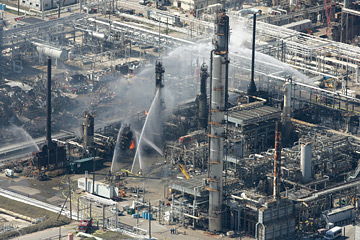

After an explosion tore through a sugar refinery in Port Wentworth, Ga., this February, killing 14 workers and injuring 40, the federal government’s Occupational Safety and Health Administration acted swiftly, announcing an $8.8 million fine against Imperial Sugar for not protecting workers against the hazards of combustible dust. The proposed fine, disclosed in July, is the third highest in the agency’s 37-year history. But if that same history is a guide, OSHA will end up collecting half that much money, or less.
ProPublica reviewed the agency’s previous 25 highest announced penalties. In 19 cases, the fines were sharply reduced after appeals and negotiations, dropping an average of 65 percent. Three others were settled the day they were announced after closed-door talks between the agency and companies. Three remain open. Citations for “willful” violations, which can bring criminal prosecution, were frequently adjusted to lesser charges that carry only civil penalties. Some cases plodded through the system; five dragged out for more than a decade. The reduced penalties are the end result of a system that emphasizes reaching settlements — settlements often proposed by OSHA itself, rather than the company under scrutiny.
An OSHA official told ProPublica that the agency’s impact on workplace safety cannot be calculated in the fines it collects. “When we issue a big penalty and a press release, that has an impact above and beyond the company,” said Richard Fairfax, OSHA’s director of enforcement programs. “Most employers are going to look at that and go back and say, ‘Let me see what I’m doing at my place.'”
Bob Leclerc, compliance manager at Maine Contract Farming, a Maine agricultural company with three OSHA citations in the past five years, seconds the idea that the very announcement of a penalty is a form of punishment. “Most companies are concerned with their public image,” Leclerc said. “Everyone and their mother see your company screwed up.”
But what Fairfax paints as sound policy, ex-OSHA officials and former Labor Department lawyers portray as weaknesses in the department’s legal arm, the solicitor’s office, that have persisted through Democratic and Republican administrations. These officials said department lawyers were overworked, overmatched and sometimes just afraid to stand up to companies that appealed citations, choosing instead to sharply reduce the proposed penalties. When labor attorneys did defend the agency’s findings, the cases often languished before the Occupational Safety and Health Review Commission, a panel of political appointees that has the final word on such cases short of federal court.
“The hard facts are that the department is understaffed,” said J. Davitt McAteer, Labor’s acting solicitor from February 1996 to December 1997. The system “tends to foster settlements and tends to diminish penalties on sometimes quite dubious grounds.”
The case of Donald Smith, a millwright at a General Motors car plant in Oklahoma City, is typical, say former OSHA officials and Labor Department lawyers. Smith was repairing a piece of machinery on the morning of April 4, 1991, when a lift table suddenly turned on, crushing his head and killing him instantly.
Shortly before his death, Smith had asked a supervisor to point out the machine that needed repair, a piece of equipment he was unfamiliar with. According to documents filed in the ensuing health and safety case, the supervisor quoted Smith as saying, “I thought that was it, but wasn’t sure. I didn’t want to get my damned head caught in that thing.” OSHA investigated the death and in September 1991 proposed a $2.78 million fine on the company for 57 violations, mostly regarding so-called lockout/tagout rules that require companies to shut down equipment and ensure the machinery can’t turn back on while workers are doing maintenance.
The case was so egregious, the Department of Labor also referred it to the Department of Justice for criminal prosecution, said Terry Goltz Greenberg, a Labor Department lawyer from 1988 to 1995. The Justice Department declined to pursue the case.
G.M. contested the OSHA fines and citation and took its case to an administrative law judge who ultimately concluded that while the plant had procedures for safe maintenance, they hadn’t been followed. The judge ruled that workers had not been properly trained to secure machines under repair. In April 1994, he reduced the fine to $1.95 million.
Both GM and the Department of Labor appealed the decision and the case went to the Occupational Safety and Health Review Commission, where it sat. And sat. In December 2007, more than 16 years after Smith died, the commission finished reviewing the case. In the end, less than half of the proposed violations remained — 26 of 57 — and the fine dropped 75 percent to $692,000.
G.M. declined to comment on the case.
Delays like those in the Smith case can have an unfortunate side effect: Employers are not required to “abate” potentially dangerous conditions until the case is decided. (In the Smith case, G.M. did address the safety issue as the case was being appealed.)
“Employers can rely on delay,” said Stuart Weisberg, who was appointed to the review commission by President Clinton and served from February 1994 to December 2000 as a member and its chairman. “An employer knows: ‘I don’t have to abate this violation until there’s a commission decision.'”
Horace “Topper” Thompson, the current chairman and a Bush administration appointee, declined to discuss specific cases but said he agreed with critics who contend appeals take too long.
“It’s very frustrating to everyone who is involved with OSHA,” he said. “When a case takes this long to come out, abatement is stayed, payment of the fine is stayed, establishment of the principle is stayed until you can get the decision out.”
How does this happen? Labor Department lawyers say they often try to settle cases to assure that workplace safety is improved immediately. Of the top 25 proposed fines, 19 were resolved within two years of the initial citation. Several current and former OSHA officials as well as former Department of Labor attorneys said this reflects a preference to eliminate health and safety hazards rather than haggle over fines. “The settlement becomes a way to resolve a backlog,” said McAteer, the former acting solicitor.
“The theory is, you get safety and health (improvements), and the employees would be protected, which is more important than the money,” said Benjamin Mintz, who was appointed by President Nixon as OSHA’s first associate solicitor for occupational safety and health and served from 1971 to 1981.
But it’s the Department of Labor’s own lawyers, who defend OSHA’s cases on appeal, who are often the ones who reduce the penalty, working with companies on settlement agreements. OSHA proposed $135 million in fines in 2007, according to figures from the Department of Labor. That number has so far been reduced to about $87 million and could be reduced even further as open cases are settled or appeals finish. (The bulk of fine reduction is through settlements as opposed to administrative court decisions, former agency officials said, although an exact breakdown was unavailable.)
On occasion, OSHA has worked out settlements so that the citation and its resolution were announced simultaneously. In two instances, the agency disclosed at the same time both the proposed fine and the lesser amount negotiated by the agency and company that would actually be paid. In three other cases, the agency announced a penalty that had been worked out behind closed doors.
Union officials questioned what incentive companies have to fix hazards when the fines — arguably small as compared to many companies’ bottom lines — are reduced so much that companies can afford to get hit again and again, sometimes for the same unsafe conditions. “For these companies the penalties are pocket change,” said Eric Frumin, health and safety coordinator for the labor federation Change to Win.
The largest fine in OSHA history, like several others that made up the top 25, was followed by repeat offenses. A $21.4 million levy against British Petroleum was unveiled in September 2005 after a Texas City explosion killed 15 and injured more than 170. (The agency did not say whether it had sought a larger amount; the fine was more than twice the previous record.)
Follow-up inspections of BP led to additional citations and more fines including a 2007 penalty for “hazardous conditions similar to those that led to the tragic March 2005 explosion,” Dean McDaniel, OSHA’s regional administrator in Dallas, was quoted as saying in an agency press release.
In a statement to ProPublica, BP wrote: “Workplace injuries, environmental incidents and fines are not and have never been an acceptable ‘cost’ of doing business at BP.”
In 1991 OSHA fined the McCrory Corp. $3.2 million after a mall fire killed two and injured 28. In 1993 the agency settled the case for $500,000. Just one year later, in an inspection at one of the company’s other stores, OSHA found fire safety violations and fined McCrory $53,500. The company went out of business in 2001.
The Department of Labor refused to let us interview anyone now in the solicitor’s office. It did, however, offer a brief statement saying that the department’s lawyers are committed to “obtaining strong settlements that protect the health and safety of workers.”
Marc Freedman, director of labor law policy at the U.S. Chamber of Commerce, said it’s normal for regulatory agencies to husband resources and settle cases. “Like any other enforcement agency, [OSHA] has an interest in coming across as aggressive,” Freedman said. “Just because you go after the largest penalty possible doesn’t mean the largest penalty is necessarily appropriate.”
The pressure to settle cases and reduce penalties is built into the system, former department officials say. A company contesting a citation can historically expect to get some relief by appealing to an administrative law judge and officials said this pushes them toward a negotiated outcome.
“These administrative law judge decisions tend to drive down the value of the penalties and the solicitor’s office is not blind to this effect,” said former acting solicitor McAteer.
If a company, the Department of Labor or both don’t like the judge’s ruling, they can petition the Occupational Safety and Health Review Commission for review. The commission is a three-member, politically appointed body that typically reflects the preferences of the administration in power. The commission has had a hand in reducing several of the high-profile cases.
Stuart Weisberg, a Democrat appointee who served on the commission, including a stint as chairman, for more than six years, said in an interview with ProPublica that the commission has “an institutional problem.” While the commission that reviews mine safety cases has five members, the Occupational Safety and Health Review Commission only has three and it is not uncommon for the commission to have vacant seats. When there are only two members, the commission can’t make any decisions unless the commissioners agree — which doesn’t always happen if one is a Republican and the other a Democrat. Sometimes the commission only has one member and can’t act at all without the required two-member quorum.
Weisberg served for a stretch from November 1997 until November 1998 as the only member on the commission while President Clinton and the Republican-controlled Congress disagreed on nominees.
“The biggest decision was, ‘Where do I go for lunch today?'” Weisberg said.
As a result of such problems, it’s not uncommon for the commission to have a backlog of cases that grows or shrinks depending not just on the number of petitions for review but also on its ability to act. The commission started fiscal year 2001 with a 10-year high of 88 cases pending. The commission started 2008 with a 10-year low of 25 cases pending. Despite the apparent reduction in pending cases, the commission has had a hard time closing the more complex, often controversial cases. In fiscal year 2007 the commission only disposed of 32 percent of cases that were at least 2 years old, a slight increase from 22 percent in 2006, according to the agency’s annual performance report.
Bob Julian was working on the line at Dayton Tire in Oklahoma City, a subsidiary of Bridgestone Firestone Inc., on Oct. 19, 1993, when a tire assembly machine suddenly turned on. Investigators told his widow, Phyllis Julian, that he had probably placed a tool on top of the machine while he was working and that it must have fallen, hitting the on switch. Julian’s death prompted a massive OSHA investigation and what at the time was the third-highest proposed fine in history, almost $7.5 million for 107 willful violations of lockout/tagout standards — regulations that protect workers from machinery accidentally turning on during maintenance.
Then Secretary of Labor Robert Reich flew to Oklahoma City to announce the citations. But like many companies OSHA hits with large penalties, Dayton Tire appealed. In 1997 an administrative law judge reduced the fine to $518,000 — a 93 percent reduction. Both the company and OSHA appealed the decision to the Occupational Safety and Health Review Commission. More than a decade has passed since that appeal — almost 15 years since Bob Julian’s death — and the case is still under review. The case has even outlived the plant, which Bridgestone Firestone closed in late 2006.
“It bothers me to think they let it go and go and go,” Phyllis Julian told ProPublica when informed OSHA’s case against Dayton Tire was still open. “It’s just hard for me to believe.”
In a statement, Bridgestone Firestone pointed to the judge’s reduction of the fine as proof the case against the company has no merit.
“The Occupational Safety and Health Review Commission’s Administrative Law Judge heard the case in 1995, and we believe it’s important to note that the (judge’s) 1997 ruling substantially rejected OSHA’s original misguided allegations and reduced the proposed penalties by more than 90 percent,” according to the statement. “We have believed from day one that there is no merit to this (case) and continue to believe this more than 10 years later.”
Another case, against E. Smalis Painting Co., in which OSHA found the company had exposed employees working on the Tarentum Bridge in Pennsylvania to high levels of lead, is still under review more than 14 years after the agency proposed a $5 million fine.
No case should take more than three or four years to decide, said Weisberg, the former commission chairman.
“If the case has been open for more than 10 years it’s inexcusable,” he said.
But that doesn’t mean the Dayton Tire or E. Smalis case will be decided any time soon. The commission has had a vacant seat since April 2007. Commission chairman Horace “Topper” Thompson is a Bush appointee, while Thomasina Rogers was first appointed to the commission by President Clinton.
“The fact of the matter is, no decision can be issued when there’s a two-member commission unless they agree on all of the facts and all of the law,” Thompson said. “There are other cases that are pending that are more likely to reach consensus and those are the ones we’re focusing on.”
– – – – – – – – – – – –
OSHA levied its highest fine in history against a service sector company in August 2007 when the agency proposed a $2.78 million fine against Cintas, the nation’s largest industrial launderer, after a worker cooked to death inside a giant clothes dryer. OSHA cited the company for 45 violations including 42 willful violations mostly related to instances where employees climbed on moving machinery to clear jams as opposed to shutting down the system and slowing work. That case led to a flurry of media coverage, congressional hearings and a host of new OSHA inspections — and citations for similar hazards — of Cintas plants around the country.
Now labor leaders expect the agency to settle with Cintas before the end of the year. Current OSHA officials refused to comment on ongoing settlement discussions in an open case. Heather Trainer, Cintas’ corporate communications manager, could only confirm that the company has been working closely with OSHA.
“We look forward to working with them to further improve our safety record,” Trainer said.
