
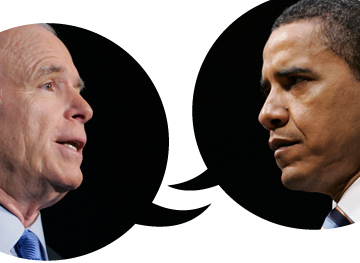

The key moments of every presidential campaign are, in order, the selection of the vice-presidential candidates, followed by the national party conventions, and then, finally, the four televised presidential and vice-presidential debates. Over the next three weeks, the Commission on Presidential Debates had scheduled three debates between John McCain and Barack Obama and one encounter between their running mates, Sarah Palin and Joe Biden. With John McCain’s decision on Wednesday to “suspend” his campaign, the first debate, scheduled for Friday night in Oxford, Miss., may not occur. As of press time, Barack Obama was still planning to show up, but if he does, he may have the stage to himself. Should there be no debate in Oxford, the first face-off between McCain and Obama will take place on Oct. 7 in Nashville.
The task for any presidential candidate in a debate is to exceed expectations, meaning both the expectations of the media and the public and the expectations carefully calibrated by the competing campaigns. We asked three experts, one journalist and two veteran political operatives, what Obama and McCain will have to do in the upcoming debates in order to be perceived as winners. All of them have firsthand experience prepping presidential candidates for debates.
Mark Fabiani is co-principal of the consulting firm Fabiani-Lehane. A former collegiate champion debater, Fabiani was the deputy campaign manager for communications and strategy on Al Gore’s 2000 presidential campaign, and before that served as special counsel to President Bill Clinton during the 1996 presidential campaign. Jim Fallows is National Correspondent for the Atlantic Monthly, a former speechwriter for Jimmy Carter, and a past winner of the American Book Award for nonfiction. He is completing a new book about China, due in early 2009, titled “Postcards From Tomorrow Square.” Russ Schriefer, a founding partner in the Stevens & Schriefer Group, has been a Republican political strategist and media consultant for more than 20 years, helping elect governors, senators and dozens of members of Congress. In addition, Russ has worked at the national level for four presidential campaigns, including the Bush-Cheney campaigns of 2000 and 2004. Salon spoke with Fabiani, Fallows and Schriefer by phone.
Schaller: Gentlemen, welcome to you all and thanks for being here. So let’s get right down to it. With John McCain and Barack Obama going through their final paces, my first question is very straightforward: How much of the debate prep is really about issue briefing and preparing answers for all possible questions, and how much of it is really coaching candidates on intangibles, like their stage presence and delivery, the use of comedy, nonverbals, and just in general dealing with their opponent? Let’s start with Jim Fallows.
Jim Fallows: My personal background here: I was a minor participant in the actual preparation for Jimmy Carter way back in the prehistoric era when he was going against Gerald Ford and I have been observing things since then. I think that preparation on the facts is a necessary but not sufficient part of debate. Three of the four candidates who are going to be in these debates, the ones other than Gov. Palin, have answered questions multiple times and should know enough about what to say on the country of Colombia or what to say about Pakistan or whatever. What tends to matter in debates is all the things other than rote factual knowledge — how you hold up against the opponent, whether you sound witty or defensive or whatever. In Gov. Palin’s case it’s different because that is her area of perceived vulnerability. I bet she is boning up on the facts, while I think the rest of them probably should just be figuring out how they can carry themselves correctly onstage.
Mark Fabiani: The debate prep that I’ve been involved in was during the Gore 2000 presidential campaign. And perhaps we spent too much time on issues and not enough on the intangibles, because people look at these and don’t judge them as Harvard-Yale debates. They look at them and they’re trying to connect with a candidate. And a candidate could have a moment that’s a good moment, such as we’ve seen in some of the primary debates, or they could have a bad moment, where Michael Dukakis mis-answers the question about his wife being raped or George Bush looked at his watch, or in the instance that I was involved in, when Al Gore was sighing into a mike that was supposed to be turned off but wasn’t. And those are the type of things that will tell the tale of these debates, not how much someone knows about Colombia or Pakistan.
Russ Schriefer: I agree with both Jim and Mark. I would also add that I think the most important thing is to decide early on what your debate strategy is going to be. What do you want to accomplish with this debate? Do you need to prove that you know more than your opponent on issues? Do you need to make a central point on messaging? I imagine going into the first debate, particularly since it’s about foreign policy and foreign affairs, that John McCain is going to want to play up his role or how he is perceived as being better as commander in chief than Barack Obama. So I think a lot of time, particularly in this first debate for both these candidates, will be devising overall debate strategy. What do they want to accomplish and what do they see as the headlines coming out of this debates?
Fallows: If I could just follow up on that. As you look back through all the big presidential debates there’s only been one where actual factual knowledge seemed to make a difference in the debate outcome. That’s one, actually, that I was involved in, when Gerald Ford misclassified Poland and that connected to some perception of him. And that’s why the factual knowledge question matters only for Gov. Palin where that’s the perception about her.
Schaller: I was curious about the debate prep, just how it operates. We now know that Greg Craig, who has done this in the past — he’s on old counselor and advisor to Obama — is standing in as McCain in Obama’s debate prep. And former Maryland Lt. Gov. Michael Steele is standing in as Obama against McCain. Is this person an important choice? Is this important as a function, as a sparring partner or does it not really matter?
Fabiani: I think it’s important but it’s not all that important when you compare it to some of the other things that candidates have to get ready for. It’s important to re-create the atmosphere of the debate. It’s important to re-create things in real time, to practice, for example, at the time in the evening when the debate is actually going to happen. But far more important than that is avoiding mistakes and trying to figure out the one moment you want to create for yourself and the one bad moment you want to create for the other side.
Fallows: I think Greg Craig is a very wise choice for Obama to have because he is very good at this. I actually have known him and seen him as an orator for a very long time, starting in college, and he knows how to produce the effect which will probably be the most difficult for Obama, mainly, the needling and the dismissiveness that McCain will probably try to use against Obama. So Greg Craig will be good in that way. It sounds silly to say that John McCain needs to find a black person to be Obama’s surrogate, but I think that’s actually wise because every bit of the intangibles in the real debate you want to re-create in debate preparation and it’s a significant fact that since there’s a young black man who is going to be John McCain’s opponent on the real stage, it’s important to have a youngish black man there in the practice.
Schriefer: I think someone who is very good at studying up and understanding and getting into the head of the person they’re playing can actually be very, very helpful. And I know that particularly Judd Greg and Rob Portman, who filled these roles for the Bush campaign in 2000 and 2004, were very good at doing that and really kind of understanding what they were going to do, studying the tapes, and not just talking about the policy positions but, as Jim said, getting their gestures and their sense of who they are.
Schaller: Mark said you have to create a moment for yourself and also a negative moment for your opponent. But these debates are so constraining, they’re so restrictive in terms of the rules, you don’t really get to ask a lot of questions or do follow-ups, it’s all moderated by these moderators. So I’m wondering how — these negative moments that have happened, are these contrived or did they just sort of happen? How can you entice your opponent?
Fabiani: When you go into the debate, you know what people are going to be looking at from you. For Obama, for example, people are going to look and see if he’s all speech and no substance. That’s clearly what the McCain people are going to drive as the negative on him. And with McCain, people are going to be looking to see if he’s old and out of touch or whether he can hang in there in a debate like this, and that’s the image that the Obama people are going to be driving against McCain. And everything that happens is going to be fed into one of those two story lines. Clearly the notion of Gore in 2000 that the Bush people were proposing was that Gore was an exaggerator. That’s how everything was seen during the first debate. In fact, the issue after the debate was whether Gore had exaggerated about visiting the wildfires in Texas. Which, in the scheme of things, seems like a very minor issue, but that was the issue that the Bush campaign created because it fit into a preexisting criticism they had of Gore.
Fallows: There’s kind of a reverse version of that too. Which is that in every debate I’ve seen, each side has tried to play the expectation game because they know that’s going to be the first thing out of the commentators’ mouths once the debate is over. How did the person do relative to the expectations? And George Bush very skillfully did that in the last two debates against Gore and Kerry. I think one of President Bush’s associates before the 2004 debates said that Kerry was sort of like the reincarnation of Cicero and there was no way that Bush could hold up. So if Bush could hold his own and not make any mistakes in those debates, he effectively won. Weirdly, both Obama and McCain come into the debates with some perceived weakness. For Obama, being seen as too professorial and too rambling in his answers and not getting to the point and not really having bested Hillary Clinton in the primary debates. For McCain, it’s being seen as at his best in other settings, in the avuncular town hall. I think they each have been subtly trying to play that expectations game so if they do better or can flummox the other, then they win on that standard.
Schriefer: I would just add to that that the interesting thing about the first debate being about foreign policy is that Sen. Obama really has an opportunity to sort of go one-on-one for the first time with Sen. McCain on the issue of commander in chief. And if he is successful and able to portray himself as not only knowing what the issues are but also knowing the importance of the role of the troops and being comfortable talking about troop levels and deployments. I think those will go a long way to helping him at the end of the day.
Fallows: In that sense, if Obama ties in the first debate, he in effect wins because this is the area of McCain’s perceived greatest strength going in.
Schaller: In terms of trying to goad the other candidate, do candidates prepare these little one-liners and jabs or do they try in some way to get the goat of their opponent by maybe going after them with a slight or attacking their credibility? What kind of training or prepping is done on having a prepackaged line for something like that?
Schriefer: I think there’s both. You have prepackaged lines and you have some you kind of think through strategically — if he says this then this is a good retort to that comment. The famous one is from the ’84 debate, with Reagan and age …
Fallows: I won’t make an issue of my opponent’s immaturity …
Schriefer: Yeah, youth and inexperience, which seemed, and legend has it, was totally spontaneous. But I have a feeling that may have been practiced once or twice before. My sense is that you go in with both. Now the interesting thing is that there are some things you can’t practice. And I go back to the 2000 debate between Bush and Gore when Gore started encroaching upon Bush’s space and Bush gave him this sort of look, which was not something that was practiced but wound up being incredibly effective.
Fallows: I would argue too that Obama’s most effective lines during the primaries seemed not to have been practiced. Also, his very, very effective debate performance against Alan Keyes in 2004 where he was quite witty and quick. And, for example, when he told Hillary Clinton, “Well, I’m looking forward to having you advise me also.” That couldn’t have been planned. And John McCain’s most effective quick line in the primaries when he was talking about Woodstock, he said, “I wasn’t there, I was tied up at the time.” That could well have been practiced, but there is always this premium on how these people behave in real time, which is why people watch these debates.
Fabiani: One of the habits McCain needs to avoid is after he does a line like that, whether it’s the Woodstock line or in one of the earlier debates he talked about following [bin Laden] to the gates of hell, he tends to smile afterwards, which sort of lets you in on the joke. That, yeah, I knew I was going to say this.
Schaller: Given the restricted debate format, the moderators have an inordinate amount of power. They aren’t just timekeeping and refereeing and making sure that the proper turn is taken. So Jim Lehrer, Tom Brokaw, Bob Schieffer, who are the presidential moderators, and then Gwen Ifill, who is the moderator for the lone vice-presidential debate — do the candidates and the campaigns prep for the moderators or is that irrelevant?
Fabiani: The moderator can have a huge impact sometimes. Sometimes they’re neutral, but Bernard Shaw in 1988 asked Michael Dukakis, the very first question, “What would you do if your wife was raped, what would your feeling be about the death penalty?” That ended the Dukakis campaign for all intents and purposes right then and there with one question. And so you always have to evaluate when you get a question like that, which moderator is more likely to ask it, what kinds of things are they likely to ask, so you do your research on the moderators to figure out where they might have been coming from during past debates, how they’ve handled these issues before, because a question like that, if you mishandle it, could be absolutely devastating.
Schriefer: I totally agree. In fact, we would go so far as finding people to play the moderator, and ask them to study the moderator, their habits, their gestures, their line of questioning, to make sure that if it’s a moderator who’s known for going off script that you tend to go off script and make sure that your candidate is prepared for any curve balls that not only your opponent may be throwing at you, but sometimes the moderator might throw at you.
Schaller: Let me rephrase this question for Jim. You’ve watched so many of these debates; is there a model of a good moderator in your mind, given the rules, and is there somebody who really violated the trust of the moderator role?
Fallows: I think there’s a reason that Jim Lehrer keeps getting this job year after year. Which is what you want in a general election debate moderator is somebody who makes the debate not about himself or herself. Aside from the Michael Dukakis question, there are really few trick questions that the candidates can face because they’ve heard so many things. They want somebody who will set up these debates to be able to engage each other as much as possible. The moderators will be paradoxically more important this time because both Obama and McCain in this debate are going to have more time for repartee and coming back at each other, so the moderator will have more discretion about when they’ve gone too far or not. One point here, the time when that mattered most historically was in the 1984 debate when Ronald Reagan was beginning to meander at the end of one of the debates against Mondale and Edwin Newman saved him by cutting off one of his meandering answers and getting back on course. I think you basically wouldn’t want the cable news moderators who did the primary debates to do the general election debates because they largely made [the primary debates] shows about themselves.
Schaller: I was wondering too, in terms of the debate format, forgetting the moderators, is this whole idea of this thing with the podium style versus the town hall where you sort of come out from behind the podium. Obviously, the most famous moment here is Clinton in 1992. It was a perfect setup for him; it showed how he was conversant literally with voters on a very regular-guy basis. Obama and McCain are two candidates who are generally regarded as not necessarily the best debaters, but are very good in informal settings. I’m wondering if either candidate has an advantage in the more informal-style debate?
Fallows: I think an advantage for McCain in the town hall style is what we saw with Pastor Rick Warren. And essentially that was town halls generally equate to no follow-up or less follow-up than you have in a more structured debate. So a candidate can get by with more of a slogan than is possible when your opponent is going to have a 30-second rebuttal or the questioner is going to say, “Oh, what do you mean by that?” So I think that has been a plus for McCain. I think Obama has been playing possum in a shrewd way, in the last month or two, in sort of saying, I’m not really that good at these debates. And I think he has been hardened and toughened by them over the last year, probably in a way McCain hasn’t. So he may show some deceptive strength that he’s downplaying now.
Schriefer: Conventional wisdom will be that the more relaxed format will benefit Sen. McCain. I get the sense that if I were in the Obama camp, I would be practicing in a way that makes him comfortable [with the format]. It’s sort of like in this first debate where the expectations are on McCain to do better. If Obama at least ties, it’ll be seen as a win for him.
Fabiani: And there’s another format here that’s going to make a difference for the first time ever and that’s how many people will be watching these debates in high definition and how the two candidates will look compared to one another. How much vigor one candidate will have versus another. And these debates, it’s not like running a marathon, but they are physically grueling. You have got to concentrate every single split second you’re up there and we’ve seen candidates who have kind of lost it. George Bush Sr. looked at his watch and that was effectively the end of his campaign.
Schaller: I’ve seen McCain up close and I find that he looks younger and crisper on TV than he actually does in person. Of course, we all know about the scars on the face and his inability to raise his arm, so are you suggesting that in high-definition TV, the age factor will literally be in higher relief?
Fabiani: I think there’s no question it will be in higher relief and it’ll be interesting to see how that plays itself out. It’s never happened before and when you just have the two guys standing right next to each other it’s going to be a pretty stark contrast. Now the question is how can McCain combat that? That’s what people are going to be looking for in these debates. Can he really hang in there for the whole 90 minutes and show himself to be vigorous and with it on all these different issues? That’s what people are going to be looking to see. And maybe he’ll do a great job of it.
Fallows: There are some parallels we can link to this in obviously the pre-hi-def TV age. One, of course, would be John Kennedy and Richard Nixon, where retrospectively most people assert that the simple difference in physical bearing between the two of them, one a movie star, one the much more experienced but 5 o’clock shadow guy, had an effect. Another, of course, would be President Clinton in his two debates, both in ’92 against the elder George Bush and in ’96 against Bob Dole. There was something about the young, vigorous man filling the screen. So I think figuring out how to deal with that is probably part of the McCain camp’s debate prep — or it should be.
Schaller: There’s only one vice-presidential debate. Sarah Palin, Joe Biden with Gwen Ifill of PBS moderating. What’s the conventional wisdom? Does it ultimately not matter if there’s a huge gap between the candidates? What can we look for from this debate?
Fallows: Generally, they don’t matter. And if you look back on different ones over time you can say that Joe Lieberman, who was running with Al Gore, essentially laid down and played dead for Dick Cheney in the 2000 vice-presidential debate — at least, in my opinion.
I think this one has an obvious plotline. This one probably will matter more than most and has an obvious plotline on each side. For Sarah Palin, the plotline is don’t make a mistake. I’m sure she is now preparing as well as she can to avoid moments like the Charlie Gibson interview moment where she seemed not to know what the question was about. [She needs to] talk about things like she really knows them as opposed to having just read them in the last month or two. For Joe Biden, the corresponding challenge is to not seem like a bully. To come across, given the dynamics of a very appealing young female candidate and an older experienced white male candidate, and establish the point about his experience without crossing the Rick Lazio line, where Rick Lazio seemed like a bully against Hillary Clinton. So each of them has so clear a path, it’s like a football Super Bowl game where there’s a great passing team against a great ground game team. You know what each of them has to do and we’ll see which one can do it better.
Fabiani: Everything that people say about that debate, before that debate, during that debate, after that debate, will have something to do with those two story lines. You just have to recognize that going in and be prepared to capitalize on something that somebody does on one of those story lines that’s a mistake. If you can do that, that also drives the post-debate coverage. Because remember, a lot of people watch these debates, but a lot of people don’t. And what they hear about them afterward makes a difference to the people who don’t watch. How you’re able to drive your story line afterward is almost as important as the debate itself.
Schriefer: I think it’s whether [Sarah Palin] makes a big mistake. I think the voters who will be voting for McCain-Palin or considering voting for McCain-Palin will actually be much more forgiving of her making a small mistake. I do not envy the position that Biden is in because I think his tendency will be to run over her and talk over her. It’s sort of what he does, what he wants to do, and I think the chances of her over-performing at the end of the debate, particularly among the voters whom the McCain-Palin team are trying to get, some of those swing voters, there’s a very strong possibility that she could actually come out of that debate even better than she is today.
Schaller: I was looking at the data taken from polls at the beginning of the debate season and at the end of the debate season, tabulated by Steven Wayne on his book on presidential elections. John Kerry says he beat the president in three debates in 2004. We could argue about that, but he did very well — and yet basically his poll numbers were the same at the end of the debate period as before. Bill Clinton’s poll numbers were about the same or even a little lower in 1992. I’m wondering, do we put too much emphasis on this? Is this like the people who are liberals read liberal magazines and conservatives go to conservative blogs? Do people hear what they want to hear out of these debates and it doesn’t really move the presidential election numbers that much?
Fallows: I’m sure that is so in this sense. Number one, presidential elections when they’re close are overdetermined. Any number of a thousand things had they gone differently could have made a difference. Think of the 2000 election. Any of us could spend the next five hours saying, well, if this had been different or that had been different the result would have been different in 2000. Therefore this is something we’re all capable of judging just on our own as laypeople and saying that’s the difference. But I would argue also, that even if it doesn’t show up in the numbers, it is one of the important emotional events because, again, it’s the only time we see these people head-to-head and we either are confirmed in what we think about them or we’re repelled in what we think about them or we’re cast into doubt. You know, the first George Bush, he was going past the time and he looked at his watch. When is this going to be over? Ronald Reagan had a kind of easy charm that he showed against Jimmy Carter. Bob Dole in his ’76 incarnation had a kind of nastiness, et cetera. I would argue that’s the effect — they solidify or crystallize something that was latently there in the voters’ mind.
Fabiani: The other thing that they do is basically consume the campaign from this point forward until the last couple of weeks. And that was to Gore’s detriment in 2000. At this point in the 2000 campaign, we were doing very well. We were ahead in the polls, we had had a great September, we went into the first debate and we were very hopeful about that. But from the first debate on, the campaign gets consumed by the debates. You’re either preparing for a debate, debating or dealing with the follow-up of the debate which leads directly into preparing for the next debate. And so, it just consumes everything from here on out and that’s why they’re so important.
Schriefer: I was interested to see how the two camps seem to be preparing for this debate. Sen. Obama has basically sequestered himself in Florida for the next couple of days to practice and to get ready, whereas McCain seems to be taking big chunks out of the day but continuing a campaign schedule. I don’t know if one is going to be better than the other, and they’re probably more stylistic for each, but you’re absolutely right, in having been involved in these, at several levels, they are just a big time suck for both campaigns.
Fabiani: In 2000, we actually viewed the debate prep as a campaign event in and of itself. We spent a lot of time in Florida prior to the debates because we thought, as it turned out correctly, that that was the key state. We still kick ourselves, though; we were trying to find a place to hold debate prep in New Hampshire because we thought that New Hampshire would be a key state and we thought that doing one of the debate preps in New Hampshire would really help us there and we just couldn’t find a place that was large enough to host all the press. And so we couldn’t go there. Had we gone there and had three or four days of debate prep up in New Hampshire, we probably would have won that state and Gore would have been president. So it’s all part of the campaign. You can make your debate prep part of the campaign and McCain’s really trying to do that by continuing with his schedule while doing his debate prep, while Obama seems to be, as you said, somewhat sequestered.
Schaller: A pair of concluding questions — advice for the candidates. We’ll do Obama first. I would ask each of you to go through and give advice if you were to be giving advice to the candidates. Dos and don’ts for Obama.
Fabiani: It’s not rocket science. He needs to connect with people. He needs to not give long answers. He needs to not seem professorial. He needs to seem like he understands the problems people have and he’s talking directly to them about how he’s going to solve those problems in specific terms.
Schriefer: I think it’s being warm and presidential and not being cold and arrogant.
Fallows: Yes, “relaxed” would be my term. There was one time when he was superbly relaxed and at ease and that was against Alan Keyes. If somehow he could see Alan Keyes, imagine himself in that setting again, which is impossible, but sort of train himself to be as relaxed and charming as he was then, that would be my tip.
Schaller: How about John McCain?
Schriefer: I’m just going to talk about it for the first debate, which is a foreign policy debate. I think his No. 1 role is to remind folks that he is the person they believe is best able to be commander in chief. And the more that he can do that and play that card, the better he’ll do in the debate.
Fabiani: Absolutely right. He has a chance in this first debate because it’s a foreign policy debate to convince people that they should trust him instead of his opponent. He’s got to do that in a way that makes him seem vigorous and seem able to handle things and do it in a way that’s engaging to people. It’s going to be a tough job, but I think it’s a break for him that this is a foreign policy debate and he should do well there.
Fallows: In addition to those points, which I agree with, as a temperamental matter, debates are a cool medium as opposed to a hot medium. It’s a personal audience, not like a speech in a huge stadium. McCain, while remaining cool and comfortable and friendly seeming, can find ways to stick little harpoons and cool jabs at Obama because Obama has not always responded well to those in past debates. So I think McCain wants to seem affable and himself and stick some barbs to Obama and see what he can produce.
Schaller: It should be another fascinating debating season. I want to thank Mark Fabiani, Jim Fallows and Russ Schriefer for joining us.
