
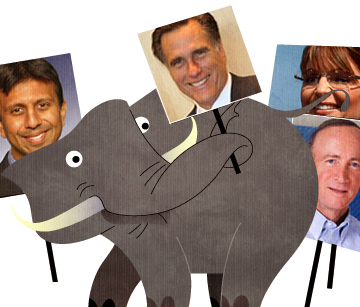

The Republican Party is now licking the wounds from its second consecutive electoral “thumpin’,” to use the outgoing president’s memorable morning-after phrase from November 2006. Just three years ago, the GOP controlled the presidency, the House and the Senate; come January Democrats will control the White House and both chambers of Congress for the first time since 1993. The Republican brand is in tatters. Can it be saved?
Salon asked three experts with a vested interest in the future of the party, two Republican strategists and one conservative intellectual, for their take on where the GOP goes from here. Alex Castellanos, Ron Christie and Reihan Salam offered their thoughts about whether the Republican Party’s core principles remain intact, whether Reaganism applies to the 21st century, and who the front-runners might be for the GOP’s 2012 presidential nomination.
Castellanos has been a media consultant to seven presidential campaigns, and was an in-studio analyst on CNN throughout the 2008 election cycle. This cycle he volunteered as an advisor to John McCain’s campaign after serving as senior strategist for Mitt Romney. Christie, founder and president of Christie Strategies, is a veteran senior advisor to Republicans in both the White House and Congress, an adjunct professor at George Washington University’s Graduate School of Political Management, and author of the book “Black in the White House” about his stint as an aide to George W. Bush. Salam, who blogs at the American Scene, is an associate editor at the Atlantic. He was previously a junior editor at the New York Times and a research associate at the Council on Foreign Relations. He is the co-author of “Grand New Party: How Conservatives Can Win the Working Class and Save the American Dream.” Salon contributing writer Tom Schaller spoke to them by phone.
Salon: Let’s start out by trying to find some historical context. Is there an analogue for where the Republican Party finds itself as of last week? Is it something like the post-LBJ ’64 landslide or after the Watergate ’74 elections or maybe just 1993 with Clinton and the Democrats controlling the White House and the Congress? Or is it none of these?
Alex Castellanos: I think there are some parallels to all of them. Certainly some parallels to the Watergate election in the sense that we have a fairly discredited Republican Party. But the difference, of course, is that technically we still knew what a Republican was or should be in those days and I’m not so sure we do now. I think this is most like the Clinton era in the sense that we’re still there. Once Bill Clinton declared that the era of big government is over, he moved Democrats, certainly new Democrats, toward the center. And Republicans at that point were left wandering in the desert, unable to draw clear distinctions with the Democrats. I think today, we’re in a little bit of the same situation. It’s hard for a Republican to tell you what a Republican is.
Ron Christie: I pretty much agree with Alex. Having worked on Capitol Hill right when Clinton came into office, and having worked in the minority, I can tell you that while the Republicans were dispirited, certainly after the Clinton election, the Republicans at that juncture had more of a sense of purpose of we understand we’re for limited government. We [wrote] a document which later became the Contract With America that formulated our conservative principles and values. Right now, I see the Republican Party, candidly, as being just the inverse of that. It doesn’t seem that we have any party platform, any coherent strategy right now other than that we’re not the Democrats. At least in 1992, the Republicans had a sense of purpose. Now the Republican Party is sitting around asking the question, “How do we move on from here and who are the leaders to get us there?”
Reihan Salam: The composition of the electorate right now is so different in the United States than it was in any of those periods, including 1992, that it’s very hard for me to see a very good analogue. We’re also living in a country that for a lot of very structural reasons is going to be more inclined to consume government services, and I think there is a real danger there for the conservative movement. If you look at conservative parties in Britain and Sweden where you have much larger public-sector workforces, they are far to the left of our conservative party, the Republican Party. And I do wonder if we have the right strategies for this environment — whether we’re going to be able to fight back against the ratchet effect of creating a much bigger government that is going to increase dependency. And I don’t mean to say that in any sort of polemical way. I think the center left wants to increase the federal government for reasons that are very admirable in a lot of ways. But when you look at 1996, Bill Clinton’s reelection, he won on a platform of “M 2, E 2” — Medicare, Medicaid, education and the environment. These are enduringly popular institutions. The same Americans who characterize themselves as believers in small government also wanted to increase the size and the influence and reach of the federal government in all of those areas.
It’s very thorny. I think for a Republican Party that is firmly committed to, for example, citing pork-barrel spending to fight waste and inefficiency in government, you have a hard time finding a better candidate than John McCain, who in each one of his presidential debates talked about 10 minutes about those issues. In the final phase of the campaign, he made a really, really strong case against redistribution and what some in the campaign referred to as socialism, somewhat idiosyncratically in my view. So it’s not obvious to me that that’s going to be the way forward for the party. I think that 1974 looks like a decent analogue, in part because you saw the Republicans coming back in six years because there was a stirring within the party. You saw people who in the supply-side movement were creating a non-zero sum ideological answer that was responding to the particular challenges and conditions of that period — the period of stagflation and the end of crude Keynesian economics. I think that hopefully this period that is starting in 2008 will be like the period between 1974 and 1980, a period of ideological rethinking, and that it’s responsive to the actual conditions of the country.
Salon: I want to get a sense of the magnitude of the problem here. Alex, you wrote in the Washington Post just last week that a lot of what happened on Election Day was the economic meltdown. You said, “Let’s not be Chicken Little.” On the same day and in the same paper, Republican strategist Ed Rogers said, “Let’s understand the legitimacy of the party defeat.” How bad are things?
Christie: I think people are overreacting in the short term, given that the sting of the electoral defeat is still very much in the forefront of our minds. But I don’t think the solution is that difficult. The solution that is going to get us back on track to be the majority party is the same solution that Ronald Reagan rode into power after losing in ’76 and gaining elective office in 1980. The Republican Party has been and needs to be the party of limited government, strong fiscal policy and strong national defense and homeland security. Unfortunately, over the past 10 years or so, the Republicans have lost their way when it comes to fiscal responsibility. When you look to distinguish between what it means to be a Republican and what it means to be a Democrat, the last several years, the Republicans haven’t vetoed onerous spending measures, the Republicans have acquiesced to some of the big expansions of the federal government that we’ve seen. Our way out of the wilderness is to go back to where we were with Ronald Reagan and the principles that he stood for and to reenact those very winning strategies and those platforms.
The Republican Party, in order to grow and in order to thrive, also has to continue to reach out to a diverse group of constituencies. I’m talking African-Americans, Hispanic Americans, women, a broad coalition across the country. It’s no longer the party of white evangelicals and those who would like to perceive the Republican Party that way. We must make significant inroads with individuals of color and others.
Salon: Reihan, I gather you agree with what Ron just said, but I’m curious if you think Alex is right, that it’s not as bad as people think.
Salam: I actually disagree a little bit with Ron. And obviously, I should be very humbled because Ron is one of those folks within the Bush White House who did a lot of good pushing certain key policy objectives. So I’m a great admirer, but I also think that when you’re looking at what Ronald Reagan did early in his presidency, he looked at a problem that was a real obstacle for the working- and middle-class voters in this country, and that was the federal tax burden. At the time, a median family of four was paying 11 percent of its earnings in federal income taxes. Right now, that number is about 5.6 percent. The same family that would have worried about their federal income in 1980 is now worried about their health-insurance premiums. Yes, the Reagan approach was very attractive and very sound in a lot of ways, but I think it was a particular response to the obstacles those families faced then, the obstacles to their upward mobility. Whereas now I think the obstacles are a more diffuse tangle that reflect what are potentially structural barriers to upward mobility.
Republicans need to talk about those issues. Republicans feel most comfortable talking about taxes and national security. And they’re always going to feel most comfortable talking about those issues. Those are areas where there are tried and true Republican solutions. But voters are talking about a different set of concerns — healthcare, education, jobs. George W. Bush in 2000 did a very good job of talking about those things, but Republicans since then found that that was a tough road to hoe. It was very tough with a lot of their core constituencies. And so they neglected those issues to some extent. Mitt Romney, by the way, did not. In the Michigan primary, he did an extraordinary job of really connecting with a lot of blue-collar Republicans. So there are signs of hope. But I think this is a very bad sign, in part because I think the problems started not in 2008 but in 1998. I think the win in 2000 was an accidental win. I think 2004 was about national security, about a very unusual landscape. I think the Republican Party was given a new lease on life, an opportunity to reframe its domestic policy vision. But it was very hard to do with two wars going on. I think the problem runs fairly deep.
Salon: Alex, let’s bring it back to you. With respect to Ron and Reihan, you’ve been around a little longer. So explain to us why you counsel caution with the people who are running around with their heads cut off right now.
Castellanos: I certainly have more gray hair. I don’t know if that means that I’m any smarter. Let me recharacterize what I wrote in the Post. There was some good news this election and that is, it takes a lot to elect a Democratic president in this country. How much worse can it get? To elect a Democratic president, you have to have an unpopular Republican brand, you have to have an unpopular Republican administration, you have to have gas that’s hit five bucks a gallon, you have to have a housing bubble pop. And then that’s still not enough, then you have to have an economic meltdown. McCain was tied coming out of the convention until the economy melted down. And that’s still not enough. Then you have to have a Democratic candidate who moves toward the center and proposes tax cuts for 95 percent of Americans, who says oil drilling might be OK, who says that what the unpopular president is doing in foreign policy and defense is terrible but he’s going to keep the same people. The secretary of defense, General Petraeus. Even Bush’s policy of preemption in Iran. Barack Obama said he would do anything, anything, anything to keep Iran from getting nuclear weapons.
That’s the good news. [But I also said that] if we took refuge in [how hard it is to] elect a Democratic president, it would be false comfort. Because we still don’t know where the Republican Party is going. And I don’t think our problems are ideological. I think America is still a center-right country and that’s why Republicans frankly hung in there. Look, the president is a daddy-bear job. He’s the guy who’s supposed to lock the door at night, bring in the paycheck for the country; he’s the head of the American political household. That’s why Republicans have done well electing presidents and why Democrats have done well electing the mommy bear to Congress and to the redistributing job. Redistributing public money to help people. Our problem is generational. And by that I mean, and I think Reihan hit it on the head, it’s a very different country. What used to be this silent majority is now the silent minority and the old Republican appeals are not enough.
Salon: I get the sense that there’s no worry here among this audience, among you three participants, about the core principles of the Republican Party, which are national defense and small government and so forth. Where is the problem? Does there need to be any rethinking of core principles?
Salam: With regards to what I call Bush’s accidental victory, I just want to stress, I think that Bush did a great deal of intellectual spade work in that race and he was trying to demonstrate that Republicans can talk about education, we can talk about how transparency and accountability can make a difference. Another thing he did was he took a lot of what happened at the level of state and local government, where pragmatic Republicans were really trying to improve the quality of government, improve the quality of public service, deliver more value for the money, and he kind of offered this possibility of being a domestic president who would be the capstone of that. Who would actually help enable a flourishing decentralized state. And I think for a lot of reasons that was very hard to accomplish once President Bush was in the White House. I think that vision is very attractive. But it’s going to take a long time to repair the brand and get back to that point.
Christie: I definitely think the Bush domestic agenda, despite the ridicule and some of the commentary that you see in the media of late, does provide a model for us moving forward. If you look back at that heyday in the mid-1990s, the Republican Party wanted to abolish the Department of Education, the Department of Energy and several other entities. I think what President Bush showed us is that there is a legitimately strong role that the federal government can play that also allows the states the innovation and the ingenuity to use federal money within certain guidelines to adapt to their constituencies. I also think that two initiatives that I was honored to be a part of were a step in this direction. The first, the faith-based and community initiatives, that’s an idea that the president, when he wanted to unleash the armies of compassion, said that we need to allow those innovators, those individuals at the local level who best understand the needs of their constituents, to receive federal assistance without being penalized due to their religious affiliation. Sort of unleashing the armies of compassion, if you will. And the second was the USA Freedom Corps, created in the wake of 9/11, that sought to have all Americans give back to their country, recognizing that the federal government could serve as a clearinghouse for opportunities, but those opportunities to serve would be best cultivated and created at the local level.
And I give one more example with No Child Left Behind, which is so often criticized. If we move our children through elementary school and high school without having any sense of how they are testing, how the schools within a particular school district are stacking up to similar districts in the state and around the country, if we don’t have a measuring stick upon which we can make some sort of judgment that our federal dollars are being spent responsibly, we’ll continue to throw money down the sink, similar to what we did with the Great Society. Again, Republicans have to stress accountability and fiscal responsibility, but we can also devolve some of that power to the state to let them create those programs that best address the needs of their constituents.
Castellanos: I don’t want to jump on board entirely with Ron here; as much as I respect the thoughts, I think I disagree that that’s what the Bush administration did. I think the Bush administration, in most of those cases just cited, became big government Republicans. And big government was OK as long as we were running it. And I don’t think that at the end, covering that with the salve of responsibility or by saying that if we had just been a little smarter and delivered results upfront, it would have been better. That, hey, we’re going to teach the elephant to dance just a little better than the Democrats did. And no, I’m not talking about that at all. I’m saying, with education, if we actually believe in our Republican principles, what we should have done was not try to create a more efficient state or a more accountable state, but an organic conservative state. Now I think, why spend the money there to start with, when what we actually believe is that we should create an incentive-based system, not a regulated system that holds people accountable, but a system that creates incentives for people to create a better educational system in America. I think the words of the environmental movement actually describe where the Republican Party, the conservative movement, should be going and that is, we’re not the party of top-down industrial control. We’re the party of a more natural, organic bottom-up way of doing things, and that means the money and power should evolve out of Washington.
Salon: Let’s move from philosophical arguments and policy discussions to more practical matters about the party and its actual operations. I mean Mike Duncan no disrespect, but he’s seemed sort of invisible as the RNC chair. He’s not a Lee Atwater or a Ken Melhman. There was a recent story in the Washington Times that indicated that former Speaker of the House Newt Gingrich and Michael Steele, the former lieutenant governor of Maryland, might be vying for that position. [Ed.: Gingrich has since announced that he is not interested in the post.] I’m wondering if a good knock-down, drag-out fight for RNC chair is a good thing and I’m wondering if you guys can give us any inside baseball on who you think will run and could be that next chair.
Christie: I think anyone who could give you inside baseball is probably going to be reluctant to do it. As someone who doesn’t have any —
Castellanos: I nominate Ron and Reihan.
Salam: I think that it’s terrific to have a real argument about how the party should be structured and where it should go in the future. When you look at what happened to the Democratic Party, you saw a bunch of disaffected Democrats who felt like the Democrats in Washington were self-marginalizing, were weak and vacillating and were not doing an adequate job of standing up for Democratic principles. And they energized the party, they poured resources into the party and they helped remake the party. And I think that Republicans, there are a lot of Republicans who just feel that they don’t have ownership of the party. They feel really disconnected. And I think that having an RNC chair who really is an electrifying figure and can engage people, and having an RNC chair who’s going to reach out to areas, as I think Michael Steele would, that are not monolithically Republican, outside of the South and outside of that narrow corridor of the interior West, I think would be very, very good for the party. Because the Republican Party needs to be a 50-state party. A lot of people who say this, say that the party needs to abandon its cultural conservatism or at least soften that part of its message. But you know Ronald Reagan won 49 states as a pro-life candidate. I think that’s important to keep in mind. I think the party can be broadly culturally conservative, but can also position itself as the party of local democracy and really rebuild in the Northeast, on the West Coast. I think that if the party doesn’t do that, the party is in danger. Look at North Carolina, for example, an area like Wake County. Wake County is today where Fairfax County, Va., was 10 or 15 years ago. A lot of these areas, these sprawling, diverse big cities — Sarah Palin talked about how the real America is small-town America, but, of course, huge numbers of Americans like myself hail from those big metropolitan areas. And I think that the America of 10 or 15 years from now is going to look a lot more like those parts of the country. So I think you need someone who is going to reengage those parts of the country. And I’m very excited to see what’s going to happen next.
Christie: I think any time you have a vigorous and robust competition, that’s good for all involved. I don’t have any negative things to say about chairman Duncan, other than that I wish that the head of the Republican National Committee had been more prominent and had played a more active role in the past election cycle. That being said, I think this is a great opportunity for us to reflect on what has gone wrong in the last election cycle and certainly what’s gone on in the last couple cycles in the congressional elections. I am hopeful that Michael Steele will run; he’s a good friend of mine and I think someone who would energize the party. I’ve heard rumors that Gov. Huckabee might be entertaining such a notion as well. I say that we bring as many prominent, powerful voices to the table as possible and let them state their case and let them articulate their vision and then let’s have that vote and then move forward. So, I think there’s only good that can come out of a vigorous challenge to see who’s going to be the next titular head of the Republican Party.
Salon: Who’s it going to be, Alex? Tell us. I know you know.
Castellanos: I wish I did. I wish I did. No, I think that our challenge is generational. I think this is like we’re writing a great movie except we don’t have a leading man or a script. But other than that —
Salon: That sounds like a terrible movie.
Castellanos: Yeah, exactly. So, yeah, I think as long as we don’t go backward, as long as we don’t think that we find the answer in Reagan era conservatism.
Salon: In the discussion of new blood and a new generation, I would be remiss if I did not ask about a certain Alaskan governor who continues to be in the news . Sarah Palin said recently she might “push through” for the Republican presidential nomination in 2012. I guess she sees opposition from the liberal elite media, though I wonder if she’ll get more opposition from within her own party. So, comment on the future of Sarah Palin as a senator or as a presidential candidate four years from now. And in addition to her, any new leaders. Bobby Jindal? Indiana Gov. Mitch Daniels?
Salam: I would love to see lots of talented Republicans get over themselves and run for offices that they think might be a little too modest for their ambitions. For example, there’s going to be a gubernatorial race in Tennessee. I see no reason why Bill Frist, one of the really formidable, tremendously smart guys who powered the Republican rise in the ’90s, should not run for that office to really prove his mettle if he wants to reenter the fray. I think that when you’re looking at Sarah Palin, I think the thing that was most striking was how quickly she learned on the campaign trail. She became a much stronger candidate by the end than she was at the beginning. I think that a big part of her problem was that the issue mix in Alaska is highly idiosyncratic. It’s different than the kind of issues that we’re concerned about in the lower 48. I think that she had a tough time with the media, as we all know, but also, her political profile in the state was very different than what her political profile was in the country.
I think it’s very easy to see why McCain chose her. She is extraordinarily charismatic and a lot smarter than people give her credit for. But if she were going to run for the Senate, if she were going to run for president in 2012, she’d have to develop a much stronger foreign-policy profile. There are quite a few Republican candidates; I think actually Republicans have a pretty strong bench for 2012. But I think it’s safe to say that whoever is going to be the candidate is someone none of us anticipate right now.
Christie: I tend to agree with that. I think Gov. Palin has a remarkably bright future in national politics should she decide that she wants to embark upon that path, either being elected the United States senator from Alaska or seeking higher elected office in a number of years. But I agree with Reihan; she has to break beyond the regional politics that one would associate with being governor of the state of Alaska or a similarly situated state like Hawaii and have more of an elevation in her policies as they relate to international issues.
That being said, I think there are a number of remarkably bright candidates that we will have to choose from. So much attention is focused on the presidential election, but I’m looking at the congressional election in just two years from now. We have a number of smart people all across the country who I think would benefit by returning to the core principles that we referred to earlier in our discussion of the fiscal conservative, pro-family values that have often characterized one as a Republican. We need these folks to run for office now so then we can have the discussion later of who’s going to trying to take the presidency. Let’s look at the people who are going to run for the House and the Senate, who are those candidates, who are the people in the state legislatures who can take back control of some of the states where we’ve lost power. There’s still a lot of work yet to be done. One last point: I think Bobby Jindal, the governor of Louisiana, embodies this model. Very smart, understands the needs not only of his constituents, but he is a doer rather than a talker. I mean, he spends a lot of his time, I was just down in Louisiana two weeks ago, and he is tackling the delivery system of healthcare, not from the ivory tower from way up above, but he is trying to implement innovative solutions from the ground up. So, these young, fresh hands-on executives will be the ones that lead us out of this winter of discontent that we’re in now and back to majority status, but it might just take a while.
Castellanos: My guess is that a couple of months from now, Sarah Palin will give a speech, will draw a large crowd, will be very well received, and a lot of folks in the elite establishment will say, “Well, doesn’t she know she’s supposed to be a joke and not supposed to be that successful?” That will fuel another speech, which will lead to a more successful draw and a larger crowd, and a year from now, they will have rehabilitated Sarah Palin. I don’t think McCain picked Sarah Palin because she was a pick for the base. I think John McCain picked John McCain in a skirt. She was an outsider and the maverick that he was trying to be in the campaign but could actually never make it work until he picked her. And then for the first time, really, the McCain campaign got a message which was, Washington’s a mess, it’s not going to fix itself, sometimes we, real regular American people, have to stand up and go change it and fix it so that we can get the country back on track. When she had a couple of bad interviews, when her lack of opportunity to gain the experience that a vice-presidential candidate needs was revealed on the campaign trail, it not only damaged her, but it damaged the only message that the McCain campaign had. Which was revving up not only the Republican base but adding the populist conservative element to it. If she can recapture that over the next year, she’ll be a contender.
Salon: We’re almost out of time, so let me close with one feet-to-the-fire question. If I gave you each a hundred dollars to place, and I’m not asking who you’d like to see be the 2012 nominee, but you’d have to predict right now, who are you going to lay your money on? Who is the 2012 Republican nominee for president?
Castellanos: Right now, how much money again?
Salon: A hundred bucks. It’s not your money.
Castellanos: I always like to think it’s my money if I’m betting. Right now, I’d say it’s a tossup between Bobby Jindal, Mitt Romney and Jeb Bush.
Christie: Two out of three. I think it’s Mitt Romney, Bobby Jindal and a person to be named later.
Salam: Mitt Romney has the money and also the Republican Party is a royalist party that always goes to the guy who just narrowly missed it the last time around. I think Mike Huckabee is going to run a tough race and I think that Mitt Romney is going to be the one who’s going to out-organize — that’s what I see as a plausible outcome. It’s not the outcome I’d like to see, by the way. But yeah, that’s what I see happening.
Salon: I’d like to thank our three guests, Alex Castellanos, Ron Christie and Reihan Salam, for participating.
