
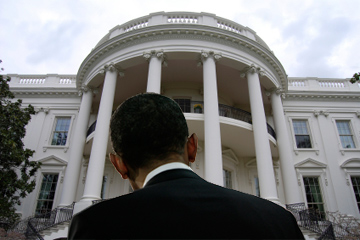

Whenever a new president is preparing to take office, talk turns to the vaunted first 100 days. Barack Obama’s historic presidential run generated a level of excitement in Washington and across the country not witnessed in a long time. With the election won, the buzz continues, but the focus is now on the possibilities and perils of the opening moments of his administration. Obama will be taking the helm of a country facing a long, daunting list of problems. With many observers citing historical analogs like Abraham Lincoln in 1861 or Franklin Roosevelt in 1933, in this Salon round table we explore a twofold question with sobering implications: What can Obama accomplish in his first 100 days, and what should he attempt?
Three experts share their opinions about what is likely to happen after Obama takes the oath of office. Steve Clemons is a senior fellow and director of the American Strategy Program at the New America Foundation, a nonpartisan public policy institute. Clemons, who blogs at the Washington Note, previously served as executive vice president of the Economic Strategy Institute and senior policy advisor to Sen. Jeff Bingaman, D-N.M. Rick Perlstein is author of two acclaimed books on the ascendancy of the conservative movement: “Nixonland,” and “Before the Storm,” on Barry Goldwater and the 1964 election. Perlstein is now senior fellow at the Campaign for America’s Future, for whom he writes the blog the Big Con. Winnie Stachelberg is senior vice president for external affairs at the Center for American Progress. Prior to joining CAP, she spent 11 years working as the political director of the Human Rights Campaign and vice president of the HRC Foundation. Winnie is a former staffer at the Office of Management and Budget in both the George H.W. Bush and Clinton administrations. Salon spoke to Clemons, Perlstein and Stachelberg by phone.
Tom Schaller: There have been many post-election comparisons of the present moment to the start of presidencies ranging from Lincoln’s to FDR’s to Reagan’s. Before we get to Obama and what he should do in his first 100 days, I want to ask how appropriate and relevant the very concept of a president’s first 100 days is in the 21st century? Rick, you’ve written about this recently, so I’ll start this first question with you.
Rick Perlstein: Of course, like a lot of things in history that seem like they’ve been with us forever, it’s a recent convention. Basically it happened during the crisis of 1932 and ’33 when Franklin Roosevelt was elected in November, but wasn’t inaugurated until March. He had a very long time to basically work up a plan for what he was going to do to rescue the economy, during which period thousands of banks were failing. So the idea that he would just hit the ground running was very much a part of how he identified his administration. He did something very new, which is the idea that a president goes into office with a package of legislation that he’s trying to pass and that you can judge his performance on how well he does in passing that. Prior to that point, basically the congressional leaders would tell presidents what the legislative agenda would be rather than the other way around.
Schaller: I’m wondering, Steve and Winnie, is this 100 day thing just a convenient rule the media relies on? Does it really have to be literally 100 days?
Winnie Stachelberg: To be honest, I think there’s some truth to it and some fiction to it. It’s a nice catchphrase to talk about — a quick, out-of-the-box push for something. But I really think 100 days is in the eyes of the beholder. It could be all the way up until the August recess. But a lot of people think that if stuff got done in that period it might be considered the first 100 days. I want to go back to a point that was made, which is that a lot of what’s on President-elect Obama’s plate is stuff that he’s already working on and that his transition team is working on with Congress. And so, there is a sense that much will get done in a first stretch of time, whether that’s three months or six months. Because a lot of these conversations have happened and a lot of the policy has been shared between elected officials.
Clemons: I have a slightly different perspective. Number one, history happens faster now than it did in other presidencies. Secondly, it’s hard to imagine a worse national security and economic portfolio handoff than what we’re seeing to Obama now. I think we can’t do with the kind of continuity of approach that we saw in the past. This is an FDR moment. The situation for America’s global position and its domestic economic position is really horrible. So, whether 100 days is exactly the right benchmark or not, the notion — you know, Jim Steinberg and Kurt Campbell [say] that Obama needs to go slowly on foreign policy. And I think that’s absolutely wrongheaded. We need to see big strategic moves, positions set by Obama, and he needs to benchmark those against the past of incrementalism, a past of continuity, and tell Americans things are going to be different tomorrow. He’s got a very short window to make the Obama bubble mean something before it explodes.
Schaller: Steve, you raise this notion that political time just moves quicker than it has in the past. I’m wondering, what’s your sense of just how much political capital Obama has as he enters the White House? In other words, how much political capital does he have on Day One and then how much might he have by Day 100? Will he have to spend a lot? Could he potentially be an unpopular president by next summer having done all the things that he hopes to do?
Clemons: I think that we’ve replaced the housing bubble in the United States with an Obama bubble. There are so many hopes not just in the United States but around the world that he’s going to produce in just sort of stunning ways on all kinds of policy challenges that are out there. As he begins to define and scope what his real priorities are and are going to be, and as he brings in his team, I think that that bubble is going to deflate. Bubbles, in the economic sense, can be very, very good. They can lay a lot of railroad tracks, they can create a lot of cheap I.T. infrastructure. Lots of folks will end up losing, but what’s going to be very important when Obama runs to the end of his honeymoon is whether he has created enough strategic shifts for the United States so that we can get back in the global game, and that there’s some resurgence of hope for the American and global economies.
And right now, I’m a real pessimist. The challenges he has are Herculean. I think when he comes into office, he has enormous support and he has got a kind of Reagan-like mandate in the sense that when Reagan came in after the Iran hostage crisis, high oil prices, high inflation and low morale in the country, Reagan had the ability to cite the crisis we were in as a way to break the bank on all the money he spent on defense. And Obama’s going to have that same ability to spend on infrastructure, keep the middle class working, but also to do other big shifts. I don’t know how long that is going to last, but he’s got to front-load it. If he goes cautious leading into it, I think the half-life of Obama’s strength and the bubble that he has are going to deteriorate very rapidly.
Perlstein: Recently, Mark Schmitt, who is the editor of the American Prospect, wrote a very convincing article. The base of it was a mirror image of mine. [In the article you cited earlier,] I had called for a liberal shock doctrine, making all the arguments you’ve heard before — you have a little store of political capital, it drains quickly, the other side is going to try to obstruct and discredit it right away. And what Mark Schmitt argued was that Barack Obama seems to perform best when he can pace out, carefully, patient maneuvers that are designed to lock in changes so that he can later fill the pot. He used the example of how Barack Obama could have done what a traditional insurgent candidate did in the primaries and after he did well in Iowa — throw all the rest of [his money] into the next one and again hope for that kind of momentum bubble to keep on going until Election Day. But he didn’t. He spread his capital out all over the country. He spread out his capital all across the primary calendar. [But that] doesn’t exactly work for governing because the Constitution makes it really easy to obstruct basically any momentum an executive branch is going to have. You can filibuster, you can place holds on things.
An intriguing thing about the way Mark laid down the rules of the road politically is that we’re in a moment in which Republican obstructionism isn’t going to fly politically. We are in a crisis. We are in a moment in which the Republican brand is so weakened that if any Republican wants to be taken seriously as a part of the governing coalition they’re just going to have to become Obama Republicans. And all you need is three or four or five Obama Republicans in the Senate and you have a comfortable margin.
You do have to worry about this breakneck pace that has its downsides, one of which is that if you do things hastily, you might not do them well. The other is that it’s a high-risk strategy to go for a big package of legislation. If it fails, like Clinton and healthcare, suddenly you have nowhere to go from there. I’m very much in wait-and-see mode.
Schaller: So should Obama budget his capital or should he use it all at once?
Stachelberg: I hate to be the economist, but on the other hand, I think you do a little bit of both. I think the crisis, the economic situation that we’re in, will allow President Obama to tuck a lot of things that otherwise would not be considered part of an economic recovery, an economic stimulus package, into this package upfront. I think the risk of losing the kind of political capital by doling these out piece-by-piece — something for green jobs, something for the stimulus — is lessened because it will be made part of a larger package. We are talking about something that is on the order of 2 to 4 percent of GDP. It’s big. It will be some combination of direct spending and some combination of tax cuts.
The economic recovery package — they’re looking at this with an interesting sort of two-screen lens. They want to include things that will have a fast, quick impact on the job force. They’re looking at something on the order of a $2.5 million job restoration that includes stuff in there that will have a multiplier effect: health information, technology, job, broadband. And they want to look at these things as being included in the economic package.
I think because there is going to be a very big economic recovery package at the beginning that will include a lot of these things that might otherwise have been pulled out and dinged up along the way, he’ll lose less political capital than he otherwise would have. On a different topic, the other piece of the political capital is the slew of executive orders that are going to be issued right off the bat. They send a signal and they’re meant to obviously promote a certain direction in terms of policy, rescind current Bush administration policies and send a signal to people who are waiting patiently or not to see what direction this administration is going to go.
Schaller: I’m assuming we’re not going to see the same type of signing statements that we saw from Bush. There should be more of an alliance between Pelosi, Reid and Obama than there was between Bush and his Republican Congresses, and certainly between Bush and his last Democratic Congress, right?
Stachelberg: I think certainly we’ll see that for the first three months, the first six months, people working together on things. We’re hearing that the chairman of the Judiciary Committee, Sen. Leahy, wants to have hearings on [Attorney General-designate] Eric Holder sooner rather than later in January so that maybe the big four [appointments] are ready to be confirmed pretty soon out of the box.
Perlstein: This is a great contrast to the Carter debacle, in which the relationship between Congress and Carter was basically adversarial right off the bat.
Stachelberg: And look at President Clinton. You mentioned healthcare reform; it must be done differently than it was in ’93 and ’94. Some of that has to do with industry and some of it has to do with Congress and some of it has to do with the pace of what’s going forward. But I do think that whether it’s closing Guantánamo, rescinding President Bush’s order to expand oil and gas drilling, rescinding the global gag rule, there will be a mix of bold turning back the clock on what Bush did and also putting [new things in place] — stem cells will be another issue.
Schaller: Steve, do you see it that way? Do you think Obama is going to have strong relations on the Hill and do you think he’ll use a lot of the strong executive powers that Bush assumed for himself in the last eight years?
Clemons: I think so. He’s imported some of the biggest players in Congress, Joe Biden, Hillary Clinton, Rahm Emmanuel, to help make that happen. I think he anticipates that there will be a period after he spends this gargantuan amount of money where it’s not as easy to seduce Congress with projects in their districts. At the end of that, Congress is really going to return to a factionalized state. You’re going to have people with different views, you’re going to have new chairmen who want to demonstrate that they’re politically significant and who are going to challenge the power of the executive. I think that Obama is smartly anticipating that and playing that game.
But when it comes to rolling forward a strategy on these various issues that Winnie just outlined, I think he’s going to roll as much forward as he can because this is the point where he’s got momentum. The surf is with him and no one is going to stand in his way. And we haven’t talked about foreign policy, but no foreign leader is going to stand in front of this guy right now until he makes a mistake. And at the point he begins to make mistakes, and that point will come, people will pile on, because there hasn’t been this kind of charismatic president who could get away with so much for quite a long time.
Schaller: Let’s stay with that point. You alluded earlier to the fact that Obama should perhaps also be ambitious on foreign policy and defense. What is it you have in mind exactly and what could he do in the first 100 days to raise eyebrows at home and abroad?
Clemons: I think he needs to reestablish that he has a horizon for how the world is going to look in 30, 40 years. That we have to try to achieve. He has to be clear with the American public that this is like a period in 1946, 1947, where we need to rewire our institutional deal with the rest of the world. Because incrementalism and inertia, from where we are now, [will not be enough.]
But his national security team makes no sense at all. He’s brought in Jim Jones, who’s on the board of Chevron and Boeing, who’s an advocate of nuclear energy and oil drilling. He’s mister military industrial complex. You have Bob Gates, a holdover from the Bush administration, who’s a very deep, thoughtful, Scowcroftian strategist. You have Hillary Clinton, the coercive diplomat wannabe who essentially wanted to be with the Iran hawk crowd.
What that group essentially means, I think, unless he’s made a disastrous mistake, is it’s really a change-game team designed to create Nixon-goes-to-China moments on a number of fronts. Because the critique of Bush is not just a political critique, it’s a substantive critique that America’s national-security leverage in the world is diminished so dramatically that the world doubts us. And the world doubts us so much that we’re going to have crises thrown at us and contrived not only by enemies but by allies who just don’t know what we’ll gamble on anymore. And in that environment you need to set a horizon, you need to set up doable tasks that the world sees us achieving — maybe putting Syria on a Libya-like track. That may end up being something small like ending the cold war with Cuba. That may be engaging in a range of secret diplomacy in the Middle East region and trying to send Bob Gates to China and Russia a lot of times behind the scenes. Try to recalibrate relations with those countries so that they become greater stakeholders with us. There’s no guarantee it will work, but I think it’s very important.
Schaller: Rick, I’d like you to respond to that and also discuss Iraq, particularly given the fact that a lot of liberals are getting worried that Obama is sending mixed signals on what he’s going to do there.
Perlstein: On this Nixon-goes-to-China idea, what is so brilliant and kind of even humbling to me, and I’m still trying to figure out how he pulls this off, in Obama’s change strategy is how he is able to basically change the battlefield. He can say something like, “Well, of course we’re going to get rid of this crazy embargo with Cuba because that’s the centrist position.” And then suddenly he’s marginalized people who are against it as right-wingers and he’s brought in the left who don’t really care whether he calls it liberal or not as long as he does the same thing.
That’s a harder game to play in Iraq. Luckily, the situation on the ground seems to be somewhat winding down, although I worry, maybe there’s a quagmire on the horizon in Afghanistan. But, the idea is that he is going to do progressive things and use establishment figures as cover. And that makes a lot of people wary. It’s new, it’s risky, it’s bold. But he’s thought about this pretty deeply and I’m inclined to give him the benefit of the doubt, although some days I’m not inclined to give him the benefit of the doubt.
Stachelberg: I think throughout the campaign, candidate Obama was consistent in maintaining his commitment to bringing an end to the war in Iraq. I do think that during the first 100 days, notwithstanding these comments about the national-security team, that President Obama needs to convene that team and develop a plan to bring the troops home on a specific timetable. And once those troops start doing so, as they leave Iraq, begin to rotate the troops into Afghanistan. Because in addition to Afghanistan, you need to fully implement a framework for Pakistan as well, which obviously has emerged in a horrific way in the last couple of weeks. And so, it’s giving him the benefit of the doubt, but I think that he will be maintaining his commitment to bringing an end to the war in Iraq and doing so in those first few months.
Clemons: Just a quick comment on Iraq. I respect what Winnie and Rick said on Iraq, but I also think it’s important to realize that none of these issues in the Middle East are easily siloed off away from any of the other synergistic elements of trying to get an equilibrium there in the Middle East. And Iraq in particular is not going to be a strong state again in our lifetimes. In my view it won’t be the kind of model of democracy we all hope for. The question for Iraq is whether Obama can engineer an arrangement where Turkey, Saudi Arabia, Iran and the United States, and, to some degree, Europe, can come together in a collaboration that keeps Iraq there, keeps Iraq semi-stable and produces opportunities for confidence building and trust building in that region. So we’ve got to stop thinking about Iraq as an entity of its own but rather as a platform for other kinds of collaboration-building vehicles in the region, because that’s all that matters today in terms of achieving a different balance in the Middle East among the powers that matter. Iraq doesn’t matter except as a compulsive ulcer in the region at this point.
Schaller: There is a notion that Obama has to do something to satisfy liberals, who perhaps are being over-reported in their worries. There have been some rumblings that Obama has forgotten who nominated him and elected him. I wonder if there is anything Obama can and should do in the first 100 days, not so much from the policy standpoint, but from an internal politics standpoint, to make sure the base is happy?
Clemons: He could invite Rick Perlstein and a lot of lefty bloggers like myself to a party as if we really mattered. He could invite lefties to the White House and say you guys really matter, I hear you, and do the Clinton bit of shaking everybody’s hand. Because what Obama is going to do is pump more money than Midas had into the U.S. economy to keep Americans working to try to hold off these big strategic shifts globally. He’s hiring people who are essentially rivals, enemies, sometimes the antithesis of what people thought he stood for. But he has the ego to think that he’s going to be able to run them to achieve his progressive targets. He needs to go out, a lot like Reagan did and other leaders, Bill Clinton in particular, and connect with the public and inspire them into this bigger project. I think it’s an optical illusion, but I think this guy has the ability to do that.
Perlstein: Without a doubt. My favorite Reagan quote these days is when he used to say, “There is no left or right, there’s only up or down.” I’m personally willing, as a dyed-in-the-wool liberal, to say if Barack Obama manages to deliver to the American citizenry, end the Cuban embargo, bring our troops home from Iraq, produce $80 trillion of green jobs and calls it all conservative, as a liberal I’m perfectly willing to fall on my sword.
Schaller: Winnie, are you hearing worries from liberals or is this just a normal jockeying for political power?
Stachelberg: Yes, I’m hearing worries from them and yes, this is the normal jockeying for political power. Let’s be real, some of it is over-reported. But I think there’s definitely a simmering going on there. The Latino leaders are a little concerned. The gay, lesbian, transgender community are concerned. Constituencies are beginning to jockey for things. And that’s true and it’s good and people need to do that in the right way.
I also think that there is a healthy understanding — this is more from a policy perspective than an appointment perspective — that it did take eight years to get into this mess and it is going to take more than a year, let alone 100 days, to get out of it. That’s why I think that Obama’s strategic use of executive orders will move through some of the things that liberals and progressives have been working on for a long time without much movement. Reauthorizing the Workforce Investment Act, modernizing unemployment insurance program, advancing manufacturing initiatives to support green manufacturing. Things that have been way outside of the sphere of the possible with the Bush administration now get put back on the possible list.
Schaller: We have time for one last two-part question. During the campaign, one of the whispers that we heard from the Clinton people was the notion that Obama’s problem is not that he’s black but that he’s green, that he’s going to get in there and get his hands on the levers of government and he’s going to be overwhelmed. We’re going to have a repeat of what the Clinton people ironically admitted was a problem in the early years of the Clinton administration and the Carter administration. What I want to ask each of you is, what indications have we had that Obama gets this problem and is working to avoid it? What specifically does he want to avoid doing in order not to start draining his massive reserve of political capital on Day One?
Perlstein: It sounds like a guilty conscience from the Clinton people. Supposedly [the Obama team has] been studying past transitions assiduously — the Clinton transition, they didn’t even have a firm chief of staff in place until very late in the game. They were running it like a college seminar. It feels to me like Obama is handling this administratively differently in every way. Differently from the Clinton people.
Stachelberg: As someone who has lost, at least temporarily, the services of the CEO of the Center for America Progress, John Podesta [former Clinton White House chief of staff, now a co-chair of the Obama transition team], I can assure you that past transitions were looked at. They’ve pulled a lot of people who had experience in the Clinton transition and the good news is they learned from their mistakes. The Clinton transition focused on naming a Cabinet that looks like America. The chief of staff is an important job, but that is only one job. With an economy as we have it, as our position in the world as we have it, naming a national security team and an economic team is essential. And he needed to get that done before identifying Cabinet folks. I think one of the things that annoys me when I hear it is, “Why are they pulling so many Clinton folks?” Well, the [Clinton folks] learned lessons and they’re doing things differently in a way that gives me great hope for this administration.
Clemons: Tom, I’m cautiously optimistic. But I’ll be slightly sourer than Winnie. During the campaign, I felt this got overplayed, but I was the guy who broke the news that when Obama was chair of this European subcommittee of the Senate Foreign Relations Committee, he never called a hearing. They tried to make it look like Obama couldn’t call a hearing without Biden’s permission, but Biden would have been more than happy to have such a request. It raises a fundamental question, could you walk and chew gum at the same time, could you handle multiple things at the same time. Certainly Obama passed that test in looking at the magnificence and brilliance of this empowered campaign that was dispersed all over the country. You see people like Greg Craig, who I greatly respect, and others, high-quality managers, John Podesta, who I really think has helped him fill the leadership void with the Bush administration.
So I’m cautiously optimistic, but at the same time I’ve talked to a number of people who know Obama very, very well and even some Bush administration Cabinet members who decided to support Obama, that say their friendly critique of him is that he has assembled a team of people that can’t be left to freelance. Who are going to need his constant attention and engagement. And he’s got these two huge portfolios, one the national-security dilemmas of the country and the other the economic crisis, and this doesn’t even count all the unexpected things that are going to hit. They worry that he underestimates how big the plate of issues are that will hit his desk and try to distract his attention. I’m cautiously optimistic from everything we’ve seen from him. The amount he’s matured in these last 24 months has been impressive, but he’s not behind the Oval Office desk yet, and the question is will he be able to manage it?
My other concern is, his biggest challenge is to figure out what kind of presidency and what sort of policy issues he wants to sculpt as opposed to what sort of issues he’s going to get dragged into in a crisis. It’s going to be very, very important to strike a balance between being reactive to things that are happening in the country and showing he’s concerned and caring and not allowing those instances to hijack his agenda. And I think that will be a very tough challenge.
Schaller: I want to thank our three guests.
