(updated below - Update II)
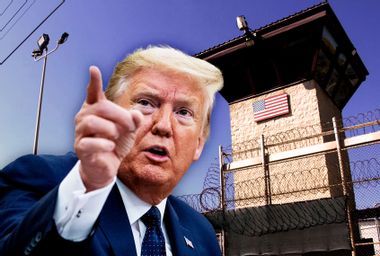
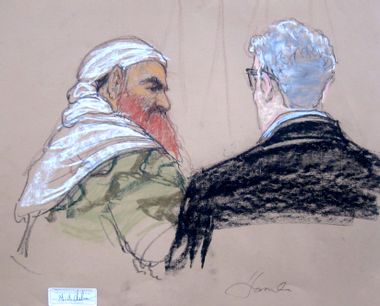
According to The Associated Press, Eric Holder will announce later today that Khalid Sheikh Mohammed and four other 9/11 defendants will be brought from Guantanamo to New York to stand trial, in a real criminal court, for the crimes they are accused of committing. This is a decision I really wish I could praise, as it's clearly both politically risky and the right thing to do.
An open criminal trial under our standard system of justice, accompanied by basic precepts of due process, is exactly the just and smart means for punishing those responsible for terrorist attacks. It announces to the world, including the Muslim world, that we have enough faith in our rules of justice to apply them equally to everyone, including to Muslim radicals accused of one of the worst crimes in American history. Numerous family members of the 9/11 victims have long argued that real trials for the accused perpetrators are vital to providing real justice for what was done -- I expect to have an interview later today with one of those family members -- and holding the trial in New York, the place where 3,000 Americans died, provides particularly compelling symbolism. So this component of the Obama administration's decision, standing alone, is praiseworthy indeed.
The problem is that this decision does not stand alone. Instead, it is accompanied by this:
Holder will also announce that a major suspect in the bombing of the U.S.S. Cole, Abd al-Rahim al-Nashiri, will face justice before a military commission, as will a handful of other detainees to be identified at the same announcement, the official said.
It was not immediately clear where commission-bound detainees like al-Nashiri might be sent, but a military brig in South Carolina has been high on the list of considered sites.
So what we have here is not an announcement that all terrorism suspects are entitled to real trials in a real American court. Instead, what we have is a multi-tiered justice system, where only certain individuals are entitled to real trials: namely, those whom the Government is convinced ahead of time it can convict. Others for whom conviction is less certain will be accorded lesser due process: put in military commissions, to which most leading Democrats vehemently objected when created under Bush. Presumably, others still -- those who the Government believes cannot be convicted in either forum, will simply be held indefinitely with no charges, a power the administration recently announced it intends to preserve based on the same theories used by Bush/Cheney to claim that power.
A system of justice which accords you varying levels of due process based on the certainty that you'll get just enough to be convicted isn't a justice system at all. It's a rigged game of show trials. This is a point I've been emphasizing since May, when Obama gave his speech in front of the Constitution at the National Archives and explained how there were five different "categories" of terrorism suspects who would be treated differently based on the category into which they fell:
If you really think about the argument Obama made yesterday -- when he described the five categories of detainees and the procedures to which each will be subjected -- it becomes manifest just how profound a violation of Western conceptions of justice this is. What Obama is saying is this: we'll give real trials only to those detainees we know in advance we will convict. For those we don't think we can convict in a real court, we'll get convictions in the military commissions I'm creating. For those we can't convict even in my military commissions, we'll just imprison them anyway with no charges ("preventively detain" them).
Giving trials to people only when you know for sure, in advance, that you'll get convictions is not due process. Those are called "show trials." In a healthy system of justice, the Government gives everyone it wants to imprison a trial and then imprisons only those whom it can convict. The process is constant (trials), and the outcome varies (convictions or acquittals).
Obama is saying the opposite: in his scheme, it is the outcome that is constant (everyone ends up imprisoned), while the process varies and is determined by the Government (trials for some; military commissions for others; indefinite detention for the rest). The Government picks and chooses which process you get in order to ensure that it always wins. A more warped "system of justice" is hard to imagine.
That the Obama DOJ is now explicitly picking and choosing different levels of due process in the very same announcement -- we can give that defendant a trial because we know we'll win, but that one over there needs to go to a military commission because we're less sure -- highlights how manipulative this "justice system" is.
Former Air Force lawyer Morris Davis was the Chief Prosecutor of the Guantanamo Military Commissions system during the Bush years and resigned in 2008 to become one of its leading critics. Although he still believes that military commissions are a viable option for detainees captured on an actual battlefield -- and even believes the President has the right to detain terrorism suspects indefinitely with no trial -- he made the same point last week in a Wall St. Journal Op-Ed about the practice of picking and choosing the system of justice one receives based on how likely the state is to win:
In a preliminary report submitted to Mr. Obama in July, the Detention Policy Task Force recommended the approval of evaluation criteria developed by the Department of Defense and the Department of Justice. The task force stated its preference for trials in the federal courts, but added the decision would be based in part on "evidentiary issues" and "the extent to which the forum would permit a full presentation of the accused's wrongful conduct." A Washington Post editorial endorsed the proposal, arguing that there should be an alternative forum when a trial in federal court is "not an option because the evidence against the accused is strong but not admissible."
Stop and think about that for a moment. In effect, it means that the standard of justice for each detainee will depend in large part upon the government's assessment of how high the prosecution's evidence can jump and which evidentiary bar it can clear.
The evidence likely to clear the high bar gets gold medal justice: a traditional trial in our federal courts. The evidence unable to clear the federal court standard is forced to settle for a military commission trial, a specially created forum that has faltered repeatedly for more than seven years. That is a double standard I suspect we would condemn if it was applied to us. . . .
The problem is trying to have it both ways: the credibility that comes from using federal courts with admissible evidence under the very strict rules of civilian tribunals, and military commissions for cases that are often comparable except for the fact that they depend on evidence (such as hearsay testimony) that is not normally admissible in civilian courts. What if Iran proposed the same for the three American hikers it is currently holding? We would surely condemn what we now stand ready to condone. . . .
Double standards don't play well in Peoria. They won't play well in Peshawar or Palembang either. We need to work to change the negative perceptions that exist about Guantanamo and our commitment to the law. Formally establishing a legal double standard will only reinforce them.
Obama is certain to be bombarded with all sorts of right-wing idiocy and fear-mongering as a result of his decision to bring 9/11 defendants into the U.S. in order to give them trials. Doing that is clearly the right thing to do: trials and due process is how civilized countries treat people who are accused of engaging in terrorism. Given how Democrats and Republicans will talk about this decision, media coverage will almost certainly fixate on the narrow question of whether (a) 9/11 defendants should be given trials in the U.S. or (b) we're all now Endangered because these Omnipotent Monsters are being brought into our communities (in handcuffs, shackles, and maximum-security prisons). The AP article already includes this preview of the inane attacks on Obama certain to come:
It is also a major legal and political test of Obama's overall approach to terrorism. If the case suffers legal setbacks, the administration will face second-guessing from those who never wanted it in a civilian courtroom. And if lawmakers get upset about notorious terrorists being brought to their home regions, they may fight back against other parts of Obama's agenda.
In a just-posted New York Times article, Charlie Savage also notes that bringing an accused terrorist of Mohammed's notoriety to the U.S. for trial is unprecedented and likely to provoke intense political controversy. In that "debate," I'm squarely on Obama's side, as is any person who believes in the most basic Constitutional precepts.
But the more consequential impact of Obama's decision is likely to be overlooked: we're now formally creating a multi-tiered justice system for accused Muslim terrorists where they only get the level of due process consistent with the State's certainty that it will win. Mohammed gets a real trial because he confessed and we're thus certain we can win in court; since we're less certain about al-Nashiri, he'll be denied a trial and will only get a military commission; others will be denied any process entirely and imprisoned indefinitely. The outcome is pre-determined and the process then shaped to assure it ahead of time, thus perfectly adhering to this exchange from Chapter 12 of Alice in Wonderland:
"Let the jury consider their verdict," the King said, for about the twentieth time that day.
"No, no!” said the Queen. "Sentence first -- verdict afterward."
"Stuff and nonsense!" said Alice loudly. "The idea of having the sentence first!"
"Hold your tongue!" said the Queen, turning purple.
"I won’t!" said Alice.
"Off with her head!" the Queen shouted at the top of her voice.
How is that remotely just or fair under any definition of those terms? As Davis wrote: "We need to work to change the negative perceptions that exist about Guantanamo and our commitment to the law. Formally establishing a legal double standard will only reinforce them." There's nothing "pragmatic" or "moderate" about creating a multi-tiered justice system where only some people get trials; it's both counter-productive and profoundly unjust.
UPDATE: Omar Khadr -- the Canadian "child soldier" imprisoned at Guantanamo for the last seven years, since he was 15 years old, for allegedly throwing a grenade at an American soldier in Afghanistan (that's apparently "terrorism") and the subject of a difficult-to-watch video of him weeping like the child he is while being interrogated -- will reportedly be one of those denied a trial and instead allowed only a military commission, according to Canada's Canwest News Service (h/t sysprog):
Canadian-born terror suspect Omar Khadr faces continued prosecution in the U.S. military tribunal established in Guantanamo Bay, Cuba. . . .
The federal system offers the full panoply of defendant rights available to U.S. citizens under the U.S. Constitution, while civil rights groups have argued the military commissions at the U.S. naval base in Cuba do not meet that standard.
The decision regarding Khadr means that the Obama administration has, for now at least, rejected calls by his U.S. and Canadian defence teams for the repatriation of the Canadian-born terror suspect" . . . My view is, he should be prosecuted," said navy Capt. John Murphy, chief prosecutor in the military commissions system.
So even for 15-year-olds who we imprison for seven years with no charges, we refuse to give them a trial. And note how the Canadian press account stresses our multi-tiered system of justice and how their citizen is receiving second-tier due process -- an observation that one can be sure will repeat itself worldwide.
UPDATE II: In his Press Release, Eric Holder says his decisions today were "based on a protocol that the Departments of Justice and Defense developed" whereby he "looked at all the relevant factors and made case by case decisions for each detainee." In other words, there's no categorical determination driving the process (e.g., all those who attack military targets get commissions and all those who attack civilian targets get trials). To the contrary, federal prosecutors choose, in their sole discretion, the level of due process each defendant gets (including "none" -- as in: indefinite detention with no trial), and Holder himself emphasized that "it is important that we be able to use every forum possible to hold terrorists accountable for their actions."
There's supposed to be one justice system for everyone -- not multiple ones from which prosecutors can pick and choose based on assurances of ongoing imprisonment. Highlighting how dangerous this is, the DOJ's investigation of al-Nashiri was originally classified as a standard criminal case, but -- as his counsel pointed out today -- he was assigned to a military commission because there simply isn't sufficient evidence to convict him in a real court.
Vividly illustrating the perverse mentality behind all of this, here's a question asked today of President Obama by AP's Jennifer Loven:
President Obama, how can you assure the American people that a trial of Khalid Sheikh Mohammed, now that your administration has now decided will take place in a civilian court in New York, will be safe and secure, but also not result in an innocent verdict for him?
Apparently, we're only supposed to give trials to people if we can assure in advance that it won't "result in an innocent verdict." Jennifer Loven -- and many of her media colleagues -- seems to yearn for the U.S. to be a lot more like North Korea.
And for those of you who favor what Obama did today, I have two questions: (1) are you in favor of allowing serial murderers and child rapists to go free if the evidence against them is "tainted," or should special commissions be created to ensure their conviction, too; and (2) did you defend the Bush administration's use of military commissions on the same grounds that you're defending Obama today?
(updated below)
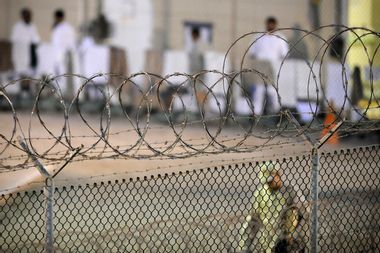
The Obama administration announced today that it will create a new "supermax" facility in Thomson, Illinois, and will transfer to it many of the detainees currently held at Guantanamo. Critically, none of those moved to Thomson will receive a trial in a real American court, and some will not be charged with any crime at all. The detainees who will be given trials won't go to Thomson; they'll be moved directly to the jurisdiction where they'll be tried. The ones moved to Thomson will either (a) be put before a military commission or (b) held indefinitely without charges of any kind. In other words, they'll have exactly the same rights -- or lack thereof -- as they have now at Guantanamo.
William Lynn, Obama's Deputy Defense Secretary, sent a letter today (.pdf) to GOP Rep. Mark Kirk of Illinois, answering multiple questions Kirk had posed, and made clear that all Thomson detainees will either have military commissions or indefinite detention without charges; none will get real trials (click images to enlarge):
The administration has already announced that it will rely on the Bush/Cheney theory to justify its indefinite detention power -- that Congress implicitly authorized that when it enacted the 2001 Authorization to Use Military Force. But because Congress has banned the transfer of any Guantanamo detainees to the U.S. for any reason other than to be tried in a court, the administration will now seek express legal authority to transfer detainees inside the U.S. to hold them without charges indefinitely. Former White House Counsel Greg Craig said back in February that it's "hard to imagine Barack Obama as the first President of the United States to introduce a preventive-detention law." One no longer needs to "imagine" it; it's soon to come.
Particularly Orwellian was Lynn's response to Kirk's inquiry about which detainees will be given the gift of an actual trial:
How perverse. Lynn is right that prosecutions traditionally occur only "when admissible evidence or potentially available admissible evidence will probably be sufficient to obtain and sustain a conviction." But traditionally, what happens when such evidence is insufficient is not that the state just imprisons them anyway with no trial or puts them before some less rigorous tribunal; what's supposed to happen when the state cannot convict someone is that the individuals are not charged and therefore not imprisoned. But here, the Obama administration is turning that most basic principle on its head: only those who it knows it can convict will get trials, but the rest will be shipped to Thomson -- Gitmo North -- to be put before a military commission or simply imprisoned without charges of any kind.
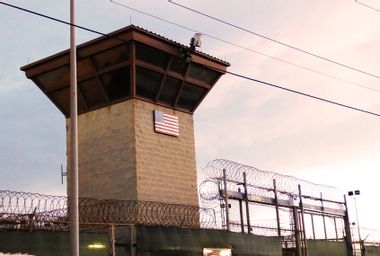
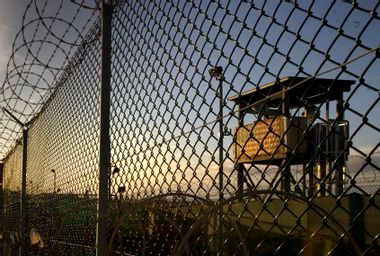
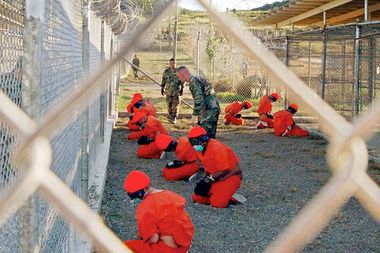
The sentiment behind Obama's campaign vow to close Guantanamo was the right one, but the reality of how it's being done negates that almost entirely. What is the point of closing Guantanamo only to replicate its essential framework -- imprisonment without trials -- a few thousand miles to the North? It's true that the revised military commissions contain some important improvements over the ones used under Bush: they provide better access to counsel and increased restrictions on the use of hearsay and evidence obtained via coercion. But the fundamental elements of Guantanamo are being kept firmly in place. What made Guantanamo so offensive and repugnant was not the fact that it was located in Cuba rather than Illinois. The primary complaint was that it was a legal black hole because the detainees were kept in cages indefinitely with no charges or trials. That is being retained with the move to the North.
There is, I suppose, symbolic value in closing Guantanamo. But what made Guantanamo such an affront to basic liberty and the rule of law was far more than symbolism, and it certainly had nothing to do with its locale. If anything, one could argue that it's now more dangerous to have within the U.S., on U.S. soil, a facility explicitly devoted to imprisoning people without charges. Even worse, by emphasizing that Thomson will be an even more "secure" supermax than the utterly inhumane hellhole at Florence, Colorado -- even boasting that it will be the most secure prison "of all time" -- it's likely that individuals who have never been charged with any crime will be held indefinitely in a facility even worse than Guantanamo.
Are we really supposed to believe that the Muslim world -- at whom this symbolism is supposedly aimed -- is so simplistic that they'll be happy because Muslims are now being indefinitely imprisoned with no charges in Illinois instead of on a Cuban island? In many ways, this move is classic Obama: pretty words, rhetorical appeals to lofty ideals, self-congratulatory preening, accompanied by many of the same policies that were long and vehemently condemned by him and most of his supporters.
UPDATE: ACLU Executive Director Anthony Romero had this to say today:
The creation of a "Gitmo North" in Illinois is hardly a meaningful step forward. Shutting down Guantánamo will be nothing more than a symbolic gesture if we continue its lawless policies onshore.
Alarmingly, all indications are that the administration plans to continue its predecessor's policy of indefinite detention without charge or trial for some detainees, with only a change of location. Such a policy is completely at odds with our democratic commitment to due process and human rights whether it’s occurring in Cuba or in Illinois. In fact, while the Obama administration inherited the Guantanamo debacle, this current move is its own affirmative adoption of those policies.
It's hard to argue with that.
The deadline that President Obama set for closing the detention facility at Guantanamo Bay always seemed ambitious. The haphazard way his administration has gone about it made the task even more difficult, and now Obama himself has acknowledged the inevitable: The prison will not close by January, as he'd wanted it to.
Obama made the admission during an interview with Fox News' Major Garrett on Wednesday. He said he still wants the facility closed sometime next year, and that he's "not disappointed" with the blown deadline, because he "knew this was going to be hard."
"I'm not going to set an exact date because a lot of this is also going to depend on cooperation from Congress," Obama said.
Stretching this out into the middle or end of next year would likely mean another missed deadline -- it's going to be politically difficult to finish the closure when vulnerable Democrats are worrying about the midterm elections, and when they are also talking about al-Qaida suspects like Khalid Sheikh Mohammed being brought to the U.S. for trial.
The Senate voted Tuesday in favor of a measure, already approved by the House, that allows the administration to continue transferring detainees from Guantanamo Bay to the U.S. for trial. President Obama is expected to sign the bill.
There is one big restriction included in the legislation: The detainees may not allowed to be brought to the U.S. if it the transfer is done for the purpose of releasing them. Despite warnings from people who oppose the idea of closing the detention facility at Guantanamo, the administration is also against the concept of releasing former detainees here.
Congress may not have the last word on this, however. Also on Tuesday, the Supreme Court agreed to hear a case that will ask the justices to decide whether detainees who are not considered a security risk can be freed in the U.S. The case was brought by 13 Chinese Muslims who were cleared for release six years ago but are still imprisoned at Guantanamo.
(updated below)
It's now apparent that the biggest sham in American politics is Barack Obama's pledge to close Guantanamo and, more generally, to dismantle the Bush/Cheney approach to detaining accused Terrorists. In August, 2008, the U.S. Supreme Court ruled in Boumediene v. Bush that Guantanamo detainees -- people abducted from around the world and shipped to our prison in Cuba -- have the constitutional right to habeas corpus (a court review of their imprisonment). Then-candidate Obama issued a statement lavishly praising that ruling:
Today's Supreme Court decision ensures that we can protect our nation and bring terrorists to justice, while also protecting our core values. The Court's decision is a rejection of the Bush Administration's attempt to create a legal black hole at Guantanamo - yet another failed policy supported by John McCain. This is an important step toward reestablishing our credibility as a nation committed to the rule of law, and rejecting a false choice between fighting terrorism and respecting habeas corpus. Our courts have employed habeas corpus with rigor and fairness for more than two centuries, and we must continue to do so as we defend the freedom that violent extremists seek to destroy. We cannot afford to lose any more valuable time in the fight against terrorism to a dangerously flawed legal approach.
That was so moving.
Yesterday, the Obama DOJ -- as expected -- filed a legal brief (.pdf) which adopted the arguments originally made by the Bush DOJ to insist that detainees whom they abduct from around the world and then ship to Bagram (rather than Guantanamo) lack any constitutional rights whatsoever, including habeas review. The Obama administration is appealing from a decision (.pdf) by Bush-43-appointed District Court Judge John Bates which, applying Boumediene, held that detainees at Bagram who are originally detained outside of Afghanistan have the right to habeas review (Afghan citizens detained in Afghanistan have none, he found). In other words, after Obama praised Boumediene as "defending the freedom that violent extremists seek to destroy," he's now attempting to make a complete mockery of that decision by insisting that it is inapplicable as long as he decides to ship detainees from, say, Thailand to Bagram rather than Guantanamo. Obama apparently sees "our core values" as nothing more than an absurd shell game, where the U.S. Government can evade the limits of the Constitution by simply moving the locale of its due-process-free detention system.
Back in April, when the Obama DOJ announced it would appeal the decision, I wrote at length about the Bagram issue, and yesterday, in the wake of this new filing, numerous commentators made excellent points about these shenanigans. Spencer Ackerman notes that, the day before the ruling, the administration leaked that they were creating "new procedures" for Bagram detainees which are very similar to Guantanamo's "Combatant Status Review Tribunals" -- the very Bush/Cheney system the Boumediene court rejected as unconstitutional. This means that, at best, the Bagram detainees will now languish in prison for still more years with no habeas review while the Obama DOJ spends years litigating whether its "new system" is a sufficient Constitutional replacement for habeas review. Ackerman quotes David Remes, the legal director of the non-profit Appeal for Justice law firm who represents 19 Guantanamo detainees, as saying: "It’s another stall. And one I would have expected from the Bush administration but not the Obama administration."
Worse still, both British journalist Andy Worthington and The New Yorker's Amy Davidson highlight this rather odd and disturbing sentence from The New York Times article on the Bagram appeal:
Officials say the importance of Bagram as a holding site for terrorism suspects captured outside Afghanistan and Iraq has risen under the Obama administration, which barred the Central Intelligence Agency from using its secret prisons for long-term detention and ordered the military prison at Guantánamo closed within a year.
Why would the closing of Guantanamo and the shuttering of secret CIA prisons increase the "importance of Bagram" -- unless Bagram was going to replace and replicate those specific weapons, which Obama is ostensibly "ending" because they became politically unpalatable as Bush/Cheney symbols? As Davidson put it:
So closing Guantánamo increases the need for a new Guantánamo, and barring the use of secret prisons just means that you need to find a new place to stash secret prisoners? Have we had it with Guantánamo because it’s unfashionable—like a played-out spring-break destination, now overrun with journalists and human-rights lawyers hopping on planes in Florida—or because we actually don’t like extrajudicial, indefinite detention? The new measures, which the Washington Post reported as well, may at least shed some light on what’s been going on in Bagram; it’s not likely to be pretty. If Guantánamo is, to quote the poetry of Donald Rumsfeld, a known known, Bagram is a known unknown.
This is the same issue raised by Obama's demand for a preventive detention scheme: what is the point of closing Guantanamo if all of its architecture and defining traits -- indefinite detentions with no trials -- will be preserved and simply moved elsewhere? What made Guanatnamo evil and destructive isn't that it was located in Cuba. What made it such was that that -- to use Obama's melodramatic campaign language -- it was a "legal black hole." Closing it, only to re-create its core tyrannies in Bagram and re-build it as part of some "preventive detention" scheme, is worse than useless: it's actively misleading. There will be some American journalists and probably some hardened Obama loyalists who believe that closing Guantanamo -- while moving and re-creating its core features -- is some sort of "change." But the rest of the world is highly unlikely to be tricked.
The day after it was released, John McCain called Boumediene "one of the worst decisions in the history of this country" and explained:
[T[hese are enemy combatants, these are people who are not citizens, they do not and never have been given the rights that citizens of this country have. And my friends there are some bad people down there. There are some bad people. So now what are we going to do. We are now going to have the courts flooded with so-called, quote, Habeas Corpus suits against the government. . . Our first obligation is the safety and security of this nation, and the men and women who defend it. This decision will harm our ability to do that.
The two candidates' starkly different reactions to that ruling was supposed to underscore one of the true differences between them: that Obama, the Constitutional Law Professor, would insist on adherence to core Constitutional liberties even while prosecuting the War on Terror, but McCain wouldn't. Yet here we are, barely more than a year later, and the Obama DOJ is filing a legal brief chock full of Bush/Cheney/McCain arguments about how "Habeas rights under the U.S. Constitution do not extend to enemy aliens detained in the active war zone at Bagram" and "No court has ever extended the Great Writ so far" and granting such rights "risks opening habeas claims brought by detainees in other theaters of war during future military actions" and doing so would pose "impediments to the military mission and threats to the national interest." As The New York Times' Charlie Savage wrote about the District Court proceeding: "The Obama administration has told a federal judge that military detainees in Afghanistan have no legal right to challenge their imprisonment there, embracing a key argument of former President Bush’s legal team."
If the Obama administration were to prevail, it would render Boumediene -- and the promised closing of Guantanamo -- absurd nullities. Who needs Guantanamo if you can just ship them to Bagram instead and deny them all rights? And who cares if the Boumediene Court found that detainees have a right of habeas review if that right magically vanishes the minute you send them off to Afghanistan instead of Cuba? Here's what Obama said when he voted against the Military Commissions Act, the statute which denied habeas rights to War on Terror detainees (the same statute on which the Obama DOJ is now relying to deny those rights at Bagram):
Mr. President, I would like to address the habeas corpus amendment that is on the floor and that we just heard a lengthy debate about between Senator Specter and Senator Warner.
A few years ago, I gave a speech in Boston that people talk about from time to time. In that speech, I spoke about why I love this country, why I love America, and what I believe sets this country apart from so many other nations in so many areas. I said:
"That is the true genius of America--a faith in simple dreams, an insistence on small miracles; that we can tuck in our children at night and know that they are fed and clothed and safe from harm; that we can say what we think, write what we think, without hearing a sudden knock on the door --"
Without hearing a sudden knock on the door. I bring this up because what is at stake in this bill, and in the amendment that is currently being debated, is the right, in some sense, for people who hear that knock on the door and are placed in detention because the Government suspects them of terrorist activity to effectively challenge their detention by our Government. . . .
But what is avoidable is refusing to ever allow our legal system to correct these mistakes. By giving suspects a chance--even one chance--to challenge the terms of their detention in court, to have a judge confirm that the Government has detained the right person for the right suspicions, we could solve this problem without harming our efforts in the war on terror one bit. . . .
Most of us have been willing to make some sacrifices because we know that, in the end, it helps to make us safer. But restricting somebody's right to challenge their imprisonment indefinitely is not going to make us safer. In fact, recent evidence shows it is probably making us less safe.
The same person who spoke those pretty, pretty lyrics is now arguing that the U.S. Government must have the power to abduct people, ship them to Bagram, and imprison them with no court review. It's true, as Adam Serwer notes, that we cannot know for certain if the Obama administration is, in fact, using Bagram as its new Guantanamo until they stop concealing the information about the numbers, identities, and places of capture of Bagram detainees which the ACLU has been seeking. But we do know that they are desperately seeking to preserve the power to use Bagram as exactly that. When that is combined with the fact that they have already announced they will continue "renditions" -- abducting people from around the world and shipping them off to third countries with no legal process -- the danger is as severe as it is self-evident: by shipping them to Bagram, they will be denied all of the rights which they would have if brought to Guantanamo.
No wonder they want to close Guantanamo: who wants to be bothered with irritating habeas reviews -- 28 out of 33 have resulted in judicial findings that insufficient evidence exists to justify the detention -- when you can just ship them off to the Black Hole of Bagram and imprison them for as long as you want with no court interference? Apparently, what the Bush administration did that was so terrible, the heinous "shredding of the Constitution" they perpetrated, wasn't about the fact that they imprisoned people indefinitely with no charges -- but that they did it in Cuba rather than somewhere else. Who knew that such grave Constitutional transgressions -- such severe denial of fundamental rights -- could be fixed so easily with a little change of scenery?
UPDATE: Digby, citing this report from torture expert Jeffrey Kaye, notes what might very well be the most despicable document of the Bush era, which is obviously saying quite a bit. But if you close your eyes really tightly and only look forward, you may be able blissfully to ignore it all.
As President Obama considers reviving the military commissions, and Congress considers various revisions to the Military Commissions Act, they should do so with a clear understanding of why the military commissions of the Bush administration were created, why they were such a catastrophic failure, and whether there would be any useful purpose to reviving them.
The military commissions clearly failed to achieve their intended purpose. Not a single terrorist responsible for the planning or execution of a terrorist attack against the United States was convicted. After more than seven years and hundreds of millions of dollars wasted, the military commissions yielded only three convictions. Two of the convicted, David Hicks and Salim Hamdan, received sentences of less than one year and were subsequently released.
And then there was my client, Ali Hamza al Bahlul, a low-level al-Qaida media specialist whom I began representing in late April 2008 as appointed military defense counsel. Six members of Hicks' jury from 2007, including the foreman, were recycled for his trial in 2008. After being denied his statutory right of self-representation, Mr. al Bahlul refused to authorize me, his appointed military counsel, to put on any defense. Not surprisingly, he was convicted of all charges and received the maximum life sentence.
Why, with the entire resources of the Department of Defense, the Justice Department and the national intelligence apparatus at their disposal, were the military commissions such an abysmal failure? The answer is simple: They were built on a foundation of legal distortions and illegality. The rules, procedures and substantive law created for the commissions were the product of, or were necessitated by, the abandonment of the rule of law by the Bush administration in the months after 9/11. In the United States of America, any such legal scheme is ultimately doomed to fail.
One of the first indications that the rule of law was to be abandoned was in President Bush's Military Order of Nov. 13, 2001: "Detention, Treatment and Trial of Certain Non-Citizens in the War Against Terrorism." In this document, President Bush found: "it is not practicable to apply in military commissions ... the principles of law and the rules of evidence generally recognized in the trial of criminal cases in the United States district courts." In other words, what we consider essential for a fair trial for us would not be required for them.
How did President Bush know, two months after 9/11, before a single major terrorist suspect had been caught, and before a single prosecutor had reviewed a single piece of evidence, that it would be impracticable to prosecute terrorism cases using existing rules and procedures? He didn't, of course. But having made this unsupported finding, President Bush and his senior advisors set out to make it a reality.
Another major step in the abandonment of the rule of law came on Feb. 7, 2002, when President Bush announced that the Geneva Conventions would not apply to "unlawful combatants" detained in the war on terror. The term itself was new and misleading. The president held not only that such persons were not entitled to be treated as prisoners of war, but also, shockingly, that they were not even legally entitled to be treated humanely.
The U.S. has recognized the Geneva Conventions as binding law since ratifying the treaty in 1955. With a stroke of the pen, the president wiped out the principal source of the law of war and the entire existing legal framework for the treatment of persons captured in an armed conflict and replaced it with a policy preference for humane treatment, which could be readily discarded whenever it interfered with military or intelligence operations. The decision that humane treatment was preferred rather than required created confusion about what was permissible and cleared the way for the use of patently illegal and highly coercive "enhanced interrogation techniques."
The abandonment of the rule of law was compounded by the decision to house the "unlawful combatants" at Guantánamo Bay, Cuba, and to turn the detention facilities there into a legal black hole, a place where detainees were not even entitled to be informed of the basis for their detention, much less challenge it. Indeed, the Bush administration, aided and abetted by Congress, made a determined (and for several years, successful) effort to prevent detainees from gaining access to courts or legal representation. In an environment with no judicial oversight or meaningful avenues for redress, the detainees were simply at the mercy of their captors -- and the captors were not in a merciful mood. The extraordinary pressure to produce "actionable intelligence" coupled with the vengeful mood of the times led inexorably to shameful abuses of detainees.
In 2002 and 2003, as Bush administration officials drafted the rules for the president's military tribunals, despite the hyperbole that the detainees represented "the worst of the worst," they were well aware that the vast majority of the detainees had no tangible connection with al-Qaida, and even fewer had any provable role in any terrorist attack. Many of the detainees were completely innocent of any wrongdoing, and had simply been turned in for bounty, or were caught in the wrong place at the wrong time. The worst that could be said about many of them was that they had fought against the U.S. and Coalition forces that had invaded Afghanistan, conduct that was not previously considered a war crime.
A small group of those captured were likely guilty of terrorism crimes, but not crimes of war. The administration was also keenly aware that, to the extent that there was some evidence of criminal acts by a small fraction of the detainees, much, if not most, of this evidence had been developed through highly coercive interrogations, which would not be admissible in a regular court of law.
The drafters of the original military commission rules resolved each of these problems by rewriting the law. First, the rules of evidence were rewritten to allow the introduction of coerced statements and to eliminate the rules barring the fruits of torture and abuse. Second, the laws of war were rewritten to create a number of previously unknown war crimes. The most egregious examples of this were the invented crimes "Murder by an Unprivileged Belligerent," and "Destruction of Property by an Unprivileged Belligerent," which appeared in the original commission's list of offenses. These provisions made killing U.S. soldiers, destroying military property, or attempting to do so, a war crime. In other words, the U.S. declared that it was a war crime to fight back, even if the fighters observed the laws of war.
After protracted litigation, the original military commissions were invalidated by the Supreme Court in Hamdan v. Rumsfeld in the summer of 2006 before anyone was ever convicted. With nearly five years wasted, there was a great rush to put a new legal system in place. Within months, "new and improved" military commissions were authorized by Congress through the Military Commissions Act of 2006 (MCA).
While these legislatively created commissions were undoubtedly an improvement over those created by presidential decree, the hastily drafted and poorly considered MCA still incorporated some of the key distortions and departures from the rule of law featured in the invalidated version. Most disturbingly, Congress retained the rules of evidence (with minor variations) that permitted coerced evidence to be introduced.
Congress also retained the full list of war crimes (again with minor variations), including the invented ones, and even added new ones, such as the flexible catch-all "material support to terrorism." The Obama administration has now acknowledged that material support is not a traditional war crime, calling into question all three of the convictions thus far attained. (Hicks, Hamdan and al Bahlul were all convicted of material support. For Hicks and Hamdan, it was the only crime of which they were convicted.)
Although the military commissions were purportedly modeled on the Uniform Code of Military Justice, the best features of that system, such as a robust pre-trial investigation and equal access to evidence and witnesses, were removed or weakened. The implementing regulations produced by the secretary of defense, which could have corrected or mitigated some of the glaring problems with the legislation, served only to exacerbate them.
Despite all the obvious legal shortcomings of the military commissions, they might have succeeded but for one factor the Bush administration never anticipated: Many of the military lawyers assigned the roles of prosecutors, defense counsels and judges in the military commissions refused to collaborate.
Many of these judge advocates, officers with decades of expertise in the law of war, considered the military commissions an affront to the military justice system to which they had devoted their careers. Ethical and courageous military prosecutors such as Chief Prosecutor Col. Morris Davis and Lt. Col. Darrel Vandeveld took their oath to defend the Constitution seriously and resigned from the prosecution rather than be party to trials using coerced evidence. Professional military judges refused to be bullied into endorsing the administration's strained interpretations of the law of war. Tenacious military defense counsel challenged the government at every turn, exposing the many flaws in this concocted legal system and the disgraceful brutality with which their clients had been treated.
Undoubtedly, the Military Commissions Act could be modified to create a fair, legitimate legal system, but this would require substantial revisions, far beyond any of the proposals currently being considered by Congress. In essence, it would require creating military commissions that mirror courts-martial, something that was authorized by statute in 2001 when this whole debacle began. Is there any point to trying?
I would argue there is not. As President Obama has stated, military commissions are a legitimate forum in which to try offenses under the law of war, but this begs the question of whether there are any law of war offenses to try.
Of the approximately 25 defendants charged in the military commissions, 99 percent are not charged with traditionally recognized war crimes. Rather, virtually all of the defendants are charged with non-war crimes such as criminal conspiracy, terrorism and material support to terrorism. In fact, there has been only one legitimate war crime charged against any Guantánamo detainee, the charge of "perfidy" against Abdal-Rahim Al-Nashiri for his alleged role in the attack on the USS Cole in October 2000. But even though perfidy is a legitimate offense under the law of war, convicting Mr. Al-Nashiri of this offense requires accepting the dubious legal fiction that the United States was at war with al-Qaida nearly a year before 9/11, for the law of war only applies during a war.
Perhaps more to the point, Mr. Al-Nashiri was also charged with several other non-law of war offenses arising out of the same conduct, including multiple charges carrying the death penalty, making the charge of perfidy redundant. Even if there were legitimate war crimes to be addressed, traditionally, military commissions have been used only when regular civilian courts are unavailable. This is simply not the case. The federal courts are open, and have a long track record of successful prosecutions of terrorism crimes.
The real reason the Bush administration created the military commissions was so that it could have a forum in which American standards of due process did not apply and convictions could be obtained under summary procedures using evidence that would not be admissible in a regular court of law. The Obama administration has now rightly concluded that constitutional due process standards should apply to military commissions. Modifying the military commissions to comport with due process and the rule of law will mean eliminating the very reason for their existence. Partially amending them will only result in many more years of protracted litigation.
Among the 200 plus detainees still at Guantánamo, there are perhaps a few dozen who have committed serious offenses. I have yet to hear any compelling reason why any of these men could not be prosecuted under existing law in federal court. Of course, if the only evidence of criminality by an individual was obtained through torture and coercion, then that person is unlikely to be convicted in a federal court. But if that is all the evidence we have, then we shouldn't be prosecuting anyway, whether in a civilian court or a military commission. If the abandonment of the rule of law that resulted in the egregious abuse of detainees may mean that a few "bad men" cannot be prosecuted, perhaps that will serve as a deterrent to such deviations from our core values in the future.
The bottom line is that there are simply no advantages to military commissions and no compelling reasons to keep them. Military commissions are not faster, more efficient or less costly than the alternative. Military lawyers have no special expertise in prosecuting or defending complex international terrorist conspiracies. Try the terrorists where they should have been tried all along, in U.S. District Courts.
(updated below - Update II)
This week, two more Guantanamo detainees -- Khaled Al-Mutairi from Kuwait and Mohamed Jawad of Afghanistan -- were ordered released by federal judges on the ground that there was insufficient evidence to justify their detention. The Washington Independent's Daphne Eviatar notes this amazing fact: "In 28 of 33 Gitmo detainee cases heard so far, federal judges have found insufficient evidence to support keeping them in prison." Virtually all of those detainees were held for many years without charges and with no opportunity for judicial review. Once they finally got into a court, federal judges (including Bush-43 appointed judges) in the vast majority of cases concluded there was virtually no credible evidence ever to justify their detention. Just consider what that fact, standing alone, means about what our Government has been doing.
The case of Jawad is particularly striking because he was a young teenager -- possibly as young as 12 -- when he was shipped to Guantanamo in 2002; unquestionably tortured; never accused of being a member of either Al Qaeda or the Taliban; barely saved after a suicide attempt in 2003; and then kept in a cage for seven years and counting with no charges. I wrote at length about Jawad's case here, and Scott Horton summarizes some of the miserable lowlights of his case today here. As Andy Worthington reports, so unpersuasive was the case against Jawad -- particularly once the "confession" he gave after being threatened with his own death and his family's death were, over the objections of the Obama DOJ, excluded -- that the federal judge excoriated the Obama DOJ with an unusually strident and hostile tone for attempting to continue his detention. Adam Serwer considers the implications of Jawad's habeas victory, as well as the fact that the Obama DOJ may try now to indict him on actual criminal charges in order still to prevent his release even in light of the judge's ruling.
I'm going to have a podcast interview posted here later this afternoon tomorrow morning with Jawad's lawyer, the ACLU's Jonathan Hafetz, but for now, I want to emphasize one point. When Congress passed the Military Commissions Act in 2006, they explicitly denied the right of habeas corpus for Guantanamo detainees. In other words, they tried to bar these detainees from having the very judicial hearings which are resulting in findings that there was no evidence to justify the accusations against them. The only reason why these hearings are even taking place is because, in June, 2008, the Supreme Court -- by a 5-4 vote in Boumediene -- struck down the MCA's denial of habeas corpus as unconstitutional and held that detainees are entitled to a hearing before a federal judge to contest the validity of their accusations. John McCain called that decision "one of the worst decisions in the history of this country."
If the members of Congress who voted for the MCA had their way -- and that includes all GOP (except Chafee) plus 12 Democratic Senators, as well as all GOP House members (except 7) and 34 Democratic House members -- then all of these detainees against whom there is virtually no evidence (including Jawad) would still be sitting in a cage, possibly forever, with no mechanism to secure their release. One should be hesitant to attribute bad motives to someone based on political disagreements, but some positions are so morally depraved and just plain tyrannical that a rational person has no choice but to do so. Voting to empower the President to imprison people for life with no charges and no judicial review -- particularly where the individuals were not captured on any "battlefield," thus ensuring a very high risk of error and/or abuse -- falls squarely into that category.
Every time a federal judge orders another Guantanamo detainee released on the grounds of insufficient evidence (and that does not mean "insufficient evidence to convict"; it merely means: "insufficient evidence even to justify their detention"), just remember that the vast majority of the current members of Congress voted to deny those detainees any opportunity to have a court review their imprisonment, the most basic and defining right of Western justice. Put simply, they knowingly voted to deny innocent people the right to have a court review their indefinite imprisonment. If that isn't morally depraved, what is?
Of course, the Military Commissions Act, like the FISA Amendment Acts, was one of those many Bush-era laws which Democrats were oh-so-sad to see enacted, and they vowed so solemnly that once they were in the majority, I mean: once they won the White House, I mean: once they had 60 Senate seats, then they would be fixing it for sure. I'm sure that'll happen any minute now.
* * * * *
On an unrelated note: as is true for the U.S., Latin America -- to an even greater extent -- is witnessing, finally, a real debate over drug policy, based on a growing recognition that the "War on Drugs" is a profound failure and criminalization schemes only worsen the problem. As a result of that growing debate, the report I wrote on Portugal's success with drug decriminaliztion and which I presented in April at the Cato Institute continues to generate interest (this Time article on my report helped substantially in that regard).
There are several new efforts on the part of Latin American governments, both separately and jointly, to formulate new approaches to drug policy. Last week in Brazil, I spoke at a conference, sponsored by Viva Rio, among government officials and policy experts from that region. My presentation on Portugal's success was my first ever in Portuguese and so I was a bit anxious about it, but those interested (and Spanish-speakers should be able to understand much of it) can view excerpts of my presentation here. For those in or near Rio de Janeiro, there is a major drug policy conference on August 21, featuring former Brazilian President Fernando Henrique Cardoso (who declared the drug war a "failure"), and I'll be speaking there as well (I'll post details once I know them). In many ways, the abuses of the War on Drugs were a precursor to many of the abuses ushered in by the War on Terror; undermining the former can only help in undermining the latter.
UPDATE: On Twitter, Eviatar notes: "If the 85% success rate for Gtmo detainees holds up, that would mean govt lacks evidence to support holding about 195 of 229 detainees left." Remember, that's The Worst of the Worst -- so evil and threatening that the Democratic-led U.S. Congress has barred the Obama administration from accepting any of them into the U.S., including the ones found guilty of nothing, even as we try to persuade other countries to accept them.
See also: this statement from Major David J. R. Frakt, who represents Mohamed Jawad, as well as this possible sign of progress from NPR.
UPDATE II: Never mind about NPR.
Meanwhile, according to a new international poll from The Economist, the U.S. population is as willing or more willing to tolerate torture when compared to citizens in countries such as Egypt, Iran, Russia, Indonesia and China (citizens of the latter two countries are substantially more anti-torture than Americans). Among Americans, roughly 52% say that "all torture should be prohibited" while 43% say that "some degree of torture should be allowed." Only in Nigeria, India, Turkey and South Korea is there a substantially higher pro-torture sentiment than in the U.S.