
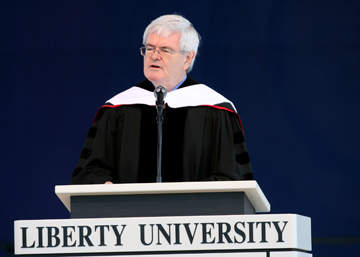

Jerry Falwell, Jr., Jonathan Falwell, Dr. Godwin, Provost Rist, members of the Board, faculty, administrators, distinguished guests, and, most of all, the Graduating Class of 2007. As I look out upon you I am deeply grateful to Dr. Falwell for inviting me to come and bear witness to our need to rediscover God in America. It is in response to his call that I ask you to hear this witness.
We gather on a day like no other in the history of Liberty University. We gather to honor the Class of 2007. Congratulations, one and all! You have worked for years to arrive at this day, and you and your parents can take justifiable pride in all of your achievements. But as we celebrate, we are all mindful of the seat of honor that is empty this beautiful Spring morning.
Dr. Jerry Falwell, our dear friend, has been called home to be with the Lord.
…
When we consider Dr. Falwell’s many achievements, we can confidently say, as was written two thousand years ago by Matthew: Well done, good and faithful servant, well done.
…
“My heart,” Jerry once said, “was burning to serve Christ … I knew nothing would ever be the same again.”
He was never the same again — and neither were we.
The image of a heart, enflamed with a desire to serve God, calls to mind the words of our Lord at the Sermon on the Mount: “Do not light a lamp and put it under a bushel, but on a stand, that it may give light to the whole house”.
Jerry Falwell was a man of courage. A servant leader of God, he lived his faith without hesitation or fear. Not once did he consider lighting a lamp, and hiding it under a bushel. No: he placed his lamp upon a stand, where it gave light to the whole house.
One of Dr. Falwell’s favorite scripture verses was from the second chapter of Habakkuk: “Write the vision, and make it plain upon tables, that he may run that readeth it. For the vision is yet for an appointed time, but at the end it shall speak, and not lie: though it tarry, wait for it; because it will surely come, it will not tarry.”
…
The vision of Dr. Falwell was more than he could accomplish in his lifetime. We know that he had much more planned for Liberty, but like him we can be confident in the scriptures’ promise that though the vision is for His appointed time, it will surely come.
All his life, Dr. Jerry Falwell bore witness to the Truth, secure in the promise that the Truth will make us free.
A man of deep wisdom, he understood something quite profound, something that too many people today would rather not acknowledge. What he understood was the deep resonance between the demands of his faith and the demands of his nation. He saw that as the Bible requires Christians to bear witness to the Truth, so too does the Declaration of Independence require Americans to bear witness to certain self-evident truths.
To be sure, the Truth of the Bible is not identical with the truths of the Declaration. But the two orders of truth do overlap, and where they overlap, they powerfully reinforce each other. Indeed, the Declaration assumes many of the central teachings of the Bible.
When our Declaration of Independence asserts “We hold these truths to be self-evident, that all men are created equal, that they are endowed by their Creator with certain unalienable Rights, that among these are Life, Liberty and the pursuit of Happiness”, it makes some key assumptions.
It assumes that God is sovereign over the universe.
It assumes that God created man.
And it assumes that man must obey an order of justice which God Himself has instituted.
That order of justice requires all men to honor each other’s natural rights, because these rights are the unalienable endowment of the Almighty. When someone violates the rights of another they are not merely breaking the law. They are violating God’s grant of protection. These are the truths of the Declaration of Independence, and they reflect the Truth of the Bible.
They are truths to which we must bear witness. They are the lamps which we must keep alight before our neighbors and before the world. These are the lamps which must be kept upon their stands.
We have relied upon these truths in our times of crisis; they have been the lights that guided us through our darkest hours.
In one of the America’s most difficult periods, as the nation plunged headlong towards civil war, Abraham Lincoln recalled the basic assertion of the Declaration, that “nothing stamped with the Divine image and likeness was sent into the world to be trodden on, and degraded, and imbruted by its fellows.”
82 years later, while the flames of war spread across Europe and the Pacific, President Franklin D. Roosevelt wrote that “Our modern democratic way of life has its deepest roots in our great common religious tradition, which for ages past has taught to civilized mankind the dignity of the human being, his equality before God, and his responsibility in the making of a better and fairer world.”
FDR, the greatest Democratic President of the 20th century, believed in good and evil and believed his generation faced a war between Christianity and paganism.
President Roosevelt understood how hard it can be to defeat evil. On D-Day, the 6th of June, 1944 as hundreds of thousands of young Americans risked their lives to defeat evil, FDR went on national radio to lead the nation in prayer.
He said these words in prayer and I take the time to recite them in their entirety today and invite all to listen in prayerful reflection as we consider our own young Americans — our sons and daughters, our neighbors in harm’s way around the world. Listen how FDR spoke of the Greatest Generation as it launched its mightiest battle:
“My Fellow Americans:
“Last night, when I spoke with you about the fall of Rome, I knew at that moment that troops of the United States and our Allies were crossing the Channel in another and greater operation. It has come to pass with success thus far.
“And so, in this poignant hour, I ask you to join with me in prayer:
“Almighty God: Our sons, pride of our nation, this day have set upon a mighty endeavor, a struggle to preserve our Republic, our religion, and our civilization, and to set free a suffering humanity.
“Lead them straight and true; give strength to their arms, stoutness to their hearts, steadfastness in their faith.
“They will need Thy blessings. Their road will be long and hard. For the enemy is strong. He may hurl back our forces. Success may not come with rushing speed, but we shall return again and again; and we know that by Thy grace, and by the righteousness of our cause, our sons will triumph.
“They will be sore tried, by night and by day, without rest — until the victory is won. The darkness will be rent by noise and flame. Men’s souls will be shaken with the violences of war.
“For these men are lately drawn from the ways of peace. They fight not for the lust of conquest. They fight to end conquest. They fight to liberate. They fight to let justice arise, and tolerance and goodwill among all Thy people. They yearn but for the end of battle, for their return to the haven of home.
“Some will never return. Embrace these, Father, and receive them, Thy heroic servants, into Thy kingdom.
“And for us at home — fathers, mothers, children, wives, sisters, and brothers of brave men overseas, whose thoughts and prayers are ever with them — help us, Almighty God, to rededicate ourselves in renewed faith in Thee in this hour of great sacrifice.
“Many people have urged that I call the nation into a single day of special prayer. But because the road is long and the desire is great, I ask that our people devote themselves in a continuance of prayer. As we rise to each new day, and again when each day is spent, let words of prayer be on our lips, invoking Thy help to our efforts.
“Give us strength, too — strength in our daily tasks, to redouble the contributions we make in the physical and the material support of our armed forces.
“And let our hearts be stout, to wait out the long travail, to bear sorrows that may come, to impart our courage unto our sons wheresoever they may be.
“And, O Lord, give us faith. Give us faith in Thee; faith in our sons; faith in each other; faith in our united crusade. Let not the keeness of our spirit ever be dulled. Let not the impacts of temporary events, of temporal matters of but fleeting moment — let not these deter us in our unconquerable purpose.
“With Thy blessing, we shall prevail over the unholy forces of our enemy. Help us to conquer the apostles of greed and racial arrogances. Lead us to the saving of our country, and with our sister nations into a world unity that will spell a sure peace — a peace invulnerable to the schemings of unworthy men. And a peace that will let all of men live in freedom, reaping the just rewards of their honest toil.
“Thy will be done, Almighty God.
“Amen.”
[PAUSE]
Since our schools so often fail to teach the full nature of President Franklin Delano Roosevelt, it would be in the spirit of Dr. Falwell’s lifetime work to ask that every radio station on June 6, D-Day, to play the full national radio prayer of FDR and remind Americans that we can be united in the face of evil, we can seek God’s guidance for America, we can support our young men and women in uniform who risk their lives, and we can be determined to defeat evil.
That project would be a living extension of Jerry Falwell’s commitment to ensure that all Americans understood that we are a nation founded and sustained by our Creator.
FDR knew this truth, as did Lincoln and Washington before him.
In our hours of desperation, both as individuals and as a country we return to our founding truths, time and again.
Even today, these truths continue to sustain and guide us. In this age we face the irreconcilable wing of Islam, an enemy who does not believe that God created all men equal by right. According to their evil ideology, the Islamist believes that justice is only owed to fellow Islamists–while the rest of humanity (even fellow Muslims) has no rights.
The American believes that all men and women — all — have equal rights, because that is the will of the Almighty and it is God that endows them. Indeed, we believe that no person stamped in the Divine image and likeness was sent into the world to be trodden on, degraded, and imbruted by its fellows.
Just as with the Nazis and the Communists, darkness is again falling across the earth, and it is again the calling of America to light her moral lamps, and place them out, for all the nations to see.
Today, however, we face an additional difficulty. We are accustomed to having the truths of the Declaration challenged from without.
But what is new, is that for the first time in our history, those truths are now being challenged from within. A growing culture of radical secularism declares that the nation cannot publicly profess the truths on which it was founded. We are told that our public schools cannot invoke the Creator, nor proclaim the natural law, nor profess the God-given equality of human rights.
In hostility to American history, the radical secularist insists that religious belief is inherently divisive, and that public debate can only proceed on secular terms when religious belief is excluded.
In this contorted logic, the public square becomes more welcoming to the extent that it strips away and banishes all religious symbols and language.
Unfortunately, these false principles of secular absolutism have deeply penetrated the legal establishment. It is called upon to justify all sorts of judicial destruction. In New Jersey, school officials prevented a student from reading to the class his favorite story, because it came from the Bible. In Pennsylvania, a teacher’s assistant was suspended because she wore a necklace with a cross. And in California, the nation’s most persistent secularist has renewed his crusade to strike the words “under God” from the Pledge of Allegiance.
To his great credit, Rev. Falwell decided to step forward publicly and counter the outrageous intolerance of the secular absolutists. This was a difficult decision. Early in his ministry, Rev. Falwell was reluctant to be involved with politics. But he changed his mind. He later explained that “I never thought the government would go so far afieldb
Jerry Falwell’s heart “was burning to serve Christ” in this way. And because of his courage, America is not the same.
…
Jerry Falwell understood that the relentless efforts to drive God from public life would inevitably affect our respect for life itself. It would pressure believers to hide their lamps beneath a bushel. Jerry refused. He would not be passive. He would not be ashamed. He would not be cowed. Instead, he would bear witness. And he would act on those convictions.
And he was absolutely correct to do so. For three reasons.
First of all, because basic fairness demands that religious believers deserve a chance to be heard. This is a democracy. We are supposed to invite all persons and all parties to the public debate. It is wrong to single out those who believe in God for discrimination. Yet today it is impossible to miss the discrimination against religious believers.
We often hear the need to celebrate free secular and artistic expression–but rarely for religious expression.
Too often, the courts have been biased against religious believers. This anti-religious bias must end.
Second, we would all benefit from reflecting on the wisdom of the Founding Fathers. The Founders considered religion a great benefit to society. They had a very straightforward belief that the purpose of government was the protection of liberty, and that the maintenance of liberty inevitably required virtue among its citizens.
…
Implicit within this vision of the Founding Fathers is a pluralistic sensibility. Any true religion would be therefore deserving of the respect of the government, which would include the freedom to express in public the moral principles of such a true religion.
Constitutional self-government requires personal self-government; the more the government can rely on its citizens, the less it will need to govern them because they will govern themselves.
This belief that religion was an indispensable support of republican government was to be found throughout the founding generation.
Its strongest and best statement is to be found in George Washington’s “Farewell Address”. He said:
“Of all the dispositions and habits which lead to political prosperity, religion and morality are indispensable supports. In vain would that man claim the tribute of patriotism, who should labor to subvert these great pillars of human happiness, these firmest props of the duties of men and citizens.”
Washington’s words are as true today as they were 210 years ago.
We must recognize that the benefits of these indispensable supports cited by Washington accrue to Americans not just of one particular faith, but of all faiths, and all people of goodwill, religious or not. Washington and the other Founding Fathers feared that the weakening of these religious supports would undermine the very republican institutions under which all Americans find their liberties.
It is in this tradition that I wrote Rediscovering God in America to outline the truth of Washington’s words as evidenced in the monuments and buildings of Washington.
Finally, speaking personally, as a Christian to fellow Christians, we must bear witness to these truths because we have been commanded to do so. We possess a treasure of great worth, one which we have been instructed to share with the world. We cannot hide our lamps, because we have been instructed by God not to hide our lamps. Let us firmly resolve to put them upon a stand, and let them burn brightly, a gift from God for all the world to see.
…
Dr. Falwell refused to put his lamp beneath a bushel, and because of that, he was often unfairly caricatured. Though he faced tribulation, he remained of good cheer. His students often heard him say: “You do not determine a man’s greatness by his talent or wealth, as the world does, but rather by what it takes to discourage him.”
Through it all, Jerry Falwell put his trust in the Lord. Despite all obstacles, he persevered and was not discouraged.
…
Carry out Dr. Falwell’s dream of creating a better America and a better world and remember always that while you live in the world, you are not of the world.
Therefore, members of the Class of 2007, as you step forward to receive your degrees, I ask you to resolve yourself to give, and never count the cost; to fight, and never heed the wounds; to labor, and never seek reward. Trust that your strength shall be renewed; that you shall be lifted as with eagles’ wings; that you shall run, and not grow weary. And together with the thousands here assembled and the millions across the country touched by this University and its founder, let us resolve to follow the charge of the Gospels and the example of Dr. Jerry Falwell, to light our lamps, and place them upon a stand, that all the world may see.
Thank You.
