
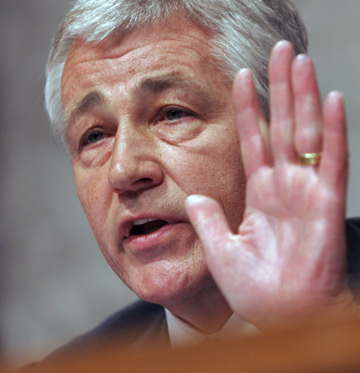

Mr. Chairman, thank you.
Gentlemen, welcome.
As Senator Dodd and others have noted this morning, every American is proud of the service of our American military and those who are serving in what ever capacity in a very difficult situation in Iraq. And we should not, at all, confuse the sense of support and the gratitude that all Americans have for your leadership and your service.
That said, we, just as you, each have responsibilities. We are elected by the people of our states. To question strategy is not unpatriotic.
Now, with that said, Ambassador, General, when you look at, and I know you have, the preceding reports that we have talked about today — and you have added to with information numbers, General Jones’ report, the General Accountability report. I spent some time with Stuart Bowen, the I.G. for Iraq reconstruction. Of the latest national intelligence estimates, Anthony Cordesman’s latest report [sic]. Thread throughout those reports, and then listening carefully to what the two of you said this morning, are some very bright line contradictions.
Now, let’s start with one that almost everyone that I am aware of has said the core issue is, the most important issue, and that is political reconciliation.
And I have quotes from you, General Petraeus, and you, Ambassador Crocker, from the president, every senior member of our government, involved in our policy and our strategy in Iraq — all agree, as you said, General Petraeus, that there will be no military solution in Iraq.
Now, when you look at the reports, let’s start with the question I asked the comptroller general last week when I asked him his analysis of the current Iraqi government: Is it a functioning government? And his response to me was: At best, it is dysfunctional. You may disagree with that.
But when you take the sum total analysis of these reports that we’ve look at, they lead us to a pretty clear conclusion, that, in fact, this government in Iraq is dysfunctional.
And when you add further to what the chief of staff of the United States Army had to say, General Casey, about tactical effects of surges and how minimal they are, and how they will, as Admiral Fallon has said, quote, “No amount of time or troops will make much difference, unless there is a political reconciliation,” I doubt if either or you disagree with that analysis. If you do, please tell the committee why.
The other part of this is that it seems to me logical that when you flood a zone with more troops, when you put more troops in Baghdad or Anbar province, you’re going to see some consequence to that, you’re going to see some result.
So I don’t think that’s particularly news, that where we have inserted more American troops, costing more American lives, we’ve seen some differences.
But just as one of the most flawed dynamics of our policy invading Iraq four and a half years ago is we never had enough troops, we still don’t have enough troops, so it seems to be logical that it would follow.
But when you look at the southern part of Iraq, which I noted that neither one of you noted today, one of the senior members of General Jones’ task force said to me when he returned, “We’ve probably lost southern Iraq.”
I said, “You must be kidding.”
He said, “No.” He said the four provinces of southern Iraq are gone. They are lawless. There is no Iraqi national army down there. The police are corrupt, as indicated in General Jones’ report, incidentally, as well as others.
The British used to have 40,000 troops in Iraq. As you well know, they are at about 5,000. They’re huddled in the airport in Basra.
What I was told by not just this individual from General Jones’ group, but other reports, intelligence reports and other reports I get, actually in the newspaper, is lawless gangs of marauders, of Shia militia, are in charge in Basra and those four provinces.
As you both know, two governors have been assassinated in the last two months. I was told by one individual who has been down there recently that we are actually essentially paying tribute to these people to keep open the port.
Now, the contradictions, in my mind, Ambassador and General, as much as you want to put a good picture on this, and that’s partly, I understand, your job. And I understand it’s your responsibility. And I don’t question that you believe exactly what you have come before this committee to say.
But I have to ask this question: Where is this going?
Now, let’s don’t get down into the underbrush of the 18 benchmarks — and by the way, let’s clear some of the record on that — those 18 benchmarks didn’t come from the Congress of the United States. Those benchmarks came from the Iraqi government and this administration.
Somehow it’s the Congress dictated these benchmarks. Well, we didn’t. We didn’t.
Well, let’s not argue about who’s got better numbers or better numbers in the context of more frequent numbers. Let’s get above the underbrush and look at the strategic context, which, essentially, we have never done.
It’s not your fault, General. It’s not Ambassador Crocker’s fault. It’s this administration’s fault. We have never, ever looked at Iraq from the larger strategic context, of not Iraq only but Iran, Syria, and the Middle East.
Now, where is this going to go?
Because the question that is going to continue to be asked — and you all know it and you have to live with it — and when you ask questions, as we all do, about is it worth it, the continued investment of American blood and treasure, when Senator Dodd presents to do [sic] the evaluation of one lonely enlisted man — and by the way, I assume you read the New York Times piece two weeks ago — seven NCOs in Iraq, today, finishing up 15 month commitments.
Are we going to dismiss those seven NCOs? Are they ignorant?
They laid out a pretty different scenario, General, Ambassador, from what you’re laying out today.
Senator Biden said to me once — I think it was on our first trip to Iraq. He turned around and I was gone. He said: Where did Senator Hagel go?
He found me out talking to the guys in the jeep, the corporals and the sergeants who have to do the dying and the fighting.
I’ve always found that, if you want an honest evaluation, and not through charts, not through the White House evaluations, you ask a sergeant or a corporal what they think.
I’ll bet on them every time, as I know you will, General. I know you will.
Now, where is this going?
We have got too many disconnects here, General — way too many disconnects.
Are we going to dismiss the five reports that I just noted?
I would say to you, Ambassador, one of your quotes: “If we don’t be careful we are going to see Iraq devolve into a civil war.”
Come on. Our national intelligence report, earlier this year, said we’re in a civil war. It is sectarian violence.
But yet you said that in your testimony this morning. You give us a great inventory of what a brutal, bloody dictator Saddam was. Well, we know that. That is not the issue here.
Are we going to continue to invest American blood and treasure at the same rate we are doing now, for what? The president said let’s buy time. Buy time? For what?
Every report I’ve seen, and I assume both of you agree with this, there’s been, really, very little, if any, political process that is the ultimate core issue, political reconciliation in Iraq.
I know my time is up, but I would appreciate, Mr. Chairman, if I could get an answer from these two gentlemen on that question. Thank you.
Crocker: Thank you, Senator. I’ll just touch very briefly on the key and critical points you raise here.
There is an enormous amount of dysfunctionality in Iraq. That is beyond question. The government, in many respects, is dysfunctional, and members of the government know it. There is a lot of discontent about that in and out of government. And, if you will, that is some qualified good news.
People who previously espoused a strict sectarian or ethnic line in how positions were apportioned, for example, are now saying: This isn’t working. That is part of the debate in Iraq; and a fairly common part of the debate. The application is going to be a lot more difficult, but Iraqis are talking about, precisely, that kind of dysfunctionality.
A second point I would make is on security and violence. Iraq, in my judgment, almost completely unraveled in 2006, and the very beginning of 2007, as sectarian violence after February ’06 just spiraled up.
Under those conditions, it is extremely difficult — it is impossible to proceed with effective governance or an effective process of national reconciliation. It is just in the last couple of months that those levels of violence have come down in a measurable way.
And we can have lots of debate about what measure is used, but the one that as a foreign service officer that I take the most seriously is the perception among Iraq’s leaders, all the main communities, that the security situation has improved.
That gives you an environment when you can start working on meaningful national reconciliation. And that’s why I placed an emphasis in my statement on the need for Iraqis to work out these fundamental questions that are as yet unresolved. What is the state going to look like? What is the relation between the provinces and the center, and the provinces and each other?
That’s still unresolved. Now they’ve got — they’re starting to get the space to work on it.
What I do point to as a moderately encouraging factor is that when security does improve, as we saw in Anbar, political life starts up again. For example, in Anbar now, every significant town has a municipal council, has an elected mayor. That was not the case six months ago.
We have also seen provinces and the center connecting to each other. And if there is one thing where the government is showing some functionality on, in marked difference to last year, is distributing revenues. Provincial budgets are being funded and are being funded in a reasonably equitable way. We do not hear from the Sunnis that they’re getting shortchanged, for example.
So that suggests to me that, at a minimum now, we’ve got an environment developing, not fully developed, but developing with violence at low enough levels where a meaningful discussion on national reconciliation can take place. That’s now what needs to happen.
Petraeus: Senator, first of all, with respect, my responsibility as I see it is not to give a good picture, it’s to give an accurate picture, as forthright a picture as I can provide, and that is what I’ve tried to do.
Second, we certainly will not be at the same rate of forces. If the recommendations are approved, as I mentioned, the Marine expeditionary unit, 2,000-plus, will be coming out this month, and we’ll then draw down one-quarter of our ground combat brigades and two additional Marine battalions.
Biden: General, point of clarification. Excuse me. Was that expeditionary force, they were scheduled to come out anyway, right?
Petraeus: Sir, they’re scheduled to come out, but I could have easily requested an extension of them. And, in fact, we were — I considered that. We did request an extension earlier, and that was granted. And, in fact, so we are now allowing them to go home.
Biden: Excuse me, again. You extended them to 15 months?
Petraeus: No, sir. This is a MEU that was a float MEU, came ashore a couple of months ago, was extended on the ground just to continue the work.
Petraeus: They’re working north of Fallujah cleaning up a pocket of al-Qaida, allow the Iraqi army to go in there and to replace them in that area, and they will now go home without replacement. The key is, without replacement, actually.
The MEU is scheduled to rotate out, and that was going to happen, but we’re not asking for the Central Command strategic reserve. Again, that’s the point.
Biden: Thank you for your clarification.
Petraeus: And then, as I mentioned, the other forces. Another important point, Senator, is that many of the positive developments have not just been a result of additional forces. In some cases, they have. There’s neighborhoods in Baghdad where we are sitting on a sectarian fault line trying to stabilize it, stop the (inaudible) that continues. It literally — just this sectarian violence that never stops until the area is stabilized.
And there are some neighborhoods where we are, indeed, trying to do that. The seven sergeants are in one such neighborhood. But in a number of cases, the progress is not just because of more forces sitting on a problem; it’s the result of a fundamental change on the ground. Nowhere is that more visible, obviously, than Anbar province where — and this bears out the whole idea that it is about political change.
What happened in Anbar is politics. It was the result of tribes, sheikhs saying no more to al-Qaida. That’s a political decision, to oppose an organization with which they were, at least tacitly, in league, and, perhaps, supporting. And that has happened in other areas now, as well.
In Diyala province, a very, very challenging area, mixed ethnic — in fact, Sunni, Shiite and Kurd — the sheiks have come together there and said, “We reject extremism of any form,” including, therefore, Shia militia extremism.
Petraeus: And the government, and we, are trying to help them build on that, how to use that to augment, to reinforce, build on the success that our soldiers and Iraqi forces achieved in clearing Baqouba of al-Qaida, to then hold it and continue that effort with the support, again, of the tribes. And that is hugely important because that is a shift.
Sunni Arabs, by and large, in Iraq for a number of years were supportive, at the least — at least tacitly, again — to al-Qaida because of their feelings of dispossession, disrespect, unemployment and a variety of other reasons. And that is an important development. That is an important phenomenon that we obviously want to work very hard to reinforce while ensuring that we still tie it into the center sufficiently so that it does not create additional problems down the road.
We are talking about really, sort of, finding who are the irreconcilables and trying to isolate them and then to help the Iraqi government to bring the reconcilables to become part of the solution instead of part of the problem.
And that is what has happened, again, most notably in Anbar but it is applicable to some degree in other areas, as well.
Thank you, sir.
