
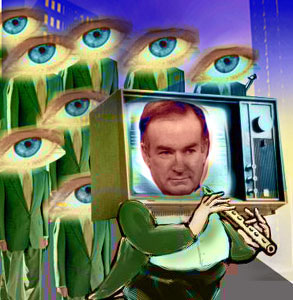

Many Americans love their televisions, their speedy Internet connections, the high they get from an Instant Messenger pop-up, the sense of gratification that washes over them when they open up their in box and watch the e-mails roll in. They have their beloved news programs and TV dramas, the Web sites they’re addicted to and the talking head experts they trust. And yet these same connected people can often be heard complaining about The Media — that simultaneously shadowy and invasive conglomerate of sounds, images and information — as if it’s responsible for much of the evil in the world. We crave information like candy, gobble it up all day and then grumble about it when our bellies ache later.
The observation that media outlets overwhelm us isn’t new, but the very nature of this seemingly all-encompassing entity makes it pretty hard to bring into focus. Todd Gitlin, a professor of culture, journalism and sociology at New York University, has spent years trying to sort out the media’s influence. His book “The Whole World Is Watching” dissected the New York Times’ and CBS’ coverage of the New Left. “Inside Prime Time” was a rigorous study of the network television industry, and Gitlin has written many other essays on everything from sound bites to MTV.
In his latest book, “Media Unlimited: How the Torrent of Images and Sounds Overwhelms Our Lives,” Gitlin attempts to break down the fast and furious influx of news, music, TV and other mediums. Gitlin recently spoke with Salon from his home in New York about the cluelessness of the TV networks, the Washington Post’s love for Ken Starr and why conservative viewpoints thrive on TV and radio.
In general it seems as if network television is really on the decline. It seems as though, in terms of quality, there’s HBO and then everything else. Network TV has increasingly bad reality shows, like “The Bachelor,” and then HBO is holding up this very high standard of programming.
HBO has the advantage of financing itself by subscriptions. Any enterprise that’s subscription-based has some latitude. That’s true of sex channels or high-end sports events, and it’s evidently true of a commercial entity like HBO. I don’t know how well they’re doing financially, and I wouldn’t rule out the possibility that there is principle at work. Certainly, large attention-getting industries are not manned or womanned solely by corrupt people without principle.
The networks, on the other hand, are obviously thrashing around in a state of panic. The Koppel-Letterman debacle, for which they were excoriated rightly, was not only terrible public relations but also a sign of their rudderlessness. There are many such signs — the quiz show binge and reality shows and so on. I don’t know how they can stop their erosion. They had a long way to come down; at the peak in prime time the three networks were able to garner some 92 percent of the viewers. They’re now down to the 50s. That’s still not insubstantial. They well may be able to hold out at that level or slightly below, but what’s striking to me is that tendencies which were already at work there — toward a kind of nihilistic whatever-goes attitude — just got more room to come into play.
“Nihilistic” is a strong word.
What I mean by nihilism — and what I learned by studying that industry 20 years ago — is that there aren’t a lot of ideas or convictions on the part of people who make these decisions. The economic rationale of their imitativeness — including their self-imitativeness — is, “Well, we don’t really know what works, so let’s repeat what worked and let’s throw money at the studio or the star or the producers who gave us hits.” When there was no competition or hardly any, this was good enough.
I actually tried to see how good they were as businessmen. I looked at a couple of seasons in the early ’80s and asked the question, “Of all the new shows that went on the air this year, after a very elaborate selection process that narrows down from thousands of ideas to tens of programs, how well did they do by strictly business criteria?” I looked at how many were renewed for the next year — straightforward success criterion. Two-thirds of them were not. That was at a time of oligopoly. The aggregate market share was 84 percent. That was when they could do anything they liked.
No surprise. There’s a culture of indiscriminateness. Generally, they don’t have very good reasons for doing what they do. And then, of course, if something succeeds, there’s a retroactive, backpatting and genius-anointing operation. But that’s the culture of the television-entertainment industry. Sometimes they’ll get lucky and strike “Survivor” for a while.
There could be some downsizing, and it’s certainly conceivable that one of the news organizations will suffer that fate. Or be so continuously downsized as to make it more of a fagade, using few bureaus, more purchase footage, having a small stable of reporters who run around narrating voice-overs for other people’s reporting.
Is there an oversaturation point in place with the news, so that we no longer care about the real issues at hand?
Definitely. Most Americans still think violent crime is increasing, when it isn’t. The local news and the cop shows cultivate this fancy. Some of these binges have more staying power than others, but they suck all of the oxygen out of the mental room. So they contribute to a national attention deficit disorder. While we’re doing OJ, OJ is the biggest character in the national news, and then we’re onto, briefly, Marv Albert, or Kathy Lee and Frank Gifford. Other stories have more legs. I’ve been realizing that during the year 1998, when bin Laden walked into national life by organizing the massacre at the two embassies in Africa, obviously that was a news story, but it pretty much came and went, while of course, the big story was Monica and Bill.
And Clinton’s retaliation for the bombings was dismissed as “wagging the dog.”
But that was also because of the political game the Republicans were playing, namely suggesting that there’s a domestic motive for fighting against terrorists. There’s a political corruption here, too. Of course, if the Democrats tried that this year, they’d be creamed for it.
Do conservative viewpoints come off better than liberal ones on TV?
Yes, and on the radio, too.
Why is this the case? And is that why Fox News is so popular?
Some of the argument is made by Jeffrey Scheuer in his book “The Sound Bite Society.” What plays best on television is melodrama, what I call “percussive punditry,” in which the point is to pound and to stir resounding reverberations. That’s easier done when you have polarized positions and simple, moralistic declarations. The right is better at that than the left. The right isn’t interested in nuance. Rush Limbaugh’s people proudly call themselves Dittoheads. The left has many sins, but people on the left tend to be looser and more uncomfortable with flat moralistic declarations. This imbalance gives an advantage to the right.
Also, there’s the fact that Rupert Murdoch or his equivalents in other enterprises are obviously far more comfortable with right-wing fanaticism than left-wing fanaticism for obvious ideological reasons. But the barking head phenomenon — the Sunday morning CNN, post-McLaughlin inspired approach — is better suited to a sort of hypermasculine aggressiveness. This aggressiveness somehow finds it more comfortable to beat up on elected politicians than on corporate types.
And this is partly because of the liberality, the tolerant social attitudes of the pundits and the news executives. They’re actually bending over backward to demonstrate that they don’t have it in for Republicans. This bend-over-backward effect has been in play since Reagan. You have to ask why it is that people who are rather tolerant and anti-repressive on social issues are actually kind to Reagan, to people around Bush Sr., to James Baker, to the Bush operation in Florida and now, to Cheney and Ashcroft. They’re at pains to demonstrate that they are rugged Americans and not pussies.
What do you think about the popularity of Fox News, and what kind of effect do you think it will have on network news in general?
Something interesting is going on. The latest figures about cable news in general are quite striking because there’s been a big upset since Sept. 11 in the aggregate of the three cable news operations. Up through 2000, the total audience during the course of a day during normal times was under a million. Now it’s a million and a half and bumping up toward 2 million. And Fox seems to be the major beneficiary of this.
People like Fox better than CNN. They like Bill O’Reilly’s kick-ass style. CNN is the unchromed, stripped-down truck and Fox is some sort of snazzy, rattling muffler sports car. That’s one factor. Secondly, a war mood brings out an aggressive devotion to simplification. CNN is scared of its shadow on this score, going back to the Gulf War when Peter Arnett was excoriated for staying in Baghdad and accused of virtual treason by Alan K. Simpson, the former senator from Wyoming, and others. [Simpson called Arnett an Iraqi sympathizer but later apologized.]
Today, we have Fox News executives … I’ve seen in-house memos, this remarkable e-mail that was sent out in the fall. This is a message from a Fox News senior vice president to staff, dated November 28, 2001:
“Let’s not get sidetracked worrying about the plight of Afghans this winter, or how many children are undernourished. We can help that country as soon as they cough up the guys who killed 5,000 Americans. When in doubt, take a look at the WTC collapsing.”
It shouldn’t be surprising, but it’s hard not to be a little shocked when you actually hear something like that. And do you think that networks will follow this lead?
Ideologically? The question is how strong are the counterpressures. You could make commercial arguments for counterpressures by saying that Fox will corral the yahoos so [other networks should try to] to corral the non-yahoos. That’s product-differentiation logic rather than journalistic principle.
The discouraging thing about CNN is how ready they were before Sept. 11 to turn into a news-magazine fluff network, which is, after all, where the news magazines have gone. That’s where Walter Isaacson, chairman and CEO of the CNN News Group, comes from. There was that famous memo from Isaacson, after he took over at CNN, saying that it was time to do more soft news. He was also running around cultivating Trent Lott and others in Washington. Then they had to fling some reporters into Pakistan and other places from which they were planning to retreat. I suspect that as they flounder about looking for a mission … I don’t think they’re going to be looking for left-of-center counterparts to Robert Novak.
An interesting passage in “Media Unlimited” was about your experience with NBC news. They manipulated your opinions about the Gulf War, and some of your friends and colleagues were pretty angry about it. The episode basically drove home that these news shows have their stories written long before they do the interviews.
I was living in Berkeley, sometime in 1988, and ABC did a “Person of the Week” on Tom Hayden. I guess Tom was a delegate to the Democratic Convention at the time. It was clear to me when the producer called that the line of the piece was “this is where ’60s activists have gone.” On the phone, I said that I thought that was one thing that was going on but that there were other things going on, too. I wasn’t included in the piece. What I said was too complicated. It’s extremely common. I’m frequently called by reporters for comments on this or that and not always, but half the time, I know what I’m expected to say. I’m being cast for a part.
On television, the institution of the pre-interview is very much apropos here. It just happened to me on the Canadian equivalent of the “Today Show.” Whether you’ve already been declared a guest or whether you’re simply being scouted as a possible guest, a producer will call you and conduct a pre-interview which can last up to a half hour. They’re probing for your views. One motive is to prepare the host. In general, they’re looking for balance and, on hard-hitting shows, for polarization. I wouldn’t call this censorship exactly; it’s a matter of smoothing the operation. But it has the effect of making you easily cast, whoever you are.
The media does sometimes get called on its mistakes, though.
I took a whole discussion out of the book about authenticity scandals and how various media police themselves. When they’re charged with violating canons of truth, they get very nervous and then will punish someone or publicly declare that they won’t do it anymore. Whether it’s moving the pyramids closer together to fit on the cover of National Geographic in the late ’80s or sticking Oprah’s face on Ann-Margret’s body in TV Guide. ABC started a binge with simulations on the news. There was a lot of anxiety and anger about that.
Most recently the New York Times Magazine ate crow when it proclaimed at great length in an editor’s note that they had run a piece by Michael Finkel which involved composites [fictional individuals described in a story who are a combination of the traits and experiences of several actual people]. That was a big message — composites violate rules of transparency. Periodically, there are these little scandals that suggest that it’s very important for news organizations to declare that they’re on the up and up. Fox has been through this with Geraldo. In a way, the fact that these scandals exist is a tribute to the depth of the expectation that most people have that what they’re seeing is true.
What about things that aren’t quite scandals, but still mistakes, like the New York Times and Whitewater? Is it their responsibility to acknowledge their complicity in pushing that investigation along for so many years, or were they doing their job at the time? Now that the Ray Report is out, and the Clintons have been pronounced innocent, should the Times have dealt with their part in all this?
Absolutely. Their part was immense, in both Whitewater and Lewinsky.
What could they have done?
They should have ‘fessed up. [New York Times Editorial Page Editor] Gail Collins should have taken the chance to step away from the shadow of [New York Times Executive Editor] Howell Raines, but I guess those politics are delicate. Or maybe she agrees with him. The insistence of the editorial page in particular, the crusade, the obsession with the hunt, the animus against the Clintons, is a scandal. It was a political force in the 1990s, and it would be honorable to face up to it. I did see the Wall Street Journal the other day. They’re very creative. On their editorial page, one point they made was that Nixon was rightly embarrassed by his misdeeds and kept the tapes, whereas the Clintons never came clean. Nixon is their moral exemplar.
Do you believe the New York Times is still America’s best newspaper?
The Times is our best newspaper, and it’s a better newspaper than ever before, but it has this squeamishness about criticism. One of the improvements of the Times is that the news of the week has become more than a book report, more than a roundup. It’s actually written by reporters with voices. There must be some growing autonomy there.
What about the Washington Post?
In yesterday’s Washington Post there’s an amazing, fiery letter from James Carville. It’s quite remarkable, to the Post’s credit, that they ran it because Carville basically says that the Post is still not owning up to the fact that they loved Ken Starr because of what he did for them in the Tavoulareas case. William Tavoulareas was the head of Mobil, and the Post did an exposi on him in the ’70s — it had to do with corruption, nepotism, favors to his son. Tavoulareas sued and won at the local level, won at the federal district level, and then the decision was overturned at the court of appeals level in a decision written by Ken Starr.
I learned about this, by the way, from Michael Schudson, who wrote a book about how Watergate was covered. He had told me the story of how he interviewed Bob Woodward in the late ’70s, early ’80s, about Watergate and Woodward said, “Yeah, Watergate was important, but more important in giving the press its head was this decision.” And Woodward ran upstairs and came back with a copy of the decision written by Ken Starr. This was the breaking of the chains on journalism. So many people thought that among the factors that made the Post rather gushy about Ken Starr was the fact that he had done them a great favor, though I don’t think that’s the whole of it. But anyway, Carville says this and the Post ran it. It’s remarkable.
Your book seems to take on the bigger questions about the state of media. What were you trying to figure out?
I had an itch of dissatisfaction with what I had done, and what others had done, which aimed to strip away some feature of media and get a grip on it — whether that’s news trends or Internet utopias or entertainment trends. When I sat down and looked at what I had written, I still felt like I hadn’t gotten to the hollow core of the beast.
Years ago, while I was working on “Inside Prime Time,” a book about the television industry, I was collecting a file of notes which I sort of goofily called Ontology. And what I meant was: “What does it mean that there’s this screen that you’re living on?” I was scribbling notes about things like the size of a screen and the brightness of the screen. These things have been gnawing at me for a long time.
I thought it was interesting that you set out to identify the different types of people and their relationships to the media. In your book, there’s the “The Paranoid,” “The Exhibitionist,” “The Ironist,” etc. Is it a good thing that people have adopted a specific identity in their relationship to the media, or do you think it will limit their ability to see the bigger picture?
It’s certainly better to cope than not to cope. So, yes, it’s a sign of aliveness that we try to find some dry land. Strategizing is better than lying prone and wallowing or collapsing into it. It’s a sign of vitality.
So are people aware of how media affects them?
Lots of people have some awareness that something odd is going on. One way that comes out is by people complaining about how busy they are. Some of the busyness has to do with real world connections — children, work, family. But some of it also is an awareness that there are too many media things to do, and yet they don’t quite satisfy.
Another way that people are aware of it is that many people sit down to watch television and end up watching more than they wanted. Just like someone regrets that they drank so much, it makes them feel uncomfortable. That’s why very modest efforts like National Turn Off Your TV Week actually get people going. It’s also why many teachers are restless with the restlessness of their students and wonder whether the fidgetiness that gets diagnosed as attention deficit disorder has something to do with the unacknowledged curriculum of all-around media.
Even the occasional campaigns to control one or another aspect of media, many of which are either too narrow or misguided, still reflect some awareness that people are bathed in a media environment that seems out of control. I’m thinking of the campaigns against violent video or nasty lyrics or the post-Columbine surge of censoriousness — the fear that violence is triggered or bad values are being conveyed. Those campaigns are often misguided and not intellectually solid, but they still reflect some anxiety about something that’s happening.
On the other hand, and this is especially true of shut-ins who tend to watch more television, there’s still a large number of people who feel thrilled or blessed with the nonstop stimulus.
You write that people find this comfort, or maybe a distraction, in connecting all the time. What’s actually good about it?
Much of it is very useful. I’m not an Internet utopian, but I’m not an Internet dystopian either. Because it’s far less controlled, the Internet does offer the possibility of something seriously challenging and interesting. As a writer, I find it very useful to get letters about pieces that I’ve written. Internet sites that cultivate some serious attention to things are a very good service to people trying to find some serious niche. Not to be overly flattering, but take Salon — the contentiousness and range and the very fact that there’s an ongoing book discussion in a culture that’s not terribly hospitable to that is a very good thing.
I’m involved with the Web site Open Democracy, based in London, which makes an effort to be cross-national and argumentative at the highest plane, inviting people to respond not to the weakness of people’s arguments, but to their strengths. And that, without any publicity, has taken off in the globalization debate, the post-Sept. 11 debate. It’s so early in the history of this thing to know how that’s going to pan out. To try to assess how valuable the Internet is at this stage would be like trying to figure out the significance of radio around 1923.
But then you do say that the Internet and various forms of media distract us from civic life, public life.
That’s largely true. It seems that the main use of it is for entertainment, for sports and celebrity stuff and even more for gambling and pornography. There’s an interesting debate about whether there’s a democratic function in Internet users being forced to confront people whose views are different from theirs. If part of what you want in a democracy is not simply that people express themselves but that they deliberate, then it’s important for them to get out of their bubbles. So the question is: Does the Internet perfect the bubbles and enable environmentalists to chat with other environmentalists while neo-Nazi skinheads chat with neo-Nazi skinheads, or is there some cross-fertilization and encounter going on?
Robert Putnam’s book “Bowling Alone” argued that television has a lot to do with why Americans are more antisocial and reluctant to join church groups, volunteer in the community or even participate in outdoor sports. You mentioned this in your own book. What are we missing and is this because of television and the Internet?
Putnam’s book is very well reasoned on this question. I find it completely conclusive that there’s this strong association, which is probably causal, between, on the one hand, dependency on television, especially for people who turn it on and leave it on all day, and civic withdrawal. What we don’t entirely know is whether this same process is operating in other countries. I’ve heard that it might not be. I was in Toronto earlier this month and I was told that the Canadian data don’t go that way. And I know about a presentation by a British scholar to the effect that this wasn’t happening in Britain either. I’m open-minded about that. But for America, I do think that Putnam has the goods. Television has a lot to do with it.
Before, you mentioned that sex and violence in the media aren’t making people more sex-crazed and violent.
I want to condemn vile video games and action movies on aesthetic and moral grounds. In general, though, people feel squeamish about saying that something is no good or debased. Instead, we want to say that it’s murderous or issue a public health warning. I just don’t find that persuasive. I have no trouble condemning racist or idiotic action movies or sentimental tripe of various kinds as bad work. But I certainly wouldn’t want Congress to legislate against bad work.
But didn’t you also say in your book that the constant presence of violence in media somehow makes it more acceptable to us?
Yes, I think that’s true. I don’t doubt that there’s a desensitizing, an anesthesia. We collectively normalized this whole repertory of blowing up buildings and “taking people out.” In some sense the years of anesthesia led many Americans to think that they “got” what happened on Sept. 11 because it was like a movie. No, it wasn’t like a movie. In a movie, the people who are “taken out” are stick figures. It doesn’t really matter that they’re gone. They were never there in the first place. Anesthesia is a more sinister consequence than the very, very occasional one where a kid sees a movie and says, “I would like to hold up a bank, too, and now I know what gun to buy.”
