

It’s finally Wizard of Oz time in America. You know — that moment when the curtains are pulled back, the fearsome-looking wizard wreathed in all that billowing smoke turns out to be some pitiful little guy, and everybody looks around sheepishly, wondering why they acted as they did for so long.
Starting on Sept. 11, 2001 — with a monstrous helping hand from Osama bin Laden — the Bush administration played the fear card with unbelievable effectiveness. For years, with its companion “war on terror,” it trumped every other card in the American political deck. With an absurd system for color-coding dangers to Americans, the president, the vice president, and the highest officials in this land were able to paint the media a “high” incendiary orange and the Democrats an “elevated” bright yellow, functionally sidelining them.
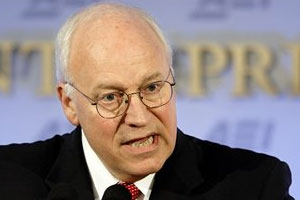
How stunningly in recent weeks the landscape has altered — almost like your basic hurricane sweeping through some unprotected and unprepared city. Now, to their amazement, Bush administration officials find themselves thrust through the equivalent of a Star-Trekkian wormhole into an anti-universe where everything that once worked for them seems to work against them. As always, in the face of domestic challenge, they have responded by attacking — a tactic that was effective for years. The president, vice president, national security advisor, and others have ramped up their assaults, functionally accusing Democratic critics of little short of treason — of essentially undermining American forces in the field, if not offering aid and comfort to the enemy. On his recent trip to Asia, the president put it almost as bluntly as his vice president did at home: “As our troops fight a ruthless enemy determined to destroy our way of life, they deserve to know that their elected leaders who voted to send them into war continue to stand behind them.” The Democrats were, he said over and over, “irresponsible” in their attacks. Dick Cheney called them spineless “opportunists” peddling dishonestly for political advantage.
But instead of watching the Democrats fall silent under assault as they have for years, they unexpectedly found themselves facing a roiling oppositional hubbub threatening the unity of their own congressional party. In his sudden, heartfelt attack on Bush administration Iraq plans (“a flawed policy wrapped in illusion”) and his call for a six-month timetable for American troop withdrawal, Democratic congressional hawk John Murtha took on the Republicans over their attacks more directly than any mainstream Democrat has ever done. (“I like guys who’ve never been there that criticize us who’ve been there. I like that. I like guys who got five deferments and never been there and send people to war, and then don’t like to hear suggestions about what needs to be done. I resent the fact, on Veterans’ Day, he [Bush] criticized Democrats for criticizing them.”) Perhaps more important, as an ex-Marine and decorated Vietnam veteran clearly speaking for a military constituency (and possibility some Pentagon brass), he gave far milder and more “liberal” Democrats cover.
For the first time since the war in Iraq began, “tipping points,” constantly announced in Iraq but never quite in sight, have headed for home. Dan Bartlett, counselor to the president and drafter of recent presidential attacks on the Democrats, told David Sanger of the New York Times that “Bush’s decision to fight back arose after he became concerned the [Iraq] debate was now at a tipping point”; while Howard Fineman of Newsweek dubbed Murtha himself a “one-man tipping point.”
Something indeed did seem to tip, for when the White House and associates took Murtha on, John Kerry, Nancy Pelosi and other Democrats leaped aggressively to his defense. In fact, something quite unimaginable even a few days earlier occurred. When Republican Rep. Jean Schmidt of Ohio, the most junior member of the House, accused Murtha (via a Marine colonel from her district) of being a coward, Democratic Rep. Harold Ford from Tennessee “charged across the chamber’s center aisle to the Republican side screaming that Ms. Schmidt’s attack had been unwarranted. ‘You guys are pathetic!’ yelled Rep. Martin Meehan, Democrat of Massachusetts. ‘Pathetic.'”
There could, however, be no greater sign of a politically changed landscape than the decision of former President Bill Clinton (who practically had himself adopted into the Bush family over the last year) to tell a group of Arab students in Dubai only two and a half years late that the Iraqi invasion was a “big mistake.” Since he is undoubtedly a stalking horse for his wife, that great, cautious ship-of-nonstate, the Hillary Clinton presidential campaign should soon turn its prow ever so slowly to catch the oppositional winds.)
If you want to wet an index finger yourself and hoist it airward to see which way the winds are blowing, then just check out how the media has been framing in headlines the recent spate of administration attacks. Headline writing is a curious in-house craft — and well worth following. Changing headline language is a good signal that something’s up. When the president attacks, it’s now commonly said that he’s “lashing out” — an image of emotional disarray distinctly at odds with the once powerful sense of the Bush administration as the most disciplined White House on record and of the president and vice president as resolutely unflappable. Here’s just a small sampling:
The Miami Herald, “President lashes out at critics of Iraq war”; the Associated Press, “Cheney Latest to Lash Out at Critics”; the Buffalo News, “Bush Lashes Out at War Critics”; even the Voice of America, “Bush Lashes Out at Political Opponents Over Iraq Accusations.”
In other headlines last week, the administration was presented in post-Oz style as beleaguered, under siege, and powerless to control its own fate: The Associated Press, for example, headlined a recent Jennifer Loven piece, “Iraq War Criticism Stalks Bush Overseas”; the New York Times, a David Sanger report, “Iraq Dogs President as He Crosses Asia to Promote Trade”; and CNN headlined the Murtha events, “A Hawk Rattles GOP’s Cage.”
The language used in such recent press accounts was no less revealing. Sanger, for example, began his piece this way:
“President Bush may have come to Asia determined to show leaders here that his agenda is far broader than Iraq and terrorism, but at every stop, and every day, Mr. Bush and his aides have been fighting a rearguard action to justify how the United States got into Iraq and how to get out.”
And Loven launched hers with, “His war policies under siege at home…” attributing the siege atmosphere and the Bush “counterattack” to “the president’s newly aggressive war critics.”
Lashing out, stalked, dogged, under siege, counterattacking, fighting a rearguard action — let’s not just attribute this to “newly aggressive war critics.” It’s a long-coming shift in the zeitgeist, as evident in the media as in the halls of Congress.
On Thursday, for instance, ABC’s prime-time TV news, which led with a story on the president “lashing out” at critics, then offered a long, up-close-and-personal segment in which a teary-eyed Murtha spoke of the war wounded he’s regularly visited at hospitals and the fraudulence of administration policy. That same night, another prime-time news broadcast turned the president’s claim that the Democrats were “irresponsible” in their criticisms into a montage of Bush repeatedly saying “irresponsible” in different poses — so many times in a row, in fact, that the segment could easily have come from a sharp opening sequence on Jon Stewart’s “Daily Show.”
None of this would have been possible even weeks ago in a country where it was once gospel that you don’t attack a president while he’s representing the United States abroad. That’s why, in the Watergate era, Richard Nixon had such a propensity for trips overseas and undoubtedly why our stay-at-home president’s handlers decided to turn him into a Latin American and Asian globetrotter. The question is: How did this happen? What changed the zeitgeist and where are we heading?
Polls are, it might be said, what’s left of American democracy. Privately run, often for profit or advantage, they nonetheless are as close as we come these days — actual elections being what they are — to the expression of democratic opinion, serially, week after week. Everyone who matters in and out of Washington and in the media reads them as if life itself were at stake. They drive behavior and politics. Fear, too, is a poll-driven phenomenon. Not surprisingly then, it was the moment late last spring when presidential approval ratings fell decisively below the 50 percent mark and looked to be heading for 40 percent, that the White House took anxious note and so, no less important, did a previously cowed media. Somewhere in that period, the fear factor, right in the administration’s hands, was transformed into a feeling fearful factor. As I’ve written elsewhere, faced with the mother of a dead soldier on their doorstep, all the president’s men blinked and the Camp Casey fiasco followed. Soon after, before hurricane Cindy could even blow out of town, Hurricane Katrina blew in and the president’s ratings headed for free-fall. In just the last month, they look as if they had been shoved over a small cliff, dipping in the latest Harris and Wall Street Journal polls to an almost unheard of 34 percent (only five points above Richard Nixon’s at his Watergate nadir).
The poll numbers that once gave the administration’s fear factor meaning have simply evaporated — as have any figures that might indicate that this administration is capable of staunching its own wounds. Emboldening media and political opposition in Washington, such figures give Murtha-like cover to behavior that not long ago would have been unthinkable. A record 60 percent of Americans surveyed in the most recent USA Today poll, including one in four Republicans, said “the war wasn’t ‘worth it.’ One in five Republicans said the invasion of Iraq was a mistake.” Those who felt things were “going well” for the country as a whole dropped nine percentage points in a month.
Democrats long ago fled the ranks of presidential supporters, as more recently have independents; now moderate Republicans are beginning to peel away too. According to Tom Raum of the Associated Press, “[Bush’s] approval on handling Iraq fell from 87 percent among all Republicans in November 2004 to 78 percent this month. Among Republican women, from 88 percent a year ago to 73 percent now. Among independents, approval on Iraq fell from 49 percent in November 2004 to 33 percent now.” If you want a figure that, from the administration’s viewpoint, offers a frightening glimpse into a possible future, consider the 79 percent of Americans who believe I. Lewis Libby’s indictment is “of importance to the nation”; this, despite Republican claims that the grounds for indicting were insignificant, and a new Libby defense fund made up of Republican high-rollers and assorted neocons.
In other words, replace the still emotionally charged issues of the war in Iraq and the president’s actions, where, at 34-40 percent, a bedrock base of support remains more or less intact, with a less charged ethics-in-government issue and that vaunted Rock of Gibraltar shatters. This is the previously inconceivable future so many Republican politicians suddenly fear.
Just for the heck of it, throw in another factor — “intensity” — and you have an even more volatile picture, given the lack of positive, potentially mobilizing news on the domestic and foreign horizons. E.J. Dionne of the Washington Post suggests that the polling figures are even worse than they look because intensity of feeling on the war issue is now “on the side of the war’s opponents.” He adds:
“The findings on the strength of feelings about the war were matched by the intensity of feelings about Bush himself: Only 20 percent of those surveyed said they strongly approved of the overall job Bush was doing, while 47 percent strongly disapproved. A president who has always played to his base finds that his base is steadily shrinking.”
In other words, doubt and demoralization are setting in — a political rot that can do untold damage. Given how many independents and moderate Republicans who once supported the war have changed their minds, the scathing attacks on Democrats for mind-changing on the war may not prove a winning strategy either. They may, as Raum comments, “backfire on Republicans.”
But here’s a question: Can we trace Bush’s polling near-collapse to its origins anywhere? In the latest issue of Foreign Affairs magazine under the eerie title, “The Iraq Syndrome,” John Mueller, an expert on how wars affect presidencies, offers a canny, cool-eyed interpretation of changing American opinion on Iraq. He tracks polling data on the three sustained wars — Korea, Vietnam and Iraq — the U.S. has fought in the last half-century-plus where we took more than 300 casualties.
All three show approximately the same polling pattern: broad enthusiasm at the outset, a relatively quick and steep falloff in support, followed by steady erosion thereafter from which no long-term presidential recovery seems possible (certainly not via heightened rhetoric). In all three wars, as support fell, pro-withdrawal sentiment rose. Though some experts link this pattern to an American “defeat-phobia,” Mueller points out that, in cases like Lebanon in the Reagan years and Somalia in the Clinton era, Americans have been quite capable of swallowing withdrawal and defeat (of a sort) without making the presidents involved pay any significant political cost.
The crucial factor in loss of support for each of these wars, Mueller insists, is a growing casualty list and not just any casualties either — only American ones. (The fact that “vastly more” Iraqis have died than all the victims of “all international terrorists in all of history” matters little, he observes, in American popular judgments on the war.) What makes Iraq stand out in this list of three “is how much more quickly support has eroded in the case of Iraq. By early 2005, when combat deaths were around 1,500, the percentage of respondents who considered the Iraq war a mistake — over half — was about the same as the percentage who considered the war in Vietnam a mistake at the time of the 1968 Tet offensive, when nearly 20,000 soldiers had already died.”
If Mueller’s right, then the steady drip of American casualties — many less dead and many more wounded than in Korea and Vietnam, in part because of improved medical care and triage techniques — has seeped deeply into American consciousness. This seems so, despite the administration’s careful attempt to keep returning bodies and individual funerals out of sight and so out of mind; despite the fact that the American dead have largely been kept off the front pages of American papers and photos of dead Americans off television (where dead Iraqis can regularly be seen). Short of massive drawdowns of American forces in Iraq, there is no casualty end in sight for this administration; and drawing down ground forces (while substituting air power for them), as Richard Nixon learned in his “Vietnamization” program, only solves a home-front problem at the cost of creating staggering problems on the war front.
For an administration still fighting “withdrawal” with all its strength, this may prove a problem with no exit — further casualties acting as a motor propelling the unhappiness that changes more minds and pushes falling polling figures ever downward, propelling unease about the country that only leads to escalating casualty figures of another kind — those growing defections from the ranks of your core political supporters.
To put the present crisis in some perspective, you could say that two central agendas of the Bush administration proved to be in conflict, although for years this was less than evident (even to the players involved). There was the long-planned neoconservative drive to invade Iraq and, through that act, begin to remake the Middle East. The neocons were backed in this by Vice President Cheney and his crew in the vice-presidential office as well as allied figures like John Bolton, Stephen Hadley and (some of the time) Donald Rumsfeld, none of whom were necessarily neocons. The motives this disparate group held for remaking the region in their image ranged from the urge to establish a planetary, militarily enforced Pax Americana and/or an urge to control the oil heartlands of the planet to a desire — from the Likudniks in the administration — to secure the region for an ascendant Sharonista Israel.
Whatever the overlapping motivations, at the heart of this policy lay an urge to unleash a constitutionally unfettered “war president” on the world. (Torture was a crucial issue in all of this largely because, once established as an essential tool of the war on terror, it would be proof beyond a shadow of a doubt that George W. Bush’s presidency had been freed of all restraints.) Put into full effect on March 20, 2003, when the “war on terror” melded into an invasion of Iraq, the policy was meant to place in the president’s hands every global lever of power that mattered for all time.
It now seems far clearer that the endless fallout from the fatal decision to invade Iraq is eating away at another agenda entirely, one that emerged from the domestic political wing of this administration — from Karl Rove, Andrew Card, Tom DeLay and their ilk. This was the Republican desire to nail down the country as a purely red (as in red-meat) Republican land. The vetting of the K Street lobbying crowd, the increasing control over the flow of corporate dollars into politics, the gerrymandering of congressional districts to create an election-proof House of Representatives, the mobilization of a religious base dedicated to an endless set of culture wars, the ushering in of a right-wing Supreme Court, and so many other activities were all meant to create an impregnable Republican Party in control of every lever of power in our country into an endless future.
The unfettered, imperial president and the unfettered, imperial Republican Party were joined at the hip by the attacks of Sept. 11, 2001, which led to both the “war on terror” abroad and the Patriot Act and the Homeland Security Department domestically. Had the Bush administration pursued both agendas, minus an invasion of Iraq, the two might have remained joined far longer. The crucial invasion decision, made almost immediately by the neocon war party backed by the president, was supported by White House Chief of Staff Andrew (“From a marketing point of view, you don’t introduce new products in August”) Card and Karl (“the architect”) Rove, both of whom believed that a good war, well promoted and correctly wielded domestically, might drive a Republican agenda to eternal domination in America. None of them expected that it would prove to be the wedge driven between the two agendas.
The first hint of this was caught perfectly in a classic headline: On May 2, 2003, George Bush co-piloted a Navy aircraft onto the deck of the USS Abraham Lincoln (carefully kept 30 miles out of its San Diego homeport so that the president could have his “top gun” photo op instead of climbing a gangplank like any normal being). Following this “historic landing,” he stepped up to an on-deck podium where, under a White House banner that read “Mission Accomplished,” he declared that “major combat operations in Iraq have ended.” This was clearly meant to be the stunning start of the president’s campaign for reelection in 2004, a classic piece of Rovian image manipulation and a nail in the coffin of the Democratic Party. And so it seemed to most at the time.
But if you revisit the CNN story about the landing and speech, headlined “Bush Calls End to ‘Major Combat,'” it’s hard now not to note the subhead lurking just under it: U.S. Central Command: Seven hurt in Fallujah grenade attack.” Seven wounded American soldiers — that really says it all. The photo op that was meant for the reelection campaign was already being undermined by another story; two policies yoked together were already pulling in different directions. Our present moment was already being born, unnoticed but in plain sight.
Now both agendas are in disarray with no help whatsoever on the horizon. Imagine, for instance, that the South Koreans timed the announcement of the withdrawal of the first of their troops from (Kurdish) northern Iraq for the moment the president arrived in their country. Imagine that Tony Blair’s people are now said to be perfecting total withdrawal plans for next year, and that the president recently may have had to slap down the top American general in Iraq for suggesting withdrawal (or at least drawdown) plans of his own. Imagine that various European nations are now investigating (or, in the case of an Italian court, charging) American agents in the war on terror with crimes. Imagine that the president, who often insisted Saddam had been overthrown to rid Iraq of its torture chambers (“the torture chambers and the secret police are gone forever”) and to end the reign of a “murderous tyrant who used chemical weapons to kill thousands of people,” now faces a “tip-of-the-iceberg” torture scandal in Iraq involving the people we’ve brought to power and another spreading scandal about the American use of a chemical-like weapon, white phosphorous on civilians in the city of Fallujah. Imagine that we proved less capable than Saddam of delivering basics like electricity and potable water to the people of Iraq, that we squandered billions of taxpayer dollars in “reconstruction” funds there, and that we face an insurgency that continues to grow and spread in opposition to a shabby elected government all but in league with the Iranians. Imagine that the president’s Iraq war is now devouring his presidency and that it can only get worse.
The Middle East is a sea of political gasoline just waiting for the odd administration match or two; American foreign policy is in a kind of disarray for which even the final days of Vietnam offer no comparison; while at home, the DeLay, Frist, Libby, and Abramoff scandals (and associated indictments) can only grow and spread. Special counsel Fitzgerald has just announced his decision to empanel a new grand jury, sure to drive the Plame scandal ever deeper and higher into the administration and ever closer to the 2006 elections or possibly beyond. It would be easy to go on, but you get the idea.
It is a truism of American politics that voters are almost never driven to the polls by foreign policy. In this case, however, the war in Iraq has chased the president and his men ever since he landed on that carrier deck. How little he knew what he was asking for when, in a moment of bravado, he said of the Iraqi insurgents, “Bring ’em on.” He just barely beat the erosive effects of his war to the polls in November 2004. Now, it continues to eat inexorably into the heartland of Republican political domination. Even Republican discipline in Congress — without the Hammer’s hammer — has disintegrated under the heat of the war. As Chris Nelson wrote recently in his Washington insider’s newsletter, the Nelson Report:
“The stunning swiftness of the bipartisan Congressional collapse of support for the Administration’s conduct of the war in Iraq, and by extension the entire anti-terrorism effort, is such that it has not been fully appreciated by the leadership’ of either party. That’s the real meaning of a Senate vote which Republicans tried to spin into a victory for the President, because they avoided the Democrat’s amendment to set performance-based withdrawal deadlines.”
Now, the war threatens to crack open the Republican base and chase the dream of a single-party Republican political future — only recently so close — right off the map. No wonder the Democrats have just come out swinging (sort of). The political shock and awe the administration so regularly deployed after Sept. 11, 2001, no longer works. The Democrats suddenly have discovered that — no thanks to them — the American people are somewhere else and they have little to fear from George Bush or Dick Cheney. No presidential “counterattack,” no “lashing out,” no set of speeches or new agenda (to be announced in the 2006 State of the Union address or anywhere else) is likely to change any of this for the better for this president. Fear is no longer on the Bush administration’s side. No wonder they’re now afraid — very, very afraid.
This article originally appeared on TomDispatch.com.
– – – – – – – – – – – –
Tom Engelhardt, who runs the Nation Institute’s Tomdispatch.com (“a regular antidote to the mainstream media”), is the co-founder of the American Empire Project and the author of “The End of Victory Culture,” a history of American triumphalism in the Cold War. His novel, “The Last Days of Publishing,” has just come out in paperback.
