
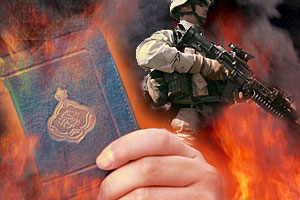

History can be a truly explosive force when it’s connected tightly to contemporary events. The linkage of Islam, terrorism and the war in Iraq has a deep and vivid history, with the potential to hit the American public like a roadside bomb, but it has gone largely untold, emerging only in bits and pieces — until now. “Devil’s Game: How the United States Helped Unleash Fundamentalist Islam” digs up the knotty roots of Islamist violence, exhuming the deep, dirty story behind the “war on terror.”
Part of the story has been told before, in newspaper and magazine articles that put together some of its many pieces. But with “Devil’s Game,” author Robert Dreyfuss has written what may be the most clear and engaging history of the deadly, historic partnership between Western powers and political Islam. Dreyfuss, who covers national security for Rolling Stone, delves deep into the explosive mix of shrewd realpolitik and raw, ignorant fervor that helped fuel the worldwide enterprise of radical Islam and create the extremist theocracies that hold sway today in Iran and Saudi Arabia.
The book is a chronicle of mistakes made, opportunities lost, and lessons most vividly not learned. It’s also the story of the historical error that has come to define U.S. foreign policy in the Muslim world: the Machiavellian use of political Islam as a sword and shield against communism and Arab nationalism. Contextualized by the modern-day neoconservative push for war with Iraq, “Devil’s Game” records the long and sordid history of right-wing and hard-line elements in the U.S. government finding common cause with fundamentalist groups in the Middle East.
For instance: In a chapter on the U.S. proxy war in Afghanistan, Dreyfuss describes how the United States deliberately channeled money to the “nastier, more fanatic types of mujahideen” in Afghanistan (to quote Stephen P. Cohen, a former top State Department official) in order to do the most damage to Soviet occupiers. Among the nastiest: Gulbuddin Hekmatyar, who won the confidence of his Pakistani and CIA backers in part by skinning prisoners alive and approving the practice of throwing acid in the faces of women who failed to cover themselves properly. After 9/11, Hekmatyar would resurface as an ally of the Taliban and a bitter opponent of U.S. occupiers.
Dreyfuss also reveals how Israel helped to create and empower the forerunners of Hamas as a bulwark against Palestinian nationalism (as embodied by Yasser Arafat and the PLO). The Likud-Hamas link — with both organizations thriving in unstable, warlike environments — is sure to be one of the book’s most controversial points, and it is a disturbing parallel to the “blowback” the United States suffered by backing bin Laden and his fellow “freedom fighters” in Afghanistan. Dreyfuss also uncovers how Citibank and Harvard University, among other international players, helped create the Islamic banking system that would act as the financial battery for the Energizer Bunny of violent anti-Western Islamism.
Along the way, Dreyfuss replays long-buried quotes from top American military and intelligence officials that illuminate the shadowy origins of America’s current foreign policy. When asked about the rise of the Taliban in 1996,President Carter’s national security advisor, Zbigniew Brzezinski, offers this thoughtful rejoinder:
“What is more important to the history of the world? The Taliban or the collapse of the Soviet empire? Some stirred-up Muslims or the liberation of Central Europe and the end of the cold war?”
Using the hammer blows of history and polemic, Dreyfuss suggests that “some stirred-up Muslims” may turn out to be something of a problem, after all.
“Devil’s Game” is a book likely to appeal to those who defend the purity of means despite the urgency of the ends. By feeding the monster of militant Islamism to fulfill short-term goals, Dreyfuss argues, the United States helped unleash the most challenging foreign policy crisis of the new millennium. Salon caught up with Dreyfuss recently to discuss the campaign to isolate Syria, the disastrous impact of the war in Iraq, and the pressing need to reduce the U.S. presence in the Middle East.
Tell me about the genesis of “Devil’s Game” — why this topic, and why right now?
Since 9/11, like a lot of reporters, I’ve been focusing pretty heavily on Iraq, the Middle East, Islamic fundamentalism and terrorism, and lots of intelligence issues. In this case the publisher actually called me and asked me if I had any book ideas, and I’d been thinking about this in the following terms: a lot of people saw what happened on 9/11 as some kind of blowback. There was talk about the origins of bin Laden in Afghanistan. What I know about the Middle East is that the blowback goes back much farther than just Afghanistan.
In other words, Osama bin Laden didn’t just emerge from Zeus’ brain in the middle of Saudi Arabia or Afghanistan. He sprang out of a movement of ideologues, of fundamentalists, of salafists, that goes back really into the 19th century, and if you wanted to be historical about it, you could trace it back to the 11th century or even before that.
What fed this movement? How did it move from the fringes to its current place of global influence?
Really, in the modern era, this began with the forebears of the Muslim Brotherhood who began organizing in the late 19th century. Their enemies were first and foremost the leftists and nationalists in the Muslim world, especially in the Arab world, but also in India and Turkey and elsewhere. And on a broader scale, they were fiercely anti-communist. On religious grounds, I think, first of all. Communism was atheism in their minds.
So for these two reasons, because they were anti-communist and because they were anti-nationalist, they became allies of convenience with first the colonial powers, and then later with the United States once the United States inherited primacy in the Middle East after World War II. And so here comes this big dumb giant, the United States, with literally zero background in understanding the Middle East. With no Middle East academic programs at any of its universities including the Ivy League, with no experience in the region. And the United States stumbles into this region as the chief guarantor and protector of Western interests and stability, and so we found ourselves time and time again over the decades in league with political Islam.
That’s the story I wanted to tell. That’s where the real legacy of blunders and stupidity and, in some cases, actually deliberate malfeasance is recorded.
Your book is coming into print just as Scooter Libby, who helped lead the U.S. into war, is leaving office under indictment. Iraq has become a bloody quagmire. The evidence that justified the U.S. invasion has turned out to be mostly exaggerated or falsified. Is there any evidence that the neoconservatives have been beaten into retreat?
I think since the invasion of Iraq went so awry, the neocons have suffered serious blows to their credibility and their prestige, and if I had to guess, I would think that even Donald Rumsfeld has thrown some tantrums about the stuff he was told by the neocons prior to the invasion of Iraq. On the other hand, they’re a very tight-knit fraternity, they stick together, and they’re very single-minded, so I don’t count them out. I think the fact that Bolton has been shuffled off to the U.N., and that Wolfowitz and Feith are both gone from the Pentagon, are useful signs, and certainly the Libby investigation has the potential to unravel the whole spider web.
But I never count them out. I think in a way if you look at the broader picture in the Middle East, they knocked down Saddam, and now pressure is building on both Syria and Iran — and that was really part of the original grand design for the region going back to 2001. We’re also still in control of Afghanistan, we’re building an empire in Central Asia, and Bush remains committed to this fantasy of democracy in places like Egypt and Saudi Arabia overnight, and so in that sense, I think the neoconservative project for the Middle East is moving forward until it’s dead and buried and flowers are growing on its coffin. I don’t see that we can relax.
And we’re still clearly in the midst of a rather poorly defined “war on terror,” which includes the war in Iraq. Is that fight doing anything at all to deter al-Qaida?
Al-Qaida is an ideology above all, and it recruits activists and supporters from a pool of angry and bitter people who are upset, both with their place in life and what they see as injustice. The way to fight al-Qaida, in the broadest sense, is to remove the sense of grievance.
So, in that sense, contrary to what the Bush administration would argue, the way to fight al-Qaida is to pull out of Iraq, because [the U.S. presence] is creating tremendous incentive for people to pick up arms on behalf of this mythical new caliphate [pan-Islamic religious-political empire] that they want to create. It makes sense to reduce our footprint in the Persian Gulf, and in fact the whole Middle East, and to remove this seemingly imperial presence that creates so much anger and unhappiness there.
We should also work a lot harder to solve the problems on what neoconservatives like Bernard Lewis call the “fringes” of the Muslim world — the conflicts from the Philippines to Kashmir to Chechnya to, of course, Palestine — all of those disputes need to be reduced because they create heat that keeps the pot boiling. It’s the molecules that escape from that boiling pot that are immediately snatched up by these terrorist groups in one form or another. They’re catching the angriest, most nihilistic people coming out of this simmering pot. And so we need to lower the temperature.
And then we need to start more generally getting out of the way and letting the people in the region engage in rebuilding their societies and starting on the process of what I call “religion building” — in other words, yanking big parts of the Islamic establishment into the 21st century and reconciling it with ideals of secular modern institutions where church and state are separated.
If we reduce our footprint now, if we pull out of Iraq, doesn’t the U.S. then reward and embolden the hard-line fundamentalists who will say: “We’ve won a victory, we’ve driven them out — next step, new caliphate.”
I don’t know how these lunatics are going to respond to the things we’re going to do, but we need to do what’s right: engage in policy reevaluation to come up with an approach to the region that is based on our real interests. And our real interests are not establishing an empire in the Middle East, and are certainly not a long-term occupation of Afghanistan and Iraq and other countries Bush decides to drag us into.
The victory that bin Laden is trumpeting now is the victory of confirming everything that he has been arguing for the past 20 years — and his forbears have been arguing for a century — which is the clash of civilizations. The West is out to destroy Islam and rape its people and pillage its oil and destroy the Muslim religion — that’s the victory that bin Laden is trumpeting now.
By reducing our presence in the Middle East, we confound him. And most of the smart people who think about the Middle East know that by stumbling into this Iraqi tar baby we have done precisely what bin Laden in his wildest dreams could not have hoped for. We’ve confirmed his worst predictions.
Are democracy and political Islam simply incompatible? Is it critical to ban religious parties from Middle Eastern elections?
I don’t think you can ban any sort of political party. I’m not for banning political parties, as long as they compete fairly in elections. I suppose you can point to Turkey as an example of a country that has a government basically run by an Islamist political party, and which is still maintaining both a democracy and sort of a universal approach toward people who don’t agree. It’s a very complicated question because passions are so high. People flock to these parties because they’re desperate or angry or riled up by imams in mosques and it’s so easy under current circumstances for this to spin out of control. It’s a very delicate question — I think the answer is to go slowly.
I think what happened in Iraq shows that most clearly. Here was a secular dictatorship. We destroyed it, and what emerged in its place is largely a Shiite theocracy on one side, and a Sunni movement that because of civil war conditions is itself pulled very strongly into a Sunni Islamic formation. Neither one of these Iraqi whirlpools — either the Sunni or the Shiite Islamist ones — need to be victorious. I believe there are many Shiites in Iraq who are unhappy with the theocrats, and there are many Sunnis — probably the majority in Iraq — who are nationalists and are secular. But as long as this conflict continues I believe both of those nonreligious elements in Iraq are going to increasingly lose out to the Islamist character of both the Shiite and Sunni leadership.
There’s been a lot of speculation about the actual (and concealed) agenda behind the U.S. invasion of Iraq. What’s your storyline for the administration’s push for this war?
The core of the movement to support the war was the fraternity of the neoconservatives. I believe they saw the war in Iraq as a way of decisively demonstrating American power in a region of the world that was up for grabs in which they believed the United States had to have preeminence because of the oil. Not oil for American oil companies — in fact, I’ve written articles about how American oil companies were opposed to the war in Iraq — but oil in the strategic sense that a principal battle in the 21st century would be for control of Middle East oil between the United States and Russia and China and other powers.
And they picked the Middle East because of its geopolitical and geo-economic value. Tied to that I think quite closely was the fact that so many neoconservatives identify the destruction of Iraq with the security of Israel. So by knocking off Saddam, they believed they could throw the whole Middle East off balance in a way that would lead to an enhanced security environment for Israel.
That’s why so many people have focused on the “clean break” paper that Richard Perle and Douglas Feith and [David and Meyrav Wurmser] and others delivered to Benyamin Netanyahu in 1996. It was kind of a redrawn map of the region that was supposed to be kind of a big-think picture of what Israel’s security could be based on. The core of it was the elimination of Iraq, the destabilization of Syria, and the suppression to nonexistence really of the Palestinian movement. So I think two big motivations kind of linked together were oil and Israel.
Had it not been for 9/11, there is no question in my mind that they could not have achieved either the political support or the support in Congress for going to war in Iraq. And most likely they probably couldn’t have even convinced President Bush to do so. Clearly, President Bush himself was traumatized by 9/11, and he and Karl Rove saw tremendous political value in carrying forward the idea of a war presidency and a war on terrorism. So, they capitalized on that, and they capitalized on Bush’s hatred of Iraq for having tried to kill his daddy, and on other kinds of almost Freudian motivations that the president must have had for all this.
But that starts to get into the tactics of how they accomplished their end. I think the end that they wanted to accomplish was simply the flattening of Iraq and the transformation of Iraq into some kind of pliable American neo-colony.
Is there a historically obvious way to depoliticize Islam in states such as Afghanistan and Iraq, where the U.S. wields some de facto political and economic influence?
Unless someone can create some benevolent despot who can do it by snapping his fingers, I think it’s going to be a project of many decades that has to be undertaken above all by the people who live there. You have to look at the reason why people turn to these kinds of movements. This wasn’t something that happened overnight. This is something that is the product of so many decades of fear and anger and bitterness that unless the temperature is lowered, unless people are given the chance to engage in normal kinds of political debate, there is no chance of separating religion and politics.
Any thoughts on what’s next for Syria as the investigation of the assassination of Lebanese politician Rafik Hariri unfolds?
Rather than increasing the pressure on Syria — rather than squeezing it until it pops, we need to step back and allow diplomacy to work. I think clearly important elements of the Bush administration, and especially the neoconservatives, are pushing for regime change in Syria. They want the Assad government to collapse. They’re doing it without any idea of what might come next.
There is an Ahmed Chalabi in the wings for Syria — a guy named Fareed Al-Ghadiri who lives in the United States who has already had meetings with the State Department and the CIA. They’re playing around with a coalition of Syrian exiles who are at least as unreliable as the Iraqi exiles were in 2003 —
That was going to be my next question…
— but probably even more so. And just like in Iraq where the Shiite religious movement was waiting in the wings until Saddam fell, in Syria there is a majority Sunni population, many of whom are loyal to the Muslim Brotherhood, who are just itching to start a sectarian battle against the Alawite minority elements in Syria.
So it’s a witches’ brew. Syria could explode into a vicious, Lebanon-style catastrophe if Assad were to collapse. On the other hand, intelligence people who I’ve talked to say that Syria was very helpful after 9/11 in providing intelligence to the United States about al-Qaida, that Syria has absolutely no interest in supporting Islamist terrorism, and that if we want to stabilize Iraq we should be approaching both Syria and Iran directly on some diplomatic grounds to help reduce sectarian conflict in Iraq. Instead, what the Bush administration is doing is increasing the pressure on both Syria and Iran … which is precisely the wrong thing to do if your goal is to stabilize Iraq.
I guess their theory is that the best defense is always a good offense, and astonishingly to me at a time when the American adventure in Iraq has gone completely and utterly off the track, rather than think about retreat, they’re thinking about advance.
It reminds me of a piece in the Onion a while ago, which was a satire, saying that Bush announced that we were going to pull our troops out of Iraq, and that they were going to withdraw through Syria. That was a hilarious satire, but it seems to be almost exactly what some people in the administration are thinking.
Are there any politicians on the national stage who seem to be articulating foreign policy ideas vis-à-vis Islam and violent fundamentalism that are well informed by history and the kind of mistakes you write about in “Devil’s Game”?
Not that I can see.
I think one of the lessons of my book is that for the last 60 years the United States has had a pathetically ill-informed notion of how this part of the world works. And even the people who pretend to be most informed sometimes are the most wrong-headed.
I guess the big gap is, there are professionals in the State Department and the intelligence community who have, I think, pretty clear ideas about the facts on the ground and how these societies are organized, but what I’ve found is that there’s an almost complete disconnect between their expertise and the politicians who make the decisions. And I don’t know how to solve that problem.
Is that a disconnect that you think has always been there, or has it gotten much worse since the election of Bush in 2000?
I think it’s always been there, at about the same level. The difference is that I don’t think we’ve ever launched a preventative unilateral war before. That’s the perfect case study because virtually everyone who knew anything about Iraq was against the invasion of Iraq before the war. And the Catch-22 is that, because they were against the war, by virtue of knowing something about Iraq, they were considered untrustworthy by the Bush administration’s planners. That left the planning of the war, by definition, to people who didn’t know anything about Iraq. And that’s true really in every decade of our policy toward the Middle East, to a greater or lesser degree, and really I think that’s the core lesson from my book.
Is there a politician who’s given real thoughtful consideration to this kind of stuff? Not that I can see, because, so far at least, the political consequences would be fatal. You’d have to come out against the war on terrorism, number one — at least as it’s currently conceived, and number two, you’d have to come out against America’s one-sided support for Israel. And either one of those stands politically would be dangerous but both of them together would be fatal for most politicians — or at least that’s how they see it.
– – – – – – – – – – – –
James Norton was the Middle East editor for the Christian Science Monitor during the first year of the Iraq war. His new book, “Saving General Washington,” comes out next spring.
