

The global economic meltdown has already caused bank failures, bankruptcies, plant closings and foreclosures and will, in the coming year, leave many tens of millions unemployed across the planet. But another perilous consequence of the crash of 2008 has only recently made its appearance: increased civil unrest and ethnic strife. Someday, perhaps, war may follow.
As people lose confidence in the ability of markets and governments to solve the global crisis, they are likely to erupt into violent protests or to assault others they deem responsible for their plight, including government officials, plant managers, landlords, immigrants and ethnic minorities. (The list could, in the future, prove long and unnerving.) If the present economic disaster turns into what President Obama has referred to as a “lost decade,” the result could be a global landscape filled with economically fueled upheavals.
Indeed, if you want to be grimly impressed, hang a world map on your wall and start inserting red pins where violent episodes have already occurred. Athens (Greece), Longnan (China), Port-au-Prince (Haiti), Riga (Latvia), Santa Cruz (Bolivia), Sofia (Bulgaria), Vilnius (Lithuania) and Vladivostok (Russia) would be a start. Many other cities from Reykjavik, Paris, Rome and Zaragoza to Moscow and Dublin have witnessed huge protests over rising unemployment and falling wages that remained orderly thanks in part to the presence of vast numbers of riot police. If you inserted orange pins at these locations — none as yet in the United States — your map would already look aflame with activity. And if you’re a gambling man or woman, it’s a safe bet that this map will soon be far better populated with red and orange pins.
For the most part, such upheavals, even when violent, are likely to remain localized in nature, and disorganized enough that government forces will be able to bring them under control within days or weeks, even if — as with Athens for six days last December — urban paralysis sets in due to rioting, tear gas and police cordons. That, at least, has been the case so far. It is entirely possible, however, that, as the economic crisis worsens, some of these incidents will metastasize into far more intense and long-lasting events: armed rebellions, military takeovers, civil conflicts, even economically fueled wars between states.
Every outbreak of violence has its own distinctive origins and characteristics. All, however, are driven by a similar combination of anxiety about the future and lack of confidence in the ability of established institutions to deal with the problems at hand. And just as the economic crisis has proven global in ways not seen before, so local incidents — especially given the almost instantaneous nature of modern communications — have a potential to spark others in far-off places, linked only in a virtual sense.
A global pandemic of economically driven violence
The riots that erupted in the spring of 2008 in response to rising food prices suggested the speed with which economically related violence can spread. It is unlikely that Western news sources captured all such incidents, but among those recorded in the New York Times and the Wall Street Journal were riots in Cameroon, Egypt, Ethiopia, Haiti, India, Indonesia, Ivory Coast and Senegal.
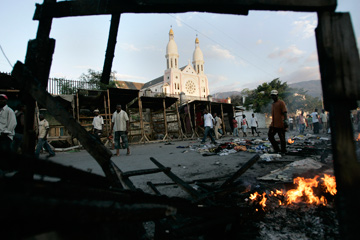
In Haiti, for example, thousands of protesters stormed the presidential palace in Port-au-Prince and demanded food handouts, only to be repelled by government troops and U.N. peacekeepers. Other countries, including Pakistan and Thailand, quickly sought to deter such assaults by deploying troops at farms and warehouses throughout the country.
The riots only abated at summer’s end when falling energy costs brought food prices crashing down as well. (The cost of food is now closely tied to the price of oil and natural gas because petrochemicals are so widely and heavily used in the cultivation of grains.) Ominously, however, this is sure to prove but a temporary respite, given the epic droughts now gripping breadbasket regions of the United States, Argentina, Australia, China, the Middle East and Africa. Look for the prices of wheat, soybeans and possibly rice to rise in the coming months — just when billions of people in the developing world are sure to see their already marginal incomes plunging due to the global economic collapse.
Food riots were but one form of economic violence that made its bloody appearance in 2008. As economic conditions worsened, protests against rising unemployment, government ineptitude and the unaddressed needs of the poor erupted as well. In India, for example, violent protests threatened stability in many key areas. Although usually described as ethnic, religious or caste disputes, these outbursts were typically driven by economic anxiety and a pervasive feeling that someone else’s group was faring better than yours — and at your expense.
In April, for example, six days of intense rioting in Indian-controlled Kashmir were largely blamed on religious animosity between the majority Muslim population and the Hindu-dominated Indian government; equally important, however, was a deep resentment over what many Kashmiri Muslims experienced as discrimination in jobs, housing and land use. Then, in May, thousands of nomadic shepherds known as Gujjars shut down roads and trains leading to the city of Agra, home of the Taj Mahal, in a drive to be awarded special economic rights; more than 30 people were killed when the police fired into crowds. In October, economically related violence erupted in Assam in the country’s far northeast, where impoverished locals are resisting an influx of even poorer, mostly illegal immigrants from nearby Bangladesh.
Economically driven clashes also erupted across much of eastern China in 2008. Such events, labeled “mass incidents” by Chinese authorities, usually involve protests by workers over sudden plant shutdowns, lost pay or illegal land seizures. More often than not, protesters demanded compensation from company managers or government authorities, only to be greeted by club-wielding police.
Needless to say, the leaders of China’s Communist Party have been reluctant to acknowledge such incidents. This January, however, the magazine Liaowang (Outlook Weekly) reported that layoffs and wage disputes had triggered a sharp increase in such “mass incidents,” particularly along the country’s eastern seaboard, where much of its manufacturing capacity is located.
By December, the epicenter of such sporadic incidents of violence had moved from the developing world to Western Europe and the former Soviet Union. Here, the protests have largely been driven by fears of prolonged unemployment, disgust at government malfeasance and ineptitude, and a sense that “the system,” however defined, is incapable of satisfying the future aspirations of large groups of citizens.
One of the earliest of this new wave of upheavals occurred in Athens on Dec. 6, 2008, after police shot and killed a 15-year-old schoolboy during an altercation in a crowded downtown neighborhood. As news of the killing spread throughout the city, hundreds of students and young people surged into the city center and engaged in pitched battles with riot police, throwing stones and firebombs. Although government officials later apologized for the killing and charged the police officer involved with manslaughter, riots broke out repeatedly in the following days in Athens and other Greek cities. Angry youths attacked the police — widely viewed as agents of the establishment — as well as luxury shops and hotels, some of which were set on fire. By one estimate, the six days of riots caused $1.3 billion in damage to businesses at the height of the Christmas shopping season.
Russia also experienced a spate of violent protests in December, triggered by the imposition of high tariffs on imported automobiles. Instituted by Prime Minister Vladimir Putin to protect an endangered domestic auto industry (whose sales were expected to shrink by up to 50 percent in 2009), the tariffs were a blow to merchants in the Far Eastern port of Vladivostok who benefited from a nationwide commerce in used Japanese vehicles. When local police refused to crack down on anti-tariff protests, the authorities were evidently worried enough to fly in units of special forces from Moscow, 3,700 miles away.
In January, incidents of this sort seemed to be spreading through Eastern Europe. Between Jan. 13 and Jan. 16, anti-government protests involving violent clashes with the police erupted in the Latvian capital of Riga, the Bulgarian capital of Sofia, and the Lithuanian capital of Vilnius. It is already essentially impossible to keep track of all such episodes, suggesting that we are on the verge of a global pandemic of economically driven violence.
A perfect recipe for instability
While most such incidents are triggered by an immediate event — a tariff, the closure of a local factory, the announcement of government austerity measures — there are systemic factors at work as well. While economists now agree that we are in the midst of a recession deeper than any since the Great Depression of the 1930s, they generally assume that this downturn — like all others since World War II — will be followed in a year, or two, or three, by the beginning of a typical recovery.
There are good reasons to suspect that this might not be the case — that poorer countries (along with many people in the richer countries) will have to wait far longer for such a recovery, or may see none at all. Even in the United States, 54 percent of Americans now believe that “the worst” is “yet to come” and only 7 percent that the economy has “turned the corner,” according to a recent Ipsos/McClatchy poll; fully a quarter think the crisis will last more than four years. Whether in the U.S., Russia, China or Bangladesh, it is this underlying anxiety — this suspicion that things are far worse than just about anyone is saying — that is helping to fuel the global epidemic of violence.
The World Bank’s most recent status report, Global Economic Prospects 2009, fulfills those anxieties in two ways. It refuses to state the worst, even while managing to hint, in terms too clear to be ignored, at the prospect of a long-term, or even permanent, decline in economic conditions for many in the world. Nominally upbeat — as are so many media pundits — regarding the likelihood of an economic recovery in the not-too-distant future, the report remains full of warnings about the potential for lasting damage in the developing world if things don’t go exactly right.
Two worries, in particular, dominate Global Economic Prospects 2009: that banks and corporations in the wealthier countries will cease making investments in the developing world, choking off whatever growth possibilities remain; and that food costs will rise uncomfortably, while the use of farmlands for increased biofuels production will result in diminished food availability to hundreds of millions.
Despite its Pollyanna-ish passages on an economic rebound, the report does not mince words when discussing what the almost certain coming decline in First World investment in Third World countries would mean:
“Should credit markets fail to respond to the robust policy interventions taken so far, the consequences for developing countries could be very serious. Such a scenario would be characterized by … substantial disruption and turmoil, including bank failures and currency crises, in a wide range of developing countries. Sharply negative growth in a number of developing countries and all of the attendant repercussions, including increased poverty and unemployment, would be inevitable.”
In the fall of 2008, when the report was written, this was considered a “worst-case scenario.” Since then, the situation has obviously worsened radically, with financial analysts reporting a virtual freeze in worldwide investment. Equally troubling, newly industrialized countries that rely on exporting manufactured goods to richer countries for much of their national income have reported stomach-wrenching plunges in sales, producing massive plant closings and layoffs.
The World Bank’s 2008 survey also contains troubling data about the future availability of food. Although insisting that the planet is capable of producing enough foodstuffs to meet the needs of a growing world population, its analysts were far less confident that sufficient food would be available at prices people could afford, especially once hydrocarbon prices begin to rise again. With ever more farmland being set aside for biofuels production and efforts to increase crop yields through the use of “miracle seeds” losing steam, the Bank’s analysts balanced their generally hopeful outlook with a caveat: “If biofuels-related demand for crops is much stronger or productivity performance disappoints, future food supplies may be much more expensive than in the past.”
Combine these two World Bank findings — zero economic growth in the developing world and rising food prices — and you have a perfect recipe for unrelenting civil unrest and violence. The eruptions seen in 2008 and early 2009 will then be mere harbingers of a grim future in which, in a given week, any number of cities reel from riots and civil disturbances that could spread like multiple brush fires in a drought.
Mapping a world at the brink
Survey the present world, and it’s all too easy to spot a plethora of potential sites for such multiple eruptions — or far worse. Take China. So far, the authorities have managed to control individual “mass incidents,” preventing them from coalescing into something larger. But in a country with a more than 2,000-year history of vast millenarian uprisings, the risk of such escalation has to be on the minds of every Chinese leader.
On Feb. 2, a top Chinese party official, Chen Xiwen, announced that, in the last few months of 2008 alone, a staggering 20 million migrant workers, who left rural areas for the country’s booming cities in recent years, had lost their jobs. Worse yet, they had little prospect of regaining them in 2009. If many of these workers return to the countryside, they may find nothing there either, not even land to work.
Under such circumstances, and with further millions likely to be shut out of coastal factories in the coming year, the prospect of mass unrest is high. No wonder the government announced a $585 billion stimulus plan aimed at generating rural employment and, at the same time, called on security forces to exercise discipline and restraint when dealing with protesters. Many analysts now believe that, as exports continue to dry up, rising unemployment could lead to nationwide strikes and protests that might overwhelm ordinary police capabilities and require full-scale intervention by the military (as occurred in Beijing during the Tiananmen Square demonstrations of 1989).
Or take many of the Third World petro-states that experienced heady boosts in income when oil prices were high, allowing governments to buy off dissident groups or finance powerful internal security forces. With oil prices plunging from $147 per barrel of crude oil to less than $40, such countries, from Angola to shaky Iraq, now face severe instability.
Nigeria is a typical case in point: When oil prices were high, the central government in Abuja raked in billions every year, enough to enrich elites in key parts of the country and subsidize a large military establishment; now that prices are low, the government will have a hard time satisfying all these previously well-fed competing obligations, which means the risk of internal disequilibrium will escalate. An insurgency in the oil-producing Niger Delta region, fueled by popular discontent with the failure of oil wealth to trickle down from the capital, is already gaining momentum and is likely to grow stronger as government revenues shrivel; other regions, equally disadvantaged by national revenue-sharing policies, will be open to disruptions of all sorts, including heightened levels of internecine warfare.
Bolivia is another energy producer that seems poised at the brink of an escalation in economic violence. One of the poorest countries in the Western Hemisphere, it harbors substantial oil and natural gas reserves in its eastern, lowland regions. A majority of the population — many of Indian descent — supports President Evo Morales, who seeks to exercise strong state control over the reserves and use the proceeds to uplift the nation’s poor. But a majority of those in the eastern part of the country, largely controlled by a European-descended elite, resent central government interference and seek to control the reserves themselves. Their efforts to achieve greater autonomy have led to repeated clashes with government troops and, in deteriorating times, could set the stage for a full-scale civil war.
Given a global situation in which one startling, often unexpected development follows another, prediction is perilous. At a popular level, however, the basic picture is clear enough: Continued economic decline combined with a pervasive sense that existing systems and institutions are incapable of setting things right is already producing a potentially lethal brew of anxiety, fear and rage. Popular explosions of one sort or another are inevitable.
Some sense of this new reality appears to have percolated up to the highest reaches of the U.S. intelligence community. In testimony before the Senate Select Committee on Intelligence on Feb. 12, Adm. Dennis C. Blair, the new director of national intelligence, declared, “The primary near-term security concern of the United States is the global economic crisis and its geopolitical implications … Statistical modeling shows that economic crises increase the risk of regime-threatening instability if they persist over a one to two year period” — certain to be the case in the present situation.
Blair did not specify which countries he had in mind when he spoke of “regime-threatening instability” — a new term in the American intelligence lexicon, at least when associated with economic crises — but it is clear from his testimony that U.S. officials are closely watching dozens of shaky nations in Africa, the Middle East, Latin America and Central Asia.
Now go back to that map on your wall with all those red and orange pins in it and proceed to color in appropriate countries in various shades of red and orange to indicate recent striking declines in gross national product and rises in unemployment rates. Without 16 intelligence agencies under you, you’ll still have a pretty good idea of the places that Blair and his associates are eyeing in terms of instability as the future darkens on a planet at the brink.
