

Israelis are digesting their lack of success in the month-old war against Hezbollah in Lebanon — formally ended as a United Nations-sponsored cease-fire went into force early Monday morning — and the country is gearing up for a postwar political bloodbath and national soul-searching over goals, aims and priorities.
Israelis were surprised by the visible inability of their military, considered the strongest and most sophisticated in the Middle East, to defeat a guerrilla army of a few thousand fighters. Having become accustomed to quick victories against Arab armies, as in the wars of the past, the current reality in Lebanon has been unprecedented and unexpected.
Israelis were astonished by Hezbollah’s seemingly intact ability to hit northern Israel with a daily barrage of 100-200 rockets, holding about a million people in shelters, regardless of what the Israel Defense Force was doing to the Lebanese. And they were shocked by the government’s incompetence in dealing with the plight of the Israeli civilian population in the rear. The fact that Lebanon’s civilians have been hit much harder was hardly comforting.
And last, but not least, Israelis were unprepared for the war in Lebanon — which remained off the public agenda in recent years — or for the length of the war. The world, and especially the American administration, stood by and allowed the shooting, killing and destruction to go on without turning over the famous “diplomatic hourglass” to stop the belligerents in their tracks.
To the older generation, the current mood in Israel is similar to that in the aftermath of the Yom Kippur War. Back in October 1973, the country lost thousands of men in the Sinai and Golan Hieghts battlefields. The Yom Kippur duel opened with a timed surprise attack by Egypt and Syria, and ended with a narrow Israeli victory, as the IDF stood closer to Cairo and Damascus than before the war. In 2006, the military and political leaders are trying in vain to convince the public that the war ended in Israel’s favor.
In both cases, the enemy shocked Israelis with its willingness and ability to fight, and the public sank into despair and got angry with a dysfunctional leadership. But unlike in 1973, this time the civilians in the rear were among the 150 casualties, and there was extensive rocket damage to many cities. And unlike in 1973, there were no “winning images” like Ariel Sharon’s crossing of the Suez Canal, which turned the tide of the war on the Egyptian front. Instead, the world saw images of a thousand Lebanese casualties, most of them civilians.
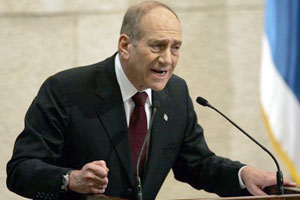
Ehud Olmert, Israel’s prime minister, is now fighting for his political survival. Olmert decided to go to war almost instantly after hearing that Hezbollah had abducted two IDF soldiers and killed eight others in a cross-border attack on July 12. The country’s nerves were already wrecked by a similar ambush and abduction conducted by Hamas near Gaza, and Olmert felt that he must react forcefully to the additional provocation on the Lebanese border. His credibility as a leader was in question, as both he and Amir Peretz, the defense minister, had had no experience in war and peace matters. So they decided to hit back. Sharon, Israel’s best battlefield commander, or Ehud Barak, the IDF’s most decorated soldier, could say that “restraint is strength” without losing face. But not Olmert, who hardly did any military service, or Peretz, a former junior ordnance officer. Hassan Nasrallah, the Hezbollah leader, even mocked his adversaries’ inexperience.
Before the recent escalation on both fronts, Gaza in the south and Lebanon in the north, Olmert and Peretz were trying to sell their lack of military background as a virtue — namely, that “civilian leaders” are better suited to lead contemporary Israel than their ex-general predecessors. The civvies, argued their supporters, would bring a fresh attitude to their jobs, rather than “watching the Arabs through the gun sights” like Sharon, whom Olmert replaced in early January. Peretz, a former trade union boss, campaigned before the March 28 election on a “social-economic platform” and argued for shifting resources from defense to welfare programs.
Alas, their initiation to the violent realities of Israel’s neighborhood occurred earlier than anybody had expected. On Aug. 12, the Olmert-Peretz coalition Cabinet marked its first 100 days in office. Rather than initiate foreign policy and domestic reforms, as it planned, the government is now preoccupied with security matters — and will remain so for a while, if indeed it survives in power. Before the election, Olmert pledged to turn Israel into a country “that’s fun to live in.” Fun is now the last thing on the minds of Israelis. Tens of thousands are still mobilized in emergency reserve duty, or need to rebuild their ruined homes and businesses in northern cities and villages.
The Lebanon campaign has shown Israelis that military experience at the top is a necessity, rather than a luxury, in a country that has been at constant war with its Arab neighbors since its inception in 1948. Olmert and Peretz failed to grasp the subtleties of using military power, and unnecessarily prolonged the war in search of an elusive victory.
The prime minister sought to use the pretext of the Israeli soldiers’ abduction to eradicate the threat posed by Hezbollah, which had accumulated thousands of missiles and rockets since Israel’s May 2000 withdrawal from its “security zone” in south Lebanon. Israeli planners viewed this arsenal as a forward base of Iran, Hezbollah’s main source of arms, money and spiritual guidance. As Israel — and perhaps America — is drawn closer to confronting Iran’s nuclear program, the threat to Israel’s rear could have complicated their calculations. Moreover, Olmert argues that had Israel waited a couple of more years, Hezbollah’s arsenal would have grown larger and more dangerous — and even compounded by an Iranian nuke umbrella.
After an initial air attack, which according to the IDF destroyed most of Hezbollah’s long-range-missile capability, Olmert could have stopped the war. Nevertheless, strengthened by strong public consensus — even the left viewed the war as justified in the beginning — and wide international backing, he was tempted to hit stronger and deeper, gradually escalating the air campaign and sending ground forces into the Hezbollah-defended area in south Lebanon. This got him entangled in the notorious Lebanese “quagmire” that has consumed Israel’s energy for almost two decades. As the ground operation grew larger, so did military casualties, but Hezbollah did not collapse under the IDF pressure and kept fighting effectively till the last day.
In his defense, Olmert blames his predecessor, who had neglected the Hezbollah threat and left the problem on his doorstep, along with an unprepared army and undefended rear. His other culprit is the military command, which presented him with the wrong solutions — relying too much on air power alone and bringing in ground forces too late to decide the war. Indeed, the IDF chief of staff, Gen. Dan Halutz, is a former fighter pilot and air force commander who got the job last year in the first-ever promotion of an aviator to the top military job. Sharon and Shaul Mofaz, his ex-general defense minister, could appoint Halutz and keep their watchful professional eyes on him. Their inexperienced successors are left with blaming Halutz and the military for failing to deliver.
The military, in turn, blames its political masters for dragging their feet in approving needed measures. It’s the old “the politicians stabbed us in the back” argument of disappointed generals. This time, however, Olmert had given them lots of political time to accomplish the mission. His main mistake was allowing a wide-scale ground offensive at the last minute, even after he realized that the IDF ground forces were clueless against their adversaries. This final-hours operation achieved little, but cost the lives of 30 servicemen, including the son of David Grossman, one of Israel’s most famous novelists. A few days before his son’s death, the writer had turned publicly against escalating the war.
Olmert argues that Aug. 11’s U.N. Security Council Resolution 1701, which ended the war, reflects an Israeli achievement and will improve the strategic situation along the northern border.
Lebanon’s government decided to enforce its sovereignty in the south, along the Israeli border, and deploy its army — strengthened with U.N. forces — instead of Hezbollah. From Israel’s perspective, it’s an important step for stability. It’s better to deal with a government, even a weak one like Lebanon’s, than a private army like Hezbollah. But this hardly constitutes a victory, and few in Israel believe that the noble goals of Resolution 1701 — like disarming Hezbollah and preventing its rearming and demilitarizing south Lebanon — will be fulfilled at all. And the fighting did nothing to bring home the abducted soldiers; Israel will have to enter prisoner exchange negotiations with Hezbollah, just like Nasrallah proposed after the abduction.
Given this poor outcome, the most-asked question in Israel today is, “Will they survive?” “They” are Olmert, Peretz and Gen. Halutz, as well as several lower-level generals responsible for the war’s other failures: poor intelligence, logistics and battlefield command. There are calls to appoint an inquiry commission; the government will probably try to circumvent that by nominating its own lesson-learning team. Politically, Olmert and Peretz are dependent upon the reluctance of the newly elected Knesset members to commit political suicide through calling an early election. Their main challengers, former Premiers Benjamin “Bibi” Netanyahu and Ehud Barak, are quietly advocating an “emergency cabinet” in which they would hold senior portfolios.
At this point, it is too early to assess the political life span of Olmert’s Cabinet. It has yet to bring the forces back from Lebanon or to negotiate the return of the three abductees from Gaza and Lebanon. Beyond these pressing missions, however, Olmert is lacking an agenda. His campaign platform had been the West Bank “realignment” — removing most of Israel’s settlements and unilaterally drawing a new border with the Palestinians. Olmert argued that settlement removal from dense Palestinian areas is essential to preserve the Jewish character of Israel, and that given the lack of a credible Palestinian “partner” Israel must go it alone. He won an unconvincing electoral victory in March while pledging to implement this idea.
Sadly for Olmert, however, the war killed his plan. Unilateralism has fallen out of favor with Israelis, as both Lebanon and Gaza — evacuated in 2000 and 2005, respectively — have turned into launching pads for rockets aimed at Israeli towns and villages. With the Islamists of Hamas running the Palestinian Authority, it appears too risky to most Israelis to leave the high terrain of the West Bank, which overlooks Israel’s population centers and vital infrastructure, in Palestinian hands. Moreover, the risk of a domestic rift still looms. When Olmert mentioned during the war that a Lebanon success might contribute to this West Bank realignment, soldiers from the settlements threatened to refuse service in Lebanon. He backed off. And since negotiations with the Palestinians are deemed useless — Abu Mazen, the P.A. president, is too weak, and Hamas too hostile — the chances for rapid diplomatic progress vis-à-vis the Palestinians appear dim.
Left-wing politicians like Defense Minister Peretz favor reopening negotiations with Syria, which have been frozen since 2000. Indeed, Syria appears to be the real winner of the Lebanon conflict. It kept its strength as the power broker there without firing a single shot. But peace with Syria means Israeli withdrawal from the Golan Heights, with its superior terrain and water resources. Given Olmert’s reluctance, his government’s poor stance and the public’s unwillingness to surrender the precious territory, chances for this “Syrian track” are slim as well.
Olmert, therefore, must find a new postwar agenda. Otherwise, even if he survives in office, he will have little to do beyond petty political wheeling and dealing. He still believes that despite what happened in Lebanon, tackling the Palestinian issue is paramount. But he may lack the political leverage to deal with it seriously.
The nation’s soul-searching goes beyond the fate of its leaders. The summer fighting has awakened the Israeli siege mentality and the feeling that peace is hopeless when your neighbors don’t really want you around. The short period of relative normalcy, which Israel had enjoyed since the Gaza evacuation last summer, ended abruptly. Foreign tourists disappeared, and Depeche Mode called off their long-anticipated Tel Aviv concert at the last minute, although Tel Aviv was untouched by the war (save for the noise of helicopters and fighter jets in the skies.)
The war will also affect Israel’s relations with its main backer, the United States. The Bush administration was disappointed by the poor performance of the IDF relative to Hezbollah, despite the generous diplomatic timetable and emergency arms supplies that Washington allowed. Secretary of State Condoleezza Rice, who negotiated the cease-fire, was angry at Olmert for thwarting her idea of a wider Israeli-Lebanese deal, aimed at strengthening Fouad Siniora, the U.S.-backed Lebanese premier. These feelings will undoubtedly fuel the ongoing debate about Israel’s strategic value to the United States.
From Israel’s side, the war prompted criticism of the American alliance, mostly from the left. The main argument was that Israelis should not risk their lives for Bush’s regional design. Others wondered if Israel should copy the peaceful European model, rather than America’s more belligerent one. While still marginal, these are interesting voices that promise to stir more controversy and debate even when the war is over.
Throughout the fighting in Lebanon and the rocket hits on Israel’s north, the Tel Aviv stock exchange and the Israeli shekel kept their value. To some economists, it represented the strength of the economy. Others argued that it only shows the indifference of the money and power elites to the plight of the poorer, weaker citizens in bombed towns like Haifa, Safed and Kiryat Shmona.
Before the war, Israel was headed for a major debate over the priorities of the 2007 national budget. Olmert’s coalition partners demanded a reconstruction of Israel’s welfare state, which has been weakened in recent years through budget cuts and privatization of public entities. Last year’s growth and budget surplus could have facilitated the change. Now that money, and probably higher taxes, will go to the military. At the same time, however, there is a growing awareness of the importance of a social-support network during war, and that market forces are an insufficient remedy during crises. This may lead to a stronger demand for welfare reconstruction, despite the tighter resources.
This debate, however, is still down the road. Israelis need first to grasp the implications of what happened up north, and have a serious reassessment of their limits of power. Only then will they be able to find a new national direction.
