

At a press conference on Thursday, George Bush was asked whether he was “in denial” about Iraq. “It’s bad in Iraq,” he shot back, to laughter. “That help?” He also noted that the report of the James Baker-led Iraq Study Group, which was released Wednesday, was important enough that he had read it.
But the immediate speculation in Washington was that even if the president has really accepted that things are “bad,” it doesn’t mean he’s ready to follow the ISG’s advice on how to make things better. Some wondered which prescriptions he would ignore, while others suggested he might be trying to sabotage the ISG’s suggested remedies altogether.
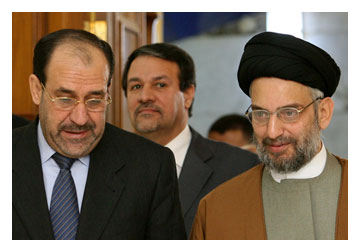
The reality is that the president, via briefings, has probably long been aware of what the ISG report would say. In fact, when Bush met Iraq’s two leading Shiite politicians in the week just prior to the report’s release, he was almost certainly acquainting Prime Minister Nouri al-Maliki and Supreme Council for Islamic Revolution in Iraq party chief Abdul Aziz al-Hakim with the ISG’s key proposals.
It is also true, however, that there are parts of the report that run counter to Bush’s own strategy in Iraq, and not just in terms of how long to stay. In a real sense, Bush has developed Iraqi constituencies and political allies. Bush has already picked his horses in Iraq, and they are Shiite. And that puts him at odds with the panelists of the ISG, most notably James Baker, the very Bush family loyalist whose efforts on his behalf in Florida six years ago helped land him in the White House.
When Bush met with al-Maliki in Amman, Jordan, one week ago, the timely leak of a scathing memo on the eve of the summit suggested that the administration was trying to undermine the Iraqi prime minister. In the memo, National Security Advisor Stephen Hadley wrote, “The reality on the streets of Baghdad suggests al-Maliki is either ignorant of what is going on, misrepresenting his intentions, or that his capabilities are not yet sufficient to turn his good intentions into action.” The memo apparently so angered the prime minister that he declined to show up at a banquet where he was scheduled to dine with Bush and with Jordan’s King Abdullah II.
In reality, though some Washington insiders were pushing for a change behind the scenes, Bush claims he’s not switching horses. At the conclusion of the summit, he publicly endorsed Maliki. “He’s the right guy for Iraq and we’re going to help him and it’s in our interest to help him.” The Shiite fundamentalist United Iraqi Alliance has come out on top in both of Iraq’s parliamentary elections, and al-Maliki heads a key component of the UIA, the Islamic Call Party (al-Da’wa). He is in coalition with the Supreme Council for Islamic Revolution in Iraq, which has also done well in the polls. Bush decided that since al-Da’wa and SCIRI were winners in Iraqi politics, he would have to develop good relations with them. Sources in Washington confirm to me that Bush thinks of the two Shiite leaders as “our guys,” and he has entertained Da’wa and SCIRI officials at private White House functions.
In turn, Bush and Maliki are in accord on several of the ISG’s key proposals. The ISG report envisages that the Iraqi army “would take over primary responsibility for combat operations.” Maliki has the same vision, and Bush likely met with him precisely in order to explore the issue of the prime minister’s control over his own army. That the president was open to the further transfer of authority over the Iraqi army to al-Maliki suggests that this recommendation by the ISG will form part of administration policy. On Monday, U.S. commanders transferred control of the Third Iraqi Army Division, stationed in the northern province of Ninevah, to the prime minister. It was the third division to be put under Baghdad’s control; seven others still take orders from the Pentagon.
The prime minister’s own timeline for taking control of the remaining divisions is even more ambitious than that of the ISG. “At the beginning of next year we will increase the training of our forces,” said al-Maliki. “When they reach an acceptable level, we can talk about transferring power from multinational forces to Iraqi forces.” He has long maintained that the Iraqi military is capable of taking over more security tasks faster than Washington imagines. He told ABC news after the meeting with Bush in Amman, “I can tell you that by next June our forces will be ready.”
Bush and al-Maliki were also in full accord with another ISG tenet — that there must be no partition of Iraq. At the Amman summit, Bush telegraphed his opposition to any decentralization of Iraq or its partition. “The prime minister made clear that splitting his country into parts, as some have suggested, is not what the Iraqi people want, and that any partition of Iraq would only lead to an increase in sectarian violence.” The two were slamming proposals like that of Sen. Joseph Biden of Delaware that would create three ethnically based super-provinces in Iraq, over which a weak federal government would preside. Biden’s plan does not actually call for partition, but many fear that such a reorganization would provoke a complete breakup of the country anyway.
As the ISG report put it, “The costs associated with devolving Iraq into three semiautonomous regions with loose central control would be too high.” It points out that Iraq’s population is mixed, so that such a devolution “could result in mass population movements, collapse of the Iraqi security forces, strengthening of militias, ethnic cleansing, destabilization of neighboring states, or attempts by neighboring states to dominate Iraqi regions.”
President Bush is presumably in sympathy with one of the ISG’s main concerns about partition, which is that there should be a central Iraqi government in control of the country’s petroleum reserves and revenues. Both James Baker and the president have ties to U.S. petroleum companies, which would rather negotiate with a single central government than be forced to strike deals with each province or regional federation.
To forestall partition, and to promote national unity and reconciliation, the ISG recommends that the United States and the Iraqi government “support the holding of a conference or meeting in Baghdad of the Organization of the Islamic Conference or the Arab League.” The Arab League is mostly made up of Sunni Arab states, and it has had a rocky relationship with the new Iraqi government, dominated by Shiites and Kurds. The Sunnis are supported by a majority of Iraq’s neighbors, especially Saudi Arabia and Jordan. Baker also has long ties to the Saudis and other Sunni Arab powers. Only Iran supports Iraq’s Shiites.
Whether Bush will adopt the idea of a conference involving Iraq’s neighbors is not clear. But it is clear that his Shiite allies will resist it, and that here is where he may be forced to choose between his new Iranian-influenced Iraqi friends and his old Saudi friends and James Baker.
On Monday, Bush met with Shiite cleric Abdul Aziz al-Hakim, who heads up SCIRI as well as being the nominal leader of the United Iraqi Alliance, which has 128 seats in Iraq’s 275-member parliament. Despite al-Hakim’s close ties to Iran, he has been a consistent ally of the U.S. in Iraq. Bush works Iraqi politicians the same way he worked the Texas Legislature or Congress, and it may be difficult for him to buck his Shiite and Kurdish allies on this issue. By Monday, the ISG proposal for a regional conference to stop Iraq’s sectarian violence had already leaked, and al-Hakim gave Bush an earful about it.
After the meeting, al-Hakim came out strongly against the ISG proposal. “We believe that the Iraqi issues should be solved by the Iraqis, with the help of friends everywhere. But we reject any attempts to have a regional or international role in solving the Iraqi issue.”
On at least one subject, however, Bush will not have to choose between the Shiites and the ISG. Both groups already disagree with him.
In Amman, Bush said he wanted to start withdrawing American troops from Iraq “as soon as possible.” He cautioned, however, that it might take time. He reassured al-Maliki that he was committed to keeping American troops in Iraq “until the job is complete.” Al-Maliki seemed not to want the reassurance.
Maliki wants American troops out, and so does the ISG. The ISG wants most active combat troops out of Iraq by early 2008. Maliki wants them out faster.
Both timetables would be unrealistic even if the president weren’t clinging to the idea of victory. But Bush is unable to let go of the neoconservative folly that a democratic Iraq will transform the Middle East and form a new pillar of U.S. policy in the region. As he said in Amman, “It’s in our interests to help liberty prevail in the Middle East, starting with Iraq. And that’s why this business about ‘graceful exit’ simply has no realism to it at all.” On this issue, Bush has fewer friends of any description every day.
