
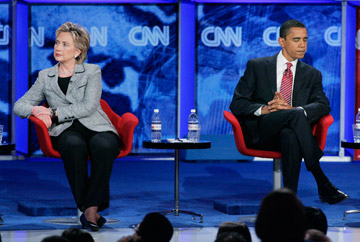

From watching the coverage of the 2008 race, you’d think that the Democratic Party has never been down this road before — divided along racial lines, mired in a bitter personal battle, seemingly incapable of repairing the divisions in time to defeat the Republicans.
If you believe this, then you probably didn’t experience the 1994 U.S. Senate race in Virginia. For three years leading up to that race, the incumbent, Sen. Chuck Robb, and Gov. Doug Wilder, both Democrats, were embroiled in a bitter dispute. Robb staffers faced federal prosecution for having procured an illegal tape of a Wilder cellphone conversation and then later playing the tape for Washington Post reporters.
In late 1993, Wilder, the first African-American ever to be elected governor of a U.S. state, flirted with challenging Robb in the Democratic Senate primary. He backed away — then changed his mind and entered the race as an independent in 1994. Six weeks before Election Day, Robb was trailing Republican nominee Oliver North by double digits. In a brutal election year for Democrats, the seat looked lost.
Few believed that Wilder could ever be persuaded to give up his campaign, and then endorse and vigorously campaign for his longtime rival. But that’s just what happened — the Democratic Party pulled together, long-standing scores were settled, debts paid, and legacies preserved. Today, some believe that Hillary Clinton will never drop out before Denver, and others ponder what she might want in return for a rapid, graceful exit. In 1994, Robb and Wilder proved that how a campaign ends is often more important than how it is waged — and both Barack Obama and Hillary Clinton can learn from the way these rivals built a lasting peace. And it all began with that most underrated of campaign rituals– the post-campaign negotiation.
I had a front-row seat to this greatest of all Democratic crack-ups as Wilder’s press secretary. The candidate trailing badly in the polls on Labor Day weekend, our campaign decided that we had only two options left: keep running the same campaign, or sink Sen. Robb.
We wanted to win. We decided to treat the month of September like a “voteless primary”; less charitable pundits might say it was an intra-party divide and conquer. We ignored Ollie North and focused our fire on Robb alone — attacking him from the left in hopes of passing him in the polls and then driving Democrats toward Wilder in the final month as the best Democratic hope of holding the seat.
In the first week of September, Wilder caught a break in a debate when Robb made an astounding gaffe — promising to take food out of the mouths of widows and orphans if that would help balance the federal budget. What followed was a solid week of good press for Wilder as he became the new champion of Virginia’s poor huddled masses. And then, a new round of polls came out, and the news was universally bad. A Mason-Dixon poll showing Wilder slipping to fourth place, far behind North, and even behind independent Marshall Coleman, was our Indiana. It was obvious that Wilder’s campaign was over.
It was hard to accept — like Hillary Clinton’s 2008 campaign, we’d finally found our message, but we were out of time and money. Wilder had dug deep into his own pocket — again, like Hillary — to fund the race, but we still couldn’t afford to put ads on the air. We’d all worked weeks without pay. We had no realistic path to victory, but we believed down deep that our candidate would make the best senator.
So the campaign ended and the negotiations began. Very often, political observers groan at the mere mention of post-campaign unity negotiations. Thoughts travel back to the “What Does Jesse Want?” questions during the Democratic presidential primary summer of 1988. It turned out that what Jesse Jackson wanted in order to end his quest for the nomination was a proportional representation primary system that would give him or another African-American a chance of winning a race in the future. Obama supporters should thank Jackson for playing those cards.
But more often, these negotiations are about smoothing over personal disputes and ensuring that no one walks away from the campaign with lost money or hurt feelings — but mostly lost money.
The interesting thing about the Wilder-Robb negotiations is that this was round 3. The first round came in December 1993, when Robb enlisted President Bill Clinton to become personally involved. Clinton hinted to Wilder that if he stayed out of the Democratic primary, a Cabinet post or choice ambassadorship could come his way. Wilder, whose gubernatorial term ended in January 1994, made a late decision not to challenge Robb for the nomination.
Fast forward to spring 1994. After a series of embarrassing gaffes, Robb won the Democratic nomination, beating Virgil Goode — yes, the same Goode who is now a GOP congressman and has become infamous for his anti-Muslim remarks. Once nominated, however, Robb sank badly behind Oliver North in match-up polls. And oh, by the way, that ambassadorship for Wilder never materialized. So Wilder, in dramatic fashion, reentered the race as an independent. When the Republicans refused to unite behind convicted felon Ollie North, and former state attorney general Coleman entered the race as an independent Republican, Wilder was declared a plausible candidate. In a four-way race, Wilder was thought to have a fighting chance to win; polls showed all four candidates within 7 points of each other.
Wilder’s reentry sparked round 2 of the Robb-Wilder negotiations in July 1994. Wilder was summoned to the White House to meet with Vice President Al Gore. The White House might have assumed that since they had promised but not delivered for Wilder the first time around, it might be worth their while to try again. But Wilder embarrassed Gore by leaking news of the meeting ahead of time to the campaign press. A White House media circus ensued, Gore was not happy, and the negotiations went nowhere.
In the third round of negotiations, which took place in September, Wilder added a request for money. He asked to have his 1994 campaign debt retired by Robb and, if necessary, President Clinton. Well, sort of. He negotiated to get all of his own money back and to pay vendors.
The third time was the charm, and the deal was struck. Wilder got his money. We hardy campaign staffers? We got a few weeks of very low money, no-show job pay with the Virginia Democratic Party until Election Day.
Wilder also won a theatrical send-off to his run: a big photo-op event in October. At a fundraising dinner, a symbolic onstage handshake with Robb and Wilder’s endorsement of his longtime rival led to a Washington Post front-page shot of Wilder, Robb and President Clinton smiling broadly, with party chairman Mark Warner standing gleefully behind all three as the peacemaker.
How important is a picture? Warner’s future role as a unifier of the Virginia Democrats began with that photo. His successful term as governor, followed by the election of Gov. Tim Kaine in 2005 and Sen. Jim Webb in 2006, has given Democrats hope of carrying the state this fall, for the first time since 1964. In 1994, however, the picture was most important for signaling to Wilder’s supporters — crucially, the one in six Virginia voters who is African-American — that all was well and that voting for Chuck Robb was the right and proper thing to do.
The final piece for Wilder was the resolution of the diplomatic post. I remember listening to him muse about being appointed to the Court of St. James. That post was never offered. I could ask Wilder if he had been promised that or any other position, but I’m sure he wouldn’t answer. Still an expert poker player, Wilder’s not one to reveal his cards. Now mayor of Richmond, Wilder’s growing surrogate role in the Obama campaign demonstrates that he’s still in the game — maybe the same game.
Like Wilder 14 years ago, Hillary Clinton is simultaneously holding a losing nomination hand and a very strong negotiating hand. It’s in Obama’s best interests to start negotiations now because Hillary has options. She can keep attacking him. And even if she just attends rallies or puts ads up on cheap West Virginia TV, she’ll make plenty of news. Based on recent polls, she can run up big wins in West Virginia and Kentucky, which could inspire another round of “Why can’t Obama close?” stories and renewed speculation about his appeal to blue-collar voters. And she can make things very uncomfortable for Obama in Florida and Michigan by not compromising and pushing for their votes to count.
So if, eventually, Hillary Clinton does the math that the rest of the world is doing and decides to fold her hand, she could learn a great deal from Doug Wilder’s negotiations back in 1994. Get your own money back. Don’t worry so much about everyone else; they knew what they were getting into. Get a big symbolic victory that will show that the race was about something more than your ego. And keep in the game long term by promoting a supporter for a future role.
So if she does concede defeat, the question “What does Hillary want?” should have some fairly obvious answers.
Debt Relief. Here’s an irony: Hillary can keep lending money to her campaign, at least in the short term, without much risk because it’s very likely that Obama will agree to pay it in exchange for peace. There are limits to Obama’s generosity, of course. Money used for negative attacks from here on out would put her debt repayment at risk. So too would any funds to stretch the campaign beyond the primary end date. And as for Mark Penn’s debts? Take a lesson from Wilder: Your staff should consider your good company compensation enough.
A Major Platform Win. Namely, healthcare. Hillary needs to be able to make the case that her campaign had a substantive impact on the race. The best way to do that is to get to write the party’s healthcare plank in the platform. If Obama folds on the mandate issue, Hillary walks away with a policy win. Plus, this would please John and Elizabeth Edwards. Choosing Elizabeth to write the healthcare plank of the platform could appease both camps.
VP Right of First Refusal. Here the Clintons have the power to tie Obama’s hands. Harold Ford on MSBNC Tuesday made a strong case that Clinton and Obama together should hammer out a team, whether it ends up Obama-Clinton or not. In 1960, John F. Kennedy felt obliged to offer the vice presidential slot to Lyndon Johnson and was stunned when he accepted. Negotiations will probably force Obama into a similar situation. In the end, Hillary Clinton may not want the vice president’s job … but she would be wise to negotiate some form of veto power over Obama’s choice. That way she can tactfully say no to another woman making it onto the ticket to steal her spotlight. She could ensure that none of the potential 2012 candidates get positioned for a run in case Obama should fail in November. And she can get in one last twist of the knife on Bill Richardson. NBC’s Lawrence O’Donnell’s speculated last month that Wesley Clark could be the compromise choice. That theory looks plausible. Clinton loyalists like Evan Bayh and Ted Strickland could be acceptable choices too. If the VP choice is a Hillary loyalist who validates her claim that Obama needs help with blue-collar voters, she will have done what Wilder did with the Chuck Robb-Bill Clinton-Mark Warner “unity” photo — maintain a grip on the future of the party.
Without question, Barack Obama is entering a very uncomfortable stage of his campaign. Comparisons to Mike Dukakis in 1988 are inevitable — and if the negotiations drag out, there will be questions about who is really in charge. The sooner he gets it over with, the better for him.
And if he needs a confidence boost that everything will turn out right, he can just ask Doug Wilder. After his endorsement, Wilder hit the campaign trail for Chuck Robb, cut radio advertisements, and did everything else possible to get out his supporters to vote for the incumbent senator. He repaired the damage not in five months, but five weeks. In 1994 — one of the worst years for Democrats in the 20th century — the supposedly divided and hopeless Virginia Democratic Party pulled off the most surprising win of the year. Wilder announced he was leaving the race in September, and his photo-op reconciliation with Chuck Robb took place Oct. 21. Less than three weeks later, Robb beat Ollie North by 3 points, largely because of a strong turnout from black voters.
So stay calm. This is what Democrats do … from bitter fights often come the most surprising and useful political alliances. But first, everyone has to talk.
