
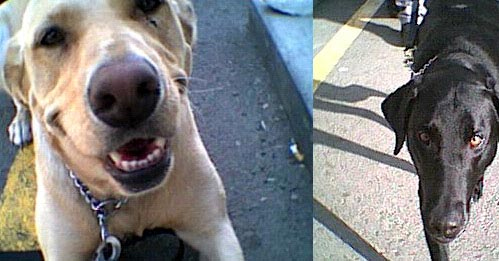

Smell works the same in both dogs and people: Molecules of odor are inhaled, and then dissolved in mucus. Traveling upwards, they are picked up by olfactory receptor cells, which then send the message on to olfactory bulbs which communicate directly with the part of the brain that stores emotions and memories. Dogs have 20 to 40 times more receptor cells than we do.
This is not news, but it’s why, since Sept. 11, dogs have lolled in the spotlight more than any time in recent memory. It was a miniature poodle that took home this year’s Westminster Best in Show but the part of the ceremony that everyone remembers best is the tribute to the NYPD search and rescue dogs that sniffed through the rubble at ground zero. Then there’s Sirius, perhaps the most famous bomb dog of all, and the only one to die in the Sept. 11 attack.
Sept. 11 forced on us the realization that despite our cleverness with technology, there are certain things that are best left to dogs. What’s more, those dogs actually enjoy their work: There is no greater demonstration of vocational happiness than a bomb dog on the scent of something explosive. And it’s lucky for us that they love it like they do.
I wanted to visit some bomb dogs on the job, so I called Detection Support Services, a bomb-dog trainer and supplier in Sacramento, Calif. Unfortunately, the bomb-sniffing dog industry guards its secrets closely. Lackland Air Force Base in San Antonio, Texas, the government’s primary center for bomb-dog training, used to talk to reporters about its training program, for example, but since Sept. 11, officials there have been under orders from the Pentagon to keep all bomb-dog information classified. The closest they’ll come to actual data is saying that the number of dogs being trained there has “increased.” The Federal Aviation Administration, which gets many of its dogs from Lackland, plans to have 300 bomb-dog teams at 80 airports by 2003, but officials there won’t say what, exactly, those dogs will be doing, how many will be at each airport or how the dogs have been trained.
Tony Lavelle, the co-founder of Detection Support Services and a former captain in the Air Force Security Police, takes his cues from the Pentagon: He’s tight-lipped on the bomb-dog issue. Here are some of the questions he won’t answer: How many dogs work here? How are they trained? Have they ever actually found anything? Lavelle won’t answer these questions because of “Opsec,” or Operational Security, a term he translates roughly as “why help the terrorists?”
Showing off the dogs, however, is not helpful to terrorists, and so Lavelle was willing to let me come along on a routine training session at Lawrence Livermore Laboratory, in Livermore, Calif., where Luka, Amy, Vader and Buddy (the dogs) were working the delivery lot with help from Tony, Herb, Greg and Ryan (the handlers). Since Sept. 11, no delivery to the laboratory makes it inside without a once-over from a bomb dog, and so DSS comes down regularly to make inspections.
Luka, a black lab, had been charged with the task of scanning a big white tent, the kind people often rent for wedding receptions. Inside this tent were boxes of things like printer cartridges and paper towels, and on one of these boxes was a test. Since bomb dogs rarely find actual bombs, Lavelle likes to keep them focused with drills like this one. He planted a trace of a chemical similar to the explosive stuff his dogs are trained to sniff out, and set Luka on the hunt.
Luka found the scent after less than 10 minutes of tail wagging, leash straining and frenzied sniffing, and then looked up at his handler, Herb Schwieger. Luka knew what was next. “Good dog!” shouted Schwieger, who left a job in corporate security after Sept. 11 to work for DSS. (This meant taking a pay cut, but it’s made him a happier guy, overall, and as a result, he says, “my wife likes me more.”) Schwieger drew a red rubber ball from his pocket and threw it to Luka. “Good dog!”
Lavelle, like his handlers, clearly loves the dogs. “His ears perk and his head turns right in the direction,” he says, describing the look Luka gets when he’s found something. “And when he’s really on it, he’ll take a giant hit. Like, I don’t know how better to describe it, but it’s like watching someone smoke a marijuana cigarette. It’s very funny to watch him do that.”
In addition to his daily dog-handling duties, Lavelle is on a mission to regulate the bomb-dog industry. He’s formed an organization called the International Explosive Dog Association — he does not think this name is funny — to set some standards for all the private bomb-dog suppliers that have sprung up to meet post-Sept. 11 demand. Currently, Lavelle says, there is no professional organization to regulate how the dogs are trained and handled — which means that pretty much anyone with a dog and a leash can install himself as a bomb-sniffing team and start doing explosives searches.
Interestingly, humans could do the job themselves if bomb-searching an airport meant licking the entire place top to bottom. We have six times as many taste buds as dogs do. But noses work the best: A dog’s nose can detect just about everything in a 5-foot radius, and with a precision humans can’t begin to match. “If you went into a bread store,” says Schwieger, “you would smell bread. The dog goes into the bread store, he smells the yeast, the flour, everything.”
Alternative bomb-sniffing strategies do exist, and in some cases they’re even more precise: X-rays and chemical analysis allow explosives to be detected electronically and entirely dog-free. Both methods are expensive: The X-ray machine is less common and costs more — about $1 million apiece. The other device is slightly cheaper, and much more common; since 1997, 882 of them have been sent to 171 airports. Both machines can be slightly more accurate than a dog’s nose, but they can’t beat the K-9 for mobility or speed. Lavelle says that Vader, one of his best dogs, searched an entire airport in less than two hours. Using a chemical analysis machine would have meant wiping down nearly every surface in the airport with a sterile cotton pad, then sticking those pads, one by one, into a computer for analysis.
Dogs also have the advantage of being relatively uncomplicated. “The [chemical analysis machines] that are used as an alternative to dogs are just extremely, unbelievably advanced and complex,” says Rick Charles, an expert on aviation security at Georgia State University. “They involve things like ion mobility spectrometry — processes that literally do a molecular analysis of the contents of the container.” The average bomb-sniffing dog may pee on a suitcase, but at least he won’t lose his ability to sniff if someone bumps into him the wrong way.
With dogs, the main concern isn’t that they’ll miss something, but that they’ll alert too easily, respond to something — a welding rod, fax toner — that smells like an explosive but isn’t. The ultimate security system, says Charles, would rely on both dogs and machines. But if you have to pick one over the other, it’s dogs that do the job best.
The right temperament is just as important as nasal acuity in the selection of bomb dogs. Typically, Lavelle’s dogs come from rescue organizations or the SPCA. They are, Lavelle says, the kinds of dogs that people adopt as puppies, and then later guiltily return to the pound when they turn out to be just a little too much dog — too energetic, too excitable. Lavelle calls this kind of dog “motivated.” And it’s a quality he looks for when he goes out interviewing potential candidates.
“I’ll see how focused the dog is on the ball,” says Lavelle. “And then the retrieval of the ball gets progressively harder. And then it finally gets to the point where I’m throwing it in the bushes or the woods, and I want to see whether this dog will just tear the bush apart trying to get to the ball.” A good bomb-sniffing dog never stops wanting the rubber ball.
No matter how good the dog, there are, say Lavelle and Schwieger, some definite operational hazards involved. These are due to the fact that handlers must take care of “both ends” of the dog.
Lavelle calls Buddy, a yellow lab, an “extremely fast food processing machine.” Avoiding untimely deposits requires the ability to read dog body language. Amy, for instance, develops a “stiffness” in her hindquarters. “It’s not so much on her face,” says Schwieger, “it’s how she’s walking. Kind of a little kid, like ‘oooh.'” This is why handlers never leave the office without a handful of “poop pellets” in the pockets of their fishing vests. A poop pellet is the kind of plastic capsule that usually contains a spider ring or a removable tattoo, only in this case it has a blue plastic bag inside. It all seems a little elaborate, though I suppose that if you are going to have to scoop poop out of some CEO’s corner office, better not to do it with a Safeway bag.
Aside from this minor flaw, bomb dogs do the job with enviable expeditiousness and verve. Lavelle says that as far as he can tell, his dog Vader is never happier than on the job.
“He loves searching warehouses and offices; he could go for hours with that stuff. He loves sticking his nose into things. I just wish that humans could have as much fun doing this as dogs do.”
