
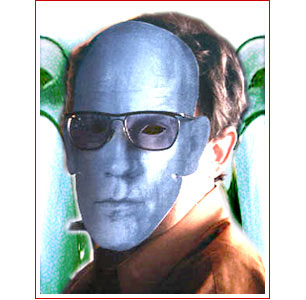

Right before Being John Malkovich” writer Charlie Kaufman phoned me for this interview last week, a telemarketer with a stuck speed dial bombarded me with repeated calls about a free trip to the Bahamas. When Kaufman rang and I began to say that I wasn’t interested in the offer, he said, brightly, “I’m calling to tell you that you won!”
That set the tone for our conversation. Although Kaufman resists being pinned down about his life or work, I found him playful and accessible. His message is that he has no message. His movie has provoked comparisons to Franz Kafka and Lewis Carroll, but he reminds me more of Larry David, who with “Seinfeld” created a TV series “about nothing.”
“I really don’t have any solutions and I don’t like movies that do,” said Kaufman. “I want to create situations that give people something to think about. I hate a movie that will end by telling you that the first thing you should do is learn to love yourself. That is so insulting and condescending, and so meaningless. My characters don’t learn to love each other or themselves.”
What this calls to mind (or at least calls to my mind) is David’s famous dictum, “No hugging, no learning.”
In a way, “Being John Malkovich” is Seinfeld through the Looking Glass. (Maybe this film’s instant popularity isn’t so mysterious, after all.) It contains a host of hapless New Yorkers, including a woebegone puppeteer, Craig Schwartz, (John Cusack), and his maritally frustrated, animal-loving wife, Lotte (Cameron Diaz), who find relief from despair and confusion only when they enter a mucky portal that drops them into John Malkovich’s brain.
Invention, thy name is “Malkovich.”
“Seinfeld,” too, mixed self-absorbed central characters and supporting crazies with creatures from the Zeitgeist — the camera often put us inside George Steinbrenner’s brain. And when George Costanza turned the bottom of his office desk into a bedroom, or Kramer transformed his apartment into the set of “The Merv Griffin Show,” it flirted with the surreal.
But “Being John Malkovich” jumps into the surreal head-first (so to speak). And that gives the comedy a whiff of transcendence that explodes the characters’ possibilities and makes them intriguing enough to follow for longer than a sitcom running-time — unlike the folks in David’s feature debut, “Sour Grapes.”
The blurbs proclaim a great movie; great fun is more like it. Kaufman prizes his creative partnership with director Spike Jonze, yet I found Jonze’s visual monotony and deadpan tone increasingly numbing. Apart from the performances, including Malkovich’s delicious turn as a blank version of himself, and Catherine Keener’s acid yet sexy rendition of a caustic single career woman (like Elaine in “Seinfeld” stripped of camaraderie), I enjoyed “Being John Malkovich” for the slyness of its slinky-toy narrative. And that’s why I enjoyed talking to Kaufman.
Since his script is a grand joke on the eternal mind-body problem, I asked him if he meant the only heroic character to be Lotte’s pet chimp, Elijah, who gets to work out a childhood trauma and feel comfortable in his own skin. But Kaufman saw through my gambit as one more case of a journalist trying to tie his creation to a theme. “Is Elijah heroic? He seems to be rather heroic, but who really knows what’s going on inside him. I just happened to be thinking about Elijah, too, but about little things I like. In the flashback to the jungle, his parents call him Elijah. And he’s Elijah to Lotte, too. How did Lotte know that Elijah was his name? And what happens to Elijah, anyway? Does he go inside Malkovich?”
I wondered whether Kaufman worried that having Lotte surround herself with animals might seem too whimsical — or, given her hunger for a child, too heavy-handed. “I don’t know,” he said. “I don’t normally think about that sort of stuff when I’m working. If it’s heavy-handed, I may still find it funny, and then if it’s embarrassing, I’ll take it out. Or,” he laughed, “maybe not.”
In short, he works on inspiration — but perspiration is never absent. “When I talk the way I do about it,” Kaufman said, “and it’s taken out of context, some people assume that I just wrote this thing in one night. But once you put it down, you explore the thing — restructure it, refine it. I throw out so much more than I keep. It’s not as if I’m not using any kind of craft. But I would make my work smaller if I didn’t leave it open; and if I were working to make any conscious point it would become banal. The fact that people are analyzing the film and coming up with different conclusions is the most wonderful part of the experience.” Kaufman is afraid he’ll curtail this interpretive cornucopia if he’s too forthcoming about his own view of the material: “People might think, ‘that’s what the writer said, so that’s what it is.'”
“Being John Malkovich” started out, Kaufman said, “as a story about a man who falls in love with someone who is not his wife.” It began to evolve when he introduced ideas meant as much to entertain him — and to keep him from getting too settled and pleased with the writing — as to keep an audience on comic tenterhooks. The first of those ideas, he said, was “The seven and a halfth floor” — an office-building floor originally built for little people and now a magnet for marginal businesses because of “the low overhead.” That’s where Craig Schwartz goes to work as a file clerk for LesterCorp, which is run by a randy aging loony (Orson Bean). “At that point Malkovich was nowhere to be seen. But you get these ideas that make it fun to write, and then you start to build a world, and justify a world, and make it work; you put in odd stuff but you have to make it organic to this world.” Eventually, that grew to include the moist, eerie umbilical that deposits its contents into Malkovich.
To me, “Being John Malkovich” is the satiric ne plus ultra of the headline that became addictive to slick-magazine editors in the ’90s: “It’s Frank’s World, We Just Live In It.” (The headline has been used for everyone from Sinatra to Regis Philbin.) Kaufman conceded that what he was doing “is sort of parallel to that. A lot of it comes from the idea of not wanting to be yourself and being envious of other people. There is for sure the idea of looking out in the world and feeling you don’t deserve to be there. How do you come to feel you have as much right as anyone else to be on this planet, when you have a barrage of information telling you that you don’t have a right to be here, or that you have to change yourself to be allowed to be here? I took each character and on an instinctive level explored how they would react to that anxiety.”
Kaufman avoids talking personally. The only biographical fact to be gleaned from publicity kits and press reports is that he once lived in New York and now lives in Pasadena, Calif. Since “Being John Malkovich” boasts a free-association brand of wit worthy of playwright Christopher Durang at his peak (say, “Beyond Therapy”) — and contains an open-air production of the one-woman show “The Belle of Amherst,” starring a 60-foot marionette of Emily Dickinson — I asked Kaufman if living in a theatrical town like New York had any influence on his writing. He answered, “I do have some theatrical background. I’ve written plays and seen plays and read plays. But I also read novels. One thing I don’t read is screenplays.” That’s because most of them are written not for the pleasure of a reader but for the use of a director. “I try to write mine so that they can be pleasurably read. You put as much feeling into it as possible, and as economically as possible try to create the world of the script and get across your feeling for it and put some ideas in the reader’s head. I also think that’s a good thing for the people who are producing it.
“What’s interesting about you bringing up the theater thing,” he continued, “is that when I wrote a series of pilots for TV, I would often get the response that what I wrote ‘seemed like plays’ — which is weird because TV is generally more like theater anyway. Maybe part of it is that my characters speak in stylized ways that seem to be anti-cinema.”
Kaufman contributed to “The Dana Carvey Show” as well as “Get a Life” (the Chris Elliott series) and “Ned and Stacey” (which starred Thomas Haden Church). But more to the point, he kept reading writers ranging from Franz Kafka, Samuel Beckett, Stanislaw Lem, Philip K. Dick and Steven Dixon to Shirley Jackson and Patricia Highsmith, who are both specialists in “the queasy, really subtle shit that happens between characters; it can seem like nothing’s happening, but it’s horrible just the same.”
Another favorite of Kaufman’s is Flannery O’Connor, who believed that Southern writers aptly render “the grotesque” because they can still recognize what it is. Reading O’Connor made Kaufman fear “that I wouldn’t have a voice because I didn’t seem to come from anywhere — I was jealous of other parts of America. I don’t want to veer into that personal area, but I grew up in the equivalent of Levittown, that kind of post-World War II development.” Part of Kaufman’s own development came from recognizing the “weirdness” within his purview.
“I don’t think my characters are a joke,” said Kaufman. “I take them seriously. And no matter how outlandish or weird their situation, their situation is real and a little tragic. I think that’s what gives people something to hang onto as they watch the film. We had to find a way to make everything play on a very naturalistic level, so it didn’t just turn into wackiness. I’m not interested in getting crazier and crazier.”
At the same time, Kaufman has a classic gag-man’s instinct for goofiness. Malkovich was picked at least partly because of how funny his name sounds in repetition. “When we were thinking of alternatives, we found that a lot of them weren’t fun to say.” Yet the script’s version of Malkovich turns out to be a somewhat piteous figure: “There’s never anyone else there with him; his life seems kind of sad and empty.” On a recent Charlie Rose show, the real John Malkovich said he figured out how to play the movie’s Malkovich manque by getting into the writer’s head. So in a sense, I suggested to Kaufman, Malkovich was portalling into him. “I can’t say how much I admire his courage in doing this,” said Kaufman. Malkovich was the writer’s first choice — unlike the guy in the movie who says the actor is his second choice. “I love that we never find out who his first choice is — in the original script I brought that up more than once.”
It was Malkovich himself who suggested Charlie Sheen for the role of “his” best friend. (Sheen’s performance is a career-saver on the order of Bruce Willis’ in “Pulp Fiction.”) And Orson Bean was the last person cast, though the role of Schwartz’s zany old boss could have been written for him. All the other outré and risky jokes, from the hanging questions about Elijah the chimp cited above to a sight gag about a nondescript plank of wood, belong to Kaufman. He tried to convey the look and meaning of virtuoso puppet turns like “The Dance of Despair and Disillusionment” in his prose. He also sweated to make sure that the fictional Malkovich’s theater jobs would augment the movie’s main action.
It’s ticklishly apt to have Malkovich read Chekhov’s “The Cherry Orchard” into a microcassette recorder while studying the text at his home; the air of deluxe ennui suits his apartment. “I knew I wanted Chekhov, and I went through a bunch of his plays to find lines that would be both overwrought and silly-sounding. I also like that Lotte is learning the lines through Malkovich’s eyes” — thus giving new meaning to the concept of two people being on the same page. And Kaufman set one scene during a run-through of “Richard III” because “I liked the idea that Malkovich would have to rehearse in a hump.” Naturally, it also aided Kaufman’s convoluted erotic story line to hear Richard pondering the wonderment of his twisted wooings.
Now that Kaufman himself is a celebrity of sorts, does he find himself constructing an alter ego of his own for the movie-going public? “Well, I’m making every effort not to allow that to happen. I don’t consider myself a public person. I am more careful; it’s weird to see myself quoted out of context. But when I’m talking like this, the only difference from the way I am normally is that maybe I’m a little less morose. I just don’t want to confuse myself. I’m confused enough, so I don’t want to add another element of … confusion. Confusion,” he said, with a laugh the size of a hiccup, “is my favorite word.”
And what about the Kaufman scripts yet to be produced? (He is reportedly working on another comedy, “Human Nature,” starring Patricia Arquette.) “I hope to do things that are somehow complicated but that won’t be repeats. Maybe I’ll try to do things that are different, and they won’t be so different, but the similarities are more for a critic to say. What would be funny is if the movie stays this ‘hot’ — and that everyone starts to want something like ‘Being John Malkovich,’ a film that took five years to get made. That would be like an episode of ‘The Twilight Zone.'”
