
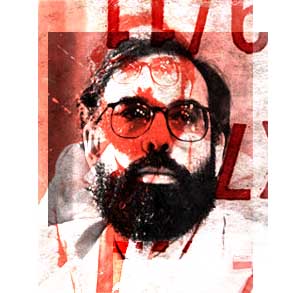

The best glimpse you can get of Francis Ford Coppola comes in
“Hearts of Darkness: A Filmmaker’s Apocalypse,” a 1991 documentary about
“Apocalypse Now” that draws on his wife Eleanor Coppola’s film and audio
recordings during the shooting of the movie (in 1976 and ’77) and her
marvelous 1979 book, “Notes.” Whether you view him as a tortured poet, an
ostentatious showman, a martyr or an ogre, it’s impossible not to get caught
up in his drive to overcome disasters — natural, political and theatrical
— and to push his movie to the finish line.
No matter how desperate his
statements, no matter how eccentric his MO, he’s vastly more engaging than
the average precocious millionaire (he was, at the time, in his late 30s).
He’s going all out for art, and persuading hundreds of people to take the
plunge with him. The project seems insane because he isn’t trying to
fulfill his inspiration — he’s trying to locate it and execute it at the same time. Yet even when his ambition grows to megalomania and his film
begins to fall apart, his zeal and riskiness are as elating as they are
dismaying. He’s in the gambling tradition of American entrepreneurs — there
isn’t a single corporate-like censor in his consciousness (or apparently in
his corporation, Zoetrope).
The excitement comes from watching him go out on a limb; the
heartbreak comes from seeing him saw it off behind him. You feel you’re
seeing, in extremis, the same creative force that generated the “Godfather”
films and helped shake American movies out of their 1960s doldrums.
Of course, despite his youth (now he’s all of 60),
the “Godfather” films had given Coppola the stature of a patriarch. What fans
knew about his life only reinforced that image. Growing up in Queens and on
Long Island, he suffered through polio at age 9 (an episode he alluded to in
his script to “The Conversation”) and grew into a high school misfit, living
in the shadow of his confident, intellectual brother August. But once Francis
started directing college theater and film he became a charismatic figure.
With his mushrooming influence in Hollywood he was soon able to employ his father, Carmine — an ace flutist and frustrated composer — to write scores for his
movies. And he directed his younger sister, Talia Shire, in her
indelible performance as Connie Corleone in the “Godfather” films. Coppola
was also the father of three children, Gio, Roman and Sofia; he infected
them, too, with the movie bug. (All went on to work in movies, Sofia as a
full-fledged director; Gio was killed in a speedboat accident in 1986.)
“Hearts of Darkness” lets you sample the dumbfounding emotional
arsenal that this premature sage must employ to get his way. You get to
witness the child-wizard flirtatiousness that continues to draw creative
people to Coppola. He has a knack for making himself larger rather than
smaller by revealing his insecurities. Sometimes, the audio track drips with flop-sweat. In “Hearts of Darkness,” he says that he knows he’s making a bad movie, that
people don’t believe him because of what he’s pulled off before. (By 1976,
he’d made three classics in a row: “The Godfather” in 1972 and “The
Conversation” and “The Godfather Part II,” both in 1974.)
His frankness has a heroic quality. He’s totally disarming when he pinpoints the biggest fear of any audacious moviemaker — that his work won’t live up to the subject
matter, that it will be merely “pretentious.” He facetiously compares
“Apocalypse Now” to the disaster films of Irwin Allen (“The Towering Inferno,” “The Poseidon Adventure,” etc.). Are these contradictory ejaculations the mark of a driven artist, a self-conscious impresario or a man trying out alternatives? Of course, he is all three —
that’s why at the time of “Apocalypse” he seemed indestructible.
A series of nonstop catastrophes wreaked havoc on the backbreaking
shoot in the Philippines. A ruinous typhoon deluged locations and wiped out
sets. The Philippines armed services were unreliable. Crucial helicopters
were often called away to fight Communist insurgents, and fresh pilots had to
be coached from scratch every day. Coppola fired one star (Harvey Keitel),
shot around the heart attack of another (Martin Sheen) and wrote (and shot)
around the forbidding obesity of a third (Marlon Brando). He encouraged his actors to be their characters: In the documentary, Sam Bottoms talks of
playing a stoned soldier while on an array of drugs himself; Frederic Forrest
— who’s terrific — reveals just how surprised he was when Coppola sprang a
tiger on him. The 14-year-old Laurence Fishburne is an electrifying presence
off-screen as well as on. There’s a glimpse of Dennis Hopper as a
decade-older, strung-out Easy Rider, with melancholy in his eyes and gray in
his beard — perfect for the role of a freelance photographer too long away
from home. Through it all, Coppola says that the film’s meanings will come
into focus partly from the experiences he has making it.
After two years of post-production, the nearly finished film
screened at Cannes in 1979 and ended up sharing the Golden Palm with “The Tin
Drum.” Coppola gave a frighteningly perfervid press conference in which he
said, “My film is not a movie; it’s not about Vietnam. It is Vietnam.”
There must have been something both lunatic and exhilarating about Coppola at
that press conference, getting carried away with his own metaphor: “We had
access to too much money, too much equipment, and little by little, we went
insane.”
Of course, “Apocalypse Now” isn’t Vietnam; it is only a movie (as
Sheen’s wife told him in the hospital). Its reflection of the filmmaker’s
despair doesn’t deepen its view of the grief in Southeast Asia. John Milius’
original script and Coppola’s nonstop rewrites couldn’t support the
director’s flood of notions; the production was designed at every stage as
the sort of spectacle that overwhelms audiences rather than prods their
understanding — a movie that blows minds, not a movie that expands them. It
wasn’t even an actors’ showcase. Only the most stylized performance — Robert
Duvall’s bravura, “Patton”-esque caricature of Lt. Col. Kilgore — had a chance
to stand up to the physical grandiosity, and understandably won the most acclaim.
Yet the movie has become a contemporary benchmark. How many
reviews of the current “Three Kings” tried to explain that film’s combination
of realism and absurdity by evoking “Apocalypse Now”? The lasting message of
“Apocalypse” lies not in the thin, awkward retread of Joseph Conrad’s “Heart
of Darkness,” with Brando’s Kurtz repeating (like his namesake in Conrad)
“The horror! The horror!” No, the message lies in its druggy yet precise,
blazing downer style, which says more about our post-Vietnam attitudes toward
war than it does about war itself.
When I talk to moviemakers about Coppola, “Apocalypse Now” comes
up as often as the first two “Godfather” films or “The Conversation.” They
admire its formidable craftsmanship — the hallucinogenic merging of sound
and image so that you can’t tell electronic buzz from animal chatter, or
jungle sounds from the whoosh of helicopters. Or the way palms burn abruptly
with napalm, not with a dramatic burst but as naturally as sunflowers opening
up to daylight, while the Doors’ dirge “The End” plays out against the
flames. Coppola has selected “Apocalypse Now” to spearhead his latest cutting-edge venture, American Zoetrope DVD Lab (the wide-screen, Dolby-digital transfer of “Apocalypse” hits stores Nov. 23). And “Apocalypse Now” was picked as the first subject of the Bloomsbury Movie Guide series (Karl French did the study). Reading it back-to-back with Michael Schumacher’s dogged new biography, “From the Heart: The Life and
Films of Francis Ford Coppola,” I found the “Apocalypse Now” guide more
engaging and illuminating.
Maybe that’s because, particularly when viewed in conjunction
with “Hearts of Darkness,” “Apocalypse Now” becomes a movie epic that’s
really the epic about moviemaking, illustrating all the skills contemporary
filmmakers need when pursuing an original vision on a mammoth scale. Seen
that way it assumes a mad grandeur. There’s Coppola’s ability to talk a
great movie: When he says that he considers the river journey a trip into
past history, the concept is strong though the proof is weak. There’s his
seductive visual sense — you can see why Eleanor Coppola, in her lucid,
too-little-read “Apocalypse” diary, “Notes,” compares watery landscapes lined
with fish traps to “Paul Klee drawings on blue-gray papers.” There’s his
consciousness of publicity and damage control, especially when he tries to
maintain stability after Sheen’s heart attack. And there’s his astounding capacity for leadership, not just when he’s dynamic and eloquent, but when he’s bewildered.
The makers of “Hearts of Darkness,” Fax Bahr and George
Hickenlooper, placed Coppola in the tradition of Orson Welles, who scored a
sensation with his radio adaptation of Conrad’s “Heart of Darkness,” and tried
unsuccessfully to helm a movie version before moving on to “Citizen Kane.”
They frame the film with Welles’ Conrad broadcast, and it’s a savvy stroke:
It passes Welles’ mantle of ravaged Hollywood genius on to Coppola. But it was RKO
Studios, not Welles, that put the kibosh on his “Heart of Darkness,” and Welles
never had the chance after “Citizen Kane” to mount his projects with
Coppola’s spectacular pyrotechnics. And if Coppola hocked his own assets to
keep “Apocalypse Now” in production (as Welles poured his own money into his
later films), Coppola’s distributor, United Artists, limited his liability by
acting as guarantor for his most publicized loans.
The similarities between Coppola and Welles are illuminating, particularly their
ability to galvanize troops and their experimentation with every element of
film. But so are the contrasts. Welles’ “Othello” won the Golden Palm at Cannes, but hardly anyone went to see it. “Apocalypse Now” not only co-won the Golden Palm, but also grossed more than $150 million worldwide. Welles made a living in his later years as the spokesman for Paul Masson wine. Coppola has made a fortune manufacturing his own wine. Coppola’s myriad extra-movie interests — from
publishing San Francisco’s City magazine in 1976 to publishing Zoetrope
All Story magazine today; from restoring the Blancaneaux Lodge in Belize to
reunifying the Niebaum and Inglenook wine estates in Napa and expanding his
Niebaum-Coppola wine and food company — have augmented rather than diluted
his status in the movie game. He’s on the board at MGM, and is said to have
his eye on the driver’s seat at United Artists, now an MGM subsidiary.
During the chaos of the Philippines, Eleanor Coppola realized that
her husband might have finally found what he wanted: a community of artists.
That longing for connection with other artists and old traditions fueled
Coppola’s art from the beginning. Some careers split naturally before and
after landmark movies — Robert Altman with “Nashville,” David Lean with “Lawrence of
Arabia.” “Apocalypse Now” has been the dividing line between the untrammeled
accomplishments of early-
carve out an empire of art and efforts to intensify his own artistic acts.
In 1997, before the 25th anniversary celebration of “The
Godfather,” Coppola told me, “I think the style of getting together with
other people, in this case young people — a lot of it came out of my
experience in college. I was a theater major at Hofstra, a school that has a
wonderful theater and theater tradition. We were near New York so we were still
close to the professional theater geographically, and that was the time, when
I was 17 or 18, that I sort of came into my own. And on campus the theater
was in that style of student organization where we students sort of had the
power. Like many people of my age I was influenced by the films of Orson
Welles and Stanley Kubrick, and the wave of great foreign films. So I had one
foot in international film and one foot in an entrepreneurial sort of
theatrical tradition.” After Coppola graduated from UCLA film school, “It was
natural for me,” he said, “to try to be close to friends and people I admired, such as Carroll Ballard and John Milius and George Lucas, and with them try to launch something independent and something American that was really related to cinema. It was like doing in a second installment what I had liked doing in college.”
As far back as college and film school, Coppola was willing to mix the image of an artist with that of a go-getter. Peter Bart, the journalist-turned-Paramount executive (now editor of Variety) who approached him to make “The Godfather,” told me that he remembered Coppola in film school as “already a great rewrite man; I’d written a story for the
New York Times about him as an up-and-comer. I wasn’t sheltered — I had
been a writer for both the Wall Street Journal and the New York Times, I
had covered the Supreme Court and the Watts riots. Yet what was astonishing
me then was that so many young filmmakers were really impressive. It was 15
years later that I realized that there was this amazing incursion of talent
into the industry — Hal Ashby, Martin Scorsese, Lucas — that hasn’t happened
since. And Coppola was perhaps the brightest.”
He was also readier than any of his peers to pay his dues, whether that meant patching together a shoestring nudie film (“Tonight for Sure,” 1961) or doing odd jobs and a quickie horror flick for Roger Corman (“Dementia 13,” 1963, when he married Eleanor), or signing up as a screenwriter-for-hire for Ray Stark’s company, Seven Arts. Coppola’s first
“personal” movie, the 1966 youth comedy “You’re a Big Boy Now” (developed on
his own dime), is the work of an exuberant young showoff. What’s most
entertaining is the quicksilver location shooting and editing. Along with the
Lovin’ Spoonful music on the soundtrack, the film turned New York into what the
city’s PR campaigns called “a summer festival.”
Coppola confessed to me that he made his next film, “Finian’s
Rainbow” (1968), because “musical comedy was something that I had been raised
in with my family and I thought, frankly, that my father would be impressed
if I were suddenly directing a Hollywood musical comedy — because he had
wanted to break into that Hollywood area.” Coppola portrays
“Finian’s Rainbow” as a “move against my main direction of doing original
films — a left turn” meant to pay off a psychic debt to his dad. But what
makes the film affecting is Coppola’s yearning to connect with Broadway and
Hollywood’s musical-comedy legacy. Enough bubbles of spontaneous lyricism
erupt to keep the creaking fantasy afloat — especially in the opening-credits scenes of Fred Astaire and Petula Clark, as an Irish rover and his daughter, traveling through magical landscapes on their way to “Rainbow Valley, Missitucky” (Carroll Ballard shot this footage). And on this film Coppola befriended a former acquaintance, USC film school legend George Lucas, who was observing the production on a scholarship from Warner Bros.
Brainstorming with Lucas about making unconventional movies
outside Hollywood rekindled Coppola’s dreams of spearheading revolutionary
theatrical enclaves. “I wanted to be with friends in a ‘La Boheme’-style
fraternity,” Coppola confirmed. “It’s true, the stimulation you receive
from hearing what so-and-so is writing, what they’re doing; the admiration I
had for these other filmmakers was self-empowering, and stimulating for my
own work. And that has been true more generally. You ask why there are
movements in movie history — why all of a sudden there are great Japanese
films, or great Italian films, or great Australian films, or whatever. And
it’s usually because there are a number of people that cross-pollinated each
other.” When I mentioned Bart’s feeling of being stunned that all these
“brilliant” filmmakers seemed to be swarming around him, Coppola replied, “I
don’t know how brilliant we were, but we were very enthusiastic about movies
and the chance to make them.”
The idea of escaping from Hollywood chores and bringing a
generation with him fueled his determination to make his next film, the
offbeat road movie “The Rain People” (1969). He plowed his own money into
mobile equipment and began shooting flashback scenes at Hofstra before he
landed financing for the movie. Working from his original script about a
pregnant Long Island housewife (Shirley Knight) who leaves her husband and
hits the highway, Coppola surrounded himself with key collaborators,
including Lucas, editor Barry Malkin (billed as Blackie Malkin), “sound
montage” expert Walter Murch and actors like Robert Duvall and the
top-credited James Caan, playing a brain-damaged college football player.
The film is simultaneously a mood piece and a period piece — it evokes an era
when personal disintegration echoed the fraying of society at large. So three
decades later, even its arty self-importance seems expressive. More
significant, with Murch wedding aural poetry to the moody cinematography of
Bill Butler, the film showed one of the first creative trademarks of the independent company whose name would end the credit roll: American Zoetrope.
Shortly after finishing up “The Rain People,” Coppola led his exodus
of tyros from Hollywood to San Francisco and established American Zoetrope
as a studio where a hundred visions could bloom. “He infused everybody with
this great indomitable spirit,” John Milius told me. “He was the rebel envoy.
He hired four or five people from my class in USC, and he was our leader.”
(Milius went on to direct such films as “Dillinger,” “The Wind and the Lion”
and “Conan the Barbarian.”)
Yet Coppola nearly lost his dream with the first American Zoetrope
production, Lucas’ Orwellian fable “THX 1138” (1971). After viewing the
rough cut, Warner Bros.-Seven Arts, which had sunk development money into
Zoetrope’s slate, decided to oversee the final editing of the film, reject
Zoetrope’s future projects and demand repayment of their seed money.
“Warner Bros. did not in any way make us a loan,” Coppola told me, still
seething decades later. “They never even said it was a loan.” It was Lucas,
the director of problem child “THX 1138,” who pointed the way out of
dire straits and urged him to direct a big bestseller for Paramount. “It’s
true, George is very practical,” Coppola said. “He really wanted me to do
‘The Godfather.'”
The making of “The Godfather” is now cemented in movie history as
a renegade movie victory on the scale of “Citizen Kane.” Coppola used all his
theatrical and Machiavellian powers, starting with a mock epileptic fit, to
secure casting choices like Brando and Al Pacino, maintain a stately pace and
an intricate lighting scheme and preserve the Italian-opera flavor of
Nino Rota’s score. The saga has been retold many times — including once by
me (in the March 24, 1997, New Yorker). And yet what I think has gone unstressed is how Coppola worked by magnetizing others. Although “The Godfather” was a Paramount picture, not a Zoetrope film,
Coppola made a host of creative choices with his once and future Zoetrope
cohorts.
“At least a year before ‘The Godfather,'” casting guru (and producer) Fred Roos recalled, “we would schmooze about various actors and exchange opinions on who was interesting coming up. I knew Talia; she may have talked to him about me. Then he called me on ‘The Godfather’ and asked if I wanted to work on this.” One of Roos’ personal coups was finding John Cazale in New York and realizing that he’d be the perfect Fredo. (Cazale
would also appear in “The Godfather Part II” and “The Conversation”; he died
in 1978.)
The late Mario Puzo told me two years ago that when he visited Coppola in San Francisco at the time “The Godfather” was being made, he was impressed with the Coppola group’s “high schoolish team spirit.” One of the most important members of that group was Murch, who was officially functioning as
the sound effects supervisor on “The Godfather” but was always involved in
Zoetrope projects as a top-flight film mind. (He had co-written
“THX 1138.”)
“From my perspective,” Murch told me, “Francis would never have
made the ‘The Godfather’ had the crisis not happened between him and Warner
Bros. When the studio said that the $300,000 they had fronted Zoetrope was a
loan, Francis was deeply in the hole and had no prospects for getting out
until Peter Bart made the call for ‘The Godfather.’ On one level, he needed the
money; there was also something about the material that deeply resonated in
him. He was even ambivalent about that until he really got into it.
Obviously, he was able to tie it into his life as a member of an Italian
family and also as someone who’d experienced the movie business as Big
Business. The fusion of the two was what was new about the film. It gave us
IBM or AT&T with a human face. Rather than seeing a corporation as thousands
of faceless people, Francis got it down to five faces, each a psychological
type, the father and four brothers.
“Aside from the fact that the role of the
Godfather was a comeback for Brando, who’d been exiled to the outhouse for
sins against the studios, it was a stroke of genius to cast four New York
actors [Pacino, Caan, Cazale and Duvall as the adopted son, Tom Hagen], who
had all become actors because Brando had inspired them,” Murch continued. “Each one was trying to impress dad with some aspect of dad that he had honed himself. So there
were all these harmonic resonances of Francis and the material, and Marlon
and the material, and the actors — the sons of the acting mafia of which Marlon Brando is the Godfather.”
“Francis fell in love with the actor who played Fredo,” Puzo
said, “and changing Fredo’s character was Francis’ doing.” Coppola put
Puzo on his side early on — a wise move, since Puzo was both his font of
Mafia lore and an astute storyteller in his own right. “On ‘The Godfather
Part II,'” Puzo said, “when Francis wanted Michael to murder Fredo, I told
him not to do it. But Francis was adamant. Then I said, All right, but you
can’t let Michael do it until their mother dies, and it turned out to be the
right decision — it even added tension to the funeral scene.”
To Puzo, “Francis had to do all the fighting, and I’ve always felt that’s where all
the credit should go.”
But Puzo took his own proprietary pride in their shared decisions: “I know Diane Keaton hated that role [as Michael Corleone’s wife], and yet she never realized that we picked her because she had a sunny face with all those grim mugs; she represented innocence in the midst of all that corruption, even though it might not have called on all her talent.
People never talk about Keaton’s role, but she’s the reflection of the real
world opposite the Mafia world — that was my intention, anyway.”
The greatness of “The Godfather” emerged both from its “harmonic
resonances” and from its dissonances. Coppola didn’t just go to war with Paramount
during the making of the movie; he also engaged in tooth-and-claw combat with
his celebrated cinematographer, Gordon Willis. Even though they and production
designer Dean Tavoularis had agreed on the film’s tableaux style, achieving
it became an agony for Coppola and Willis. It’s a measure of Coppola’s
confidence and clarity at this creative peak that he rehired Willis to do
“The Godfather Part II.”
Under pressure to repeat the success of the first film, Coppola
achieved an unprecedented American urban epic. What the two films said
together was that for the immigrant groups that have become this country’s
backbone, the American Dream was always limited by the burdens of poverty,
unsettled Old World scores and insular cultures. As in the old countries,
immigrants were prey to powerful economic and political forces; but here
these forces took more various, insidious forms. Many post-Vietnam movies
told us that America was evil, but “The Godfather Part II” told us that in
America the evil sleeps with the good. The same Senate committee that exposes
the Corleones includes a politician in the family’s pocket — one of many
who have paved the Corleones’ road to criminal ascendancy.
In between the “Godfather” films came the precious gem “The Conversation,” which once
again displayed Coppola at his pinnacle — synthesizing influences,
reconciling conflicts and shrewdly delegating responsibility until he created
a masterpiece. It was fellow filmmaker Irvin Kershner (“The Empire
Strikes Back”) who nudged Coppola to check out the world of electronic
eavesdropping. Under the influence of Antonioni’s “Blow Up” (and Kurosawa’s
“Rashomon”), that hint grew into a tour de force of suggestive filmmaking
about a hermetic, guilt-wracked bugging master named Harry Caul (Gene
Hackman) who believes he hears intimations of murder on surveillance tapes.
Once more, Coppola found himself and his production designer (Tavoularis again) at loggerheads with a renowned cinematographer (Haskell Wexler) during filming; this time, he fired Wexler and continued with Bill Butler, the veteran of “The Rain People.” More important, he entrusted the working out of the intricate audio clues (and ultimately the clinching of the plot) to Murch, who for the first time was also made supervising editor. When the film premiered, the technological tricks and sleek corporate backdrop
evoked Watergate. Thanks to Murch’s uncanny instincts and Hackman’s uniquely
clammy, subtle performance, the movie captures a more elusive and universal fear — losing the power to respond, emotionally and morally, to the evidence of one’s senses.
The influence of Coppola’s first two “Godfather” movies and
“Apocalypse Now” has been epochal, from their catch phrases (“I’ll make him
an offer he can’t refuse,” “I love the smell of napalm in the morning”) and
divergent techniques to their expressions of contemporary confusion. But “The
Conversation” has had its own lingering aftereffects — most notably last
year, when screenwriter David Marconi, who worked as a gofer on Coppola’s
“The Outsiders,” penned the sizzling high-tech thriller “Enemy of the State,”
in which Gene Hackman co-starred (with Will Smith) as a grizzled, more ornery
version of Harry Caul. With each passing decade, “The Conversation” seems
more prophetic in its demonstration that the more technology advances, the
more it leaves us feeling existentially stripped.
In the seven years between the releases of “The Godfather” and “Apocalypse Now,” Coppola produced “American Graffiti,” launched Carroll
Ballard’s feature career with the Zoetrope production of “The Black
Stallion” and saw Lucas and many of the younger producer-director’s friends
veer off into their own company, Lucasfilm. When he didn’t know how
successful “Apocalypse Now” would be, he streamlined Zoetrope into a company
mostly meant to service only himself; when “Apocalypse Now” became a hit, he
tried to expand it again with the purchase of an actual physical plant (the
creaking Hollywood General Studios) in Los Angeles. “I saw him a lot then,
during the Hollywood thing,” Milius told me in 1997. “It was his last great
act of rebellion. There were grand ideas, like doing ‘One Hundred Years of
Solitude’ or ‘The Killer Angels.’ He was going to get Werner Herzog $20
million to do ‘The Conquest of Mexico.'”
But the ambitious studio plans didn’t survive the fiasco of Coppola’s
exercise in nouveau back-lot style, “One From the Heart” (1982). Milius
insists, “Like I say about the American Indian, or the mob in Vegas — I
think he gave in too easy. But I think he just got worn out after ‘Apocalypse
Now,’ and it changed him forever.”
The ’80s and ’90s saw the emergence of several new and barely
recognizable Coppolas: the nostalgist of “The Outsiders” (1983), “Peggy
Sue Got Married” (1986) and “Tucker” (1988); the overactive visual virtuoso
of “Rumblefish” (1983), “The Cotton Club” (1984) and “Bram Stoker’s
Dracula” (1992); the kiddie filmmaker of “Life Without Zoe” (his segment of the 1989 trilogy “New York Stories”) and “Jack” (1996). When he consented to extend his greatest triumph with “The Godfather Part III” in 1990, the result was a fascinating misfire (and a suitable subject for a running joke on the part of TV’s “Godfather”-loving mobsters
in “The Sopranos”: “What happened with ‘III’?”).
Yet every so often, passages in
a Coppola film will show signs of his old warmth and fullness, as in the
marvelous funereal rituals and the “Old Guard” camaraderie of James Caan and
James Earl Jones in “Gardens of Stone” (1987), set in Arlington National
Cemetery during Vietnam. And, in general, there’s no sign that Coppola has
merely become cynical or hackneyed or malicious. I was not a fan of “John
Grisham’s The Rainmaker” (a minority position when it premiered in 1997), but
the problem was that Coppola, as the writer-director, had given himself over
to Grisham too completely; he showed flair with the extensive supporting cast
of slickers and slimeballs (particularly Danny De Vito’s self-described
“para-lawyer”), yet was paralyzed into sentimentality by Grisham’s bright-eyed
legal-beagle hero (Matt Damon).
I interviewed Coppola about “The Godfather” when he was working
on “The Rainmaker.” He mentioned that a tool from his theater background
that he used consistently in movies was a notebook like the one Elia Kazan
put together while directing “A Streetcar Named Desire,” in which he
“provided the core to every scene. When I did ‘The Godfather,’ I took a lot
of time and annotated the novel very carefully, trying to extract absolutely
everything that I thought pertained, and put it in the form of a big
loose-leaf book. I made a synopsis of each section and described the time,
the period, the era, and outlined the pitfalls. And then I actually directed
from that book. I find when I do a novel, I don’t really use the script, I
use the book; when I did ‘Apocalypse Now,’ I used ‘Heart of Darkness.’ I find
that novels usually have so much rich material it’s better to look through it
and base the film on that.”
Although Coppola has always declared his desire to make original
movies, the fact remains that most of his major work has derived from
fiction; even Harry Caul’s character in “The Conversation” was rooted in
Hermann Hesse’s “Steppenwolf.” Viewed in that light, the fluctuations in his
directing career are rooted in the varying quality of his sources, from Puzo
to Grisham. Just like his magazine Zoetrope All Story, which “purchases both first
serial rights and film options on the short stories and one-act plays
published here-in,” Coppola’s ongoing effort to gain control of studios and
production companies, with UA as a possible next goal, may derive from an
ambition to acquire massive and diverse amounts of material the way Old
Hollywood did.
Coppola is only 60. He may also want to reestablish the communal
dream he banked so much on achieving and never fully abandoned. Were he able
to assemble a millennial team as strong-minded and challenging as his old
one, who knows what wonders he could still pull off. “Geronimo, Sitting Bull
— a lot of those great Indians went off the reservation in one great spark
of rebellion,” Milius told me two years ago. “Francis may have that kind of
gesture and vision left in him; and if he ever really wants to do it he can
count on my sword, too.”
