

In Atlanta on Monday afternoon, Dec. 4, the scene at Gate E12 was pandemonium. There was barely room to move amid a crush of elbows and carry-ons, and it was tough to hear the announcements above the din. It was noisy, frantic and disorganized.
Isn’t that always the case? Except this time, for most of the people on hand, it was downright exciting, even joyous. For this wasn’t your typical pre-departure chaos, it was launch day for Flight 34, Delta Air Lines’ new nonstop service between Atlanta and Africa.
The gate had been decked out with balloons, ribbons and banners. A makeshift podium was flanked by Senegalese and South African flags. Television cameras craned above the crowd. There was live music, a free buffet and cocktails, and performances by the Zulu Dancers. Some carved-wood figurines — giraffes and elephants — were assembled on the check-in kiosk. Delta had the look and feel just right, colorful and apropos, with no slip into caricature. How to say this, exactly, but the choice of cultural props for this sort of thing isn’t always appreciated. Dragging out a cardboard windmill to herald a new run to Amsterdam might be clichéd, but it’s a safe, inoffensive cliché. Africa is owed more careful forethought.
The Delta brass were beaming as they introduced a short series of speakers, including staff from the Washington embassies of Senegal and South Africa and the director of the South Africa tourism board. And it wouldn’t be an inaugural without a ribbon-cutting (complete with a pair of oversize novelty scissors that had more than one observer cracking jokes that the Transportation Security Administration screeners had missed them).
Flashbulbs popped as Atlanta Mayor Shirley Franklin took the podium. Franklin wasn’t there merely for the cameras; she clutched a boarding pass for Johannesburg, South Africa. Franklin told the story of her first trip to Africa some 40 years ago. “On Pan Am,” she added emphatically, drawing scattered applause.
As the crowd was informed earlier, today’s departure — commencement of a daily service to Dakar, Senegal, and onward to JoBurg — would be more than a first for Delta, it would be the first regularly scheduled flight to Africa by a major U.S. airline in more than 15 years. The last to operate such a flight: the fabled Pan American.
Two qualifiers here: The first is that I’m referencing scheduled network passenger carriers — the so-called majors. At least one small niche company, the little-known North American Airlines, has been running flights from New York to Ghana and Nigeria for a while now. The second qualifier is that by “Africa” I mean the continent proper. That is, black Africa. TWA and Delta were calling at Cairo, Egypt, until 2001, but nobody has ventured sub-Sahara since Pan Am. (Its routes there had grown from government contracts commissioned during World War II. I’m sure today you can stumble across examples of Pan Am’s famous blue globe — faded, peeling and streaked with rust — on abandoned trucks and ground equipment in Monrovia, Abidjan, Nairobi and elsewhere.)
In Atlanta, however, the Pan Am references, albeit reverent, would need to be kept to a minimum. For all its global adventuring and aerohistorical superlatives, what disgraces Pan Am’s legacy is that, when push came to shove in the post-deregulation era, it couldn’t get its act together. The most storied franchise in the history of civil aviation closed its doors for good in December 1991.
Or, to be more eerily precise, it closed its doors for good on Dec. 4, 1991 — 15 years ago to the very day. I don’t know how many of those on hand, if anyone, knew that, but it’s not a karma any earnest airline, particularly one looking to emerge from bankruptcy while fending off a hostile takeover bid, wants to become too cozy with.
Be that as it may, wishful disassociation only goes so far. After all, it was Delta that purchased Pan Am’s massive transatlantic and intra-European networks in 1990. In a proverbial heartbeat, the once parochial carrier from Monroe, La. — hence “Delta,” from that of the river Mississippi — was flying to places like India and Russia, and was suddenly running a hub (since closed) in Frankfurt, Germany. In the process, the Southerners may have inherited a little of Juan Trippe’s globetrotting DNA — he the visionary founder of Pan Am, who would scope out new destinations using a giant model globe that stood in his office. They were, at the outset, in over their heads, but by 2006, a glance at the Delta route map shows what is arguably the most impressive overseas network of any U.S. contender. Ignoring Dakar and Johannesburg for a moment, the capstone of that network is probably the JFK-Mumbai nonstop introduced last month, the only direct flight — and at 6,777 nautical miles one of the longest in the world — between America and India’s largest city. Delta has greatly intensified its South American presence — up to nine cities in seven countries — and while it won’t be a milestone event like Flight 34, service from JFK to Accra, Ghana, starts on Dec. 11. (Freight will be major factor, and potential profit maker, on that one.)
Across the Atlantic, Delta has more flights than anybody, and by next summer, with the pending additions of Prague, Bucharest, Pisa (gateway to Florence), Vienna and Dubai, that’ll mean 400 weekly flights to 36 cities in Europe, India, Africa, the Middle East and beyond. Several of those markets will be Delta exclusives. It’s the only American airline currently flying, or soon to be flying, to Greece, Turkey, Austria, the Czech Republic, Hungary, Romania, Ukraine, Russia, the United Arab Emirates — and, of course, Senegal, South Africa and Ghana. (Of the latter, by the way, my hunch is that Senegal disappears once Delta takes delivery of the on-order, long-range 777-LRs it needs to make Johannesburg a nonstop.)
Granted, cutthroat competition on the domestic front has forced all of the network carriers to go looking offshore for profits, but it’s Delta that has made the most rapid and impressive strides. Originally hoping to secure 25 percent of revenues from international flying, putting it roughly on a par with American and United, the new target is 35 percent, and possibly higher. “Forty isn’t out of the question,” said Andy McDill, a Delta spokesman on hand for Monday’s launch. “Even closer to 45.” I asked McDill how it feels being the first back to Africa, reminding him that Continental had seen its 2005 plans for Nigeria dashed over governmental squabbling. “We’re very proud, naturally,” he replied. “And we’re proud to be doing it from here, our world headquarters. But we won’t be stopping with this.”
If there’s anything keeping Delta from legitimately calling itself a “global” carrier, on a par with players like British Airways, Lufthansa and Air France — airlines that are smaller overall, but worldlier in reach — it is a conspicuous lack of presence in Asia. Currently, the extent of Delta’s Pacific Rim flying consists of a single daily nonstop between Atlanta and Tokyo. Seoul, South Korea, is on tap for next spring, and there’s talk of China in time for the Beijing Olympics.
For now at least, the addition of Africa puts Delta in league with Continental and United as the three U.S. mainstays offering service to five continents. That sets the bar a little higher: Who will be first since Pan Am to join the Six Continent Club?
Though I know what some of you are thinking: Why is any of this important? Why should the average American care, one way or the other, which airlines do or don’t fly to which cities, which regions, which continents? Does it matter that you’re flying South African Airways and not Delta, if the price is right and the schedule convenient?
There are a couple of ways to answer that. The first way dares us to explore some of the softer implications contained in a word that makes many of us uneasy: “patriotism.” Love them or hate them, airlines are more than corporations. They operate, in a sense, as de facto ambassadors. Just after Sept. 11, America’s big airlines began reducing their international schedules. This included Delta, which quickly dropped flights to Cairo and Dubai. If on one hand this made sense for the bottom line, it ran starkly counterintuitive to the long-term sensitivities of geopolitics — and was furthermore anathema to everything I believe in as an aviator and traveler. Was this insular, isolationist trend more than a simple, temporary affliction of economics? Was it a withering of national spirit, a withdrawal into fear?
The answer, it turns out, is no. But until we knew for sure, was it not shameful that the five largest airlines on earth, all of which are commercial entities of the United States — they are, in order, American, United, Delta, Continental and Northwest — were collectively ignoring an entire continent? Africa in whole comprises less than 3 percent of worldwide passenger traffic, and of that, traffic to and from the United States is a smaller fraction still, but you mean to tell me that while carriers from Europe, Asia, the Middle East, Australia and even South America could succeed there (if only with a token route or two, in some cases), none of ours could? Not one, to a single city? It just wasn’t right. It didn’t seem American, in either the best or worst connotations of that word. Now, finally one of them is giving it a try. I wouldn’t call it historic but it’s surely good and important — for Delta, for travelers and for the country.
Another thing, too. The bulk of aviation news percolating through the media nowadays inevitably revolves around the data of airline finances: the windless arcana of stock prices, cost structures and collective-bargaining battles; the legal vagaries of mergers and acquisitions; charts and graphs. How much of that can we take? This, I hope, is different and refreshing, a throwback rediscovery of adventure, celebrating the thrill of striking out somewhere new. Isn’t that what travel is all about? Isn’t that what airplanes are for?
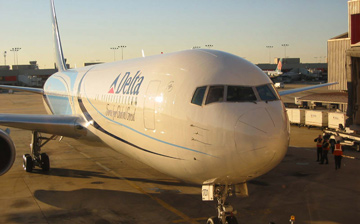
Back at Gate E12, the late afternoon sun is falling fast, reflecting obliquely off the ivory-and-blue 767 parked outside. The plane is done up in a special livery, commemorating Delta’s partnership with the Georgia-based Habitat for Humanity. It says “Force for Global Good” across the forward flanks. A contingent of 30 Delta employees will be among the passengers, on their way to a volunteer building project in Katlehong, outside Johannesburg, the first of several foreign commitments Delta has made with Habitat for Humanity.
Through the concourse windows I can see captain D.L. Mosley and his crew rifling through paperwork. What are they thinking, I wonder? For them, this is something new. Aviators may no longer be pioneers — the technicalities of cross-border flying, from runway markings to radio phraseology, have long been standardized and ironed of their more challenging wrinkles — but that doesn’t mean it won’t be exciting, and even a little mysterious. There will be new chart maps to consider, new routings to plot, strange new frequencies to tune in and accents to decipher.
At the initial boarding call, the crowd, which looks to be about 70 percent airline and airport staff and 30 percent passengers, has reluctantly strained and heaved, opening up a corridor so the first group of customers can reach the jetway. The very first passenger, whose name I don’t catch and who probably has no idea of the significance of his being the head of the line, is an elderly man in a wheelchair. The rest come slowly, and it saddens me to notice how uninterested a number of them seem: lugubrious and sullen, as if burdened by the very thought of the journey ahead. They’d been enjoying the buffet, but now they have to fly.
There are times when the discomforts of having to spend many hours aloft in a tiny chair should give way to the temporal thrill of having been a part of something special. For heaven’s sake, people, this hasn’t happened in 15 years.
“Now boarding all passengers,” sing the loudspeakers. “All passengers for Dakar and Johannesburg.” There’s something about the drama of a boarding call that, if done right, gets your pulse thumping. And what I wouldn’t give to be riding along, wedged into the back of that overbooked Boeing.
I imagine the sunrise touchdown in Senegal — the smell of tropical humidity stewed with kerosene as the doors are thrown open to a set of drive-up stairs. Then, the second leg, south to JoBurg. The precise routing will vary, but imagine the possibilities: over the dry Sahel of Mali and the great Niger River; across the continent’s great central bight; over saw-toothed mountains and some of the planet’s last stands of untouched jungle; over the scarred battlegrounds of Angola, the skeleton coast, the primordial emptiness of the Kalahari. All in daylight, no less! How many people will be looking out the window with the contemplative awe such sights deserve? How many will have their shades drawn?
– – – – – – – – – – – – – – – – –
Do you have questions for Salon’s aviation expert? Send them to AskThePilot and look for answers in a future column.
