
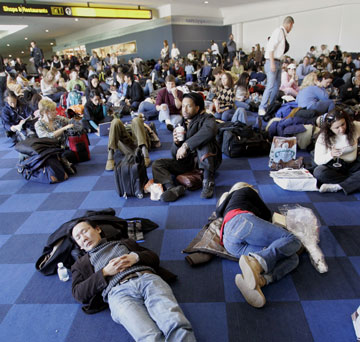

Last Wednesday, after a midwinter snow and ice storm slammed the northeastern United States, hundreds of JetBlue passengers at New York’s JFK airport were stranded aboard grounded aircraft for as long as 10 hours. The incident made front-page news nationwide and has kept the talk shows busy for more than a week — another glistening black eye for the beleaguered industry Americans love to hate.
Regrettably, we’ve seen this before. In late December, a massive storm system caused a similar drama to unfold at American Airlines. Nearly a hundred flights headed to that carrier’s Dallas-Fort Worth megahub were diverted to other cities, where in some cases there were inadequate facilities and staff to handle them. One of those diversions, Flight 1348, sat on the tarmac at Austin, Texas, for more than eight hours. And perhaps most notorious of all, seven years ago in Detroit, thousands were stuck aboard Northwest Airlines planes for up to 11 hours during a New Year’s weekend blizzard. These and other incidents have left people shocked, outraged and dismayed. Why, exactly, do such things happen? How are such preposterous situations allowed to develop?
The short answer is: I don’t know, and I’m as appalled as you are. If you find it hard to imagine any plausible reason for locking people in a ground-bound plane for 10 hours, so do I, and frankly there isn’t one. Such breakdowns are abhorrent and inexcusable.
The long answer mostly involves the capricious nature of weather and air traffic delays. It requires an understanding of the typical airline’s interdepartmental communications and an acknowledgment of the vastness of the typical airline’s network. Taking that last one first, a single large airline operates hundreds of planes, transporting hundreds of thousands of people daily across continents and oceans. Even little JetBlue, the 12th-largest carrier in the United States, flies some 50,000 people a day using more than a hundred aircraft. Whether in spite of or because of this, when things go bad, they sometimes go really bad.
When a storm hits, there are two kinds of delays. The first is a material delay — the physical slowdown that inevitably results when human beings are forced to perform their duties in harsher than normal conditions. Once the snow begins to fall, planes tend to be late taking off for the same reasons that people tend to be late getting to work or school: We move more slowly; our vehicles move more slowly; aircraft need to be de-iced, and in some cases de-iced again. And so forth.
The second kind, which is usually more serious and harder to predict, is the air traffic control delay. Storms hinder the flow of traffic both locally (on and in the vicinity of the airport) and en route (along the high-altitude flyways that connect cities). Even in ideal weather the skies are crowded and delays common; throw in any number of specific meteorological complications — icing, low runway visibility, strong crosswinds, possible wind shear, slick surfaces, etc. — alone or in combination, and you’ve greatly reduced the number of allowable arrivals and departures. You can blame the ATC system itself — one that has been glacially slow to adapt and modernize — or you can blame the carriers that attempt to cram too many flights into already saturated airspace. Regardless, aircraft need to be choreographed into complicated instrument approach patterns; crosswinds or low visibility might render one or more runways unusable, and as local traffic backs up, the effects are soon felt hundreds, even thousands of miles away. A plane headed to New York City might be asked to fly a holding pattern over Pittsburgh. Or, as happens quite commonly, controllers issue “ground stop” orders preventing planes from ever leaving the gate.
What makes ATC postponements maddening to airlines and passengers alike is their fluidity. They change hour to hour, minute to minute. Typical scenario: A crew is preparing for a noontime departure from Washington to Chicago. Passengers are loaded, the aircraft is fueled, the checklists are complete. Suddenly, owing to a line of thunderheads somewhere above Ohio, there comes word of a ground stop. The pilots are assigned a “wheels up” time of 2 p.m., or two hours hence. Passengers are asked to disembark, with the plan to reboard at approximately 1:30. But then, 15 minutes later, ATC calls back with a revised time: The plane is cleared for departure immediately. Unfortunately, the passengers have all wandered off, to browse in the bookstore or have coffee at Starbucks.
Once a flight misses its ATC departure window, it usually goes back to the end of the queue and the clock starts again. And once that happens, the dominoes fall faster and harder. Pilots and flight attendants, remember, are subject to federally enforced flight and duty time limits. Once large numbers of crews begin timing out, it sends a ripple effect through a carrier’s entire operational matrix that can last for days, affecting millions of fliers and costing millions of dollars.
So, while nobody enjoys sitting on a taxiway for long periods, keeping everybody together and at the ready often saves time in the long run. Ten hours? That’s excessive and nobody denies it, but this is the thinking process that occasionally allows manageable situations to, yes, snowball out of hand.
Airlines coordinate delays both on-site and remotely. At or near company headquarters is the carrier’s operational control center, where teams of dispatchers, flight controllers, meteorologists and crew schedulers work in a huge room that looks like NASA control. Locally at the terminal, the highest-level employee is somebody called the station manager. On paper this would seem to be a straightforward and efficient flow of command. In practice, information makes its way through a series of departments, each with its own expertise, its own lingo, and to some extent its own needs and priorities. What appears in one department to be a simple solution to a simple problem might not appear that way to somebody else down the line. This is where experience can really make a difference. As things unfolded at JetBlue, its bare-bones communications network left both employees and passengers in the dark.
And as information is passed along, there’s plenty to lose in translation. Explaining delays to the public isn’t easy. In the heat of battle, some carriers do it better than others. What the passenger finally hears crackling over the public address system at the gate, or inside the airplane, may or may not represent the entire story. (And the various personnel can be mighty territorial: Several years ago I was the captain of a commuter plane victimized by a snowstorm at Boston’s Logan airport. Our 20 or so passengers were confused, and the gate staff did little to make things clear. So, there in the boarding lounge, I asked for people’s attention and began to explain what was happening. Maybe I got too in-depth with the definitions of things like “wheels-up time,” but a few seconds later came some loud footsteps and a voice behind me asking, “What the hell does this asshole think he’s doing?” It was the station manager.)
Bear in mind that crews do not enjoy being stranded any more than passengers do. Cynical fliers have remarked that pilots and cabin attendants enjoy long delays because they’re able to collect overtime pay. Without getting into the nitty-gritty of how crews are (or aren’t) compensated, this is nonsense. If you’re envisioning a pair of pilots up there in the cockpit, rubbing their hands and making that annoying cash register sound, believe me, nothing is further from the truth. A single extended delay can disrupt a pilot’s entire monthly rotation, costing him dearly.
And although the captain has absolute authority over the aircraft and its occupants, there is only so much he or she can do if, quite simply, there is no place to go and no place to park. At JFK last Wednesday, apparently all gates were occupied and a number of aircraft had become frozen in their parked positions. You’re forgiven for wondering why passengers couldn’t be bused or otherwise escorted into the terminal, but if for whatever reason, good or bad, that is not an option, is the crew supposed to usher people down the escape slide and out onto the tarmac unattended? The captain would likely be arrested, prosecuted and fired.
(A number of readers have asked what might happen if passengers, on their own volition, organize a mutiny and pop an exit. I’m somewhat surprised this hasn’t happened yet, but suffice it to say, the airport police would be extremely unhappy and you’d probably be responsible for the expense of restowing the emergency escape slide. Also, it’s a long way down and those slides are very steep, so you’re liable to get hurt.)
Carrier culpability, meanwhile, has become a highly contentious issue. Northwest Airlines eventually paid more than $7 million to settle a class action lawsuit for the 1999 Detroit fiasco, which included charges of “unlawful imprisonment,” but admitted no wrongdoing. American Airlines said it was sorry for the Dallas debacle and issued thousands of $500 vouchers, pointing out that the storms that swept across Texas were the worst in 20 years. And JetBlue, an airline that prides itself on straight talk and good customer service, has publicly apologized for what happened at JFK. Founder and CEO David Neeleman called himself “humiliated and mortified.” Days later his airline was still canceling dozens of flights and trying to reorganize, admitting it had badly underestimated the storm’s potential impact, choosing to stick with a full schedule while competitors had been canceling departures and rerouting ticket holders in advance. JetBlue says it will soon unveil a “customer bill of rights” guaranteeing compensation to its passengers in the event of a sequel.
Neeleman’s mea culpa was as swift, heartfelt and forthright as anyone could ask for. It was also designed, in part, to help stave off more binding resolutions soon to be put forth by politicians. Sen. Barbara Boxer and Rep. Mike Thompson of California will formally introduce versions of the oft-called Passenger Bill of Rights to the U.S. Congress in the next few weeks. Their legislation would, among other things, offer passengers the option of leaving any airplane delayed on the ground more than three hours after its doors are closed.
That certainly sounds reasonable, but although the proposal is well intended, it’s wrongheaded for at least a couple of reasons. First, deplaning even one passenger requires a return to the gate, the possible offloading of luggage, and the very real danger of a flight missing its departure slot, subjecting those who remain to a substantially longer wait. It’s never fun, but there are times when sitting on a plane for three and a half hours is the better alternative.
But more important, let me ask you this: Is the call center at my bank obligated under federal law to answer its phones in a certain amount of time? When UPS delivers a package late, is it beholden by an act of Congress to make amends? And so on. I’m not one of those people who believe the free market should be left to its own Darwinian devices every time, but it sets a bad precedent, and it’s a very slippery slope, once we start legislating what is effectively customer service.
Additionally, these laws would go beyond the issue of delays to address matters like misdirected luggage and overbooking — things already covered by the laws of common carriage, if not common sense, as outlined in the fine print on your ticket. Should we legislate legroom too? What about seat width and a law covering pillows and blankets? Apparently it’s open season on the airlines; how petulant can we get? Well, last year, Sen. Chuck Schumer of New York came up with something called the Air Travel Delay Awareness Act of 2006, stipulating that carriers “make available to the public information regarding the delay of a scheduled passenger flight not later than 10 minutes after such information is available.”
Sorry, Chuck, but if you feel that an airline hasn’t given you the proper information at the precise moment you’d like it, you should take your business to one of its competitors. And if you’re that worked up over delays, you should begin by addressing their root causes — an outmoded ATC system, and airline scheduling practices. In the meantime, if you or anybody else feels that you’ve been violated, “kidnapped,” held against your will, or had your civil rights trampled upon, you are welcome to sue.
Contrary to popular assumption, airlines are not sadists intent on imprisoning their customers. No lone individual at JetBlue or any other airline comes to the sort of decision you might imagine: “Yes, we will lock people in that airplane without food, water or clean lavatories.” It doesn’t happen that way. It’s a chain of errors and a combination of circumstances both within and beyond a carrier’s control.
Don’t get me wrong. As a pilot and avid traveler, I was offended by what happened in New York last week, and regardless of whether such breakdowns are entirely their fault, airlines need to realize the string is out. If they have any hope of winning back the public’s trust and beating back mandatory regulations, they first and foremost need to communicate better. Their patrons don’t want apologies and vouchers after the fact. They want timely information and timely decisions.
However, collapses like the one at JetBlue are the rare exception. More than 2 million Americans fly every day. The vast majority of them get to where they are going in an acceptable amount of time, in near-perfect safety, for a ridiculously low price. Airfares, adjusted for inflation, continue to hover near or around where they were 25 years ago, and that $179 you just paid for a trip to Florida equates to about 8 cents a mile. Airlines face razor-thin margins and cannot provide inexpensive tickets and top-notch service at the same time. By no means does that grant any carrier an abrogation of basic responsibility, but it reminds us to keep things in perspective.
– – – – – – – – – – – –
Do you have questions for Salon’s aviation expert? Send them to AskThePilot and look for answers in a future column.
