

Something different this week.
There’s a new book out. While it has nothing to do with flying, I can’t help giving it a plug. “Taking Things Seriously: 75 Objects With Unexpected Significance” was published last month by Princeton Architectural Press. Says the cover blurb, “This is a book about the things that inspire all of us … Artists, writers, designers, among many others, contribute their objects and ruminations that encourage, motivate, and energize their own creativity.”
The editors are Joshua Glenn and Carol Hayes. I’ve known Josh Glenn for more than 20 years, during which he has progressed from slacker Svengali to capo of the Boston literary mafia. (He was previously the creator of Hermenaut magazine and associate editor of the Boston Globe’s “Ideas” section.) He knows that I travel a lot, and that I moonlight as a columnist. Apparently that made me a good candidate for inclusion.
My “thing” appears on Page 48, between a pencil sharpener and a cheese box. More correctly, there are two things — a pair of ceramic insulator pegs that I appropriated from the grounds of the former Birkenau concentration camp, in southern Poland, during a visit there in 1995. The pegs, through which deadly wires were once strung, had been part of an electric fence. Each is about the size and shape of a salt shaker. When I found them, they’d broken from the stanchion and lay half-buried in the mud. I pried them out, put them into my backpack and carried them home. Today they sit on a bookshelf, inconspicuous and awful.
Birkenau is part of the Auschwitz/Birkenau complex, Europe’s largest and most notorious death camp of the Second World War. Plenty of people visit the somewhat prettified Auschwitz portion, a low-rise complex of restored brick buildings and a tourist museum, where the impeccably manicured grounds are perversely reminiscent of a boarding school campus. Auschwitz will always be a place of intensely profound impressions, but just the same, they are reconstructed impressions. They are not always as emotionally or viscerally genuine as they could be. For that, one needs to make the mile-long trip across town to the staggeringly huge, mostly untouched remains of Birkenau, also known as “Auschwitz II.” Birkenau is the place you see in the old newsreels and photographs, with its long lines of barracks and infamous boxcar depot. This is where the majority of prisoners lived and died, and it’s Birkenau that will leave you with knees shaking, having glimpsed the ultimate scale of mechanized mass murder. And you don’t merely see it through a glass-enclosed viewing platform. You touch it, breathe it, get it stuck in the soles of your shoes. Lonely Planet is correct when it states: “Tour groups who are shown only Auschwitz will get a totally false impression.” Simply put, you have not been to Auschwitz unless you have been to Birkenau. You can crawl amid the ruins if you like, mingling with the ghosts of those million-plus victims. Later, you’ll ponder the significance of the fragments of grit and mortar embedded in the treads of your sneakers.
Along with the keepsakes you’ve dug from the ground and stolen.
I mentioned my excursion to Birkenau in a column once before. For perhaps obvious reasons — guilt, shame, regret — I did not mention my theft of the cylinders.
For the same reasons, I at first balked at using them as my “Things” contribution. In the end, I’m somewhat surprised they were accepted. When you think about it, the pegs are not objects of “unexpected significance” at all. Their significance is pretty obvious — which goes against the grain of the book. Worse, their meaning is easily misinterpreted. They become about me — specifically, the story of my having pilfered them. (I already exploited this story years ago, in a small zine I used to write and self-publish.) That in itself makes their significance “unexpected,” I suppose, as does their perverse anonymity, resting innocently on a shelf in Somerville, Mass., utterly out of context. But also wrong.
Or maybe not? Could the theft of these two tiny objects be anything other than blasphemous? Is it possible to deface or defame something so over-the-top sinister and beyond redemption? There are those who argue Birkenau should be torn down and bulldozed over, which in a way leaves the taking of a souvenir, if still a bit audacious, less ethically encumbered.
If you can’t already tell, the psychology of souvenir collecting is something I’ve never totally understood. This might explain why my collection of travel souvenirs is, if not exactly limited, undeniably odd. Apart from a Moroccan kilim and a handful of inexpensive carvings, it consists entirely of small, idiosyncratic keepsakes: a black pebble of lava from an Icelandic beach; a section of newspaper (presumably radioactive) from Chernobyl, Ukraine; an acacia thorn from Botswana; a hunk of salt from Timbuktu. I prefer the sort of miscellaneous scavengings that are free, portable and pocketable. Most of this detritus rests on a bookcase in the converted bedroom where I write my columns. The pegs are perhaps the most profound item in this jumble of mysterious, vaguely scientific-looking knickknacks. But they are not the only ones acquired through dubious means. In fact, my backup submission for the “Things” project was yet another item carted home from abroad with a less than clear conscience — a human jawbone.
The story of the jawbone doesn’t carry with it quite as much baggage, and is one that I tell more freely. All things considered, I am lucky, if that is indeed the proper word, to have poached it successfully.
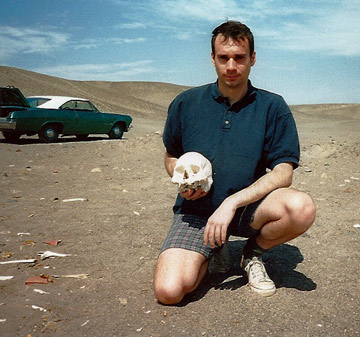
It comes from a place called the Cemetery of Chauchilla, located in the coastal desert along the shoreline of southern Peru. The area is best known for the famous Nazca Lines — a series of giant, mysterious patterns and figures carved into the landscape thousands of years ago, some of them miles long and distinguishable only from an airplane. I’d been fascinated by the Nazca Lines since childhood, inspired by the voice of Leonard Nimoy in the ’70s documentary show “In Search Of.” In May 1994, during a weeklong trip to Peru, I went and saw them.
No less impressive than the Lines, albeit in a totally different way, was the nearby Cemetery of Chauchilla, a short taxi ride from Nazca town along the Pan American Highway. Set in a field of shallow dunes, the cemetery is a pre-Columbian burial ground, centuries old and badly ravaged by looters. I am told the looted area is closed to tourists now, but I can tell you how it looked 13 years ago.
Most of the graves have been dug up, with the ancient corpses scattered and heaped about. (Strange as it might sound, I would later be reminded of Chauchilla during a visit to the famous airplane graveyard in the Mojave Desert. But these aren’t planes, they are people.) Visitors wander freely through a sandscape of mummies, skeletons and random body parts. It’s a hot, impossibly ghastly place, a death kiln of nightmare imagery. Several of the bodies, propped upright, remain more or less intact — racks of bone held together by tattered shawls and rope. The skulls, many sprouting wild manes of postmortem hair, wear ghoulish death masks of blackened, leathery skin. Elsewhere, bodies are strewn in various states of dismemberment and decay. Limbs and bones lay cracked and bleaching under the desert sun: feet, fingers, tibias, ribs, fractured craniums, femurs.
And, yes, a jawbone — an entire lower mandible, still with several teeth. I kneel on the ground and pick it up, turning it in my hands. Who did it belong to — a man, a woman, adolescent or adult? It could be a thousand years old, maybe more. I think in long, circular sentences of ways in which to justify the act of petty theft that I know, without the least bit of doubt, is about to occur. My taxi driver is tailing a few feet behind me, kicking idly at the detritus. He seems to know exactly what I’m thinking, and offers a slight, conspiratorial shrug. I blow a few grains of sand from the empty tooth sockets and drop the artifact into my day pack. Then we head back to the car. At the hotel, I rinse it clean in the bathroom sink.
A few days later, I am packing up my things for the long journey home. The jaw isn’t my only Nazca souvenir. I had also purchased two small pieces of pottery — clay saucers decorated with Nazca motifs. The saucers are gifts for Erin MacNeil, a girl back home. I wrap all three items in sheets of crumpled newspaper. When the wrapping is done, it is impossible to tell which item is which. All three have become identical balls of newspaper, each about the size of a grapefruit. I place them together in my backpack, near the bottom, swathed in a heavy cushion of socks and T-shirts.
That evening, at Jorge Chávez International Airport in Lima — one of the world’s dumpiest terminals — I’m standing in line at the American Airlines check-in counter. The flight to Miami leaves just after midnight. As the line slowly ambles forward, fellow passengers turn in my direction, flashing brief expressions of consternation. Considering my outfit, I can’t really blame them: I am wearing a beat-up pair of Docksiders, dirty chinos, a creased and wrinkled oxford shirt missing its cuff buttons, and an awful checkered tie that had belonged to my grandfather.
What I’d like to be wearing is a pair of camping shorts and a T-shirt, but industry employees flying standby must adhere to a rather specific dress code. For men, this means a shirt, tie, slacks and shoes. (This protocol has since been relaxed, but for years it was strictly enforced and generally reviled among those of us forced to comply.) The style and condition of these accessories, however, are unspecified and left to the passenger’s discretion. Business attire doesn’t travel well during long, hot vacations with no access to irons or washing machines. When it comes time to dress again for the trip home, the results can be freakish. (Growing up around the airline business, one thing I learned is how easy it was to spot freeloading employees at airports. Generally, they were the people who looked like they’d been sleeping in their clothes for the past two weeks.)
In addition to my thrift store ensemble, I am sunburned, exhausted and haven’t showered in 24 hours. My backpack is sandy and smeared with some unidentifiable goo acquired during the bus ride from Nazca.
I can’t say for certain that my appearance — that of an obvious and demented drug smuggler pretending to be a business traveler — is alone responsible for what happened next, but I am approached by two policemen. One is tall, the other short. They are wearing paramilitary uniforms and sunglasses.
The officers ask me to please step out of line. After examining my ticket and credentials, including the Scotch-taped, mostly delaminated I.D. badge from the commuter airline I work for. “You are a pilot?” asks the shorter man. He stresses the word “pilot” with a tone of comical disbelief, as though I’d told him I was a lion tamer, or a ukulele repairman.
“Would you mind coming with us,” the taller guy says. It’s a command, not a question. “Downstairs.”
Downstairs? Turns out the Lima airport is equipped with a sort of basement interrogation center. The room I’m led to is a concrete chamber the size of a small kitchen, completely empty save for a 100-watt bulb and a stainless steel table. I am thoroughly frisked and asked to remove my socks and shoes.
“Can you put your bag up here, please.”
I hoist my backpack onto the steel table, and the cops begin to go through it, painstakingly inspecting each item as if it contained some rare and coveted secret. They poke, prod, squeeze and tap. Socks are unrolled; my guidebook is held out and shaken; my camera is opened; the caps are removed from ballpoint pens. My Timberland hiking boots are paid careful, almost loving attention, their soles tapped gently with a small hammer in a search for false compartments.
I am nervous, of course, and I wonder if the men can sense it. If so, my reason for being nervous isn’t quite what they expect. Though I have no hidden stash of opium or cocaine, I do have a human jaw, wrapped in newspaper, masquerading as a souvenir. If discovered, it almost certainly will be confiscated, and I’m likely to face a fine. I’m unsure which of those possibilities worries me more, but I’m praying they won’t find it.
The jawbone is near the bottom of the bag. I stand there silently, watching the two officers work their way toward it, slowly but surely.
After about 15 minutes, they have gone through everything — everything, that is, except for three items: Erin’s pottery and the jaw. There on the table, next to a pile of stale laundry, sit the identically wrapped packages. I have no idea which one contains the bone.
And so commences the most nerve-racking shell game I’ll ever watch. As his partner begins returning my ransacked clothes to my now empty backpack, the tall officer reaches down and starts to unwrap the first package. I can feel my heart beating, and I’m trying to remember how much money I’ve got in my checking account back in Boston, to cover the penalty — “plundering of artifacts” or whatever Peruvian statute might apply — I’m about to be hit with.
It’s one of Erin’s clay saucers. The saucer is red, black and brown, painted with the figure of a spider — a replica of one of the immense etchings I’d seen from the air during my Cessna ride over the Nazca Lines. It, too, I figure, will probably be confiscated.
So now there are two remaining packages: one more piece of 50-cent pottery and one ancient, grinning, human mandible taken from an Indian burial ground.
The officer picks up the second package and peels back the paper. I can’t watch.
To the sound of ruffling newsprint, I see the second officer, the shorter one, glance lazily toward his partner’s hands. There’s a clunking sound, and he quickly glances away again and continues shoving clothes into my bag. When I return my eyes to the table, I see the other clay saucer sitting there.
It has come down to this. Every one of my belongings, from my camera to my underwear to my ballpoint pens, has been opened and inspected, except for the very item that will get me in trouble. There it rests, waiting. All the policeman needs to do is pick it up and open it.
Except he doesn’t. Instead, he looks at his watch and yawns. “Souvenirs,” he says with a brush of his arm.
He rewraps the two clay saucers, then hands all three packages to his partner, who covers them in a shirt and shoves them into the backpack.
They thank me for cooperating, and I am free to go.
For a series of photographs accompanying the article, click here.
Do you have questions for Salon’s aviation expert? Send them to AskThePilot and look for answers in a future column.
