

Back in May 2007, I served up a scathing critique of West Africa’s busiest airport, Léopold Sédar Senghor International, in Dakar, Senegal. Between the grime and the mosquitoes and the unrelenting onslaught of touts and hustlers, I declared it nothing less than the world’s worst airport.
I have since been back to Senegal. Conditions are slightly better, thanks to a new, air-conditioned departure hall, but not much else has improved. The arrivals area remains dirty and decrepit, and those who arrive or depart during daylight will notice the incredible volume of litter abutting the runways and taxiways. The grassy area south of the main parking apron, photographed here, looks like a plastic bag farm.
So with this in mind, you’d think I would have rejoiced after recently learning that a brand-new international airport is in the works for Dakar, to be built 28 miles southeast of the city. Completion of Blaise Diagne International, named in honor of the first black African elected to the French Parliament, is expected sometime in 2011. The Saudi Binladin Group, an experienced airport builder owned by the estranged family of You Know Who, is heading construction. A German company, Fraport AG, operators of Frankfurt International, will administer the facility for a contracted period of 25 years.
I happen to think it’s a terrible idea. Or a needless one, at any rate.
As a general rule, you build a replacement airport because the existing one has run out of room or is hopelessly overcrowded. Its faults duly noted, Senghor International is plenty spacious. There is loads of room on the tarmac and it has a long (if unusually narrow), instrument-equipped runway. What it needs is a larger, more modern passenger complex. There is ample room for that as well, and obviously one could be built for a fraction of the estimated $450 million to be spent on a whole new airport.
Senghor is also close to the city center. Placement of the new airport, far to the south, is a curious one. On the one hand it will make things easier for the thousands of European tourists who vacation each year at the beach resorts along Senegal’s southwest coast. On the other hand, it will require that a massive new highway be built. The existing southbound road out of Dakar is a nightmare of traffic, dust and fumes, and a driving time of up to three hours to or from the airport would be unacceptable. Construction of the new highway has already begun.
Presumably the government of Senegal sees this enormous dual project as a national investment. Big new airports mean more jobs, more passengers, more revenue; a smooth new highway can relieve some of the capital’s notorious traffic jams.
Then again, Africa being Africa, perhaps this is overly optimistic. Call it “development,” or call it a half-billion-dollar opportunity for contractors and politicians. Senegal’s president boasts that not a franc of state money will be needed. Funds will come from passenger taxes and foreign investors. I’m nevertheless reminded of white elephant airports that I’ve seen in Mandalay, Myanmar, and in Timbuktu, Mali. Oversize and underused, they are statements of hubris and deceit, monuments to money that ought to have been spent elsewhere.
As an enthusiast of all things air travel, I’m supposed to be excited by any prospect of a big new airport. But here in Senegal it strikes me as obscene. This is a nation where 56 percent of the population lives on less than $2 per day. Call me naive, and who am I to speak for Africans, but I have a hard time believing that the people of Senegal need or desire a new international airport. What they need and desire are clean drinking water, basic medical care, a cleaner environment, and a literacy rate that is something better than the existing 39 percent. As investments, airports bring many good things, but I don’t think those can be counted among them, long or short term.
And plenty of people, I suppose, already know that. As Kurt Vonnegut used to say, So it goes. For me to make note of such injustices, as if they have not yet been discovered, and as if, by virtue of feeling bad about it, we can change the order of things, is perhaps a fool’s errand of the highest magnitude.
There are those who say the world is slowly righting itself. We are, the thinking goes, on the cusp of some great, inexorable push toward social and ecological justice. We are moving this way because, with our backs against a wall of human-engineered oblivion, we have to.
Well, I am not sure I agree with that.
If I have grown more cynical in recent years, it is travel, I think, that has pushed me in this direction. Exploring other parts of the world is beneficial in all the ways it is typically given credit for, and I remain appalled by the average American’s geographical know-nothingness and lack of interest in visiting foreign countries. I am of the mind that every American student, in exchange for financial aid, ought to be conscripted into a semester (or more) of overseas service. Certain international travel, like the purchase of a hybrid car, should be tax-deductible. Perhaps then we wouldn’t have such a vulgar sense of entitlement and a xenophobic worldview. Not to mention, many places are just knock-your-socks-off cool: Kaieteur Falls, the Suleyman Mosque, the Okavango Delta … where to begin?
But traveling can also burn you out, suck away your faith in humanity. You will see, right there in front of you, how the world is falling to pieces; the planet has been ravaged, life is cheap, and there is little that you, as the Western observer, with or without your good conscience, are going to do about it.
Senegal leaves me especially weary. Like so many places around the world, the country is both beautiful and awful. One minute you are driving through an otherworldly vista of baobab trees, cruising among mangroves, visiting a picturesque African village; the next minute you are holding your nose as you pass the open sewers of some fetid slum. Cattle herds are destroying the emerald splendor of the Sine-Saloum Delta, while elsewhere the land and water are strewn with billions of plastic bags and bottles, and countless tons of refuse. There are more troubled places on earth, for sure, but Senegal’s poverty and pollution are beyond most Americans’ wildest comprehension.
Take a drive sometime along the Route de Rufisque, a two-lane, badly potholed stretch that runs southbound out of Dakar. A half-hour’s excursion along the Rufisque is a full-immersion tour of everything that is wrong in the world. What makes the area uniquely awful is the brutal mix of both organic and industrial squalor, some of it piled so high that it’s a wonder citizens do not routinely die beneath avalanches of waste. And perhaps they do. There is excrement and animals and rotting garbage, yes. And there are mountains of old tires; three-story towers of discarded axles; the smashed, rusted hulks of automobiles set amid knee-deep pools of oil and grease.
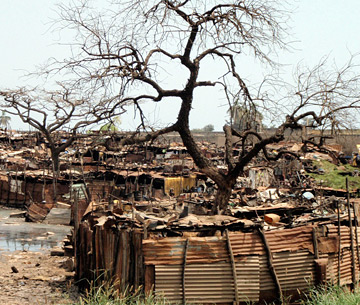
There is one particular spot, about a half-hour from central Dakar, where the Rufisque curves to the right and merges with the larger southbound road, roughly parallel to where that new airport highway will run. Here, the view opens up and presents a scene that is straight out of Dante: a slum so horrifying that it is impossible to tell where the refuse ends and the people and their homes begin.
I first saw this place out of the window of a taxi some weeks ago, during the long drive back to Dakar from the island village of Fadiout. It especially caught my attention because I had just finished reading Mike Davis’ “Planet of Slums.” I made a mental snapshot and decided that, when I next returned to Senegal, I would hire a driver and go back there for a closer look.
A month or so later I did exactly that.
My escort was a young Wolof named Mustafa M’Baye. Mustafa is a freelance guide who hangs around the lobby of the Sofitel looking to round up clients. He speaks good English and knows his way around, though he was yet to encounter a foreigner interested in seeing one of the city’s poorest areas.
Turns out that slum is both a neighborhood for people and a pig farm. Some of the dwellings are for pigs; the others are for people. You cannot, at first glance (or second glance in some cases), tell which are which. (The farming of pigs struck me as somewhat curious for a nominally Muslim country. According to Mustafa they are eaten mainly by Senegal’s Christian minority.)
People and animals live side by side in decrepit shacks cobbled together from sheets of wood, metal and plastic. Many of the roofs are little more than plastic bags, knotted together and encrusted with sludge. Rising out of this hell are a pair of gnarled old trees, long ago denuded and stripped of their bark, their trunks stained black by fumes and cooking fires. Ragged, leafless branches claw toward the sky.
I have visited the favelas of Rio de Janeiro, Brazil, and the shantytowns of Johannesburg, South Africa. I have seen urban and rural poverty in places like Mali and Cambodia. And while there are, I suppose, plenty of cities more desperate than Dakar — Karachi, Pakistan? Dhaka, Bangladesh? Lagos, Nigeria? — I have never been anywhere so wretched as this.
But degrees of poverty aren’t the point. The important fact is that most of the world’s population now exists in some form of what we in the developed West would describe as squalor. And that percentage — whatever it is, exactly — is growing. For the first time in human history, more people now live in cities than in the countryside, and over a billion of them are packed into slums. India alone has close to 50 cities with populations exceeding 1 million. How many Americans, I wonder, can name even three cities in India? An estimated 2.6 billion people — over a third of the earth’s population — have no access to a toilet.
As Mustafa and I navigated the maze of shacks, it became clear that some of the residents did not appreciate the white guy roaming around with the camera. Eventually we were asked to leave.
“They don’t understand,” said Mustafa. “They don’t know what you want.”
And what did I want? I suppose it was fair, being kicked out, since ultimately it was difficult to justify my being there in the first place. I knew I wanted to see this place, and I knew I wanted to describe it in a column. OK, but why, exactly? On one hand I wished every American could have been with me. Words like “awareness” and “insight” and “perspective” kept jumping to mind. On the other hand, I felt like a cultural voyeur out for a thrill — slumming as they say, in the most raw and literal sense. In the end I was glad to have seen it. And I was just as glad to leave.
Mustafa then brought me to a similar area nearby, adjacent to a railway line. The conditions here weren’t as filthy, but were no less pathetic — random detritus formed into rough, almost comically makeshift dwellings.
On the way back, Mustafa and I were cutting through a sandy, littered alleyway just off the train tracks. There was a thin fence made of plastic chicken wire, tough as fishing line, that we had to crawl through. Someone had cut a hole through the fence just large enough for a person.
As I was crouching to step through, something caught my eye. There at my feet was a small spiny clump about the size of a grapefruit, covered in sand and miserably entangled by the wire. I suspect most people would have ignored it, perhaps not realized that it was, in fact, a living creature. I recognized it instantly. It was an African pygmy hedgehog — Erinaceus albiventris– exactly like the one I had as a pet several years ago.
I stopped and called Mustafa over. The hedgehog was still alive, but so entangled it could hardly move. Its forward right leg was mangled, blackened and dislocated, wrapped to the shoulder by a seemingly impossible tangle of knots. There was also a length of wire around the animal’s neck, pulled so tightly that it had broken the skin and ripped into the muscle.
I spent a good 20 minutes extricating the hedgehog from the wire. Mustafa shattered a beer bottle, and I used the shards of glass as a knife. First I got the leg out, then severed the wire around its neck. It was messy and horrible and I cut myself to boot. You could not have intentionally bound an object as tightly as this poor creature had managed to bind itself. The knots were so thick and tight that I wondered if maybe a person had done the tying.
Once free, the hedgehog crawled a few inches, then sat motionless. It was too weak even to curl into the spiny protective ball that is the reflex position for any threatened hedgehog. Judging by the condition of its leg, I reckon it had been there for several days.
I picked him up and Mustafa, who was holding my camera, snapped this photo.
I decided to bring the hedgehog back to my hotel, not quite sure what to do if it survived, a prospect that frankly seemed doubtful. Mustafa scrounged up an old section of burlap and a plastic bag, and we placed the animal inside.
He endured the long taxi ride, and I spent about half an hour cleaning him up in the bathroom sink. I doused the wounds with contact lens solution. Then I covered him in a towel and put him on the floor, near the doors to the balcony.
Unfortunately, about two hours later, the hedgehog was dead. It was going to happen anyway, probably, but I wonder if maybe the sink bath was too stressful.
I remember a quote, though I can’t recall the exact words, or who the speaker was, basically submitting that human beings will only be as kind or respectful to each other as they are kind and respectful to animals. I believe that, I think.
Or else I am a fool. I also remember reading that Adolf Hitler was especially fond of animals.
As I packed for the flight home, I reflected: There I had been, standing amid some of the worst human poverty on planet Earth, fighting like mad to save a tiny injured mammal. The irony, if we should call it that, was not lost. Was expending so much effort on the hedgehog the right thing to do, I wondered, or the wrong thing?
Or was it simply no thing — just a tic of human nature, irrelevant to any greater context?
I don’t know. I am not even sure why I’m telling you this story. Somehow it all seems connected: the airport; the slum; our feelings of guilt and ambivalence; the fallacy of good intentions. And one more African death, however small.
– – – – – – – – – – – –
Do you have questions for Salon’s aviation expert? Contact Patrick Smith through his Web site and look for answers in a future column.
