

Two Junes ago in West Virginia, a group of astronomers working for SETI, the Search for Extra-Terrestrial Intelligence, had the ride of their lives. Sifting the heavens for a faint whisper of otherworldly life using the 140-foot telescope at Green Bank, one of the country’s leading radio telescope observatories, they picked up a radio signal that sounded as if it might be The One. The crew went on full alert for an unprecedented 24 hours. They received inquiries from the media — serious outfits like the New York Times. “This one looked real,” remembers astronomer Seth Shostak. “Nobody went home.”
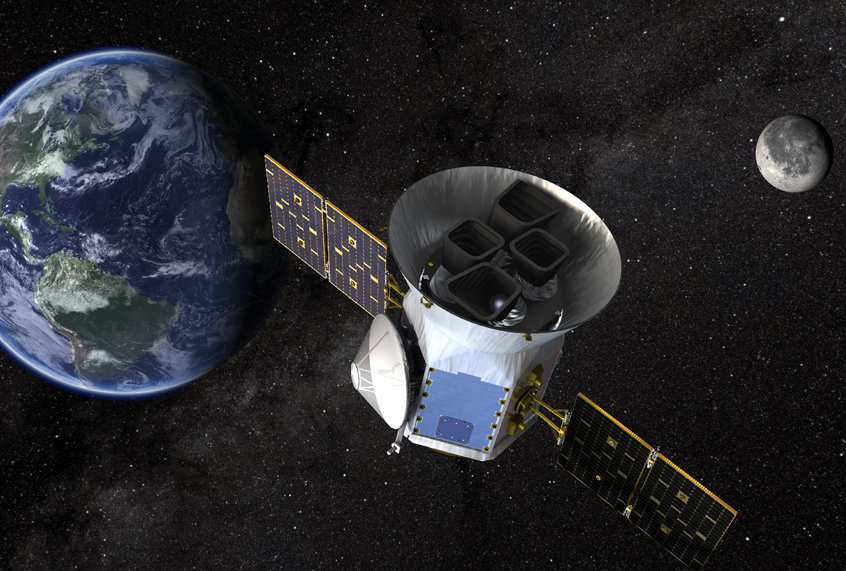
The noise turned out to be not E.T., but the Solar and Heliospheric Observatory (SOHO), phoning home to NASA from a million miles away. The research satellite is designed to study the internal structure of the sun and the solar wind, a stream of highly ionized gas that blows continuously outward through the solar system. SOHO orbits the sun just ahead of the Earth and beams back data using radio waves.
Still, the episode did more than get astronomers’ hearts racing; it presaged the noisy near future. Of the thousands of satellites in orbit, those dedicated to scientific research are relatively few. But the number of telecommunications satellites is exploding. Led by the Iridium satellite telephone network, these high-altitude “birds” are nearly always buzzing overhead, creating what one astronomer calls a “dial tone in the sky.”
As they send signals to Earth, the satellites are confined to frequencies just outside the ones reserved for radio astronomers to study celestial events too distant to be seen by optical telescopes. But these satellite transmissions are imprecise. They tend to bleed over into other frequencies like unkempt shrubbery; scientists call them names like “spurious” and “out-of-band.”
For centuries astronomers studied only the visible portion of the electromagnetic spectrum. But many cosmic phenomena emit more strongly at radio wavelengths than at those of light — a discovery made by a Bell Labs engineer in 1932. Since then, the radio telescope has provided countless previously unavailable clues about the universe. In just the last six months, radio astronomy has advanced scientific knowledge about evolving planetary systems and black holes lurking at the hearts of most galaxies. SETI scientists also rely largely on radio telescopes in their quest to find the transmissions of alien life. But space noise is becoming a potent threat to this relatively young branch of astronomy, making the operation of a radio telescope these days a bit like aiming a flashlight at a star from amidst the flash and neon of Times Square.
Since mankind first got off the Earth in the 1960s, space has been seen more as a territory to be conquered than a puzzle to be solved. And corporations now mimic nations — staking claims on the new frontier with satellites instead of flags, while relegating astronomers to distant observation decks. So, many of the scientists most interested in studying space have been negotiating with satellite owners for heavenly quiet time.
Last month, European astronomers became the fourth entity — after their peers at Green Bank, in Canada and at the Arecibo Observatory in Puerto Rico — to negotiate a sky-time share deal with Iridium. Radio astronomers in Europe were allotted a seven-hour daily window, plus one full weekend day each month, to study the skies, during which Iridium will keep its homing signals below a key threshold. (The others received between four and eight hours daily, and no weekends.)
The settlements came about after astronomers complained about earthbound noise from Iridium’s chain of 66 satellites, which orbit at about 500 miles. While Iridium’s satellite transmissions are supposed to begin at 1620 megahertz (MHz), they spill over into 1612 MHz, a microwave frequency used by astronomers to study phenomena such as red giants, aging stars that may yield insights into stellar evolution. In fact, the 1612 frequency has been reserved for radio astronomers by the International Telecommunications Union. Commercial companies cannot broadcast on it, but they can transmit very close by.
“They radiate very strong signals,” said Mark McKinnon, an associate scientist at Green Bank, part of the National Radio Astronomy Observatory. But the radio telescope is one of the most sensitive instruments ever created. It was designed to observe very weak signals, the kind that can be easily overwhelmed by noise in our own neighborhood. For SETI astronomers, who frequently use the facilities at Green Bank and Arecibo, such noise can be particularly vexing. “We don’t know what part of the dial E.T. might be using,” says Shostak, who works for SETI in California. “So we’re interested in all of it. But we’re wiped out over most of it.”
As recently as 1984, when SETI was founded, scientists had a relatively unobscured “view” of the sky. But then the number of low-earth orbiting satellites (LEOs) began to outpace those in a geosynchronous orbit — those in synch with the rotation of earth. Geosynchronous satellites are far less onerous to astronomers, who set up shop in remote sites. “But you can’t really escape a LEO satellite,” said Tomas Gergely, who manages the electromagnetic spectrum for the National Science Foundation.
The commercial development of space, says astronomer Michael Davis, “means not just a few satellites, but total global coverage.” Like most astronomers, Davis, a researcher at Arecibo, is wary of future encroachment, but he is relatively content with the eight-hour window of observation, constraining though it is. At Arecibo and other observatories, any particular celestial object can only be viewed without interference from Iridium for a maximum of four months out of the year. For scientists dealing with the riddles of pulsars, quasars, black holes and other cosmic phenomena, the time can be short.
The deal with Iridium appears satisfactory, but astronomers aren’t sure if that’s because the arrangement actually works for both parties or if the company’s slow start means it just doesn’t need as many signals as it might at full capacity. Iridium, which cost $5 billion to launch, has just over 10,000 customers — far short of the 100,000 it expected to have by the end of 1998 and about 490,000 shy of the 500,000 it has said it needs to break even. The company announced in May that it is in technical default on $800 million in debt, and a class action suit has been filed on behalf of its shareholders.
But scientists are watching for other potential problems: the 48-satellite GlobalStar system, set to go into operation later this year, and the 288-satellite Teledesic system, a kind of orbiting Internet service provider, whose backers include Bill Gates and cellular pioneer Craig McCaw. (The first Teledesic launch is slated for 2001, and the system is scheduled to go online in 2003.) Also looming on the horizon are the broadband data communications network Spaceway, with Hughes Electronics on board, and Boeing’s Ellipso project, which will provide phone service with 17 satellites in unusual elliptical orbits. Some systems, such as GlobalStar, have reserved alternative radio frequencies in advance.
But with so many satellites poised to go up in the next five years alone, and with only so much radio spectrum to go around, scientists are braced for the worst. “We’re looking for a needle in the haystack,” Shostak says of the SETI institute. “Our activities on Earth are seeding the hay with billions of needles, but not the one we’re looking for. In the end you’re going to be forced to move this whole thing to the far side of the moon.”
