
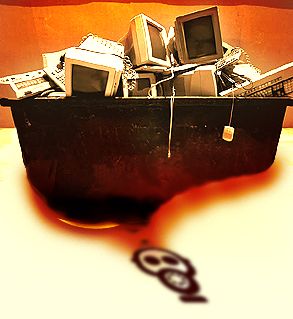

I was packing 17 dead monitors; nine cannibalized Macintosh CPUs; six obsolete PCs; five printers; five fax machines; three flatbed scanners; six boxes of PCI cards and other stripped components; a garbage bag of cables; a dead Macintosh SE from 1991; a box full of brick-sized Seagate 2.9 GB SCSI drives, external CD-ROM drives, fried power supplies and failed memory; and a giant 21-inch Apple Studio Display crate filled with keyboards, office phones and miscellaneous plastics.
My U-Haul was headed to the Computer Recycling Center in Santa Clara, Calif., one of the few places within 75 miles of San Francisco that accepts cast-off computer equipment for disposal. I later learned of recyclers closer to home, though that morning the CRC was my only lead, and I confess to a certain thrill in returning my toxic e-junk to the county of its birth.
Our company’s IT department, to which I belong, had conducted its usual triage on the castoffs collected during three years at a growing Internet company, salvaging what seemed useful and abandoning the rest. The dead matter was crammed into the truck and I was at the wheel.
Companies assume that system administrators, who seem to know everything else about computers, have information they don’t about recycling electronics. The truth is that these monitors, printers and CPUs that silently disappear after a couple of months in a storage closet rarely make it to a recycler; instead they’re sacrificed in a space crunch, hastily loaded on to a handcart and more often than not left outside the freight elevator with a stickie that says “Basura.”
I’d recently come across a statistic, however, that pointed out that monitors contain an average of 5 to 8 pounds of lead per unit, thanks to the radiation shield in the cathode ray tube (CRT). It turns out it’s worse than that: Lead constitutes approximately 25 percent of monitors by weight, and the estimate of 5 to 8 pounds per unit is based on 14- and 15-inch monitors. The standard-issue monitor today, at least for workers in the clean new economy, is 17-inch or above. In addition, lead is spackled across printed circuit boards as part of the soldering alloys that fuse electrical connections. It’s no surprise that consumer electronics constitute 40 percent of the lead found in landfills.
Some reminders about lead: If ingested, it can have toxic effects on the central and peripheral human nervous systems, and cause brain damage in children. It can seep into groundwater, poisoning plants, animals and microorganisms. More than two decades after the U.S. government banned lead from house paint, the feds estimate that 4.4 percent of children between the ages of 1 and 6 suffer from lead poisoning, typically from tainted paint flaking off old walls. In short, it’s a toxin, and doesn’t belong in the dump.
Leave an old monitor by the freight elevator, however, and that’s just where it’s going. “If you landfill a CRT, it will get crushed in the process,” says Ted Smith, executive director of the Silicon Valley Toxics Coalition, an organization founded in 1982 in response to a rising number of birth defects and other health problems near the leaking Fairchild Semiconductor plant in San Jose. “The fine particles of glass laced with lead eventually degrade. With rainfall getting into the dump site, the water will become contaminated with lead, and that lead-filled water will leach out of the landfill and into the groundwater.” It’s a process that may take several decades, but it will happen: It’s as ineluctable as the flaking of paint.
“Lead is an element,” Smith says. “It isn’t going away. You can burn it, you can stomp on it, you can bury it; it isn’t going away. It’s going to get back into the life cycle.”
None of this is a secret to the U.S. electronics industry. Yet rather than developing consumer take-back programs for the recycling of its obsolete products, PC makers and other consumer electronics companies are lobbying to stop a European Commission proposal that would demand that they take responsibility for the hazardous materials in their wares. The European Commission’s draft directive on waste electrical and electronic equipment (WEEE) would hold producers legally responsible for the reuse and recycling of their products, and phase out some of the worst toxic chemicals used in the manufacture of electronics.
The WEEE Directive so alarmed the U.S. computer industry — specifically the American Electronics Association, whose over 3,000 members include Microsoft, Intel, IBM and Motorola — that it prepared a legal position paper claiming the directive violates — surprise — the international trade rules of the World Trade Organization; the association managed to convince the United States Trade Representative to adopt its key positions. Targeted are the directive’s phaseouts of hazardous chemicals because, as the USTR states in its 2000 National Trade Estimate Report on Foreign Trade Barriers, “viable substitutes may not exist” — though plenty of people will tell you they do.
“The United States supports the drafts’ objectives to reduce waste and the environmental impact of discarded products,” the National Trade Estimate Report states. “The Administration has expressed concerns, however, on the adverse impact on trade from the current proposals’ ban on certain materials … and with the provisions regarding producers’ retroactive responsibility for the collection and recycling of end-of-life products.”
While it’s hard to say just how much USTR and AEA lobbying has influenced the directive, a list of revisions in the various drafts (the most recent version is the fifth) casts a recognizable shadow. The deadline for the phaseouts of hazardous chemicals has retreated from 2004 to 2008; the list of materials scheduled for phaseout has shrunk; the minimum recycling rate for cathode-ray tubes has dropped by 20 percent; provisions mandating the use of recycled plastics have vanished; and most worrisome of all, the most recent draft splits the directive into two separate legal documents: one dealing with the phaseouts of toxic materials, the other with everything else.
“I’m concerned they’re going to focus on one [document] and relegate the other to obscurity,” says Smith of the Silicon Valley Toxics Coalition, who’s convinced the U.S. electronics industry will continue to fight, particularly against the phaseouts. “[The directive] is not just talking about producers who are home-based in Europe; it’s talking about everyone who wants to sell into the European market. Everybody wants to do that. Everybody has to do that. If this thing holds, it’s going to set the de facto global standard.”
For the time being, the de facto global standard is that the industry sells products to consumers, and consumers are responsible for their disposal. No matter that consumers have no control over — much less any idea of — what materials are used in the manufacture of electronics. I was appalled to learn the extent of the toxins in my e-junk.
Along with the lead in my cathode ray tubes and circuit boards, my U-Haul was loaded with chemicals with documented risks to public health and the environment: There was cadmium in my semiconductors, SMD chip resistors and infared detectors; there was mercury in my switches and position sensors; chromium in my steel housing; brominated flame retardants in my circuit boards and connectors; nickel, lithium, cadmium and other metals in my batteries; and in my cabling and older casings was polyvinyl chloride (PVC), a widely used plastic that during both production and incineration releases dioxins, which are among the most toxic chemicals known. All that was missing was a 55-gallon drum.
I had started my recycling mission by asking around for referrals. Few were forthcoming — not from my co-workers, not from friends in IT departments at other companies. The typical suggestion was to donate the equipment to schools or nonprofits. “But the stuff doesn’t work,” I found myself sputtering. “It’s defunct. It’s ‘end-of-life.’ What’s a school going to do with fried 486s and blown cathode-ray tubes?”
It wasn’t until I showed up in person at the Market Street offices of the Solid Waste Management Program in San Francisco, and asked with some belligerence what to do with my dead computer, that I was handed a comprehensive Commercial Re-use and Recycling Directory, listing a handful of local electronics recyclers.
In the meantime, I learned that schools and nonprofits have wised up in recent years. Many reject anything less than a Pentium 166, and refuse individual donations as a matter of policy. With the growing demand for newer and faster machines, “the nonprofits became everyone’s dumping ground,” says Dan Schimenti, purchasing manager for HMR-USA, a San Francisco recycling business that was recently awarded a $100,000 grant from the city’s Solid Waste Management Board to purchase a $350,000 monitor-crushing machine. “They don’t want 486s, they don’t want low-end Macs.”
It’s not just CPU speed that’s the problem: Few schools or nonprofits can afford the skilled help necessary to refurbish old equipment. “Most schools in California are budgeted for a single, part-time computer repair person,” says Steven Wyatt, executive director of the Computer Recycling Center. “Given what schools pay, it’s also the case that they don’t always get computer people with lots of experience and skills.”
To make things easier, the CRC makes a point of donating clusters of machines with identical components and drivers — a practice that makes it easier for schools or nonprofits to make them functional, but difficult for individual defunct computers to find useful second lives. At the Santa Clara warehouse (just a few blocks from an Intel Superfund site) pallets of shrink-wrapped CPUs and cathode-ray tubes tower nearly to the ceiling. On the warehouse floor, a group of volunteers and paid technicians test newly donated systems. Nonworking equipment, or equipment that can’t fit into clusters, is carted to the back room to be dismantled for recycling.
Recycling electronics means determining which parts can be sold intact and which must be unloaded as scrap. For example, monitor manufacturers can use intact cathode-ray tube guns, and third-party service companies — the businesses that contract with computer makers to manage their warranty programs — can use parts from old product lines. Eventually, however, one is left with electro-scrap and mixed plastics that can’t be reused.
The only buyers are specialized recyclers, such as MBA Polymers in Richmond, Calif., a business that’s developed a commercial process for recovering mixed plastics, or Micro-Metallics in San Jose, a wholly owned subsidiary of the Canadian mining giant Noranda, Inc., which operates a smelter in Quebec.
Electronics recyclers like Micro-Metallics, says Schimenti, “get thousands of tons of circuit boards” each year, which they strip of recoupable components, like microprocessors and memory chips, before shipping them off to smelters. The end product is “a metal stream … that is worth money based on the composition of the metals. It’s got a lot of lead, because of all the solder connections, and there’s also steel, aluminum and copper.” Needless to say, smelting is a dirty business, and one that’s heavily regulated in the United States and Canada. It’s no coincidence that almost no smelting is done near the population centers of the Bay Area.
While the Noranda smelter is probably the largest consumer of electro-scrap generated in North America, it is a best-case scenario. Due to regulations and pollution laws, it’s often cheaper to export the scrap to countries where such laws, if they exist at all, are more lax than those in Canada and the United States. Not surprisingly, reliable figures on the export of electro-scrap are hard to find, especially after the 1989 Basel Convention on the Control of Transboundary Movements of Hazardous Wastes, which the United States refused to join, began monitoring and regulating “toxic trade” of hazardous materials between developed and developing nations. Even so, an estimated 1 million of the 1.7 million monitors recycled in 1997 were shipped abroad for disassembly and processing.
“There are a lot of countries that make a huge business in the processing, recycling, smelting and disassembly of electronics, and it is done in an environmentally unfriendly manner,” Schimenti says. “Different countries have done it over the years, but when they reach a certain economic level, they stop.” The perfect example is Taiwan, which only a decade ago was desperate for raw materials like copper, silver and steel. “So what did they do? They imported it [and smelted it themselves]. That’s their source; they’re not mining the stuff.” Now that Taiwan is on its feet, it’s no longer in the market for scrap.
After a tour through the HMR facility, filled like the Computer Recycling Center with towers of palletized, shrink-wrapped computer components, Schimenti takes me out to the warehouse yard, where I hear the scream of drills and the crack of plastics before noticing four workers, bent over a workbench, dismantling monitors stacked in refrigerator-sized crates. They break the monitors into five key components: the plastic casing, the metal chassis, the yoke, the circuit board and the cathode-ray tube. The tubes, looking like giant chocolate kisses, are thrown onto a conveyor belt and carried into an environmentally sealed container to be crushed. The lead and glass are then separated with a heavy magnet and discharged for shipment as commodities.
“We deal with trailing-edge electronics,” Schimenti tells me once we’re inside. “The new Pentium 650, the new Mac G4 — that’s not us. We’re trailing-edge. We’re last year’s stuff.”
————
Despite the fact that California requires cathode-ray tubes to be handled as hazardous waste, I found no mention of consumer electronics on the Web sites of local waste management agencies, including San Francisco’s Hazardous Waste Management Program and Santa Clara County’s Hazardous Waste Recycling and Disposal Program. These programs provide detailed instructions on what to do with wastes such as aerosols, antifreeze, used tires and motor oil, but they share a glaring omission of electronics, with the exception of used batteries.
The one local program I found that did mention electronics — the city of Mountain View’s — did more to discourage computer recycling than help it along: “Electronic equipment … has too many intricate parts for recycling to be economical,” the site reads. “It is labor intensive to separate the multiple, and sometimes minuscule, material types for recycling, and markets aren’t readily available for small quantities of some of the material types. Therefore, recycling of electronic equipment is not common at this time.”
Would the folks in Mountain View, Silicon Valley’s ground zero, really rather have local companies like Netscape, Rambus, Veritas and scores of start-ups dump their old lead-filled monitors and circuit boards in the local landfill?
I have to assume not — but why do they make information on recycling e-junk so hard to obtain? Robert Haley, residential and special projects coordinator at the SF Recycling Program, says “the thing about solid waste [administrators] is that every new product that gets invented, we have to then figure out what it is and deal with it. It takes us a little while to catch up.”
“That’s why the producers have to get involved. They know what’s in there, yet a lot of times they won’t tell us because it’s proprietary,” adds Haley. A good example is the new flat-panel displays, which some organizations believe contain the kinds of gases that contribute to global climate change. No one knows for sure, however, because the industry won’t say. “Are [the manufacturers] thinking about what’s going to happen with these displays two years from now? They’re not required to, but they should be. That should be part of their job.”
Fortunately, not all domestic manufacturers shy away from the problems of producer responsibility. At Apple Computer — whose P.R. department failed to return several calls for comment — “Design for Environment” guidelines are becoming closely tied to the development cycle, with Apple Product Environmental Specifications (APES) tables measuring various product attributes with an eye to reuse and recycling options.
Similar design guidelines are in place at Hewlett-Packard, whose recycling facility in Roseville, Calif., is an encouraging example of how a large producer can responsibly dispose of its retired products and manufacturing overruns.
In the computer industry, “The cost of recycling — because there is a cost, it doesn’t happen for free and it doesn’t generate positive revenues — has never been a part of the commercial equation,” says Renee St. Denis, an environmental manager at the Roseville facility, which began as an in-house operation salvaging repair parts from old HP product lines. “To this day, the industry-wide solution to what we call ‘breakage'” — the mixed plastics, metals and glass left over after cannibalization — “is to put that stuff in a container and ship it to China.”
In fact, when St. Denis joined the group in 1994, that’s just what the Roseville plant was doing with breakage from 600,000 pounds of equipment recovered each month from its North American manufacturing plants, as well as from HP employees exchanging their own computers for newer models. “My job … was to find out for sure what was happening [with the breakage]. I found out for sure, and didn’t like it very much.”
Soon after her arrival, all shipments to China had stopped, and St. Denis was coordinating with Micro-Metallics to jointly manage a recycling facility on-site, with the breakage disassembled in Roseville and sent directly to Noranda’s smelter in Quebec. It may not be an ideal solution, but when dealing with 3.5 to 4 million pounds of recovered equipment per month — the current volume processed at Roseville — one can’t do much better than ship the scrap to one of the largest, most monitored smelters in North America.
When asked for her position on producer responsibility, however, St. Denis chooses her words carefully. “What we talk about [at HP] is the concept of shared responsibility vs. extended producer responsibility … Shared responsibility is the concept that there are several players along the value chain. Distributors get value out of our products, and even the consumer who uses the product at home or in the office gets some kind of value out of it.”
“We feel the responsibility for how you dispose of it at end-of-life needs to be shared,” she explains. “That doesn’t mean that we think we shouldn’t play a role or bear some of the cost; it just means that we shouldn’t do it all.”
Today, although Roseville gets a small but steady volume of equipment from commercial customers exchanging old equipment when purchasing new models, what goes on at places like Roseville is of little relevance to the average consumer. Individual users and small-to-medium businesses are more likely to purchase an HP product through a third-party distributor, such as a computer superstore or mail-order business, than from a sales representative who deals with large commercial customers. While an HP sales representative is prepared to take back end-of-life products as part of a purchase, try striking the same bargain with your CompUSA clerk next time you buy, say, a new Pavilion PC Minitower off the shelf. These days, more than half of all American households own a computer and one study, conducted six years ago at Tufts University, found that 75 percent of all computers ever bought in the United States are gathering dust in a closet, basement or garage. A report by the National Safety Council’s Environmental Health Center found that in 1998, only 6 percent of computers were recycled compared to the number of new computers put on the market that same year. That same report estimated that by the year 2004, there will be nearly a third of a billion obsolete computers in the United States. Today the average life span of a computer is estimated to be about two years — down from five years in 1997. We cannot just stockpile this stuff indefinitely; people need their space. Eventually the e-junk is going to get chucked.
Wyatt of the Computer Recycling Center tells me of a law firm that donated two dozen Pentium machines in May. “Their reasons for getting rid of the computers were speed, small hard drives, not enough RAM — the usual complaints,” he says. “The computers had the manufacturer stickers right on them.” The stickers told when the computers were first put into service. The dates on the stickers? May, 1999.
It’s not hard to believe. In my own company, it’s rare that I’m able to repurpose a year-old computer without a manager interceding and authorizing new equipment. And the managers have a point: used computers, like used cars, are less reliable than new models. The entropy ratio is accelerating; computers are breaking down at faster rates. The approaching rule of thumb: one computer per user per year.
Why can’t we just treat old computers like used toner cartridges, and ship them back to the manufacturer with a pre-paid return label? It’s a logistical problem, says St. Denis: “It’s easy with cartridges: the old one is exactly the same size as the new one, so it’ll fit right in the packaging … [Whereas] if you were to trade in your PC, it’s probably a different size, a different shape; even the boxes have changed.”
Meanwhile, agencies like the Solid Waste Management Program are rushing to classify and divert the increasing stream of electro-toxins from landfill. A new pilot program, begun Aug. 15 — just a few weeks after my cruise in the U-Haul — announced a free recycling service for obsolete and nonworking computers, with dropoff locations at eight San Francisco computer stores and four metal recyclers, including HMR-USA. Equipment dropped off at the stores will be picked up in bulk by the recyclers.
The program’s next goal is to arrange for the capture of electronics directly at residential public disposal areas, or “transfer sites.” For the time being, however, there’s little hope for diversion (the legal term for the reduction or elimination of targeted materials from a waste stream).
Take a load of cathode-ray tubes to your local dump, as I did that morning on my drive to Santa Clara, and you won’t find much resistance. In fact, workers at the Sanitary Fill Company at Candlestick Point, the main disposal site for San Francisco residents, gave me a blank look when I asked if they accepted old monitors. I pointed to the cathode-ray tubes in my U-Haul; they handed me a brochure with tonnage rates. To them, it was general refuse. I thanked them and got back on the freeway.
Contrast this with trying to dispose of tires, mattresses or household hazardous wastes such as paint, used oil, solvents, batteries or coolant. “Dump a mattress at the landfill, it could cost you a hundred bucks,” Schimenti says. “[The waste companies] don’t want them, and they’re going to process them in a different way.” They don’t want them because, by law, the waste is marked for diversion. With the exception of Massachusetts, which in April became the first state to ban cathode-ray tubes from landfills, no such diversion exists for computer systems, despite the hazardous materials in their components.
Had I paid the $16 listed on the brochure, my cathode-ray tubes and lead-laden computers would have become part of the municipal waste stream, loaded onto containers and hauled to Altamont Landfill in Livermore. (San Francisco, despite a per-capita waste-generation rate 1.5 times that of the national average, does not have a landfill within city limits.) This same landfill made news last year when its operating company, Waste Management Inc., inadvertently dumped 6,000 cubic yards of lead-tainted dirt, disgorged from the infield of San Francisco’s new ballpark, on the Altamont hills outside Livermore. The mistake cost taxpayers just under $1 million, the price of gathering up the spill and shipping it to a hazardous-materials dump in Kings County.
The point here is not negligence. It was actually the state and not Waste Management Inc. that was to blame in this case. The point is that lead and other toxins do not belong in Altamont or in municipal landfills anywhere. The cities know it, the states know it, the feds know it. Yet today, there’s nothing to stop electronics, with their toxic cocktail of heavy metals, from getting dumped. The only reason we know about these hazardous materials is because of nonprofit watchdogs like the Silicon Valley Toxics Coalition and taxpayer-funded agencies like the Solid Waste Management Board.
“We’re still learning,” Haley says. “We’re trying to get the information and build the infrastructure, but really the industry has to come to the table and try to help with this. They’re the ones making the money, they need to pay the infrastructure costs … They’re not going to do it unless someone compels them to do it, because right now they can make money without having to be responsible for it.”
