
Ask the Pilot

Did U.S. airport security get it right this time?

It's heartening that our luggage-screening protocols are effective enough to detect what could have been dangerous

Ask the Pilot
AP
A man is led off a plane at Schipol Airport in Amsterdam on Monday after suspicious items turned up in his luggage.

In Amsterdam, two men headed from the United States to Yemen were detained after security staff discovered suspicious items in one of the men's checked luggage.

The story began when security screeners at the airport in Birmingham, Ala., discovered watches, cellphones and a bottle of Pepto-Bismol strangely taped together in a suitcase belonging to 48-year-old Ahmed Mohamed Nasser al Soofi, a U.S. permanent resident. After determining the items posed no threat, al Soofi was allowed to catch his flight from Birmingham to Chicago's O'Hare International Airport, from which he planned to connect onward to Washington-Dulles, and then overseas.

When al Soofi missed his connection at O'Hare, he was rebooked on a United Airlines flight to Amsterdam. His bag, meanwhile, was sent unaccompanied to Dulles, where it was loaded aboard the United plane to Dubai that al Soofi originally intended to catch.

There are rules banning unaccompanied suitcases on planes going overseas, however (a stricture going back to the Lockerbie catastrophe in 1988), and the Dubai-bound jet was forced to return to the gate. When al Soofi's suitcase was offloaded and rescreened, authorities became worried and alerted Dutch officials, who arrested al Soofi upon his arrival in Amsterdam.

Also arrested was Hazem Abdullah Thabi al-Murisi, a Yemeni citizen whose only crime appears to be that he shared Yemini citizenship with al Soofi, and happened to be seated near him. Reportedly the men had never met or spoken before, though both spent several years living near one another in Detroit, among the large Arab-American population there.

Do I believe that al Soofi and al-Murisi were terrorist operatives on a test run, sniffing out weaknesses in airport security? No, I don't. The evidence doesn't point that way.

Ignoring for a moment whether they were unfairly profiled (I don't necessarily feel that way, either, though al-Murisi's detention is a little hard to reconcile), I find the incident strangely comforting. As I've been writing for years, the No. 1 threat to commercial aircraft is, just as it has always been, bombs and explosives. And although we will never be completely protected -- a resourceful enough saboteur will always figure out a way to smuggle deadly components onto an aircraft -- it is heartening to see that our luggage screening protocols actually work, and are effective enough to detect what could have been something dangerous.

Also heartening is the way in which screeners in Birmingham seem to have handled their odd discovery. They checked things out and did not overreact.

Do the Dutch know something we don't, or are they the ones overreacting?

Abdul-Hakim Al-Sadah, Yemen's consul general in Detroit, says that mobile phones and watches are commonly packed together by traveling Arab-Americans (and other cultures too, I should add) as gifts for relatives and friends.

As for al Soofi's Pepto-Bismol, in the end it made sense. Turns out he probably needs it.

- - - - - - - - - - - -

Do you have questions for Salon's aviation expert? Contact Patrick Smith through his website and look for answers in a future column.

Is takeoff the riskiest part of flying?

And what's with the History Channel's "extreme" airports? These and more questions from the reader mail bag

Is takeoff the riskiest part of flying?
iStockphoto

What are your thoughts on the History Channel's recent program "Most Extreme Airports"? The show featured St. Bart's, Lukla airport in Nepal, and some other notorious spots. And is it true, as the show suggested, that some airports require a special "signoff" in order for pilots to fly there.

These "extreme airport" lists pop up from time to time on TV, in magazines and on the Web. And they always drive me crazy. For starters, these lists often contain airports that aren't even served by scheduled airlines. But more important, there is no such thing as an unsafe commercial airport. If an airport were unsafe, no commercial carrier, big or small, would be flying there. Some are challenging, yes, usually due to terrain, unusually short runways or both. The workload is higher, and they require greater concentration. But so what? Just as in any profession, some tasks are harder than others. In the context of aviation these tasks all are well within the capabilities of pilots and the aircraft they are trained to fly. Off the top of my head: Bogotá, Quito, Tegucigalpa. Heck, even the "Expressway Visual" pattern into LaGuardia can be tricky. Airlines often require crews to undergo supplemental training in order to operate into certain airports -- usually those in mountainous regions. 

I flew several segments aboard Southwest on a recent trip. At each landing the brakes were applied very abruptly, pitching us forward uncomfortably. The airports were San Francisco, Chicago-Midway and LaGuardia, none of which I would think would have runways too small for a 737.

Not too small, but small enough that harder-than-normal braking at these airports is fairly common. Especially at LGA and DCA. Landing distances aren't arbitrary or subjective. Adequate room to stop is guaranteed; pilots don't simply eyeball a runway and figure, "That looks about long enough." (There is no set length that particular aircraft type requires. It depends on weight, wind, surface conditions, etc.) Nevertheless, shorter runways leave less margin for error, and so a little extra on the brakes is sometimes a good idea.

Most of the time, though, hard braking is the result of pilots aiming for a particular turnoff. At LGA, when landing on Runway 31, pilots often attempt to clear the runway prior to the intersection with Runway 04/22. Once past that point, having to recross the active runway can add several minutes during the taxi-in. And air traffic control, for its part, appreciates a quick runway exit, especially when traffic is close behind.

Thus, long runway or short runway, braking can occasionally be abrupt. It's a bit jarring if you're not expecting it, but it is not a sign that you were about to go barreling off the end or colliding with another plane.

On many commercial aircraft the initial braking is taken care of automatically. The plane I fly has four "autobrake" options for landing, numbered 1, 2, 3, 4 and something called "max auto." Selections 1 or 2 give you a nice, gentle deceleration. Max auto feels like you've hit a brick wall, and is saved for those occasions when runways are both very short and very slick. I rarely select anything more than a 3. At some point during the landing roll, whichever pilot is flying (captain or first officer) will disengage the automatic brakes and take over manually. 

The other night, after we landed, instead of taxiing to the gate under its own power, our plane shut down its engines and was towed to the gate from a spot just shy of the terminal. I had never experienced this before. My husband speculated that the plane was probably low on fuel after our long transatlantic flight.

No, no, no. You'll occasionally encounter one of these "tow-in only" gates, designated as such because parking at one requires one or more tight turns that are difficult for a larger plane to negotiate under its own power, and/or because of the proximity of other aircraft, ground equipment or personnel. Even at low thrust, jet engines are powerful enough to wreak havoc at close range. 

I am a particularly nervous flier during takeoff. An old boyfriend, who was training to become a pilot, upon my badgering conceded that in spite of the overwhelmingly safe nature of flying, takeoff is perhaps the riskiest moment. When I asked how long I needed to be nervous during takeoff, he suggested one minute. I immediately tripled this number, and have established a ritual during takeoff whereby I count to 60 three times after the plane lifts off, after which I can begin to breathe normally again.

Statistically most accidents do occur shortly after takeoff or shortly before landing (with no real definition of what "shortly" means), but your boyfriend was right. He was more or less paraphrasing something I say in my book: "Here the airplane is making the transition from ground to flight, and its grip on the latter is much more tentative than when coming down. More fingernails are probably chewed during landings, but in deference to the laws of inertia, gravity and momentum, this anxiety is misplaced. If you insist on being nervous, liftoff is your moment."

Three minutes, though? It's more like the first 10 seconds that are most critical.

Actually, I'd back that up to take in the latter portion of the takeoff roll as well. Similar to landings, as discussed above, stopping distance is guaranteed should a takeoff be aborted up to so-called V-1 speed (just prior to liftoff). But that's a bet I wouldn't want to take on some runways in slick conditions at maximum weight. There's a point where you're safer in the air than on the ground.

- - - - - - - - - - - -

Do you have questions for Salon's aviation expert? Contact Patrick Smith through his website and look for answers in a future column.

Why can't they all be like Pan Am?

The airline's blue-and-white globe was a Jet Age classic. Today, too many carriers jump on the ugly bandwagon

Salon

It's time again to talk about airline logos and livery design, just for a minute. Because I like to and because it's fun.

And because there is a new company called Pan Am Brands, which is selling travel merchandise (luggage, passport wallets), using the old Pan Am trademark. See here.

I have mixed feelings about this venture. On the whole it's pleasing to have the Pan Am name being kept alive, one way or the other. One of the downsides, though, is how this ruins things for those of us who happen to own real vintage Pan Am bags and products. Suddenly we're confused with the kind of people who'll spend $170 for a designer gym bag.

And I hope they don't get carried away and start marketing perverted versions of the livery in the way sports teams do nowadays -- i.e., pink Red Sox caps.

Oops, too late. You can buy a "Pan Am" bag in olive green. Juan Trippe is spinning in his grave.

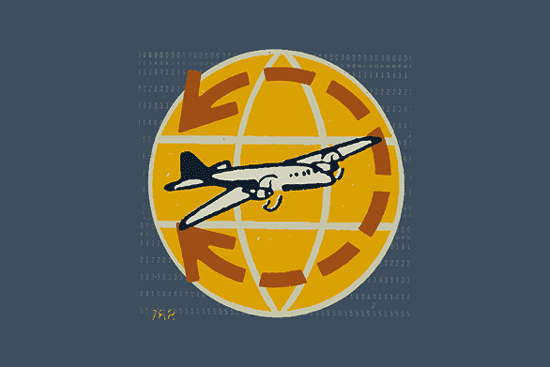
That blue-and-white Pan Am globe was such a Jet Age classic, was it not? So simple, elegant, timeless. It has been said that a truly successful logo is one that a young child can render by hand with reasonable accuracy. Pan Am's globe certainly fit that criterion, and had the airline not gone bust, one suspects it would have stuck with it, more or less unchanged.

And it dawns on me too that Pan Am's is perhaps the only airline identity ever to lend itself to a commercial product outside of aviation. That's saying something about both the legacy of Pan Am, and the sunken state of modern air travel. Southwest Airlines designer luggage? I don't think so.

Kudos, meanwhile, to those dwindling few carriers that have held onto their longtime trademarks, albeit with minor tweaks. The best and most enduring is probably the "AA" of American Airlines. Aeroflot as well deserves a round of applause, having retained its elegant hammer and sickle long after the breakup of the Soviet Union (just don't get me started on Aeroflot's tail; see GMST below). Lufthansa's stylized crane is another.

We continue mourning, however, over the obliteration of the historic Tsurumaru crane at Japan Airlines.

As discussed in this space before, the current fixation in airline livery design is something I call the GMST, or Generic Meaningless Swoosh Thing. (Actually, this was a term concocted by Ask the Pilot reader Amanda Collier several years ago.) Take a look around the tarmac. There are enough streaks, swishes, arcs, twists, swirls and curls out there to make anybody dizzy. The idea, we think, is to suggest a company that is "in motion," or "moving forward." In the process, sadly, they have become indistinguishable from one other.

Other industries, too, have jumped on this ugly bandwagon. UPS, for example. The original United Parcel Service emblem was a bow-tied box and heraldic-style badge. This was the work of Paul Rand, a legendary design guru who also did Westinghouse and IBM. It was a wonderful, heart and soul manifestation of the company's core mission: delivering packages. Its replacement is a singularly bland, almost militaristic "modernization." The box and string have been deposed, swapped out for a meaningless gold slash mark (GMST). It's the worst thing we've seen in the shipping business since the U.S. Postal Service came up with that monsterized eagle head.

Of course, UPS is an airline, at least in part. You can't say that for Holiday Inn. Check out the hotel chain's newest identity makeover. The old look was a touch too vintage Americana, but the latest rendering is staggeringly uninspired. It's a fat letter H with, yawn, a Swoosh Thing for the crossbar. That's it. It could be any company in the world, selling anything: insurance, computer products, food ... 

For more on airlines and identity, see these two essays of mine, here and here, compiled from earlier columns here on Salon. 

- - - - - - - - - - - -

Do you have questions for Salon's aviation expert? Contact Patrick Smith through his website and look for answers in a future column.

It's engineering and training, not miracles

Let's not forget that planes are designed with survivability in mind. But try telling that to CNN

It's engineering and training, not miracles
AP/Salon

Wrapping up from last week's piece about the media's irritating and irresponsible use of the world "miracle" in describing survivable plane crashes ...

One point that I wish I had emphasized more strongly is that of the design of modern commercial planes. The latest-generation aircraft are constructed with survivability in mind, and are much safer than they used to be, thanks to things like greater fire resistance and seats that are able to withstand 16 times the force of gravity. Cabin crew training and evacuation protocols also have evolved. Together these improvements have likely saved thousands of lives over the past several years.

On the day my "miracle" piece ran, Alan Levin, over at USA Today, published a somewhat similar story, emphasizing the engineering aspects that have made certain accidents less lethal.

His article included this quote, from FAA deputy safety chief John Hickey: "I cringe when I see these headlines that this was a miracle. We as engineers and scientists don't believe that this is a miracle. We are totally convinced that the work that we did in the 1980s has proven its value."

Sure, but tell that to CNN.

Somewhere in here too is an important lesson for those passengers who scoff at the pre-takeoff safety briefing, and those flight attendants who themselves don't take it seriously. I am the first to admit those briefings are overstuffed with verbal fine-print, but if nothing else, know where the exits are and how to use them.

The "miracle" invocation isn't offensive only to those who devote their careers to air safety. It also undermines safety itself by inhibiting understanding and reinforcing people's irrational fears of flying.

Among those ruffled by this phenomenon is Joe Sharkey, "On the Road" columnist for the New York Times, who survived a midair collision between a corporate jet and a 737 over Brazil four years ago. (See here and here.) 

"The miracle in the Amazon," says Sharkey in an e-mail. "It drove me nuts, because what saved my butt was the consummate skill of two pilots who kept that airplane flying for as long as they could, and then the dumb luck that suddenly showed up, in the form of an airstrip hidden in the jungle. As I pointed out to every media type who parroted the miracle line, if it was a 'miracle' that saved my life, what was it that doomed those 154 innocent men, women and children on the plane we collided with? No miracle for them, obviously."

To whit, here's a quote from Terry Pratchett:

"Whatever happens, they say afterwards, it must have been Fate. People are always a little confused about this, as they are in the case of miracles. When someone is saved from certain death by a strange concatenation of circumstances, they say that's a miracle. But of course if someone is killed by a freak chain of events -- the oil just spilled there, the safety fence just broke there -- that must also be a miracle. Just because it's not nice doesn't mean it's not miraculous."

- - - - - - - - - - - -

Do you have questions for Salon's aviation expert? Contact Patrick Smith through his website and look for answers in a future column.

Note to media: Time to retire the M-word

Why are we so quick to call it a miracle when people survive crashes? What about the crew's skill?

Note to media: Time to retire the M-word
AP/iStockphoto/Salon

A "miracle." That was the operative term, at least as the media saw it, after Monday's crash of a 737 on the Colombian resort island of San Andres. Only one person was killed after the jetliner skidded and broke apart while landing in stormy weather. One hundred and thirty others survived.

We witnessed an earlier miracle, or so we were told, back in May, when a 10-year-old boy was the sole survivor of an Afriqiyah Airways A330 that crashed in Tripoli, Libya.

In 2009, a young girl became the lone passenger to escape a Yemenia Airways crash in the Indian Ocean. Miraculous, yet again.

Shortly before that, of course, we had Captain Sully and his "Miracle on the Hudson."

Shall we keep going? Five years ago this month, an Air France A340 overran a runway in Toronto. Similar to Monday's Aires mishap, catastrophe was narrowly averted following a botched landing in stormy weather. The jet went careening off the end of the runway and caught fire -- but not before every one of its 309 occupants made it out alive. On CNN, host Aaron Brown gifted us with perhaps the gaudiest playing of the miracle card to date. In one broadcast, he repeated the noun at least three times in a groaning whisper of incredulity -- "a miracle; a miracle; a miracle" -- infusing the word with a spiritual oomph. Brown's next guest may as well have been a Catholic priest. The piece had everything except heavenly harp music and a choir of angels.

And so on. Actually this sort of thing goes way, way back. When a Northwest Airlines DC-9 crashed on takeoff in Detroit in 1987, the one survivor was a 4-year-old girl. A miracle, naturally -- though in the pre-Internet era this invocation was less permeating and therefore more tolerable.

As I wrote the other day, for one to escape alive from an airplane accident is hardly surprising or unprecedented. Statistically, most crashes have survivors. This includes some of history's blackest disasters. To choose just two: Sixty-one people survived the Tenerife collision in 1977, and four survived the horrific JAL crash outside Tokyo in 1985 -- history's worst and second-worst disasters, respectively. The idea of a lone passenger making it out alive might seem particularly unlikely, as is the inverse, of everybody emerging unscathed, but as we see, it has happened several times. Luck, not some spiritual hand, is often the potent factor.

This same inverse is part of what makes the "miracle" phenomenon so peculiar and annoying. Is it miraculous that nobody was killed, or that everybody was killed save for a single soul? How many fatalities (or lack of them), exactly, separates the miraculous from run-of-the-mill happenstance? How about those survivors at Tenerife and in Japan? Somehow, numbers like "61" and "4" don't inspire such wondrous exaltation.

We're perhaps not being asked to take the term literally -- to believe that some supernatural force or deity has lent its power. But to those who see it that way, consider for a moment the odd benevolence of a deity who saves one at the expense of dozens, or hundreds of others. If those children who were pulled alive from the wreckage of Yemenia and Afriqiyah, et al., were indeed saved by miracles, what of those who perished? Can we chalk up their fate to some reverse miracle? Thus, the pretense of supernatural intervention is not, by itself, the main problem, but rather the way in which it is alleged, whereby one person's miracle is everybody else's curse.

This trend isn't going away, probably. At this point the M-word has become almost as pervasive in American media culture as the H-word (hero). In the US Airways Hudson incident, both of these terms were overplayed to a nauseating extreme.

Maybe this bothers me more than it should, but it seems indicative of, among other things, the devolved state of news reporting and a sort of continued infantilizing of the American consciousness. Aside from the contradictions already cited, it's exasperating that we are so inclined to credit the supernatural rather than credit, say, the design of the aircraft or skill or the crew. By the same token, much as we're thankful for this unseen hand when the outcome is something fortunate, we are eager to blame ourselves when it's not. It's tedious, hypocritical and offensive, not to mention insulting to the thousands of victims of air crashes who weren't so, well, lucky.

- - - - - - - - - - - -

Do you have questions for Salon's aviation expert? Contact Patrick Smith through his website and look for answers in a future column.

Survivable plane crashes are not miracles

Luck is more likely at work. Plus: It's time to put the silly Steven Slater story behind us

Survivable plane crashes are not miracles
Reuters/Ho New
Navy officers walk near the wreckage of a Colombian passenger plane that crashed in the Caribbean resort island of San Andres on Monday.

Early on Monday morning, an Aires airlines Boeing 737 crashed on the resort island of San Andres, Colombia.

One person was killed as the plane skidded down the runway and broke into three large pieces while landing in stormy weather. One hundred and thirty passengers and crew escaped.

Predictably, that all but one person survived is being called a "miracle." We hear this word virtually every time there's a survivable accident. In fact most airplane crashes have survivors. Doest that mean most crashes are miraculous?

The 737 landed hard and broke apart, but did not catch fire. Luck, not some unseen guiding hand, was more likely at work.

Anyway, in this most recent case, it is far too early to know what happened, but a few things jump out at me.

First off, you can probably discount the various reports that lightning may have contributed to the accident.

To review from an earlier column, while the idea of a bolt of lightning striking a plane seems dramatic, it happens a lot more frequently than you might expect. An individual jetliner will be struck about once every two years, on average. Planes are designed accordingly: The energy does not travel through the cabin, electrocuting the passengers and frying cockpit instruments; it is discharged overboard through the plane's aluminum skin, which is an excellent electrical conductor, nine times in 10 leaving little or no evidence. I have personally experienced a handful of strikes, the worst of which left a mostly superficial entry wound near the airplane's nose.

Once in a while there's damage or upset, most commonly to a plane's electrical systems. In 1963 lightning caused a wing explosion aboard a Pan Am 707 over Maryland. Afterward, the FAA decided to enforce several protective measures, including fuel tank modifications and the installation of discharge wicks aboard all aircraft. That was almost 50 years ago and I know of no other lightning-caused disasters to date.

What did go wrong on San Andres island? If I were an investigator, among the things I'd be looking into is the possibility of wind shear -- specifically a microburst.

This too is something we've covered before.

One of those buzzwords that scare the crap out of people, wind shear is a sudden change in the direction and/or velocity of the wind. Although garden-variety shears are extremely common and rarely if ever harmful, encountering a powerful shear during takeoff or landing, when airplanes operate very close to their minimum allowable speeds, can be dangerous. Remember that a plane's airspeed takes into account any existing headwind. If that velocity suddenly disappears or shifts to another direction, those knots are lost. It can happen vertically, horizontally or both, as in the case of a microburst preceding a thunderstorm. Microbursts are intense, localized, downward-flowing columns of cold air spawned by storm fronts. As the air mass descends, it disperses outward in different directions.

Wind shear and microbursts got a lot of press in the 1970s and 1980s when they were still misunderstood phenomena. The crash of Eastern Flight 66 in New York in 1975 is considered the watershed accident after which experts began to study them more carefully. Since then, conditions that propagate dangerous shear have become relatively easy to forecast and avoid. Major airports are now equipped with detection systems, as are planes. Pilots are trained in escape maneuvers, and can recognize which weather conditions might be hazardous for takeoff or landing. In the United States, the last headline crash attributed to wind shear was in Dallas in 1985.

Which isn't to say it can't still happen -- though whether this was the case in Colombia we don't know, and any number of other things also are possible.

- - - - - - - - - - - -

We can all be thankful for the lack of carnage, but another fortunate aspect to the Aires crash is that it takes our attention away from Steven Slater, the JetBlue defector and future celebrity game show guest.

I, for one, am a little bit tired of him.

To wrap things up, though, it's interesting to note how the Slater story has developed a second narrative -- one that portrays him less as a working-class hero and more as a confrontational crank who was working through serious personal issues and family traumas. Several passengers have come forward claiming Slater was rude and acting erratically, not only aboard Flight 1052, but on previous flights as well.

Look, let's give the guy a break. He does not deserve (and won't get) any jail time. He needs some breathing room.

Or maybe we need the breathing room. That is, we need to put this silly story behind us. It should never have been the sensation it was in the first place. It's depressing, in a way -- this idea of America trying to see itself, trying to find and measure itself, through the hysterical actions of a troubled flight attendant.

And one last point, some confusion over Slater's résumé. "I've been in this business 20 years and that's it," Slater allegedly announced over the public address system of the ERJ-190 as he made his way toward the emergency door. Later, in an interview with the New York Times, he spoke again of his 20 years in the business. This number has been widely referenced elsewhere in the media. Some sources have erroneously reported the number as "28 years."

I'm a little confused because, as these very same outlets report, seemingly not afraid of openly contradicting themselves, Slater is only 38 years old. Cabin crew need to be at least 21 -- not 18, and certainly not 10. According to Wikipedia, Slater began his cabin crew career in 1994, with the now-defunct Business Express Airlines, the former Delta Connection carrier. That's 16 years.

Either way it's not a big deal, but I find it curious that despite all of the attention devoted to the Slater saga, nobody in the media, to the best of my knowledge, has brought up this discrepancy.

I suppose Slater could have worked in another capacity -- ticket counter, reservations, etc. -- before becoming a flight attendant, but I have not been able to confirm this.

One thing for absolute certain is that Slater has not been employed, in any capacity, be it for 28, 20 or 16 years, at JetBlue.

JetBlue did not begin operations until February 2000.

That was about two years before the first installment of Ask the Pilot, by the way. Using the Slater Sliding Scale, one could say that I've been writing this column for 15 years!

However long it has been, it's too bad there isn't a way to copyright this pilot-answers-questions gig once and for all.

The reason for my concern is that USA Today is about to reintroduce its not-at-all-derivative "Ask the Captain" online column. It begins again on Monday, Aug. 16. This time the host is John Cox, a retired US Airways captain and former human factors specialist with the Air Line Pilots Association. (OK, admittedly the naming options for this sort of thing are limited.)

Some of you might remember that "the Nation's Newspaper" ran a previous FAQ column a few years back under the same title. The original host was a former United captain named Meryl Getline. Getline eventually gave up her gig, as did "Captain Steve," the fellow who pitched in at the Freakonomics blog a few months back. Neither could compete against my singular blend of trenchant insight, eloquence, keen humor and shameless self-promotion. Either that or they found the traveling public's questions too insufferable to handle without heavy amounts of meditation and alcohol.

That leaves you and me, Cox.

Best of luck, but don't say I didn't warn you. You've got your work cut out, believe me. My advice is more or less the same advice I gave to Getline and Steve:

1. Never underestimate people's hatred and distrust of the airlines.

Part and parcel of this are Nos. 2 and 3 ...

2. Never underestimate how much bad information is out there -- myths, wives' tales, conspiracy theories -- which the bulk of people heartily believe.

3. Realize that no matter how hard you work to tell the truth, a substantial number of people simply won't believe you. (See my efforts on cabin air, et al.)

(Incidentally, for all the criticism that people throw at USA Today -- "McNews," and such -- I don't find it a bad newspaper, and its aviation writer, Alan Levin, is one of the good guys who tries to get his stories right.)

A couple of weeks ago, when Cox was introducing himself to his new constituents, several readers posited questions in the letters forum. Many were exact dupes of questions I've covered in my own column, in some case multiple times, so I couldn't help myself. I dove in to answer a few.

A couple of days later I got a letter from the paper's deputy editor asking me to please not do that. Fair enough, I guess. Maybe it was the www.askthepilot.com tag that I included with each answer?

Ah, speaking of self-promotion, why aren't more of my devotees purchasing hats and T-shirts? (FYI, I'm just breaking even on these things, not trying to turn a profit. I need help spreading the Good Word, the Gospel of ATP.) And Steve Hartman, my Cult Affairs Coordinator over at Facebook, says that I need more "friends." He's hoping to hit 2,000. I don't know what happens at that point, but Steve seems to think it's important.

What are your thoughts, by the way, on expanding the Ask the Pilot merchandising options? Luggage tags, beer mugs, a Patrick Smith bobblehead, commemorative golf balls? What's your fancy?

Golf balls, that's funny. Funny because I have never in my life swung a golf club.

That's correct. And in the interest of unsolicited disclosure, I have never gone scuba diving or skiing either.

My lack of experience in these fields sometimes makes me insecure, seeing how popular they are among my colleagues.

Little do they know I don't own a car, either. In fact, I'd be willing to bet that I am the only airline pilot in the United States of America who doesn't drive.

If there are more of you out there, please be in touch. We need to start a support group or something.

- - - - - - - - - - - -

Do you have questions for Salon's aviation expert? Contact Patrick Smith through his website and look for answers in a future column. 

Page 1 of 69 in Ask the Pilot Earliest ⇒

Flying in the news

Loading...

Currently in Salon

Other News

www.salon.com - sacdcweb02.salon.com