Chuck Palahniuk
Chokin’ on Chuck
Sam Rockwell and director Clark Gregg render Palahniuk's "Choke" as madcap sex farce. Plus: The man who destroyed American culture! Filipina ladyboys in Iceland!
Fox Searchlight/Jessica Miglio
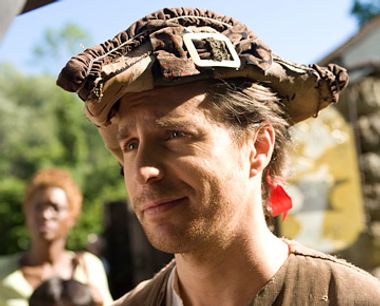
Sam Rockwell in “Choke.”
Maybe the secret to adapting Chuck Palahniuk’s novels into movies is not to take them so damn seriously. If David Fincher’s “Fight Club” became a problematic monument in American film history by outdoing its source material in paranoid portentousness — and by overwhelming it with cinematic technique — then actor-turned-director Clark Gregg’s adaptation of Palahniuk’s “Choke” (which I covered briefly from Sundance last January) takes an entirely different approach. Pretty much dumping any effort at high-minded social satire, Gregg’s “Choke” is a fantastical sex farce, and a highly amusing one at that, without being the least bit momentous or memorable.
Speaking as a reader who’s barely able to tolerate Palahniuk’s prose even at the Barnes & Noble page-browsing level, I think this is a terrific idea; the writer’s loyal fans may feel differently. One thing all parties can probably agree about: As Victor Mancini, the thoroughly unredeemed sex addict and con artist who is the roguish hero of “Choke,” Gregg has the perfect leading man in Sam Rockwell. There’s no American actor who does queasily-weaselly-lovable the way Rockwell does, and making this beyond-implausible script work demands a careful balancing act between Victor’s odious behavior and his evident charm.
Victor works in a 17th century historical-recreation theme park that’s quite a bit like Colonial Williamsburg, where he spends most of his time boffing his female co-workers and engaging in silly gadzooks-varlet period banter with his jealous male rivals. Then there’s the hospital where Victor’s aging and apparently deranged mother lives (Anjelica Huston, I am sorry to say, is consigned to this role), and he has a significant track record with the female staff there too. Then there’s the sex-addict support group headed by Joel Grey (in a hilarious cameo) and a medical researcher (Kelly Macdonald) who believes that Victor may carry the same genetic material as Jesus Christ — and who, in her prim, buttoned-down hotness, may hold the cure to his sexual addiction.
It’s all par-for-the-course Palahniuk material, but played as enjoyable nonsense rather than trenchant social critique. The title derives from Victor’s pattern of pretending to choke in restaurants so strangers can “save” him with the Heimlich maneuver, after which he scams money out of them in various unpleasant, parasitical ways. But these episodes play almost no role in the film, which is a predictable Don Juan yarn about a too-smooth loverboy who will, of course, eventually meet his comeuppance and find the woman who can set him straight. Acting is uniformly good (in addition to those mentioned, Brad William Henke plays Victor’s lovable, chunky sidekick, a Palahniuk staple) and the filmmaking is straightforward, in a bright, bold, off-Hollywood style. One could certainly point out the casual misogyny of “Choke” or its wildly unconvincing portrayal of heterosexual promiscuity, but that would be to mistake the film as even a vague gesture in the direction of realism. (Now open in major cities, with wider release to follow.)
Daniel O’Connor and Neil Ortenberg’s documentary “Obscene” takes quite a while to get going. If you’re not already convinced that longtime Grove Press publisher Barney Rosset is a worthwhile subject, you might wonder whether all these fragments of 1930s home movie and 1980s cable talk show and aging-bohemian interviews will ever add up to anything. But Rosset’s tale of triumph and tragedy is definitely worth your attention — he’s the guy who broke the back of American censorship by publishing unexpurgated editions of banned books, including D.H. Lawrence’s “Lady Chatterley’s Lover,” Henry Miller’s “Tropic of Cancer” and William Burroughs’ “Naked Lunch.”
When Grove was riding high, along with Rosset’s literary magazine Evergreen Review, he was unmistakably a premier reshaper of American culture. He published “Waiting for Godot” and “Story of O” and “The Autobiography of Malcolm X” and countless other influential books, all in those ultra-cool, Abstract Expressionist-flavored paperback editions. His office was occupied by a feminist group in the early ’70s, reputedly angry about his ardent interest in republishing Victorian pornography — Rosset believes to this day that the group was an FBI front, and it’s not as ridiculous a claim as it sounds — and firebombed after he published an excerpt from Che Guevara’s diaries. If there’s anyone the right wing should demonize for the destruction of traditional American values and mores, it’s Barney Rosset.
Somehow, although Rosset at one point ran the hottest publishing house in New York, made a mint off the softcore Swedish film “I Am Curious (Yellow)” and owned more than 200 acres of undeveloped land in the Hamptons (estimated current value: $100 million), he managed to lose the company, all the money and all the property. A puckish, cheerful man who seems reasonably healthy in his mid-80s, despite the decades of all-night boozing and womanizing, Rosset now lives alone in a modest Manhattan walk-up apartment. With lots of books. It’s hard to know exactly what lessons to draw from Rosset’s convoluted story, or even to know for sure whether he should be seen as an epoch-defining cultural hero or just a guy who was in the right place at the right time. He shouldn’t die forgotten, let’s say that much, and O’Connor and Ortenberg’s fascinating film does its part. (Now playing at Cinema Village in New York, with more venues to follow.)
Into the ever-murkier gulf between documentary and fiction rides Olaf de Fleur Johanneson’s film “The Amazing Truth About Queen Raquela,” which churns a lot of familiar ingredients into a strange, bittersweet and distinctive slurry. There’s already a movie about the difficulties of Filipina transgender women (aka “ladyboys,” in local parlance) who work as immigrant labor in Israel — but ladyboys in the fish canneries of Reykjavik, Iceland? No, we haven’t seen that one yet.
Johanneson is himself an Icelandic filmmaker who met his star, Raquela Rios (birth name Earvin), in the booming transgender scene of Cebu City, Philippines, and determined to make a movie about her. A reflective dreamer who can, appropriately enough, pass both as a beautiful young woman and a slight but unaffected young man, Raquela becomes the protagonist of a shaggy-dog doc-turned-drama, going from Cebu City streetwalker to Internet porn star to cannery worker in Reykjavik. Along the way she strikes up an instant-message flirtation with her boss, a taciturn New York Web entrepreneur named Michael (played by co-writer Stefan Schaefer), who decides to fulfill Raquela’s lifelong dream of seeing Paris.
“Queen Raquela” is a crackpot hybrid of a film, quite likable on the whole, and Raquela is surely a born star. And if the movie gave her a chance to go to Paris, that’s great. (I’m not so sure she dreamed of the treeless landscape and freezing fogs of Iceland, but I imagine it was an interesting change of pace.) Still, this might have been better as a regular documentary without the faintly postmodern narrative trappings; Raquela and her two ladyboy friends hanging out in Cebu City, checking out cute guys and exchanging bitchy repartee in mingled Tagalog and English, is superior to any of the fictional material. (Now playing in New York and Los Angeles, with more cities to follow.)
Sundance hands out hardware
Park City's big prizes go to the atmospheric Canadian-border drama "Frozen River" and the inspirational Katrina doc "Trouble the Water."
Scenes from “Frozen River” and “Trouble the Water”
Film-festival awards, with the partial and occasional exception of the Palme d’Or at Cannes, have all the aesthetic significance and marketplace impact of yesterday’s bus transfer. Very often the most intriguing premieres and highest-profile titles aren’t in competition (again, Cannes is an exception), and very often both jury and audience awards tend to land on a film that excels in no particular area, but doesn’t offend anybody or piss anybody off.
Continue Reading CloseBlood on the streets
"Made in America," an operatic history of the Crips-Bloods feud, generates heat at Sundance. Plus: Palahniuk's "Choke" makes much of Jesus' foreskin.
Made in America
PARK CITY, Utah — We’re into the homestretch here at Sundance, with the mountains bathed in that Western combination of brilliant sunshine and crippling cold, the kind of cold that freezes car-door locks, not to mention any iPhones or BlackBerrys left outside for more than 10 minutes. After numerous ritual proclamations of sobriety and abstinence, the buyers are now rushing to spend money like a bunch of drunks running from the 12-step meeting to last call.
Continue Reading CloseIn your tribe
Young people are staying single longer because they are so fulfilled by their network of friends, says journalist Ethan Watters in a new book. Has he touched on a generational phenomenon, or did he just write a book about his Burning Man crew?
It’s 7 p.m. on a Thursday night, and Ethan Watters and I are at the Rite Spot, a cheap, popular, moderately Bohemian hangout in San Francisco’s Mission district, well known for its good lighting, great music, and terrible food. Tonight the place is almost empty, but we’re a bit early — this is just a quick pit stop before we meet up with Watters’ friends for their weekly softball game. A San Francisco journalist and author of the new book “Urban Tribes: A Generation Redefines Friendship, Family and Commitment,” Watters is agreeing with me that a lot of people might be pretty skeptical about the premise of his book — that loose networks of close friends, or tribes, sustain each other emotionally and professionally for the years in between college and marriage, and that the strength of these tribes is a particularly new phenomenon.
Continue Reading CloseSheerly Avni is a freelance writer living in Oakland. More Sheerly Avni.
The company of men
Admirers of "Fight Club" author Chuck Palahniuk convene to discuss art, life, masculine pain and why groin kicks are very, very popular.
Entering the wood-paneled hall, it’s tempting to check the surrounding faces for telltale signs: mushy black eyes, hospital-shaven heads, the acknowledging smirk on a bruised face. In advance of “Postcards From the Future,” the first-ever Chuck Palahniuk conference, no one seems quite certain who will show up in the sleepy northwestern Pennsylvania town of Edinboro, nor what form their dedication to the cult-favorite author of “Fight Club” might take.
“It’s kinda weird,” says Amy Dalton, coauthor of the Chuck Palahniuk.net Web site, one of the conference’s sponsors, “because I’m a little bit afraid of some of these people. I try to think that they’re just like me, and they’re interested in this writer. But there’re people on this other [online] message board who are really ‘fight clubbing’ it — not like the guys on our board saying ‘Why isn’t there a fight club in Omaha?’ These people are really doing it!”
Continue Reading CloseJustin Hopper is the music editor of the Pittsburgh City Paper. More Justin Hopper.
Susan Faludi coaches “Fight Club” author
As the two compare notes, Chuck Palahniuk gets prepped for an appearance on "Politically Incorrect."
It was to be a meeting of two millennial media icons. Susan Faludi was reading from her new book on the disappointed and disenfranchised modern American male, “Stiffed,” to a standing-room-only crowd at Powell’s, Portland, Ore.’s massive indie bookstore. In the audience was Chuck Palahniuk, whose novel on the disappointed and disenfranchised modern American male, “Fight Club,” had just opened in its film version. He and Faludi were planning to compare notes after the reading. As Palahniuk and I stood together (in a
section, as it turned out, of books on sailing, hunting and other manly pursuits), he showed me an article by Faludi in which she’d praised “Fight Club,” calling it “the male ‘Thelma and Louise.’”
Diana Abu-Jaber is the author of "Arabian Jazz" and is writer-in-residence at Portland State University. More Diana Abu-Jaber.
Page 1 of 2 in Chuck Palahniuk