
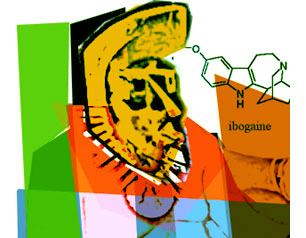

Tabernanthe iboga is an ordinary-looking shrub found in a small area of West Africa. The bush produces simple yellow blossoms and edible orange-colored citrus fruit that is tasteless and oddly sticky. Under optimum conditions, iboga can grow into a tree rising as high as 35 feet.
Despite iboga’s common appearance, in those few nations that know of it, the plant is worshipped as the source of spiritual knowledge and as a tool for accessing the wisdom of the ancestors. The root bark — scraped off, ground into powder and eaten — contains one of the world’s most powerful, long-lasting and mysterious psychedelic agents. The tribal religion associated with iboga is called Bwiti and exists in only two equatorial countries, Gabon and Cameroon. When Bwiti shamans eat iboga, they believe they are granted the power to see the future, to heal the sick and to speak with the dead.
“The Bwiti believe that before the initiation, the neophyte is nothing,” my guide, Daniel Lieberman, told me on my first morning in Gabon, as we took a cab through Libreville, the nation’s capital. “Through the ceremony, you become something.”
“What do you become?” I asked.
“You become a baanzi, one who knows the other world, because you have seen it with your own eyes.”
“How do the Bwiti think of iboga?” I asked
“The Bwiti believe that iboga is a superconscious spiritual entity that guides mankind,” he said.
I had found Lieberman, a botanist from South Africa, on the Internet, where he offered to bring Westerners to a shaman’s tribal village, for a fee. “I have spent time in the rain forests of Africa east and west, Madagascar and the Amazon working with shamans, brujos, witch doctors, healers,” Lieberman e-mailed me beforehand. “Iboga I feel to be the one plant that needs to be introduced to the world, and urgently.”
In person, the botanist was thin and pallid, in Teva sandals and safari clothes, and quite a bit younger then I expected. He said that his ghost-white complexion was due to a nearly fatal bout of cerebral malaria. “I caught it during a Bwiti ceremony a year ago,” he told me. “It took me months to recover.”
This was worrisome. I had expected my guide to be robust and adventurous. Instead, he turned out to be younger then me, and shakier.
Libreville was a hot and stagnant city. Sunlight reflected off gleaming glass corporate towers, the headquarters of oil companies. Because of its oil deposits, Gabon is richer and more secure than other countries in the region. Iboga is another natural resource, but one that has yet to be exploited by the Gabonese.
“Why would the Bwiti allow me to join their sect?” I asked my guide.
“Bwiti is like Buddhism,” he replied. “Anyone can join. The word ‘Bwiti’ simply means the experience of iboga, which is the essence of love.”
Over the last decades, iboga has developed a cult following in the United States and in Europe, where it is known as ibogaine. In the West, the psychedelic is being promoted as a potential one-shot cure for treating addiction to heroin and other drugs. Some researchers believe that ibogaine has the ability to “reset the switches” of addiction, freeing addicts from withdrawal symptoms and all drug cravings for up to six months. Animal tests seem to have reinforced these claims.
In America, scientists at Harvard, New York University and elsewhere are studying the ibogaine molecule, seeking to unlock its mechanism. Later this week, on Nov. 5 and 6, the NYU School of Medicine is hosting a conference on ibogaine’s potential as a treatment for drug addiction. Papers will be presented by various scientists, including Kenneth Alper, the conference director and a professor of psychiatry and neurology at NYU; Stanley Glick, chairman of the Department of Pharmacology and Neuroscience at Albany Medical College; and Zbigniew Binienda, a senior research scientist in the Department of Neurotoxicology at the FDA. James Fernandez, professor of anthropology at the University of Chicago, will talk on the Bwiti’s ritual use of ibogaine. The NYU conference symbolizes the growing worldwide interest in the healing powers of the sacred plant.
Because of this growing interest, a music magazine had agreed to pay my expenses to Africa. The trip was not without its dangers — malaria being one of them, the intense tropical heat throughout most of the year another. It was in the jungles of Gabon that the deadly ebola virus first appeared. Then there were the hazards of trying a little-known, long-acting hallucinogen far from the nearest hospital. After iboga is in your system for a while, it must be vomited out — producing what one study euphemistically described as “tremendous cleansings.” In rare cases, Bwiti initiates have overdosed and died during the initiation.
But none of this mattered to me. I was eager to try iboga for myself. I had reached a point in my New York life where I felt spiritually stunted, morally anesthetized, psychically detached. I was losing interest — not in anything in particular, but in everything. I sometimes felt like I could float off the surface of the planet. Sick of my own culture, my own self, I yearned for access to a different dimension. But could I be guided into the African spirit world?
Lieberman and I stopped at a hotel to pick up his other client for this journey. I was expecting a young anthropologist, psychedelic explorer or beautiful hippie heiress. Instead, a short gray-haired woman greeted us wearing a “Free Tibet” T-shirt.
“I just came from Bhutan, where I got a terrible bladder infection,” she announced immediately, in a familiar accent. We were introduced. “You’re from New York also? What a surprise! I’m a psychoanalyst in the West Village. Maybe you know my friend who works for the New York Times? Or my sister, the novelist?”
I nodded at the familiar names, trying to recover from the shock of unwanted familiarity. I had dreamt of some pristine experience of the exotic, the “other” that I had read about in the novels of Joseph Conrad and Paul Bowles. Instead, I had traveled 7,000 miles to share my tribal adventure with a woman I might have tried to avoid at a Manhattan cocktail party.
The botanist took us to the Libreville house of our shaman. Tsanga Jean Moutamba wore a purple robe that showed off a broad stomach and a necklace of lion’s teeth. “Le Roi du Gabon Bwiti,” as he called himself, had eight wives and 14 children, and members of his family kept passing through the sitting room as we spoke. His manner with us was a bit gruff but friendly. The tribe packed our bags into his jeep, and the king drove us down Gabon’s single highway, four hours into the dense jungle foliage that unfolded monotonously around us. Moutamba’s village was located 40 kilometers outside of Lambourene, the riverside town where Albert Schweitzer built his hospital.
Over the next days I tried to learn what Moutamba’s status as “king of the Bwiti” meant. I received different answers; in Gabon, it was often difficult to separate truth from fantasy. Alain Borgia Dukaga, an English-speaking Gabonese who acted as our translator, told me: “Moutamba is like Jesus to us. Most of the people now are like lacking roots, they got tied to the Christian ways and forgot their culture. Moutamba is helping to bring back our culture. We hope soon they will start teaching Bwiti again in the schools.” A few days later, when relations soured between us and our shaman, Borgia (as he asked us to call him) reversed himself. “Moutamba?” he scoffed. “He’s not the king of anything. He just calls himself that.”
The king’s homestead consisted of a complex of wooden buildings in a jungle clearing where children, hens and roosters meandered about. One roofless structure decorated with palm fronds, the “Pygmy House,” honored the region’s natives for discovering “le bois sacre,” the sacred wood, another name for iboga. The Pygmies still live in small bands in Gabon’s interior jungles, and it is theoretically possible to have a Pygmy initiation. But I will have to save that experience for another trip. Or more likely a future life.
The temple’s stone walls were decorated with crude portraits of the tribal ancestors. A large wooden statue of the first Bwiti couple stood at the entryway. I stared at that statue for a while. I had read about junkies who took ibogaine without knowing anything about Bwiti. On the drug, some of them had described meeting an original African mother and father similar to the tribe’s mythical founders.
Not much is definitively known about the Bwiti. James Fernandez, a Princeton anthropologist who studied the sect, concluded that the Bwiti religion worked by “indirection and suggestion and other kinds of puzzlements,” leaving “many loose ends and inconsistencies.” Throughout his long book on the Bwiti, Fernandez was frustrated by his failure to grasp the belief system behind it. In the end, he threw up his hands, writing that “any attempt to demonstrate the coherence of the Bwiti cosmos founders upon the paradoxes with which it plays.”
The night before the ceremony, the analyst, the botanist, the king and I slept in his temple, along with various members of the tribe. When we awoke, the king gave us what the Bwiti call La Liste, a long, traditional roster of things neophytes contribute to the ritual. La Liste includes a mirror, a tin bucket, a red parrot’s feather, yards of fabric, a machete, a woven mat and supplies for the next day’s feast for the tribe — a live coq du village and a large quantity of sweet liquors such as rum and cassis. Lieberman, the analyst and I spent the morning driving around Lambourene with a few of Moutamba’s sons, whose gravity as they assisted us made me aware of the serious nature of the ceremony. Everywhere we went in the virtually all-black township, people peered into our car with curiosity, and Moutamba’s clan seemed proud to parade “les blancs” — the whites — around like exotic trophies.
Back at the village, the king called us into the temple. “It was good you stayed here last night,” he said. “Last night, I dreamt that le journaliste” — he pointed at me – “will have many wonderful visions. Now you must give us the rest of the money.”
This was a surprise. We had already paid the agreed-upon $600 for the ceremony, double the fee for the average Gabonese. We reminded him of this, but the king started to shout. “You want to cheat me?” he screamed.
He demanded another $600 from each of us. Lieberman tried to bargain with him. The argument raged on for hours. The young men of the tribe stared at us stonily, as if they were shocked we would challenge the king’s authority. Although Lieberman assured us the Bwiti were pacifists, the situation did not feel safe.
“I’m not sure I like the power dynamics I see here,” the analyst commented.
Finally, it was announced that the initiation would proceed even though we had cheated them. However, at the end of the ritual, the king would not give us the special oil bestowing a deeper understanding of our visions through the year. “He himself will not walk with you into the forest and explain to you the myth of the Bwiti,” our guide translated. Moutamba’s tribe now seemed to regard us with contempt. Bwiti no longer suggested quite the “essence of love” our guide had referred to.
At dusk, the ceremony began. The women took the analyst away and then the men came for me. The Bwiti had changed to full tribal dress — animal skins, body painting, feathers — and they played drums and rattles and horns. In single file, we marched from the village over a path through the jungle to the banks of a small stream. The younger men of the tribe had the sleek and muscular bodies of hunters, and the white patterns on their dark skin glowed like neon. Stumbling along with them, I felt like a tall blancmange.
I was directed to undress completely and step into the ice-cold stream. The young man assigned to be my “Bwiti father” poured a soapy liquid over me — some kind of spirit-medicine — and smeared a red paste across my face and torso. The Bwiti chanted while I put on the initiate’s outfit — straps of tanned animal skins and shells looped across my chest and upper arms, a short garment of red fabric and the red feather twirled in my hair. For the Bwiti, the color red is like a mystical traffic light, signaling the crossing zone between this reality and the other world.
Woozy with anxiety, I looked up at the group assembled on the slope above me as they sang and drummed a dirge-like melody. By casting off my clothes, I had symbolically died; after taking iboga, I would be reborn. Moutamba produced a plaintain that had been sliced open and filled with white powder. My Bwiti father carried this sacrament to me gingerly while the others watched with serious, expectant faces. He held it up to my lips.
Even now, whenever I think of the taste, I start to shudder. The iboga was like sawdust laced with battery acid. When I finished chewing the dry fruit, I was fed a few more spoonfuls of the drug mixed with honey. Moutamba nodded encouragingly. I struggled to hold the stuff down.
“Le journaliste a mangé beaucoup, beaucoup,” he said.
I was worried as we returned to the village. Had I eaten too much?
Walking was more difficult now, as my legs had become rubbery. In a courtyard, the men sat down around me and continued playing music. One of them strummed the M’congo, a one-stringed mouth harp resembling a bow, with an eerie, almost humorous tonality. The M’congo is the essential Bwiti instrument; the voices of the ancestors are channeled through it. My Bwiti father put a bundle of leaves in my right hand and a tight whisk of dry thistles in my left and instructed me to keep shaking both in time to the music. As with many of the rules surrounding the ritual, this one was strictly enforced — whenever I lowered the rattles, my Bwiti father would rush over to have me shake them again.
“Seeing anything yet?” the botanist asked.
“Not really.” I asked him how the analyst was doing.
“She is having lots of visions — members of her family appearing to talk to her and other things. She is in the temple, describing them to Borgia.”
They fed me more iboga and brought me into the torch-lit temple. I was placed alone at the center, facing a mirror decorated with fern leaves and carved figurines. Moutamba and the tribal elders sat to my left, and the rest of the tribe on my right, about 25 people in all. Even in my stoned state, I felt acutely self-conscious. The atmosphere was tense. The king had decreed I would have “wonderful visions,” and I began to realize that not satisfying him was not an option.
The analyst lay along a wall of the temple surrounded supportively by the women as she recounted her visions. “There’s Buddha,” she called out, staring at the ceiling. She turned around. “And I see my dead grandma over there,” she said, waving at the wall. “Hello, grandma.”
It was a long, awkward time before I began to see anything at all. Finally, out of the corner of my eye, I watched a large wooden statue, faceless and made of rough logs, walk across the room and sit in front of me. Then, in the scratched surface of the mirror, a small screen lit up. Pictures from New York City — a window of my apartment, street scenes — flashed with brief, hyperreal clarity.
“I see my apartment in New York,” I said. “But nothing seems to be happening there.”
“If you see a window, you must try to go through it,” the king instructed me, “and if you meet somebody there, you must try to talk to them. Perhaps they have a message for you, some information.”
The Bwiti insisted I should relate my visions out loud. I was not prepared for that. I had expected whatever I saw to be my own concern. But the Bwiti didn’t sympathize with my ideas about privacy. “Everything you see must be shared,” the king urged. “You might have a message for the tribe.” But in my stoned state I was tongue-tied, and I sensed the Bwitis’ rigid disapproval.
Other hallucinations passed before my eyes — burning skulls and goblin faces, the figures of women in black dresses stretching out long white arms toward me from the edges of my vision — but when I tried to speak of them, they disappeared. Meanwhile, the iboga was making me sick. I fought against waves of nausea. I wanted to reach the deeper visionary state, but I was also afraid of the drug. If iboga was indeed a “superconscious spiritual entity,” I wasn’t sure whether this entity liked or hated me. I suspected the latter was more likely. I started to perspire. My head seemed several times its normal size. I wondered if I was going to die. I vomited into my pail.
“Can I go to the hotel now?” I heard the analyst ask. The Bwiti laughed in response. “Oh, les pauvres, les pauvres,” the king said, mocking us. The ceremony had many hours left to go.
I lay on a mat on the hard-packed earth, looking up at the unsympathetic faces of the tribesmen. I scorned my own foolishness: Who was I to try entering the African spirit world? In the future, I promised myself in a moment of insight, I would seek some easier assignments.
Closing my eyes, I saw Technicolor patterns. I fell into a trance, floating to the Bwiti music. Aspects of my past life flared up in my mind, like gleaming facets of a larger whole. I reviewed my childhood — my parents’ separation, my mother’s loneliness, my own unhappiness. I felt myself as the product of all the forces that had acted upon me. Henry James once described human consciousness as “a helpless jelly poured into a mold.” It seemed as if iboga compelled me to perceive the exact shape of that mold. It was dizzying and liberating.
Then the iboga trip became a cinematic cyclone, whirling images and ideas at me at high speed. A series of unknown houses appeared and I drifted down into them before they faded. Images of ex-lovers came and went, dancing away into the ether. I saw the sign of the now-defunct Manhattan restaurant, Teacher’s Too, where I had met my first girlfriend. The letters of this sign spun around in space and reassembled, rebus-like, to spell the phrase, “Touchers Teach Too,” which seemed to contain a message about my own future relationships. But what did it mean?
Sometimes the percussive music became deafening in the low-ceilinged temple. At other times the Bwiti’s songs seemed awesome in their beauty. The rhythms seemed organic, as if the music was itself an emanation of the plant’s essence. In my altered state, I understood the tribe’s deep relationship with this plant that showed them things. I felt how complete their culture was in itself — so complete that no outsider could disturb it.
Late at night, the Bwiti made us rise and dance with them. Then we watched as each tribesman danced around the temple, whirling a torch, scattering shadows across the walls like living forms. “After you take iboga you will know what Bwiti is,” the king had told me the day before. I felt that iboga activated an ancient symbiosis between plant and human. Perhaps what Lieberman had suggested was true, that in Bwiti, like Buddhism, there is no single deity, just a play of forms and spirits spinning across the Void.
At dawn, the Bwiti led us outside to watch the sunrise. We sang with them. We were still woozy as the ritual ended, but the king started shouting again. “Now you have been initiated, you give me presents of money!” he screamed. “I demand more money!”
We decided to check into a hotel. This required another long and tense negotiation.
“I have had visions of terrible ruin!” Moutamba shouted. Because I had not seen and spoken all my visions, the king explained, we would be in mortal danger if we did not stay another night. As Lieberman insisted we were leaving anyway, the king tried to make a bargain. Introducing the analyst to the father of a 9-year-old girl, he suggested that, instead of paying more, she should take the man’s daughter and raise her in America.
We convinced one of Moutamba’s sons to drive us to the Ogobue Palace, a placid hotel overlooking the river. At the hotel, I discovered that the iboga trip was continuing. I was wide awake and without hunger, despite the fact that I had not slept or eaten in more than 30 hours. Lying in bed, I watched a fleeting phantasm that drifted across cracks in the white wall. Strange men in funny hats and coats marched away, melting into the plaster. I realized these were “ancestor shades,” ghost-impressions of my forefathers, a vision that the iboga trance often produced, in accounts I had read. So faint, so quickly, they melted away.
We did not see the king again. After a night’s rest, Lieberman and I searched Lambourene for other Bwiti Ngongo. Our guide was eager to buy iboga seeds and powder to bring to South Africa. Off the main streets, the town’s back alleys formed mazes of little houses and shacks, and each separate maze seemed its own community. Many of these communities had built their own Bwiti sanctuary from wooden boards and palm fronds, rudimentary compared to Moutamba’s temple.
In one of these shrines we found Papa Simone, a young, bearded shaman, with an ascetic, intellectual appearance. I described my visions, scant though they were, to Papa Simone, and he interpreted them for me. The wooden statue, he said, was the spirit of le bois sacre itself, “which comes out and engages you in conversation.” The pictures of my apartment and the city streets were a telepathic check-in, showing me that everything was calm at home. The beckoning female figures, he said, indicated what paths to take. I was sorry I hadn’t known better how to follow them.
Papa Simone organized another all-night ceremony for us with his Bwiti village, a closing ritual to give us the oil that Moutamba had withheld. During this ceremony, which also involved dancing, drumming and singing, I saw what Lieberman had described as “the essence of love” in the community around Papa Simone. At the end of the night, each of the Bwiti in turn embraced the analyst, then me, and danced us around the temple fire, as violently and quickly as possible. The embraces told us — more directly than words could — that despite our alien language and culture and pale skin, we had been accepted among them.
The second ceremony also required eating iboga, but I could not bring myself to swallow enough to hallucinate. Papa Simone’s tribe included a large, laughing man wearing a red loin cloth, his sleek black body daubed with white paint. One of the older members of the tribe, he ate iboga throughout the ceremony. He kept pointing at the bowl of shavings, then at his own eyes and then at me, trying to convince me to eat more so I would see things.
Towards morning, he announced that he was having a vision, which Lieberman translated. He said he saw the spirit of my dead grandmother, of my mother’s mother, hovering over me where I sat by the yellow flames of the bonfire. “You had a very close relationship with your grandmother,” he told me. “She loved you very much, but now she is dead, and she doesn’t want to let you go. Her spirit is hanging over you, and she is stopping you from seeing visions, and from visiting the other world.”
The tribesman’s vision surprised me. My mother’s mother was the only grandparent I had known — the others had died before I was born. If the tribesman was guessing, he had only a one-in-four chance of getting that right. And I did have a close relationship with my grandmother, in a way. She had often taken care of me when I was young. As I got older, I found her a repressed and gloomy presence, and I even tried to avoid her. My grandmother had lived through a sad story of immigrant America — her father came from Poland, but when he could not find a job in New York, he killed himself, leaving his family in desperate straits. Later on, in revenge, the family destroyed his papers and all traces of him. They never spoke of him again. This repressive act had shaped my grandmother’s mental life. It was not difficult to imagine my grandma as a possessive spirit, lingering above me, protecting – preventing — me from having revelations. After I returned to New York, the tribesman’s vision stayed with me as something uncanny and intuitively wise.
Scientists don’t know exactly how iboga affects the brain. One speculative theory is that the alkaloid restores a balance between the brain’s two halves. Carl Anderson of the Developmental Biopsychiatry Research Program at McLean Hospital in Virginia believes that people prone to addiction suffer from an imbalance between the left and right hemispheres. This disparity disrupts REM sleep, which, according to Anderson, is “essential for emotional regulation, learning and memory consolidation.” Iboga, or ibogaine, accesses REM cycling in a powerful way — after having taken a large dose, many people report their need for sleep is reduced by several hours, for weeks or even months. By this theory, ibogaine returns to psychically damaged people the healing power of their sleep and dreams.
When I returned to New York, I needed less sleep for a while. I mulled over the Bwiti initiation. The psychedelic had given me such strange figments, such glancing views. For a few hours, I was granted a powerful lens through which I could view my life — that fragile assemblage of habits, moods, past events and relationships — like an object seen through a magnifying glass. More memorable than the greed of my shaman, the emotional power of my insights stayed with me as an indelible lesson. I am still waiting to learn what touchers can teach.
