Alan Goldstein

Bio-stupid

The protesters at a San Francisco biotech summit were scientifically illiterate and politically irrelevant. But they were also right.

  • more
    • All Share Services

Bio-stupid

I am a doctor of genetics, a Ph.D. in molecular biology. I am standing in a cable car descending Powell Street into Union Square on a quest to achieve total understanding of the issues raised by the appearance of BIO in San Francisco. I will disembark at the St. Francis Hotel and proceed on foot to witness, record and analyze both the BIO meeting and the reactions of an opposing force called Reclaim the Commons.

As a certified member of the techno-elite, I understand BIO. These, after all, are my people: the gene splicers, the sequencers, the oncologists, the toxicologists. But, of course, this is the Biotechnology Industry Organization. Which means that along with science comes the rest — the MBA managers, the marketers, the V.C. guerrillas and the lawyers. These are not my people. But I assume they are fellow travelers, committed to the goal of science in service to humanity.

I am not here solely as a scientist, however. During the BIO meeting I intend to periodically exchange my pinstripes for blue jeans and consort with the environmental activists who are also in town. I know these people too. Unlike most biotechnologists, I came to molecular biology trained in classical plant breeding and agronomy, an unusual launching pad from which to land on Biotech Planet. Working with plants brings you into contact with a much greener crowd than, say, working with lab rats or hybridoma cell cultures.

In the 1970s, when I was in graduate school in Arizona, many of my peers were already deeply concerned with issues such as organic farming and the potential dangers of GMO (genetically modified organism) crops. One classmate, Gary Nabhan, would later win a MacArthur “genius” grant for his pioneering work to preserve the genetic diversity of Native American crops. Andrew Weil was across the street at the medical center extolling the healing power of plants.

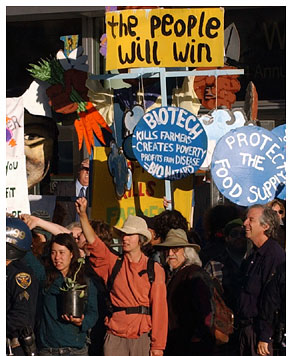
During the BIO meeting in San Francisco, I will come to realize that looks are truly deceiving. The motley crew of protesters, chanting “biotech industry, go to hell” and waving signs that are equally eloquent, are, despite their low numbers and logistical confusion, engaging in a crucial ideological battle, a battle whose birth I witnessed right here in the Bay Area almost a quarter-century ago.

In America this battle appears hopelessly one-sided in favor of industry. The BIO forces are well armed and provisioned to excess, and they fly business class. Their propaganda offers up visions of a techno-green future for all but, in fact, their ascension could have devastating and irrevocable consequences for the ecology of our planet.

During the San Francisco BIO festival, the media will generally miss the real implications of this battle. In this case it is not the media’s fault, since the battle is being waged with rhetoric that is virtually incoherent on one side and impossibly arrogant on the other. But to a farmer who grew up to become a cloner, it couldn’t be more obvious. Left unchecked, agricultural biotechnology will lead us directly into an environmental catastrophe. And yet, those who have rallied to protest this march to disaster are themselves a toxic waste zone of incomprehensible and woefully misinformed ignorance.

My revelations are still a few hours away when I reach Union Square on a warm, bright Saturday morning. I feel excited to be on my way to the Moscone Convention Center to make sense of this mess. And I am just the man for the job. I have been in the biotechnology business since there was a biotechnology business to be in. As a result I have no illusions about the altruism quotient of scientists. We’re just folks, people like everybody else. As I trundle across Market Street at Fourth, I look up Market past the Palace Hotel toward 555. When I joined Biotechnology Nation in 1980, 555 Market was still Chevron corporate headquarters and it was truly a weird scene inside the gold mine. It was almost 25 years ago today when, as a freshly minted Ph.D., I stepped into the eye of a hurricane.

I couldn’t know it in 1980, but big oil and biotech had just decided to fake a shotgun wedding that would help kick industrial biology into high gear. This decision was fueled by a socioeconomic hat trick involving fossil fuels, new life forms and the free market pizzazz of a future pitchman for Viagra.

The first scoring maneuver evolved from the 1973 Arab oil embargo. Influential journals predicted that the United States was about to fall into a dangerous “energy gap.” We would literally be out of gas by 2000. Following the 1979 revolution in Iran, corporate fear escalated into naked terror, driving the price of oil to all-time highs. This inspired the federal government to impose a windfall profits tax on big oil in 1980, and the ensuing economic turmoil created an industry with enormous taxable profits desperate to diversify. Score goal No 1.

Goal No. 2 hit the net when the Supreme Court affirmed the right to patent genetically engineered microorganisms. The problems involved with the ownership of one life form by another remains at the center of our national bioethics debate and the stance against it is certainly the most scientifically coherent and politically astute mantra of the counter-BIO forces.

The final goal was scored with the Bayh-Dole Act, which allowed patenting of government-sponsored research in universities. Passed into law in 1980, Bayh-Dole immediately turned colleges into major players in the hi-tech intellectual property arena. Professors Stanley Cohn and Herb Boyer discovered the basic manipulations that allowed scientists to isolate and clone genes to create recombinant life forms. As of 1980, these life forms were legally patentable.

Driven by the forces of diversification and windfall profits, virtually every major oil company in the U.S. had a biotech group by the early ’80s. But a business based on the creation of new life forms was controversial from the jump. Dissenting voices, serious and strident, raised vigorous objections to the existence of an industry that required the safe practice of a highly unnatural form of sex, one that violated 4 billion years of procreational tradition. A wild party was about to begin, so it was no surprise to find the San Francisco Bay Area at the forefront of consensual cloning.

I am abruptly hauled back from my dreams of test-tube sex to the press registration desk at Moscone West. The possibility of total understanding has just vanished. The short version is that I will not be allowed to register for press credentials. The deadline for Web-based registration passed two weeks ago and no college journals, freelancers or online publications will be credentialed onsite. I toss out a few pro forma objections. What’s wrong with online journals? Freelancers embody the entrepreneurial spirit of BIO. I have my passport with me. I am a college professor, not a college student. I even point out that, in this other incarnation, I am a member of BIO.

But the post-9/11 environment combined with the presence of anti-BIO forces has apparently turned San Francisco into Switzerland. The rules are the rules, next person. Except that there is no next person. The central hall is empty of registrants at 11 a.m. on Saturday. But I do notice two security guards tacking toward me from opposite sides of the entrance. As becomes a doctor of genetics, I beat a dignified retreat to a nearby Starbucks and consider my options. For the sake of verisimilitude, I put in a call to BIO’s president, Carl Feldbaum, at the organizaiton’s headquarters in Washington but no one is answering the phone on a Saturday. Anyway, Carl is in San Francisco and something tells me that, even though I have met him on several occasions, he is not going to return my call. The obvious answer is to conduct a controlled experiment. I will determine if I have a similar problem registering with the opposition.

At 6:30 Saturday night, I end up at the First Unitarian Universalist Church on Franklin Street. On the Web site calendar the event is called “Final Teach-In Planet Resistance & Alternatives.” Like California itself, membership in Reclaim the Commons is apparently a state of mind, although a $5 contribution is appreciated and you can sign up to receive information by e-mail if you want to.

I pay my volitional registration fee, give one of my e-mail addresses, and pick up one copy of every brochure on the table. To the extent that the brochures discuss biotechnology, they focus almost entirely on the issue of genetically engineered foods. For the logical mind, this presents a bit of a quandary since the overwhelming number of companies at BIO are engaged in producing medicine and healthcare products. The Associated Press wire will notice this same disconnect on Monday. For those of us attempting a logical analysis, it is easy to use this missed communication as a reason to dismiss Reclaim the Commons and, after reading their literature, I am inclined to do this. But I will rethink my position shortly.

I nab an aisle seat in a front pew and open the first brochure entitled, “Keeping California Free of Genetically Engineered Food” by Californians For GE-Free Agriculture. My fellow Californians explain genetic engineering as, “a new process used by scientists to insert genes from various organisms (human, plant, animal, bacteria, or virus) into crop plants.” So far so good. They go on to tell me that this technology, “…. differs fundamentally from traditional plant breeding in that it forces the exchange of genes across species barriers — a process that does not occur in nature.”

A process that does not occur in nature. This is the key although I don’t immediately get it on Saturday night. I take a look around and think, yes this is God’s wooden ship. God would build it this way. Oak floors, oak pews, sedately beautiful wood ceiling with crossed beams shaped like a ship’s hull. Classic stained glass windows shining God’s light on this classic activist crowd. White-haired 60′s worriers. The lifetime committed. The pierced and the paisley. Young people with sensible Mohawks. Tonight they will come dressed for the new global church. No makeup, little jewelry except for humble stones from the Earth; turquoise, a small topaz, a bit of polished jade.

The podium remains empty, so I surmise that it will be a while before the Teach-In begins. I embark on further acts of coverage. I already have a general concept that Unitarians are into hip social action; harboring refugees from Central America or holding funeral services for counterculture heroes like Allen Ginsburg; very cool people. I begin to circulate. The vibe has a distinct flavor of mandated serenity. I approach a well-dressed woman with a haircut that obviously involved a professional. She appears to be about my age and is, in fact, a fifty-something doctor’s wife who tells me that mechanized farming is evil and that all the best land has historically been inhabited by people who live in villages and use slash-and- burn agriculture. I move off thinking she needs to try her luck in the slash-and-burn section the Berkeley Bowl Market on her weekly visit. My next target is a young professional activist who tells me that that genetically engineered rice has ruined Thailand’s water, no details available. Everyone I meet has stories of spectacular damage from genetically engineered crops but, like paranormal phenomena, no one ever seems to be in the right place with a real measuring device. The focus is on failures without a coherent alternative definition of success. The universal message from my pre-seminar survey is; we take it on faith that it’s all a big lie. And so it goes until the Teach-In finally begins.

Looking over my notes, I see that services were convened by Luke Anderson, who looked like a rock star/surf dude and spoke with an impeccable English accent. This was in interesting juxtaposition to the panel, which seemed to contain no other Caucasians. Which was in even more interesting juxtaposition to the audience, which seemed to contain virtually no non-Caucasions. The other panelists mainly wore native dress of one sort or another; sashes, capes, and the implication of ritual ornaments. No one except Luke looked to have missed a meal, natural or genetically modified, in recent memory. Luke told us that we had an amazing night ahead. He was right but not, I suspect, in the way he intended.

The native garb of the panel turned out to be subliminal preparation for the true horror of the 21st century Ghost Dance that was about to unfold. The original Ghost Dance was an attempt by some North American Indian tribes to save themselves from the white man. The despair and nostalgia of the Ghost Dance invoked magical thinking to the maximum in a desperate last spasm by an indigenous population about to lose their entire way of life. It was an attempt to resurrect a continent full of dead people along with their entire ecosystem; including hundreds of millions of buffalo. They were, in fact, engaged in a supernatural reclamation of their commons.

But whatever the Indians did on the Great Plains, tonight’s Ghost Dance was listless and anemic. From the beginning there was a sense in the audience of the dutiful obeisance that presides over a normal Sunday sermon, when you don’t expect the minister to actually transform your life in a real way. But these people did sit awfully well. I consider that, for professional activists, the ability to sit often takes the measure of ones commitment. Pews, bus-benches, crowded old Volvos. These people know sitting in their souls, but I do not. I emerge from the First Unitarian Universalist Church with serious sciatic neuropathy knowing only that the people I have met are profoundly in favor of all that is natural, and deeply opposed to any pollution of their vital bodily fluids by artificial technology.

And yet I can’t shake that spooky feeling that I have been clubbed with a hard and dangerous reality deceptively wrapped inside a gigantic wad of fuzzy thinking. I have attempted to decipher a congregation who despises globalization but believes in the global village. I have heard about the evils of NAFTA and the people’s intrinsic right to food sovereignty. I interviewed a biofeminist who knows in her heart that vitamins are an insidious plot by the new military-industrial complex. As I walk down Franklin towards the ocean, a concept is focusing through the lens of memory. And I think, none of this garble, even the most fractured of these fairy tales can erase the reality that the green revolution was a complete hoax and that forcing genetically engineered food down the throats of unsuspecting hungry people is evil.

Those who remember the past are condemned to repeat it too; perhaps they are even inspired. I am beginning to remember and to synthesize. Reclaim the Commons is not in San Francisco to stop the members of BIO from finding a cure for cancer. They have made the tactical error of setting themselves up against all of BIO when, in fact, they are here because a few companies are pushing relentlessly to release the fruits of genetic engineering into the environment. This is the reality that has pushed the collective primal scream buttons of the environmentalists. They fervently believe that this technology is dangerous; and they may be right. But what is absolutely crucial to realize is that Reclaim the Commons does not have to be right in order for Monsanto to be wrong.

Although they can’t articulate it, Reclaim the Commons has instinctively recognized the truth. Agricultural biotechnology is different. For most of the biotechnology industry, genetic engineering is just a means to an end. An advanced processing technology conducted under highly controlled laboratory conditions. Only agricultural biotechnology requires the immediate, wholesale, release of recombinant organisms on a global scale in order to create a profitable product. Therefore, only the agricultural biotechnology companies are in a hurry to flood the world with these new life forms. The horror stories retold by Reclaim the Commons may be true, false, or some shade of grey… but no farmer anywhere is waking up today thinking, “boy if only I had genetically engineered BT corn, my problems would be over.” There are simply too many alternative and equally efficient crop production technologies available. Monsanto, the first and largest industrial player in ag biotech, is still the poster child for the utopian joys that will ensue from the release of recombinant organisms into the environment. They are in a hurry when the truth is… there is no reason to hurry.

I cross Van Ness to Polk Street to treat my sciatica with a dose of Thai curry. Over the steaming bowl, I consider the irony and turn of fate that has brought us full circle to the place where the first brutal de-greening of ag biotech took place. It was right here in the Bay Area 17 years ago. Some of us witnessed that particular end of innocence. It came with “The Great Ice-Nucleating Bacteria Strawberry-Spray Circus.”

A young Berkeley plant pathologist claimed to have discovered a bacterium that behaved like Ice-9 in Kurt Vonnegut’s novel “Cat’s Cradle.” This bacterium, or more precisely, a protein on its surface, catalyzed the formation of ice crystals at air temperatures above freezing! The natural protein was called Ice+. Folks at a humbly named biotech start-up called Advanced Genetic Sciences (AGS) got a cool idea. They would take the gene for Ice+ out of its natural host, mutate it into Ice-, and put it back. This kind of genetically modified organism could be made in many ways but, as a biotech company, they would make theirs via cloning.

AGS claimed that by spraying the surface of strawberry leaves with genetically engineered Ice- bacteria, the plant could be protected from frost damage. Notice the concept of spraying, as in the release of large quantities of recombinant organisms directly into the environment. Artificial colonization of the leaf surface with friendly bacteria is called bio-control. In 1980 bio-control usually qualified as an eco-friendly green technology, a good guy. But when done by cloned GMO, bio-control was not considered green by the bona fide greens. AGS persisted, arguing that the world would ultimately catch up to its vision. Like Monsanto today, AGS fought repeated legal challenges and intense local opposition to gain approval to release its Ice- bacteria. The first Frankenbugs hit the fan on the morning of April 24, 1987, in the East Bay town of Brentwood when AGS officially inaugurated the Age of Agricultural Biotechnology.

As scientific experiments go, this was an amazing show. I attended as a sort of poll watcher and roadie, accompanying a friend who worked at AGS. An international cadre of reporters and TV cameras witnessed a kaleidoscope of tie-died eco-warriors demonstrating across chain-link fencing, barbed wire and hired guards. These folks chanted loud and long to banish the towers of petri plates and miles of sensors attached to biotechies in full-body hazmat space suits (mandated by the FDA). But the opposition did more than chant. In a preemptive strike, over 80 percent of the plants had been pulled out of the ground during the night. AGS restored what it could and began to spray. At the end of the day recombinant genetically engineered organisms had been intentionally introduced into the environment.

But to what end? Why did AGS fight so hard? The answer remains equivocal, but by applying for and ultimately receiving permission to spray, the company was signaling that it was close to the Holy Grail of every start-up: a product almost ready for the marketplace. In the end AGS was allowed to spray, no environmental disaster ensued, and 17 years later strawberries are still freezing all over the world.

AGS is gone now and, as of 2001, only the fully natural Ice+ bacteria have achieved product status for the relatively low-tech application of entertaining rather than feeding the world. Ice+ bacteria are an active ingredient in Snomax, which is used to make snow on the ski slope just down the road from my home university. To quote the Web site: “Snomax Snow Inducer is an ice-nucleating protein derived from the naturally occurring bacterium … found readily in nature, from grass to trees to vegetable crops, and even in the air we breathe.”

And that, as they say, was the end of innocence. As I approach Moscone West in the year 2004, it strikes me as profoundly ironic that so many years later, the anti-biotechnology forces appear once again to be rallying against the push by a company to release genetically engineered organisms directly into the environment, and into our digestive systems. Has either side learned anything in the meantime?

Sunday morning I check for messages from Carl Feldbaum. My voice-mail box is empty but I no longer care. I have come to realize that BIO has nothing to do with the social phenomenon happening on the streets of San Francisco. The worlds of BIO and Reclaim the Commons have no possibility of intersecting. BIO knows it is bigger and better than ever and that all the myths perpetrated about agricultural biotechnology by misguided environmental activists are false. Just read their Web site. The FDA has already determined that biotech foods and crops are safe. Biotech animals eat, drink and behave just like “conventional” animals. And, most importantly, biotech does not harm monarch butterflies.

While the environmental activists pass the hat to collect money to copy their manifestos, biotechies will run networking excursions from their booths in Moscone Center’s exhibition hall, take in colorful animated PowerPoint presentations, and have a little fun on the corporate expense account. Prominent members will also attend a gala dinner featuring gourmet GMO foods prepared by a chef with a Ph.D. in biochemistry flown in from Austin, Texas, or someplace equally groovy. Gavin Newsom, the newly elected mayor of San Francisco, is viciously schmoozing the biotech elite, offering them everything from free utilities to their own cable car branch in return for locating in the new China Basin research park. Newsom, a 37-year-old political prodigy, is perhaps the first truly millennial mayor. With a progressive sensibility, from fashion to gay marriage to biotechnology, Gavin sees the future and is committed to bringing the fun back to San Francisco. Fun and profit. To ensure the profit he has placed hundreds of police around Moscone Center and it is clear that Reclaim the Commons has about as much chance of disrupting this meeting as the ghost dancers had of bringing back the buffalo.

The story here is clearly not about whether Reclaim the Commons can disrupt the BIO meeting. These folks will not even stop BIO members from getting their next latte. The real story is how these people found their way here at all, and what, if anything, they really think they can accomplish. They know something is happening. While they truly don’t know what it is, that doesn’t mean their intuition is wrong. We may, in fact, be sharing our last human breath together. We may, in reality, be losing our identities as free individuals. It may, in truth, be the end of the world as we know it. If all this does come to pass, we won’t be able to blame Reclaim the Commons. They, at least, have attempted to name of the root cause of all this evil. For them, its name is technology.

Technology as the root of all evil. I will hear this mantra endlessly at the Really Really Free Market held Sunday afternoon on Union Square. The Really Really Free Market is described as “a real gift economy.” From the Saturday night teach-in, I have surmised that, in the global village (as opposed to the globalized free market), one starts off giving away the things one produces. The next step is hierarchical bartering; first within the local community, followed by regional trade. Profit per se is never a factor. Everyone works for cost and the sense of spiritual well-being that comes from being close to nature. This concept sounds especially ludicrous during my walk up Powell Street through the highly organized, relentlessly profit-driven chaos of San Francisco’s Chinatown, a place where the idea of giving away anything that could be sold was probably discarded before it ever reached the communal lower id.

In terms of consumer goods, the Really Really Free Market didn’t measure up to a decent Berkeley garage sale, and it made the average flea market in rural West Virginia look like Macy’s. A generous estimate would be two cardboard boxes full of threadbare clothing, small anemic plants wilting in the sun, and perhaps a half dozen other booths and service providers. In fairness, there were plenty of free bakery products, but no more than one would find at a regular AA meeting.

As a contribution to the Really Really Free I put up a sign reading, “Genetic Engineer: Free Inside Information About Biotechnology.” For the first half-hour folks give me a wide berth. Then a person gathering signatures on a petition about stem cells stops to talk. He has no idea what a stem cell is. Another, violently against cloning, doesn’t know what a gene is. I pick up a third marketeer, who knows that the FBI is compiling a list of farmers who save their own seed. None of these people is over 30, and none has any pressing questions about the nuts and bolts of genetic engineering or biotechnology. But after years of teaching introduction to cell biology I have strategies to draw them out.

I start with the stem cell dude. Using a modified psychiatrist’s approach, I ask him how he feels about stem cells. He responds that he doesn’t really understand what they are but he has heard that they have something to do with human cloning. This is all the daylight I need. I tell him that the issue is really about tissue engineering, and that biotechnology will soon be able to grow humans, or any part of them, in a laboratory. I ask if he understands what this means. He says no.

I have three people in class now so the time has come to make my move. Keep in mind, I say, that your entire body grew inside your mother from a single cell. Obviously, that single cell had the ability to make every part of the human body since, in fact, that is how you got here. Cells like that are called embryonic stem cells. I go on to explain that, in the near future, biotechnology will learn how to take normal cells, say skin cells, and turn them into stem cells. I finish with a flourish. In a tone meant to transmit enthusiasm mixed with menace, I inform them that we will soon be able to grow body parts and even whole bodies. Obviously, I conclude, this technology has the potential to create serious ethical dilemmas for society. The stem cell dude looks at me and says, “Like what?”

Since I teach undergraduates professionally, I am unfazed. I offer the example of growing him a headless body and keeping it on life support in case he needs a new liver or heart. I ask my impromptu seminar group if that would be OK. The general consensus is that it might be, but they would definitely have to think it over.

I decide to take my sign down and circulate around Union Square. It is a beautiful sunny day. There is a kind of reggae band playing and a couple of people are dancing, but what strikes me is the almost complete lack of energy. During the next hour I am unable to locate a single person who can speak coherently about science. Most of the people I talk to come from elsewhere, as in not from San Francisco. The stem cell dude was from Santa Cruz; another member of my seminar was from Spain but was now living in the Mission; the girl concerned about the FBI menacing farmers is from Portland. Many people I interviewed made outrageous claims without a clue as to where their information came from.

I was informed that, because foods are not labeled, we don’t know if we are eating a tomato with fish genes or corn with human genes. And, since it’s not labeled, we obviously can’t know what effect eating all this weird stuff will have on our health. I heard that biotechnology is not how the people want their food or medicine grown. I heard from people who would try a biotechnology cure for cancer, but only if acupuncture failed. I heard that the ecological impact of biotechnology looks pretty grave. I heard that research into Viagra: The Next Generation was preventing the development of a cure for malaria. I learned that our government needs to put a lot more energy into providing healthy alternatives rather than giving corporate welfare to big biotech. I heard a lot about faith, a lot about belief, and a lot about magic. Someone offered to read my future with Tarot cards.

The Really Really Free Market took place on a classic summer day that is the stuff of California dreamin’. All that sun and all that sky cried out for a festival. Yet there was almost no sense that these people were willing or able to celebrate the real, real human spirit that had supposedly brought them together in Union Square. There was no flower power in that park on that Sunday. Whatever their dreams, these people seem to know in their hearts that the most they can hope for is more corporate responsibility, enforced by government regulations. Where is Abby Hoffman, or even Wavy Gravy when you need them? Rather than watching activists, the overwhelming sense was of watching canaries in a coal mine.

The cosmic irony is that these people have tapped directly into the most profound and basic social truth of modern life. But rather than being energized by this connection, the sheer voltage of reality has them paralyzed. What they know in their hearts is that they are witnessing the ascendancy of the corporate capitalist model for controlling human behavior and ultimately human consciousness. These people correctly recognize that they are the subject of the most massive and sophisticated behavior modification campaign in human history — a campaign that appears to be going splendidly. They have correctly identified BIO as a manifestation of this campaign, but have incorrectly targeted it as a causal agent. Biotechnology is much too young an industry to have any real control. The folks at BIO are simply the newest merchants on a very old trade route. The route itself is the product of powerful trade winds that blow at the behest of far more ancient market forces, forces that control transportation, energy, weapons and the ultimate power that resides with those who take and hold entire regions of the planet itself.

Perhaps this explains the transcendent lethargy that consumed the event at Union Square. On some level, the denizens of the Really Really Free Market know that they cannot win a real battle, much less the war. As a result these people are confused, frustrated and angry. But ultimately they appear to be resigned to going out with a whimper. Just please don’t force-feed them any more corn with rat genes.

As I retrace my cable car route back up Powell Street, I know that I will not continue my mission. This battle has been lost. In the sound-bite war for America’s heartland, Reclaim the Commons made the gravest of all tactical errors. They got off message. Or, perhaps they never understood their true message. The green revolution, totally reliant on mechanized agriculture, chemical pesticides and fertilizers, was never a true green technology. Now the same players are going to feed us with the green biotechnology revolution even though there is no real evidence that hunger in today’s world is the result of a shortage in food production technology.

Agricultural biotechnology is different from the rest of BIO. To succeed, it must literally flood the globe with recombinant genotypes. The people of Reclaim the Commons knew this instinctively, but failed to get their message across. The people in BIO also know this truth, but they believe in their technology. It is, in fact, way beyond the point of belief. If America cannot evolve a coherent environmental action movement Gaia, BIO and entropy will just have to work things out.

Bioterror hysteria: The new “Star Wars”

The federal rush to find antidotes for biological weapons is diverting essential funding from the fight against truly scary enemies -- like cancer.

  • more
    • All Share Services

Bioterror hysteria: The new

The good news is that Americans are finally getting universal healthcare. The bad news is that you qualify only after you’ve been exposed to a weapon of mass destruction. It is an irony of almost cosmic proportions that the most profound danger to the future of American medicine is the headlong, chaotic rush to militarize biotechnology.

The federal government has sold us a hundred-billion-dollar insurance policy that promises ultra-high-tech “bioterror countermeasures” in the event of a contagious Armageddon so improbable that the sales pitch achieves an hallucinatory level of paranoia. To underwrite this policy, our medical research infrastructure has been tasked with developing monumentally expensive containment systems for epidemics that, in all probability, will never happen. Bye-bye, Prozac nation. Anxiety is back in vogue, requiring us to put the greatest medical-research system in history under the control of politicians and their scientifically subliterate security czars.

The shocking reality is that, as a result of 9/11, we are in the process of turning over control of our national medical-research infrastructure to the Department of Defense (DOD) and its new domestic incarnation, the Department of Homeland Security (DHS). Just as we stand poised to reap the benefits of 50 years of revolutionary progress in molecular medicine, we are told, in effect, that cures for cancer, atherosclerosis, and Alzheimer’s will have to wait. America’s national security dictates that biodefense is job one.

This may spell the end of America’s dominance of the cutting edge of molecular medicine. Like the tropical rain forest or the Great Barrier Reef, our leadership in biomedical technology has grown as a result of a unique ecosystem where government, the marketplace and academic forces are held in a dynamic and complex equilibrium. Our biotechnology “industry” is a marvelous experiment in controlled chaos, linking universities and multinational corporations, geriatric investment bankers, and gonzo graduate students. Propagating this exotic and delicate creature makes breeding pandas in captivity look like a milk run. The rush to divert research dollars to bioterror defense will screw up everything.

A recent New York Times editorial quotes our president saying, “It would take only one vial, one canister, one crate slipped into this country to bring a day of horror like none we have ever known.” The DHS and DOD intend to use this endgame declaration as a mandate to convert the diverse ecosystem of basic medical research into a working ranch. They say we are at war and have no choice. But what about the horrors faced daily by the millions of Americans who are victims of the bioterror caused by cancer, stroke, and diabetes?

We have a right, in fact a duty, to question the wisdom of hijacking our biomedical research infrastructure for a theoretical battle against bioterrorism when there are shooting wars all over the medical landscape now. We need to know who has sanctioned this new imperative, and who will supervise its implementation, because the resources for biodefense research reside mostly in nonmilitary venues: namely, those that serve human healthcare. Our federal biomedical research infrastructure is simultaneously powerful and fragile, infinitely resourceful yet painfully finite in its resources. This is especially true for the “research community” that inhabits the unique environment that forms around a specific disease. Laboratories working on HIV or liver cancer form a delicate, extremely complex intellectual ecosystem.

To function effectively, researchers must navigate a densely tangled web of shared information and resources. New ideas entering a research ecosystem are continuously filtered by a self-critical apparatus whose very nature is anathema to big military projects. The name of this filter is peer review. On the cutting edge of human knowledge, basic research organizations like the National Institutes of Health (NIH) and the National Science Foundation (NSF) must constantly scan the horizon of new ideas. What is probable? What is absurd? To do this, science has evolved a rigorous system of analysis whereby the distribution of research funds in any given area is controlled by experts in that area. This is the essence of peer review.

But now, billions of dollars are being diverted into biodefense on a scale that will warp existing research priorities completely out of whack. If the current trend continues, defense and security applications may quickly become the premier source of all federal biotechnology funding. The enormous allocation of new funds for biodefense threatens to destroy the peer review system and uncouple this crucial symbiotic relationship between basic life sciences researchers and the federal agencies that fund them — a symbiosis that, arguably, has been the best investment ever made by the U.S. taxpayer.

Before the federal government spent a dime, the Manhattan project had been rigorously vetted by some of the greatest minds of the 20th century. Today, with a minimum of consideration for scientific feasibility, the executive branch is moving inexorably toward the establishment of a multibillion-dollar program whose goal is to use America’s leadership in biotechnology to make us invulnerable to bioweapons. Budgets are announced and billions of dollars become available with little discussion of how a gold rush in biodefense spending might rock the world of peer-reviewed scientific research.

The agents of death derived from life, bioweapons, are the most terrifying exactly because they operate far beyond the twilight zone of our collective imagination. Even the experts don’t know what can be created, what the symptoms will be, how deadly, how painful. Even the experts don’t know how it will spread or who is at risk. Theoretical next-generation bioweapons invoke a surreal level of terror because, in truth, we have no idea where this technology can go.

We are talking about the potential for a deadly marketplace of metabolism where “genetic or protein engineering” and “directed evolution” are standard tools of the trade. And it is precisely because no one can tell us what could happen that American biotechnology, the undisputed world heavyweight champion, appears ready to go down and take that induction physical. The plan is to multitask this crown jewel of our economic future to drive America’s other great technology business: weapons. But how far should the cutting edge of biotechnology research be deflected toward national defense? How much of the federal budget for life sciences R&D should go toward defense and security applications — and who decides?

This question is crucial because the federal government supports almost all the basic research from which next-generation biotechnology products evolve. This in no way minimizes the creativity of America’s biotechnology industry, which invests an enormous amount of money and intellectual capital to bring these basic discoveries to the marketplace. But the current pipeline is almost entirely filled with blockbuster products that originated in long-term fundamental research sponsored by NIH and NSF. What happens when the basic research mission of these agencies is short-circuited by the delusional lurches of homeland security?

Fueled by the enormous budgetary clout of the new Department of Homeland Security (DHS), biodefense mission creep is already reaching inward to federal labs and outward to the universities and private industry. The American Association for the Advancement of Science reported that for the fiscal year 2004 there would be an increase in federal R&D of $7.9 billion, nearly all of which would go to just three agencies: DHS, DOD and NIH. Nowhere is the golden rule more relevant than in the brutally expensive world of technology research. Whoever has the gold rules, which now makes DHS a major player in American science policy.

The newly hatched DHS has a baby of its own: “Project BioShield.” While still in its infancy, this government venture in biodefense has been budgeted for $6 billion, twice the amount spent on the entire Human Genome Project. Originally announced in the president’s State of the Union address, Project BioShield is billed as a comprehensive effort to develop and make available modern, effective drugs and vaccines to protect against attack by biological and chemical weapons or other dangerous pathogens. Project BioShield is a putative collaboration between DHS and NIH, but many in the research community doubt that this shotgun wedding can work.

Because Project BioShield is designed to protect a civilian population, $1.75 billion will be subcontracted by DHS to NIH’s National Institute of Allergy and Infectious Diseases (NIAID). We are supposed to be reassured that biomedical research will be handled by the professionals. But DHS still writes the checks for a project that is supposed to reach warp speed in a single year. Informed sources estimate that a staggering 10 percent of NIH’s funding is now directly or indirectly related to biodefense R&D. In coming years, the “expedited” authority provided by Project BioShield will route additional hundreds of millions into biotech research that does not follow the normal protocols of peer review.

This is a very risky proposition. NASA brought us Tang and DARPA may have created the Internet, but for every executive branch R&D success there have been spectacular failures. Billions of dollars disappeared into the ill-fated Strategic Defense Initiative (popularly known as “Star Wars”) venture. Billions more are still required to decontaminate the residue of a nuclear arms race that represents the last time the federal government took one of our great scientific assets to war. In the final analysis, our national defense infrastructure is simply not designed to foster the environment essential for pushing back the frontiers of basic science.

The Department of Defense is also requesting an enormous slice of the biodefense pie, but bottom-line numbers are impossible to assess. Unlike DHS or NIH, DOD can hide biodefense funding within a maze of classified projects that makes Chris Carter’s vast X-Files conspiracy look like a game of kick-the-can.

Even a cursory analysis of the DOD budget shows an enormous amount of biotech funding buried under a bewildering array of acronyms like COWATAA and DTRA or embedded in mega-technology initiatives like DARPA’s Bio/Micro/Info Sciences Program — which could just as well be called the DARPA’s EVERYTHING Program.

Under the heading “Combating Terrorism” the president’s budget request allocates $7.3 billion for DOD efforts to combat terrorism, including biowarfare. Highlights include $578 million in R&D funding for advanced individual-protection programs, and for equipment to detect and decontaminate chemical-biological agents. Additional biowarfare countermeasures are buried in the $378 million Cost of War Against Terrorism Authorization Act (COWATAA), as well as $452 million for something called the “Defense Threat Reduction Agency (DTRA).” In just those few appropriations we find almost $1.5 billion dollars.

Don’t feel safe quite yet? There’s the “Homeland Security Biological Defense Test Bed.” Sorry, no acronym and no explicit price tag — but if you have to ask, you can’t afford it. In this modest little program, DOD will create an “integrated capability for protection of urban areas, high value assets, and special events, and detect and respond to biological incidents.” In FY 2003 we start on the “establishment of fully equipped test beds on selected military installations, an enhanced biological monitoring system in the National Capital Region, and an initial biological monitoring capability in two additional urban areas.” Welcome to Tomorrowland in the paranoid magic kingdom of bioterror.

One can only guess at what an “integrated capability to protect, detect, and respond to biological incidents” in urban areas might include, but this project has the potential to make Star Wars be the last nickel bargain on the planet. One is assaulted by visions of ubiquitous bioweapons sensors hanging like smoke detectors and air fresheners. Mood rings replaced by miniature DNA sequencers that constantly sample the genomes of microorganisms as they fall on our skin. Office buildings equipped with windowpanes that change color when a chemical or biological agent settles on its surface.

Finally we come to DARPA’s Biowarfare Defense Technology (BDT) program. For FY 2003, DARPA proposed to dedicate 50 percent of its entire $150 million budget to a project called “Bio/Info/Micro Sciences.” This project will “explore and develop potential technological breakthroughs that exist at the intersection of biology, information technology and micro/physical systems.” That’s the same as saying that this project will explore and develop the fusion of biotechnology, computer technology and nanotechnology — essentially the entire future of high technology! This 50 percent allocation becomes even more amazing when compared to the historical DARPA funding requests, which show that Bio/Info/Micro Sciences was budgeted for zero dollars in FY 2001.

It is essential to recognize that very little of DOD’s research will occur in-house, which means that just like the DHS, DOD will be a major player in science policy through its vast capability to fund university and industry laboratories. As our military and security commanders draft more of America’s biotechnology infrastructure to support a war on terror that has already cost hundreds of billions of dollars, it is crucial to remember that NIH, the premier federal source of all basic healthcare research, will receive only about $28 billion in FY 2004. This budget includes everything from public health initiatives to basic genome research. If the current trend continues, federal biotechnology funding for defense and security will easily rival funding for basic biomedical research within a generation.

But will this current trend continue? Industrial biology is coming of age in a government-proclaimed age of terrorism, and that will be hazardous to your health… though the reason may not be obvious. Before we spend these uncounted and uncountable billions for biodefense, we must ask whether we have the real enemy in our sights.

What if the true danger is not some fanatic attempting to slip across an international border? Do we dare consider that, fueled by a xenophobia that is out of all proportion to reality, we are in pursuit of a specious alien “other”? Is the greatest threat to our security really the possibility that a group of fanatics enabled by satellite phones and e-mail will get their hands on a doomsday vial? These questions take on monumental significance when we recognize the true cost of the war on terror, when we understand too late that these valuable resources could have been used to target and destroy a much more dangerous enemy that is already here. It’s in our true heartland, it’s in someone we love: a mother, a husband, a child.

This enemy doesn’t have to cross an ocean in disguise or procure forged documents. This alien has already gained entry into our homes. We must seriously reconsider a policy that deflects attention from an enemy that is here, known and extremely deadly. No WMDs have been found in Iraq, but it is an irrefutable fact that there are WMDs in our living rooms. No conceivable enemy of the American people has the might and capability to destroy, ravage and inflict damage the way real cellular terrorists do. Maybe we should be outraged that, even as we stand on the threshold of annihilating the enemy within, our resources are being summarily redirected by acts of subterfuge and deceit camouflaged to make us think, with the old American sense of isolationism, that we are safe only when the enemy is kept far across the ocean.

We will all die eventually, of course. But it is a terrifying fact of life that, in the year 2000, cancer and heart disease alone prematurely took the lives of more than 1.2 million Americans and, since Sept. 11, 2001, these diseases have killed more than 2,500,000 of us while the total number of lives lost to terrorism must stand well below 4,000.

This staggering reality does not even begin to count the terror suffered by survivors of these and other major diseases or, of course, their families. To date, the war on terrorism has cost hundreds of billion of dollars, enough to accelerate discoveries in the basic life sciences by a decade or more. It is beyond irony that just as we stand on the brink of turning an abstract struggle against our own metabolism into a plausible stand-up fight with recognizable victories, we should be ambushed and paralyzed by the fear of vague, implausible scenarios. By remaining at this level of fear, we sentence millions of Americans to a premature death.

The war on terror is very real, and America needs to fight its suicidal, homicidal enemies with all appropriate vigor. But if we let these people distort the greatest scientific enterprise our democracy has ever created, they will have achieved a victory out of all proportion to their true capabilities. For all its horror, the World Trade Center disaster was a preventable anomaly. But cancer, heart disease and their allies are the true inevitability that must be fought with every weapon in our arsenal.

The post-9/11 militarization of our federal biotechnology research infrastructure represents the most dangerously misguided government science initiative in history. Al-Qaida and the new Department of Homeland Security have coauthored a national performance-art piece wherein the American people join a cargo cult dedicated to the construction of multibillion-dollar totems with the magical power to make our borders impermeable to all vials, ampuls, and other canisters of contagion … including the ones that don’t exist. As executive producer of our new national reality show, “Survival of the In-vial-ate,” Osama bin Laden will kill millions of Americans without losing a single minion. We will die. Not from terrorist cells, but from the cellular terrorists whose molecular weapons of mass destruction — cancerous mutations, arterial plaques and cryptic retroviruses — are already embedded in our bodies.

Continue Reading Close