Alfred McCoy

How America will collapse (by 2025)

Four scenarios that could spell the end of the United States as we know it -- in the very near future

  • more
    • All Share Services

How America will collapse (by 2025)

A soft landing for America 40 years from now? Don’t bet on it. The demise of the United States as the global superpower could come far more quickly than anyone imagines. If Washington is dreaming of 2040 or 2050 as the end of the American Century, a more realistic assessment of domestic and global trends suggests that in 2025, just 15 years from now, it could all be over except for the shouting.

Despite the aura of omnipotence most empires project, a look at their history should remind us that they are fragile organisms. So delicate is their ecology of power that, when things start to go truly bad, empires regularly unravel with unholy speed: just a year for Portugal, two years for the Soviet Union, eight years for France, 11 years for the Ottomans, 17 years for Great Britain, and, in all likelihood, 22 years for the United States, counting from the crucial year 2003.

Future historians are likely to identify the Bush administration’s rash invasion of Iraq in that year as the start of America’s downfall. However, instead of the bloodshed that marked the end of so many past empires, with cities burning and civilians slaughtered, this twenty-first century imperial collapse could come relatively quietly through the invisible tendrils of economic collapse or cyberwarfare.

But have no doubt: when Washington’s global dominion finally ends, there will be painful daily reminders of what such a loss of power means for Americans in every walk of life. As a half-dozen European nations have discovered, imperial decline tends to have a remarkably demoralizing impact on a society, regularly bringing at least a generation of economic privation. As the economy cools, political temperatures rise, often sparking serious domestic unrest.

Available economic, educational, and military data indicate that, when it comes to U.S. global power, negative trends will aggregate rapidly by 2020 and are likely to reach a critical mass no later than 2030. The American Century, proclaimed so triumphantly at the start of World War II, will be tattered and fading by 2025, its eighth decade, and could be history by 2030.

Significantly, in 2008, the U.S. National Intelligence Council admitted for the first time that America’s global power was indeed on a declining trajectory. In one of its periodic futuristic reports, Global Trends 2025, the Council cited “the transfer of global wealth and economic power now under way, roughly from West to East” and “without precedent in modern history,” as the primary factor in the decline of the “United States’ relative strength — even in the military realm.” Like many in Washington, however, the Council’s analysts anticipated a very long, very soft landing for American global preeminence, and harbored the hope that somehow the U.S. would long “retain unique military capabilities… to project military power globally” for decades to come.

No such luck. Under current projections, the United States will find itself in second place behind China (already the world’s second largest economy) in economic output around 2026, and behind India by 2050. Similarly, Chinese innovation is on a trajectory toward world leadership in applied science and military technology sometime between 2020 and 2030, just as America’s current supply of brilliant scientists and engineers retires, without adequate replacement by an ill-educated younger generation.

By 2020, according to current plans, the Pentagon will throw a military Hail Mary pass for a dying empire. It will launch a lethal triple canopy of advanced aerospace robotics that represents Washington’s last best hope of retaining global power despite its waning economic influence. By that year, however, China’s global network of communications satellites, backed by the world’s most powerful supercomputers, will also be fully operational, providing Beijing with an independent platform for the weaponization of space and a powerful communications system for missile- or cyber-strikes into every quadrant of the globe.

Wrapped in imperial hubris, like Whitehall or Quai d’Orsay before it, the White House still seems to imagine that American decline will be gradual, gentle, and partial. In his State of the Union address last January, President Obama offered the reassurance that “I do not accept second place for the United States of America.” A few days later, Vice President Biden ridiculed the very idea that “we are destined to fulfill [historian Paul] Kennedy’s prophecy that we are going to be a great nation that has failed because we lost control of our economy and overextended.” Similarly, writing in the November issue of the establishment journal Foreign Affairs, neo-liberal foreign policy guru Joseph Nye waved away talk of China’s economic and military rise, dismissing “misleading metaphors of organic decline” and denying that any deterioration in U.S. global power was underway.

Ordinary Americans, watching their jobs head overseas, have a more realistic view than their cosseted leaders. An opinion poll in August 2010 found that 65 percent of Americans believed the country was now “in a state of decline.”  Already, Australia and Turkey, traditional U.S. military allies, are using their American-manufactured weapons for joint air and naval maneuvers with China. Already, America’s closest economic partners are backing away from Washington’s opposition to China’s rigged currency rates. As the president flew back from his Asian tour last month, a gloomy New York Times headline  summed the moment up this way: “Obama’s Economic View Is Rejected on World Stage, China, Britain and Germany Challenge U.S., Trade Talks With Seoul Fail, Too.”

Viewed historically, the question is not whether the United States will lose its unchallenged global power, but just how precipitous and wrenching the decline will be. In place of Washington’s wishful thinking, let’s use the National Intelligence Council’s own futuristic methodology to suggest four realistic scenarios for how, whether with a bang or a whimper, U.S. global power could reach its end in the 2020s (along with four accompanying assessments of just where we are today). The future scenarios include: economic decline, oil shock, military misadventure, and World War III. While these are hardly the only possibilities when it comes to American decline or even collapse, they offer a window into an onrushing future.

Economic Decline: Present Situation

Today, three main threats exist to America’s dominant position in the global economy: loss of economic clout thanks to a shrinking share of world trade, the decline of American technological innovation, and the end of the dollar’s privileged status as the global reserve currency.

By 2008, the United States had already fallen to number three in global merchandise exports, with just 11 percent of them compared to 12 percent for China and 16 percent for the European Union. There is no reason to believe that this trend will reverse itself.

Similarly, American leadership in technological innovation is on the wane. In 2008, the U.S. was still number two behind Japan in worldwide patent applications with 232,000, but China was closing fast at 195,000, thanks to a blistering 400 percent increase since 2000. A harbinger of further decline: in 2009 the U.S. hit rock bottom in ranking among the 40 nations surveyed by the Information Technology & Innovation Foundation when it came to “change” in “global innovation-based competitiveness” during the previous decade. Adding substance to these statistics, in October China’s Defense Ministry unveiled the world’s fastest supercomputer, the Tianhe-1A, so powerful, said one U.S. expert, that it “blows away the existing No. 1 machine” in America.

Add to this clear evidence that the U.S. education system, that source of future scientists and innovators, has been falling behind its competitors. After leading the world for decades in 25- to 34-year-olds with university degrees, the country sank to 12th place in 2010. The World Economic Forum ranked the United States at a mediocre 52nd among 139 nations in the quality of its university math and science instruction in 2010. Nearly half of all graduate students in the sciences in the U.S. are now foreigners, most of whom will be heading home, not staying here as once would have happened. By 2025, in other words, the United States is likely to face a critical shortage of talented scientists.

Such negative trends are encouraging increasingly sharp criticism of the dollar’s role as the world’s reserve currency. “Other countries are no longer willing to buy into the idea that the U.S. knows best on economic policy,” observed Kenneth S. Rogoff, a former chief economist at the International Monetary Fund. In mid-2009, with the world’s central banks holding an astronomical $4 trillion in U.S. Treasury notes, Russian president Dimitri Medvedev insisted that it was time to end “the artificially maintained unipolar system” based on “one formerly strong reserve currency.”

Simultaneously, China’s central bank governor suggested that the future might lie with a global reserve currency “disconnected from individual nations” (that is, the U.S. dollar). Take these as signposts of a world to come, and of a possible attempt, as economist Michael Hudson has argued, “to hasten the bankruptcy of the U.S. financial-military world order.”

Economic Decline: Scenario 2020

After years of swelling deficits fed by incessant warfare in distant lands, in 2020, as long expected, the U.S. dollar finally loses its special status as the world’s reserve currency. Suddenly, the cost of imports soars. Unable to pay for swelling deficits by selling now-devalued Treasury notes abroad, Washington is finally forced to slash its bloated military budget. Under pressure at home and abroad, Washington slowly pulls U.S. forces back from hundreds of overseas bases to a continental perimeter. By now, however, it is far too late.

Faced with a fading superpower incapable of paying the bills, China, India, Iran, Russia, and other powers, great and regional, provocatively challenge U.S. dominion over the oceans, space, and cyberspace. Meanwhile, amid soaring prices, ever-rising unemployment, and a continuing decline in real wages, domestic divisions widen into violent clashes and divisive debates, often over remarkably irrelevant issues. Riding a political tide of disillusionment and despair, a far-right patriot captures the presidency with thundering rhetoric, demanding respect for American authority and threatening military retaliation or economic reprisal. The world pays next to no attention as the American Century ends in silence.

Oil Shock: Present Situation

One casualty of America’s waning economic power has been its lock on global oil supplies. Speeding by America’s gas-guzzling economy in the passing lane, China became the world’s number one energy consumer this summer, a position the U.S. had held for over a century. Energy specialist Michael Klare has argued that this change means China will “set the pace in shaping our global future.”

By 2025, Iran and Russia will control almost half of the world’s natural gas supply, which will potentially give them enormous leverage over energy-starved Europe. Add petroleum reserves to the mix and, as the National Intelligence Council has warned, in just 15 years two countries, Russia and Iran, could “emerge as energy kingpins.”

Despite remarkable ingenuity, the major oil powers are now draining the big basins of petroleum reserves that are amenable to easy, cheap extraction. The real lesson of the Deepwater Horizon oil disaster in the Gulf of Mexico was not BP’s sloppy safety standards, but the simple fact everyone saw on “spillcam”: one of the corporate energy giants had little choice but to search for what Klare calls “tough oil” miles beneath the surface of the ocean to keep its profits up.

Compounding the problem, the Chinese and Indians have suddenly become far heavier energy consumers. Even if fossil fuel supplies were to remain constant (which they won’t), demand, and so costs, are almost certain to rise — and sharply at that. Other developed nations are meeting this threat aggressively by plunging into experimental programs to develop alternative energy sources. The United States has taken a different path, doing far too little to develop alternative sources while, in the last three decades, doubling its dependence on foreign oil imports. Between 1973 and 2007, oil imports have risen from 36 percent of energy consumed in the U.S. to 66 percent.

Oil Shock: Scenario 2025

The United States remains so dependent upon foreign oil that a few adverse developments in the global energy market in 2025 spark an oil shock. By comparison, it makes the 1973 oil shock (when prices quadrupled in just months) look like the proverbial molehill. Angered at the dollar’s plummeting value, OPEC oil ministers, meeting in Riyadh, demand future energy payments in a “basket” of Yen, Yuan, and Euros. That only hikes the cost of U.S. oil imports further. At the same moment, while signing a new series of long-term delivery contracts with China, the Saudis stabilize their own foreign exchange reserves by switching to the Yuan. Meanwhile, China pours countless billions into building a massive trans-Asia pipeline and funding Iran’s exploitation of the world largest percent natural gas field at South Pars in the Persian Gulf.

Concerned that the U.S. Navy might no longer be able to protect the oil tankers traveling from the Persian Gulf to fuel East Asia, a coalition of Tehran, Riyadh, and Abu Dhabi form an unexpected new Gulf alliance and affirm that China’s new fleet of swift aircraft carriers will henceforth patrol the Persian Gulf from a base on the Gulf of Oman. Under heavy economic pressure, London agrees to cancel the U.S. lease on its Indian Ocean island base of Diego Garcia, while Canberra, pressured by the Chinese, informs Washington that the Seventh Fleet is no longer welcome to use Fremantle as a homeport, effectively evicting the U.S. Navy from the Indian Ocean.

With just a few strokes of the pen and some terse announcements, the “Carter Doctrine,” by which U.S. military power was to eternally protect the Persian Gulf, is laid to rest in 2025. All the elements that long assured the United States limitless supplies of low-cost oil from that region — logistics, exchange rates, and naval power — evaporate. At this point, the U.S. can still cover only an insignificant 12 percent of its energy needs from its nascent alternative energy industry, and remains dependent on imported oil for half of its energy consumption.

The oil shock that follows hits the country like a hurricane, sending prices to startling heights, making travel a staggeringly expensive proposition, putting real wages (which had long been declining) into freefall, and rendering non-competitive whatever American exports remained. With thermostats dropping, gas prices climbing through the roof, and dollars flowing overseas in return for costly oil, the American economy is paralyzed. With long-fraying alliances at an end and fiscal pressures mounting, U.S. military forces finally begin a staged withdrawal from their overseas bases.

Within a few years, the U.S. is functionally bankrupt and the clock is ticking toward midnight on the American Century.

Military Misadventure: Present Situation

Counterintuitively, as their power wanes, empires often plunge into ill-advised military misadventures. This phenomenon is known among historians of empire as “micro-militarism” and seems to involve psychologically compensatory efforts to salve the sting of retreat or defeat by occupying new territories, however briefly and catastrophically. These operations, irrational even from an imperial point of view, often yield hemorrhaging expenditures or humiliating defeats that only accelerate the loss of power.

Embattled empires through the ages suffer an arrogance that drives them to plunge ever deeper into military misadventures until defeat becomes debacle. In 413 BCE, a weakened Athens sent 200 ships to be slaughtered in Sicily. In 1921, a dying imperial Spain dispatched 20,000 soldiers to be massacred by Berber guerrillas in Morocco. In 1956, a fading British Empire destroyed its prestige by attacking Suez. And in 2001 and 2003, the U.S. occupied Afghanistan and invaded Iraq. With the hubris that marks empires over the millennia, Washington has increased its troops in Afghanistan to 100,000, expanded the war into Pakistan, and extended its commitment to 2014 and beyond, courting disasters large and small in this guerilla-infested, nuclear-armed graveyard of empires.

Military Misadventure: Scenario 2014

So irrational, so unpredictable is “micro-militarism” that seemingly fanciful scenarios are soon outdone by actual events. With the U.S. military stretched thin from Somalia to the Philippines and tensions rising in Israel, Iran, and Korea, possible combinations for a disastrous military crisis abroad are multifold.

It’s mid-summer 2014 and a drawn-down U.S. garrison in embattled Kandahar in southern Afghanistan is suddenly, unexpectedly overrun by Taliban guerrillas, while U.S. aircraft are grounded by a blinding sandstorm. Heavy loses are taken and in retaliation, an embarrassed American war commander looses B-1 bombers and F-16 fighters to demolish whole neighborhoods of the city that are believed to be under Taliban control, while AC-130U “Spooky” gunships rake the rubble with devastating cannon fire.

Soon, mullahs are preaching jihad from mosques throughout the region, and Afghan Army units, long trained by American forces to turn the tide of the war, begin to desert en masse. Taliban fighters then launch a series of remarkably sophisticated strikes aimed at U.S. garrisons across the country, sending American casualties soaring. In scenes reminiscent of Saigon in 1975, U.S. helicopters rescue American soldiers and civilians from rooftops in Kabul and Kandahar.

Meanwhile, angry at the endless, decades-long stalemate over Palestine, OPEC’s leaders impose a new oil embargo on the U.S. to protest its backing of Israel as well as the killing of untold numbers of Muslim civilians in its ongoing wars across the Greater Middle East. With gas prices soaring and refineries running dry, Washington makes its move, sending in Special Operations forces to seize oil ports in the Persian Gulf. This, in turn, sparks a rash of suicide attacks and the sabotage of pipelines and oil wells. As black clouds billow skyward and diplomats rise at the U.N. to bitterly denounce American actions, commentators worldwide reach back into history to brand this “America’s Suez,” a telling reference to the 1956 debacle that marked the end of the British Empire.

World War III: Present Situation

In the summer of 2010, military tensions between the U.S. and China began to rise in the western Pacific, once considered an American “lake.” Even a year earlier no one would have predicted such a development. As Washington played upon its alliance with London to appropriate much of Britain’s global power after World War II, so China is now using the profits from its export trade with the U.S. to fund what is likely to become a military challenge to American dominion over the waterways of Asia and the Pacific.

With its growing resources, Beijing is claiming a vast maritime arc from Korea to Indonesia long dominated by the U.S. Navy. In August, after Washington expressed a “national interest” in the South China Sea and conducted naval exercises there to reinforce that claim, Beijing’s official Global Times responded angrily, saying, “The U.S.-China wrestling match over the South China Sea issue has raised the stakes in deciding who the real future ruler of the planet will be.”

Amid growing tensions, the Pentagon reported that Beijing now holds “the capability to attack… [U.S.] aircraft carriers in the western Pacific Ocean” and target “nuclear forces throughout… the continental United States.” By developing “offensive nuclear, space, and cyber warfare capabilities,” China seems determined to vie for dominance of what the Pentagon calls “the information spectrum in all dimensions of the modern battlespace.” With ongoing development of the powerful Long March V booster rocket, as well as the launch of two satellites in January 2010 and another in July, for a total of five, Beijing signaled that the country was making rapid strides toward an “independent” network of 35 satellites for global positioning, communications, and reconnaissance capabilities by 2020.

To check China and extend its military position globally, Washington is intent on building a new digital network of air and space robotics, advanced cyberwarfare capabilities, and electronic surveillance. Military planners expect this integrated system to envelop the Earth in a cyber-grid capable of blinding entire armies on the battlefield or taking out a single terrorist in field or favela. By 2020, if all goes according to plan, the Pentagon will launch a three-tiered shield of space drones — reaching from stratosphere to exosphere, armed with agile missiles, linked by a resilient modular satellite system, and operated through total telescopic surveillance.

Last April, the Pentagon made history. It extended drone operations into the exosphere by quietly launching the X-37B unmanned space shuttle into a low orbit 255 miles above the planet.  The X-37B is the first in a new generation of unmanned vehicles that will mark the full weaponization of space, creating an arena for future warfare unlike anything that has gone before.

World War III: Scenario 2025

The technology of space and cyberwarfare is so new and untested that even the most outlandish scenarios may soon be superseded by a reality still hard to conceive. If we simply employ the sort of scenarios that the Air Force itself used in its 2009 Future Capabilities Game, however, we can gain “a better understanding of how air, space and cyberspace overlap in warfare,” and so begin to imagine how the next world war might actually be fought.

It’s 11:59 p.m. on Thanksgiving Thursday in 2025. While cyber-shoppers pound the portals of Best Buy for deep discounts on the latest home electronics from China, U.S. Air Force technicians at the Space Surveillance Telescope (SST) on Maui choke on their coffee as their panoramic screens suddenly blip to black. Thousands of miles away at the U.S. CyberCommand’s operations center in Texas, cyberwarriors soon detect malicious binaries that, though fired anonymously, show the distinctive digital fingerprints of China’s People’s Liberation Army.

The first overt strike is one nobody predicted. Chinese “malware” seizes control of the robotics aboard an unmanned solar-powered U.S. “Vulture” drone as it flies at 70,000 feet over the Tsushima Strait between Korea and Japan. It suddenly fires all the rocket pods beneath its enormous 400-foot wingspan, sending dozens of lethal missiles plunging harmlessly into the Yellow Sea, effectively disarming this formidable weapon.

Determined to fight fire with fire, the White House authorizes a retaliatory strike. Confident that its F-6 “Fractionated, Free-Flying” satellite system is impenetrable, Air Force commanders in California transmit robotic codes to the flotilla of X-37B space drones orbiting 250 miles above the Earth, ordering them to launch their “Triple Terminator” missiles at China’s 35 satellites. Zero response. In near panic, the Air Force launches its Falcon Hypersonic Cruise Vehicle into an arc 100 miles above the Pacific Ocean and then, just 20 minutes later, sends the computer codes to fire missiles at seven Chinese satellites in nearby orbits. The launch codes are suddenly inoperative.

As the Chinese virus spreads uncontrollably through the F-6 satellite architecture, while those second-rate U.S. supercomputers fail to crack the malware’s devilishly complex code, GPS signals crucial to the navigation of U.S. ships and aircraft worldwide are compromised. Carrier fleets begin steaming in circles in the mid-Pacific. Fighter squadrons are grounded. Reaper drones fly aimlessly toward the horizon, crashing when their fuel is exhausted. Suddenly, the United States loses what the U.S. Air Force has long called “the ultimate high ground”: space. Within hours, the military power that had dominated the globe for nearly a century has been defeated in World War III without a single human casualty.

A New World Order?

Even if future events prove duller than these four scenarios suggest, every significant trend points toward a far more striking decline in American global power by 2025 than anything Washington now seems to be envisioning.

As allies worldwide begin to realign their policies to take cognizance of rising Asian powers, the cost of maintaining 800 or more overseas military bases will simply become unsustainable, finally forcing a staged withdrawal on a still-unwilling Washington. With both the U.S. and China in a race to weaponize space and cyberspace, tensions between the two powers are bound to rise, making military conflict by 2025 at least feasible, if hardly guaranteed.

Complicating matters even more, the economic, military, and technological trends outlined above will not operate in tidy isolation. As happened to European empires after World War II, such negative forces will undoubtedly prove synergistic. They will combine in thoroughly unexpected ways, create crises for which Americans are remarkably unprepared, and threaten to spin the economy into a sudden downward spiral, consigning this country to a generation or more of economic misery.

As U.S. power recedes, the past offers a spectrum of possibilities for a future world order. At one end of this spectrum, the rise of a new global superpower, however unlikely, cannot be ruled out. Yet both China and Russia evince self-referential cultures, recondite non-roman scripts, regional defense strategies, and underdeveloped legal systems, denying them key instruments for global dominion. At the moment then, no single superpower seems to be on the horizon likely to succeed the U.S.

In a dark, dystopian version of our global future, a coalition of transnational corporations, multilateral forces like NATO, and an international financial elite could conceivably forge a single, possibly unstable, supra-national nexus that would make it no longer meaningful to speak of national empires at all. While denationalized corporations and multinational elites would assumedly rule such a world from secure urban enclaves, the multitudes would be relegated to urban and rural wastelands.

In “Planet of Slums,” Mike Davis offers at least a partial vision of such a world from the bottom up. He argues that the billion people already packed into fetid favela-style slums worldwide (rising to two billion by 2030) will make “the ‘feral, failed cities’ of the Third World… the distinctive battlespace of the twenty-first century.” As darkness settles over some future super-favela, “the empire can deploy Orwellian technologies of repression” as “hornet-like helicopter gun-ships stalk enigmatic enemies in the narrow streets of the slum districts… Every morning the slums reply with suicide bombers and eloquent explosions.”

At a midpoint on the spectrum of possible futures, a new global oligopoly might emerge between 2020 and 2040, with rising powers China, Russia, India, and Brazil collaborating with receding powers like Britain, Germany, Japan, and the United States to enforce an ad hoc global dominion, akin to the loose alliance of European empires that ruled half of humanity circa 1900.

Another possibility: the rise of regional hegemons in a return to something reminiscent of the international system that operated before modern empires took shape. In this neo-Westphalian world order, with its endless vistas of micro-violence and unchecked exploitation, each hegemon would dominate its immediate region — Brasilia in South America, Washington in North America, Pretoria in southern Africa, and so on. Space, cyberspace, and the maritime deeps, removed from the control of the former planetary “policeman,” the United States, might even become a new global commons, controlled through an expanded U.N. Security Council or some ad hoc body.

All of these scenarios extrapolate existing trends into the future on the assumption that Americans, blinded by the arrogance of decades of historically unparalleled power, cannot or will not take steps to manage the unchecked erosion of their global position.

If America’s decline is in fact on a 22-year trajectory from 2003 to 2025, then we have already frittered away most of the first decade of that decline with wars that distracted us from long-term problems and, like water tossed onto desert sands, wasted trillions of desperately needed dollars.

If only 15 years remain, the odds of frittering them all away still remain high. Congress and the president are now in gridlock; the American system is flooded with corporate money meant to jam up the works; and there is little suggestion that any issues of significance, including our wars, our bloated national security state, our starved education system, and our antiquated energy supplies, will be addressed with sufficient seriousness to assure the sort of soft landing that might maximize our country’s role and prosperity in a changing world.

Europe’s empires are gone and America’s imperium is going. It seems increasingly doubtful that the United States will have anything like Britain’s success in shaping a succeeding world order that protects its interests, preserves its prosperity, and bears the imprint of its best values.

America and the Dictators: From Diem to Karzai

The Obama administration's dealings with Afghanistan's president ominously echo disastrous missteps of Vietnam

  • more
    • All Share Services

This article originally appeared at TomDispatch.com.

The crisis has come suddenly, almost without warning. At the far edge of American power in Asia, things are going from bad to much worse than anyone could have imagined. The insurgents are spreading fast across the countryside. Corruption is rampant. Local military forces, recipients of countless millions of dollars in U.S. aid, shirk combat and are despised by local villagers. American casualties are rising. Our soldiers seem to move in a fog through a hostile, unfamiliar terrain, with no idea of who is friend and who is foe.

After years of lavishing American aid on him, the leader of this country, our close ally, has isolated himself inside the presidential palace, becoming an inadequate partner for a failing war effort. His brother is reportedly a genuine prince of darkness, dealing in drugs, covert intrigues, and electoral manipulation. The U.S. Embassy demands reform, the ouster of his brother, the appointment of honest local officials, something, anything that will demonstrate even a scintilla of progress.

After all, nine years earlier U.S. envoys had taken a huge gamble: rescuing this president from exile and political obscurity, installing him in the palace, and ousting a legitimate monarch whose family had ruled the country for centuries. Now, he repays this political debt by taunting America. He insists on untrammeled sovereignty and threatens to ally with our enemies if we continue to demand reforms of him. Yet Washington is so deeply identified with the counterinsurgency campaign in his country that walking away no longer seems like an option.

This scenario is obviously a description of the Obama administration’s devolving relations with Afghan President Hamid Karzai in Kabul this April. It is also an eerie summary of relations between the Kennedy administration and South Vietnamese President Ngo Dinh Diem in Saigon nearly half a century earlier, in August 1963. If these parallels are troubling, they reveal the central paradox of American power over the past half-century in its dealings with embattled autocrats like Karzai and Diem across that vast, impoverished swath of the globe once known as the Third World.

Our Man in Kabul

With his volatile mix of dependence and independence, Hamid Karzai seems the archetype of all the autocrats Washington has backed in Asia, Africa, and Latin America since European empires began disintegrating after World War II. When the CIA mobilized Afghan warlords to topple the Taliban in October 2001, the country’s capital, Kabul, was ours for the taking — and the giving. In the midst of this chaos, Hamid Karzai, an obscure exile living in Pakistan, gathered a handful of followers and plunged into Afghanistan on a doomed CIA-supported mission to rally the tribes for revolt. It proved a quixotic effort that required rescue by Navy SEALs who snatched him back to safety in Pakistan.

Desperate for a reliable post-invasion ally, the Bush administration engaged in what one expert has called “bribes, secret deals, and arm twisting” to install Karzai in power. This process took place not through a democratic election in Kabul, but by lobbying foreign diplomats at a donors’ conference in Bonn, Germany, to appoint him interim president. When King Zahir Shah, a respected figure whose family had ruled Afghanistan for more than 200 years, returned to offer his services as acting head of state, the U.S. ambassador had a “showdown” with the monarch, forcing him back into exile. In this way, Karzai’s “authority,” which came directly and almost solely from the Bush administration, remained unchecked. For his first months in office, the president had so little trust in his nominal Afghan allies that he was guarded by American security.

In the years that followed, the Karzai regime slid into an ever deepening state of corruption and incompetence, while NATO allies rushed to fill the void with their manpower and material, a de facto endorsement of the president’s low road to power. As billions in international development aid poured into Kabul, a mere trickle escaped the capital’s bottomless bureaucracy to reach impoverished villages in the countryside. In 2009, Transparency International ranked Afghanistan as the world’s second most corrupt nation, just a notch below Somalia.

As opium production soared from 185 tons in 2001 to 8,200 tons just six years later — a remarkable 53% of the country’s entire economy — drug corruption metastasized, reaching provincial governors, the police, cabinet ministers, and the president’s own brother, also his close adviser. Indeed, as a senior U.S. antinarcotics official assigned to Afghanistan described the situation in 2006, “Narco corruption went to the very top of the Afghan government.” Earlier this year, the U.N. estimated that ordinary Afghans spend $2.5 billion annually, a quarter of the country’s gross domestic product, simply to bribe the police and government officials.

Last August’s presidential elections were an apt index of the country’s progress. Karzai’s campaign team, the so-called warlord ticket, included Abdul Dostum, an Uzbek warlord who slaughtered countless prisoners in 2001; vice presidential candidate Muhammed Fahim, a former defense minister linked to drugs and human rights abuses; Sher Muhammed Akhundzada, the former governor of Helmand Province, who was caught with nine tons of drugs in his compound back in 2005; and the president’s brother Ahmed Wali Karzai, reputedly the reigning drug lord and family fixer in Kandahar. “The Karzai family has opium and blood on their hands,” one Western intelligence official told the New York Times during the campaign.

Desperate to capture an outright 50% majority in the first round of balloting, Karzai’s warlord coalition made use of an extraordinary array of electoral chicanery. After two months of counting and checking, the U.N.’s Electoral Complaints Commission announced in October 2009 that more than a million of his votes, 28% of his total, were fraudulent, pushing the president’s tally well below the winning margin. Calling the election a “foreseeable train wreck,” the deputy U.N. envoy Peter Galbraith said, “The fraud has handed the Taliban its greatest strategic victory in eight years of fighting the United States and its Afghan partners.”

Galbraith, however, was sacked and silenced as U.S. pressure extinguished the simmering flames of electoral protest. The runner-up soon withdrew from the run-off election that Washington had favored as a face-saving, post-fraud compromise, and Karzai was declared the outright winner by default. In the wake of the farcical election, Karzai not surprisingly tried to stack the five-man Electoral Complaints Commission, an independent body meant to vet electoral complaints, replacing the three foreign experts with his own Afghan appointees. When the parliament rejected his proposal, Karzai lashed out with bizarre charges, accusing the U.N. of wanting a “puppet government” and blaming all the electoral fraud on “massive interference from foreigners.” In a meeting with members of parliament, he reportedly told them: “If you and the international community pressure me more, I swear that I am going to join the Taliban.”

Amid this tempest in an electoral teapot, as American reinforcements poured into Afghanistan, Washington’s escalating pressure for “reform” only served to inflame Karzai. As Air Force One headed for Kabul on March 28th, National Security Adviser James Jones bluntly told reporters aboard that, in his meeting with Karzai, President Obama would insist that he prioritize “battling corruption, taking the fight to the narco-traffickers.” It was time for the new administration in Washington, ever more deeply committed to its escalating counterinsurgency war in Afghanistan, to bring our man in Kabul back into line.

A week filled with inflammatory, angry outbursts from Karzai followed before the White House changed tack, concluding that it had no alternative to Karzai and began to retreat. Jones now began telling reporters soothingly that, during his visit to Kabul, President Obama had been “generally impressed with the quality of the [Afghan] ministers and the seriousness with which they’re approaching their job.”

All of this might have seemed so new and bewildering in the American experience, if it weren’t actually so old.

Our Man in Saigon

The sorry history of the autocratic regime of Ngo Dinh Diem in Saigon (1954-1963) offers an earlier cautionary roadmap that helps explain why Washington has so often found itself in such an impossibly contradictory position with its authoritarian allies.

Landing in Saigon in mid-1954 after years of exile in the United States and Europe, Diem had no real political base. He could, however, count on powerful patrons in Washington, notably Democratic senators Mike Mansfield and John F. Kennedy. One of the few people to greet Diem at the airport that day was the legendary CIA operative Edward Lansdale, Washington’s master of political manipulation in Southeast Asia. Amid the chaos accompanying France’s defeat in its long, bloody Indochina War, Lansdale maneuvered brilliantly to secure Diem’s tenuous hold on power in the southern part of Vietnam. In the meantime, U.S. diplomats sent his rival, the Emperor Bao Dai, packing for Paris. Within months, thanks to Washington’s backing, Diem won an absurd 98.2% of a rigged vote for the presidency and promptly promulgated a new constitution that ended the Vietnamese monarchy after a millennium.

Channeling all aid payments through Diem, Washington managed to destroy the last vestiges of French colonial support for any of his potential rivals in the south, while winning the president a narrow political base within the army, among civil servants, and in the minority Catholic community. Backed by a seeming cornucopia of American support, Diem proceeded to deal harshly with South Vietnam’s Buddhist sects, harassed the Viet Minh veterans of the war against the French, and resisted the implementation of rural reforms that might have won him broader support among the country’s peasant population.

When the U.S. Embassy pressed for reforms, he simply stalled, convinced that Washington, having already invested so much of its prestige in his regime, would be unable to withhold support. Like Karzai in Kabul, Diem’s ultimate weapon was his weakness — the threat that his government, shaky as it was, might simply collapse if pushed too hard.

In the end, the Americans invariably backed down, sacrificing any hope of real change in order to maintain the ongoing war effort against the local Viet Cong rebels and their North Vietnamese backers. As rebellion and dissent rose in the south, Washington ratcheted up its military aid to battle the communists, inadvertently giving Diem more weapons to wield against his own people, communist and non-communist alike.

Working through his brother Ngo Dinh Nhu — and this should have an eerie resonance today — the Diems took control of Saigon’s drug racket, pocketing significant profits as they built up a nexus of secret police, prisons, and concentration camps to deal with suspected dissidents. At the time of Diem’s downfall in 1963, there were some 50,000 prisoners in his gulag.

Nonetheless, from 1960 to 1963, the regime only weakened as resistance sparked repression and repression redoubled resistance. Soon South Vietnam was wracked by Buddhist riots in the cities and a spreading Communist revolution in the countryside. Moving after dark, Viet Cong guerrillas slowly began to encircle Saigon, assassinating Diem’s unpopular village headmen by the thousands.

In this three-year period, the US military mission in Saigon tried every conceivable counterinsurgency strategy. They brought in helicopters and armored vehicles to improve conventional mobility, deployed the Green Berets for unconventional combat, built up regional militias for localized security, constructed “strategic hamlets” in order to isolate eight million peasants inside supposedly secure fortified compounds, and ratcheted up CIA assassinations of suspected Viet Cong leaders. Nothing worked. Even the best military strategy could not fix the underlying political problem. By 1963, the Viet Cong had grown from a handful of fighters into a guerrilla army that controlled more than half the countryside.

When protesting Buddhist monk Quang Duc assumed the lotus position on a Saigon street in June 1963 and held the posture while followers lit his gasoline-soaked robes which erupted in fatal flames, the Kennedy administration could no longer ignore the crisis. As Diem’s batons cracked the heads of Buddhist demonstrators and Nhu’s wife applauded what she called “monk barbecues,” Washington began to officially protest the ruthless repression. Instead of responding, Diem (shades of Karzai) began working through his brother Nhu to open negotiations with the communists in Hanoi, signaling Washington that he was perfectly willing to betray the U.S. war effort and possibly form a coalition with North Vietnam.

In the midst of this crisis, a newly appointed American ambassador, Henry Cabot Lodge, arrived in Saigon and within days approved a plan for a CIA-backed coup to overthrow Diem. For the next few months, Lansdale’s CIA understudy Lucien Conein met regularly with Saigon’s generals to hatch an elaborate plot that was unleashed with devastating effect on November 1, 1963.

As rebel troops stormed the palace, Diem and his brother Nhu fled to a safe house in Saigon’s Chinatown. Flushed from hiding by promises of safe conduct into exile, Diem climbed aboard a military convoy for what he thought was a ride to the airport. But CIA operative Conein had vetoed the flight plans. A military assassin intercepted the convoy, spraying Diem’s body with bullets and stabbing his bleeding corpse in a coup de grâce.

Although Ambassador Lodge hosted an embassy celebration for the rebel officers and cabled President Kennedy that Diem’s death would mean a “shorter war,” the country soon collapsed into a series of military coups and counter-coups that crippled army operations. Over the next 32 months, Saigon had nine new governments and a change of cabinet every 15 weeks — all incompetent, corrupt, and ineffective.

After spending a decade building up Diem’s regime and a day destroying it, the U.S. had seemingly irrevocably linked its own power and prestige to the Saigon government — any government. The “best and brightest” in Washington were convinced that they could not just withdraw from South Vietnam without striking a devastating blow against American “credibility.” As South Vietnam slid toward defeat in the two years following Diem’s death, the first of 540,000 U.S. combat troops began arriving, ensuring that Vietnam would be transformed from an American-backed war into an American war.

Under the circumstances, Washington searched desperately for anyone who could provide sufficient stability to prosecute the war against the communists and eventually, with palpable relief, embraced a military junta headed by General Nguyen Van Thieu. Installed and sustained in power by American aid, Thieu had no popular following and ruled through military repression, repeating the same mistakes that led to Diem’s downfall. But chastened by its experience after the assassination of Diem, the U.S. Embassy decided to ignore Thieu’s unpopularity and continue to build his army. Once Washington began to reduce its aid after 1973, Thieu found that his troops simply would not fight to defend his unpopular government. In April 1975, he carried a hoard of stolen gold into exile while his army collapsed with stunning speed, suffering one of the most devastating collapses in military history.

In pursuit of its Vietnam War effort, Washington required a Saigon government responsive to its demands, yet popular with its own peasantry, strong enough to wage a war in the villages, yet sensitive to the needs of the country’s poor villagers. These were hopelessly contradictory political requisites. Finding that civilian regimes engaged in impossible-to-control intrigues, the U.S. ultimately settled for authoritarian military rule which, acceptable as it proved in Washington, was disdained by the Vietnamese peasantry.

Death or Exile?

So is President Karzai, like Diem, doomed to die on the streets of Kabul or will he, one day, find himself like Thieu boarding a midnight flight into exile?

History, or at least our awareness of its lessons, does change things, albeit in complex, unpredictable ways. Today, senior U.S. envoys have Diem’s cautionary tale encoded in their diplomatic DNA, which undoubtedly precludes any literal replay of his fate. After sanctioning Diem’s assassination, Washington watched in dismay as South Vietnam plunged into chaos. So chastened was the U.S. Embassy by this dismal outcome that it backed the subsequent military regime to a fault.

A decade later, the Senate’s Church Committee uncovered other U.S. attempts at assassination-cum-regime-change in the Congo, Chile, Cuba, and the Dominican Republic that further stigmatized this option. In effect, antibodies from the disastrous CIA coup against Diem, still in Washington’s political bloodstream, reduce the possibility of any similar move against Karzai today.

Ironically, those who seek to avoid the past may be doomed to repeat it. By accepting Karzai’s massive electoral fraud and refusing to consider alternatives last August, Washington has, like it or not, put its stamp of approval on his spreading corruption and the political instability that accompanies it. In this way, the Obama administration in its early days invited a sad denouement to its Afghan adventure, one potentially akin to Vietnam after Diem’s death. America’s representatives in Kabul are once again hurtling down history’s highway, eyes fixed on the rear-view mirror, not the precipice that lies dead ahead.

In the experiences of both Ngo Dinh Diem and Hamid Karzai lurks a self-defeating pattern common to Washington’s alliances with dictators throughout the Third World, then and now. Selected and often installed in office by Washington, or at least backed by massive American military aid, these client figures become desperately dependent, even as they fail to implement the sorts of reforms that might enable them to build an independent political base. Torn between pleasing their foreign patrons or their own people, they wind up pleasing neither. As opposition to their rule grows, a downward spiral of repression and corruption often ends in collapse; while, for all its power, Washington descends into frustration and despair, unable to force its allies to adopt reforms which might allow them to survive. Such a collapse is a major crisis for the White House, but often — Diem’s case is obviously an exception — little more than an airplane ride into exile for the local autocrat or dictator.

There was — and is — a fundamental structural flaw in any American alliance with these autocrats. Inherent in these unequal alliances is a peculiar dynamic that makes the eventual collapse of such American-anointed leaders almost inevitable. At the outset, Washington selects a client who seems pliant enough to do its bidding. Such a client, in turn, opts for Washington’s support not because he is strong, but precisely because he needs foreign patronage to gain and hold office.

Once installed, the client, no matter how reluctant, has little choice but to make Washington’s demands his top priority, investing his slender political resources in placating foreign envoys. Responding to an American political agenda on civil and military matters, these autocrats often fail to devote sufficient energy, attention, and resources to cultivating a following; Diem found himself isolated in his Saigon palace, while Karzai has become a “president” justly, if derisively, nicknamed “the mayor of Kabul.” Caught between the demands of a powerful foreign patron and countervailing local needs and desires, both leaders let guerrillas capture the countryside, while struggling uncomfortably, and in the end angrily, as well as resentfully, in the foreign embrace.

Nor are such parallels limited to Afghanistan today or Vietnam almost half a century ago. Since the end of World War II, many of the sharpest crises in U.S. foreign policy have arisen from just such problematic relationships with authoritarian client regimes. As a start, it was a similarly close relationship with General Fulgencio Batista of Cuba in the 1950s which inspired the Cuban revolution. That culminated, of course, in Fidel Castro’s rebels capturing the Cuban capital, Havana, in 1959, which in turn led the Kennedy administration into the catastrophic Bay of Pigs invasion and then the Cuban Missile Crisis.

For a full quarter-century, the U.S. played international patron to the Shah of Iran, intervening to save his regime from the threat of democracy in the early 1950s and later massively arming his police and military while making him Washington’s proxy power in the Persian Gulf. His fall in the Islamic revolution of 1979 not only removed the cornerstone of American power in this strategic region, but plunged Washington into a succession of foreign policy confrontations with Iran that have yet to end.

After a half-century as a similarly loyal client in Central America, the regime of Nicaragua’s Anastasio Somoza fell in the Sandinista revolution of 1979, creating a foreign policy problem marked by the CIA’s contra operation against the new Sandinista government and the seamy Iran-Contra scandal that roiled President Reagan’s second term.

Just last week, Washington’s anointed autocrat in Kyrgyzstan, Kurmanbek Bakiyev, fled the presidential palace when his riot police, despite firing live ammunition and killing more than 80 of his citizens, failed to stop opposition protesters from taking control of the capital, Bishkek. Although his rule was brutal and corrupt, last year the Obama administration courted Bakiyev sedulously and successfully to preserve U.S. use of the old Soviet air base at Manas critical for supply flights into Afghanistan. Even as riot police were beating the opposition into submission to prepare for Bakiyev’s “landslide victory” in last July’s elections, President Obama sent him a personal letter praising his support for the Afghan war. With Washington’s imprimatur, there was nothing to stop Bakiyev’s political slide into murderous repression and his ultimate fall from power.

Why have so many American alliances with Third World dictators collapsed in such a spectacular fashion, producing divisive recriminations at home and policy disasters abroad?

During Britain’s century of dominion, its self-confident servants of empire, from viceroys in plumed hats to district officers in khaki shorts, ruled much of Africa and Asia through an imperial system of protectorates, indirect rule, and direct colonial rule. In the succeeding American “half century” of hegemony, Washington carried the burden of global power without a formal colonial system, substituting its military advisers for imperial viceroys.

In this new landscape of sovereign states that emerged after World War II, Washington has had to pursue a contradictory policy as it dealt with the leaders of nominally independent nations that were also deeply dependent on foreign economic and military aid. After identifying its own prestige with these fragile regimes, Washington usually tries to coax, chide, or threaten its allies into embracing what it considers needed reforms. Even when this counsel fails and prudence might dictate the start of a staged withdrawal, as in Saigon in 1963 and Kabul today, American envoys simply cannot let go of their unrepentant, resentful allies, as the long slide into disaster gains momentum.

With few choices between diplomatic niceties and a destabilizing coup, Washington invariably ends up defaulting to an inflexible foreign policy at the edge of paralysis that often ends with the collapse of our authoritarian allies, whether Diem in Saigon, the Shah in Tehran, or on some dismal day yet to come, Hamid Karzai in Kabul. To avoid this impending debacle, our only realistic option in Afghanistan today may well be the one we wish we had taken in Saigon back in August 1963 — a staged withdrawal of U.S. forces.

Alfred W. McCoy is the J.R.W. Smail Professor of History at the University of Wisconsin-Madison. He is the author of The Politics of Heroin: CIA Complicity in the Global Drug Trade, which probes the conjuncture of illicit narcotics and covert operations over the past 50 years. His latest book, Policing America’s Empire: The United States, the Philippines, and the Rise of the Surveillance State, explores the influence of overseas counterinsurgency operations on the spread of internal security measures here at home.

Continue Reading Close

Calling Afghanistan what it is: A drug war

Thirty years ago, Afghanistan barely produced any opium. Then along came the CIA

  • more
    • All Share Services

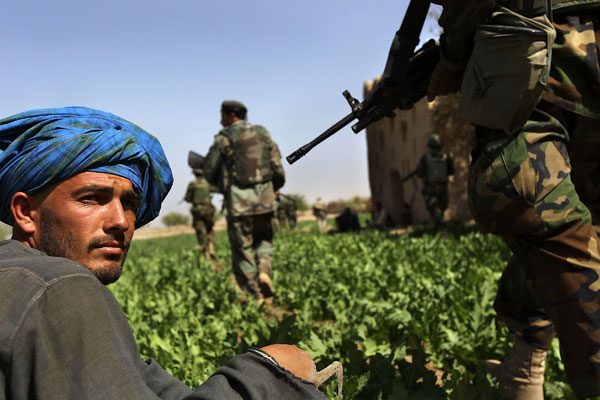
Calling Afghanistan what it is: A drug warAn opium poppy farmer watches as Afghan Army troops pass through his field shortly before a firefight broke out with Taliban insurgents on March 14, 2010, in Kandahar province, Afghanistan.

This article originally appeared at TomDispatch.com

In ways that have escaped most observers, the Obama administration is now trapped in an endless cycle of drugs and death in Afghanistan from which there is neither an easy end nor an obvious exit.

After a year of cautious debate and costly deployments, President Obama finally launched his new Afghan war strategy at 2:40 am on Feb. 13, 2010, in a remote market town called Marja in southern Afghanistan’s Helmand Province. As a wave of helicopters descended on Marja’s outskirts spitting up clouds of dust, hundreds of U.S. Marines dashed through fields sprouting opium poppies toward the town’s mud-walled compounds.

After a week of fighting, U.S. war commander Gen. Stanley A. McChrystal choppered into town with Afghanistan’s vice-president and Helmand’s provincial governor. Their mission: a media roll-out for the general’s new-look counterinsurgency strategy based on bringing government to remote villages just like Marja.

At a carefully staged meet-and-greet with some 200 villagers, however, the vice-president and provincial governor faced some unexpected, unscripted anger. “If they come with tractors,” one Afghan widow announced to a chorus of supportive shouts from her fellow farmers, “they will have to roll over me and kill me before they can kill my poppy.”

For these poppy growers and thousands more like them, the return of government control, however contested, brought with it a perilous threat: opium eradication.

Throughout all the shooting and shouting, American commanders seemed strangely unaware that Marja might qualify as the world’s heroin capital — with hundreds of laboratories, reputedly hidden inside the area’s mud-brick houses, regularly processing the local poppy crop into high-grade heroin. After all, the surrounding fields of Helmand Province produce a remarkable 40 percent of the world’s illicit opium supply, and much of this harvest has been traded in Marja. Rushing through those opium fields to attack the Taliban on Day One of this offensive, the Marines missed their real enemy, the ultimate force behind the Taliban insurgency, as they pursued just the latest crop of peasant guerrillas whose guns and wages are funded by those poppy plants. “You can’t win this war,” said one U.S. Embassy official just back from inspecting these opium districts, “without taking on drug production in Helmand Province.”

Indeed, as Air Force One headed for Kabul Sunday, National Security Adviser James L. Jones assured reporters that President Obama would try to persuade Afghan President Hamid Karzai to prioritize “battling corruption, taking the fight to the narco-traffickers.” The drug trade, he added, “provides a lot of the economic engine for the insurgents.”

Just as these Marja farmers spoiled Gen. McChrystal’s media event, so their crop has subverted every regime that has tried to rule Afghanistan for the past 30 years. During the CIA’s covert war in the 1980s, opium financed the mujahedeen or “freedom fighters” (as President Ronald Reagan called them) who finally forced the Soviets to abandon the country and then defeated its Marxist client state.

In the late 1990s, the Taliban, which had taken power in most of the country, lost any chance for international legitimacy by protecting and profiting from opium — and then, ironically, fell from power only months after reversing course and banning the crop. Since the U.S. military intervened in 2001, a rising tide of opium has corrupted the government in Kabul while empowering a resurgent Taliban whose guerrillas have taken control of ever larger parts of the Afghan countryside.

These three eras of almost constant warfare fueled a relentless rise in Afghanistan’s opium harvest — from just 250 tons in 1979 to 8,200 tons in 2007. For the past five years, the Afghan opium harvest has accounted for as much as 50 percent of the country’s gross domestic product (GDP) and provided the prime ingredient for over 90 percent of the world’s heroin supply.

The ecological devastation and societal dislocation from these three war-torn decades has woven opium so deeply into the Afghan grain that it defies solution by Washington’s best and brightest (as well as its most inept and least competent). Caroming between ignoring the opium crop and demanding its total eradication, the Bush administration dithered for seven years while heroin boomed, and in doing so helped create a drug economy that corrupted and crippled the government of its ally, President Karzai. In recent years, opium farming has supported 500,000 Afghan families, nearly 20 percent of the country’s estimated population, and funds a Taliban insurgency that has, since 2006, spread across the countryside.

To understand the Afghan War, one basic point must be grasped: In poor nations with weak state services, agriculture is the foundation for all politics, binding villagers to the government or warlords or rebels. The ultimate aim of counterinsurgency strategy is always to establish the state’s authority. When the economy is illicit and by definition beyond government control, this task becomes monumental. If the insurgents capture that illicit economy, as the Taliban have done, then the task becomes little short of insurmountable.

Opium is an illegal drug, but Afghanistan’s poppy crop is still grounded in networks of social trust that tie people together at each step in the chain of production. Crop loans are necessary for planting, labor exchange for harvesting, stability for marketing, and security for shipment. So dominant and problematic is the opium economy in Afghanistan today that a question Washington has avoided for the past nine years must be asked: Can anyone pacify a full-blown narco-state?

The answer to this critical question lies in the history of the three Afghan wars in which Washington has been involved over the past 30 years — the CIA covert warfare of the 1980s, the civil war of the 1990s (fueled at its start by $900 million in CIA funding), and since 2001, the U.S. invasion, occupation and counterinsurgency campaigns. In each of these conflicts, Washington has tolerated drug trafficking by its Afghan allies as the price of military success — a policy of benign neglect that has helped make Afghanistan today the world’s No. 1 narco-state.

CIA Covert Warfare, Spreading Poppy Fields, and Drug Labs: the 1980s

Opium first emerged as a key force in Afghan politics during the CIA covert war against the Soviets, the last in a series of secret operations that it conducted along the mountain rim-lands of Asia, which stretch for 5,000 miles from Turkey to Thailand. In the late 1940s, as the Cold War was revving up, the United States first mounted covert probes of communism’s Asian underbelly. For 40 years thereafter, the CIA fought a succession of secret wars along this mountain rim — in Burma during the 1950s, Laos in the 1960s, and Afghanistan in the 1980s. In one of history’s ironic accidents, the southern reach of communist China and the Soviet Union had coincided with Asia’s opium zone along this same mountain rim, drawing the CIA into ambiguous alliances with the region’s highland warlords.

Washington’s first Afghan war began in 1979, when the Soviet Union invaded the country to save a Marxist client regime in Kabul, the Afghan capital. Seeing an opportunity to wound its Cold War enemy, the Reagan administration worked closely with Pakistan’s military dictatorship in a 10-year CIA campaign to expel the Soviets.

This was, however, a covert operation unlike any other in the Cold War years. First, the collision of CIA secret operations and Soviet conventional warfare led to the devastation of Afghanistan’s fragile highland ecology, damaging its traditional agriculture beyond immediate recovery, and fostering a growing dependence on the international drug trade. Of equal import, instead of conducting this covert warfare on its own as it had in Laos in the Vietnam War years, the CIA outsourced much of the operation to Pakistan’s Inter-Service Intelligence (ISI), which soon became a powerful and ever more problematic ally.

When the ISI proposed its Afghan client, Gulbuddin Hekmatyar, as overall leader of the anti-Soviet resistance, Washington — with few alternatives — agreed. Over the next 10 years, the CIA supplied some $2 billion to Afghanistan’s mujahedeen through the ISI, half to Hekmatyar, a violent fundamentalist infamous for throwing acid at unveiled women at Kabul University and, later, murdering rival resistance leaders. As the CIA operation was winding down in May 1990, the Washington Post published a front-page article charging that its key ally, Hekmatyar, was operating a chain of heroin laboratories inside Pakistan under the protection of the ISI.

Although this area had zero heroin production in the mid-1970s, the CIA’s covert war served as the catalyst that transformed the Afghan-Pakistan borderlands into the world’s largest heroin producing region. As mujahedeen guerrillas captured prime agricultural areas inside Afghanistan in the early 1980s, they began collecting a revolutionary poppy tax from their peasant supporters.

Once the Afghan guerrillas brought the opium across the border, they sold it to hundreds of Pakistani heroin labs operating under the ISI’s protection. Between 1981 and 1990, Afghanistan’s opium production grew tenfold — from 250 tons to 2,000 tons. After just two years of covert CIA support for the Afghan guerrillas, the U.S. attorney general announced in 1981 that Pakistan was already the source of 60 percent of the American heroin supply. Across Europe and Russia, Afghan-Pakistani heroin soon captured an even larger share of local markets, while inside Pakistan itself the number of addicts soared from zero in 1979 to 1.2 million just five years later.

After investing $3 billion in Afghanistan’s destruction, Washington just walked away in 1992, leaving behind a thoroughly ravaged country with over 1 million dead, 5 million refugees, 10-20 million landmines still in place, an infrastructure in ruins, an economy in tatters, and well-armed tribal warlords prepared to fight among themselves for control of the capital. Even when Washington finally cut its covert CIA funding at the end of 1991, however, Pakistan’s ISI continued to back favored local warlords in pursuit of its long-term goal of installing a Pashtun client regime in Kabul.

Druglords, Dragon’s Teeth, and Civil Wars: the 1990s

Throughout the 1990s, ruthless local warlords mixed guns and opium in a lethal brew as part of a brutal struggle for power. It was almost as if the soil had been sown with those dragons’ teeth of ancient myth that can suddenly sprout into an army of full-grown warriors, who leap from the earth with swords drawn for war.

When northern resistance forces finally captured Kabul from the communist regime, which had outlasted the Soviet withdrawal by three years, Pakistan still backed its client Hekmatyar. He, in turn, unleashed his artillery on the besieged capital. The result: the deaths of an estimated 50,000 more Afghans. Even a slaughter of such monumental proportions, however, could not win power for this unpopular fundamentalist. So the ISI armed a new force, the Taliban and in September 1996, it succeeded in capturing Kabul, only to fight the Northern Alliance for the next five years in the valleys to the north of the capital.

During this seemingly unending civil war, rival factions leaned heavily on opium to finance the fighting, more than doubling the harvest to 4,600 tons by 1999. Throughout these two decades of warfare and a 20-fold jump in drug production, Afghanistan itself was slowly transformed from a diverse agricultural ecosystem — with herding, orchards, and over 60 food crops — into the world’s first economy dependent on the production of a single illicit drug. In the process, a fragile human ecology was brought to ruin in an unprecedented way.

Located at the northern edge of the annual monsoon rains, where clouds arrive from the Arabian Sea already squeezed dry, Afghanistan is an arid land. Its staple food crops have historically been sustained by irrigation systems that rely on snowmelt from the region’s high mountains. To supplement staples such as wheat, Afghan tribesmen herded vast flocks of sheep and goats hundreds of miles every year to summer pasture in the central uplands. Most important of all, farmers planted perennial tree crops — walnut, pistachio and mulberry — which thrived because they sink their roots deep into the soil and are remarkably resistant to the region’s periodic droughts, offering relief from the threat of famine in the dry years.

During these two decades of war, however, modern firepower devastated the herds, damaged snowmelt irrigation systems, and destroyed many of the orchards. While the Soviets simply blasted the landscape with firepower, the Taliban, with an unerring instinct for their society’s economic jugular, violated the unwritten rules of traditional Afghan warfare by cutting down the orchards on the vast Shamali plain north of Kabul.

All these strands of destruction knit themselves into a veritable Gordian knot of human suffering to which opium became the sole solution. Like Alexander’s legendary sword, it offered a straightforward way to cut through a complex conundrum. Without any aid to restock their herds, reseed their fields, or replant their orchards, Afghan farmers — including some 3 million returning refugees — found sustenance in opium, which had historically been but a small part of their agriculture.

Since poppy cultivation requires nine times more labor per hectare than wheat, opium offered immediate seasonal employment to more than a million Afghans — perhaps half of those actually employed at the time. In this ruined land and ravaged economy, opium merchants alone could accumulate capital rapidly and so give poppy farmers crop loans equivalent to more than half their annual incomes, credit critical to the survival of many poor villagers.

In marked contrast to the marginal yields the country’s harsh climate offers most food crops, Afghanistan proved ideal for opium. On average, each hectare of Afghan poppy land produces three to five times more than its chief competitor, Burma. Most important of all, in such an arid ecosystem, subject to periodic drought, opium uses less than half the water needed for staples such as wheat.

After taking power in 1996, the Taliban regime encouraged a nationwide expansion of opium cultivation, doubling production to 4,600 tons, then equivalent to 75 percent of the world’s heroin supply. Signaling its support for drug production, the Taliban regime began collecting a 20 percent tax from the yearly opium harvest, earning an estimated $100 million in revenues.

In retrospect, the regime’s most important innovation was undoubtedly the introduction of large-scale heroin refining in the environs of the city of Jalalabad. There, hundreds of crude labs set to work, paying only a modest production tax of $70 on every kilo of heroin powder. According to U.N. researchers, the Taliban also presided over bustling regional opium markets in Helmand and Nangarhar provinces, protecting some 240 top traders there.

During the 1990s, Afghanistan’s soaring opium harvest fueled an international smuggling trade that tied Central Asia, Russia and Europe into a vast illicit market of arms, drugs and money-laundering. It also helped fuel an eruption of ethnic insurgency across a 3,000-mile swath of land from Uzbekistan in Central Asia to Bosnia in the Balkans.

In July 2000, however, the Taliban leader Mullah Omar suddenly ordered a ban on all opium cultivation in a desperate bid for international recognition. Remarkably enough, almost overnight the Taliban regime used the ruthless repression for which it was infamous to slash the opium harvest by 94 percent to only 185 metric tons.

By then, however, Afghanistan had become dependent on poppy production for most of its taxes, export income, and employment. In effect, the Taliban’s ban was an act of economic suicide that brought an already weakened society to the brink of collapse. This was the unwitting weapon the U.S. wielded when it began its military campaign against the Taliban in October 2001. Without opium, the regime was already a hollow shell and essentially imploded at the bursting of the first American bombs.

The Return of the CIA, Opium, and Counterinsurgency: 2001-

To defeat the Taliban in the aftermath of 9/11, the CIA successfully mobilized former warlords long active in the heroin trade to seize towns and cities across eastern Afghanistan. In other words, the Agency and its local allies created ideal conditions for reversing the Taliban’s opium ban and reviving the drug traffic. Only weeks after the collapse of the Taliban, officials were reporting an outburst of poppy planting in the heroin heartlands of Helmand and Nangarhar. At a Tokyo international donors’ conference in January 2002, Hamid Karzai, the new prime minister put in place by the Bush administration, issued a pro forma ban on opium growing — without any means of enforcing it against the power of these resurgent local warlords.

After investing some $3 billion in Afghanistan’s destruction during the Cold War, Washington and its allies now proved parsimonious in the reconstruction funds they offered. At that 2002 Tokyo conference, international donors promised just $4 billion of an estimated $10 billion needed to rebuild the economy over the next five years. In addition, the total U.S. spending of $22 billion for Afghanistan from 2003 to 2007 turned out to be skewed sharply toward military operations, leaving, for instance, just $237 million for agriculture. (And as in Iraq, significant sums from what reconstruction funds were available simply went into the pockets of Western experts, private contractors, and their local counterparts.)

Under these circumstances, no one should have been surprised when, during the first year of the U.S. occupation, Afghanistan’s opium harvest surged to 3,400 tons. Over the next five years, international donors would contribute $8 billion to rebuild Afghanistan, while opium would infuse nearly twice that amount, $14 billion, directly into the rural economy without any deductions by either those Western experts or Kabul’s bloated bureaucracy.

While opium production continued its relentless rise, the Bush administration downplayed the problem, outsourcing narcotics control to Great Britain and police training to Germany. As the lead agency in Allied operations, Donald Rumsfeld’s Defense Department regarded opium as a distraction from its main mission of defeating the Taliban (and, of course, invading Iraq). Waving away the problem in late 2004, President Bush said he did not want to “waste another American life on a narco-state.” Meanwhile, in their counterinsurgency operations, U.S. forces worked closely with local warlords who proved to be leading druglords.

After five years of the U.S. occupation, Afghanistan’s drug production had swelled to unprecedented proportions. In August 2007, the U.N. reported that the country’s record opium crop covered almost 500,000 acres, an area larger than all the coca fields in Latin America. From a modest 185 tons at the start of American intervention in 2001, Afghanistan now produced 8,200 tons of opium, a remarkable 53 percent of the country’s GDP and 93 percent of global heroin supply.

In this way, Afghanistan became the world’s first true “narco-state.” If a cocaine traffic that provided just 3 percent of Colombia’s GDP could bring in its wake endless violence and powerful cartels capable of corrupting that country’s government, then we can only imagine the consequences of Afghanistan’s dependence on opium for more than 50 percent of its entire economy.

At a drug conference in Kabul this month, the head of Russia’s Federal Narcotics Service estimated the value of Afghanistan’s current opium crop at $65 billion. Only $500 million of that vast sum goes to Afghanistan’s farmers, $300 million to the Taliban guerrillas, and the $64 billion balance “to the drug mafia,” leaving ample funds to corrupt the Karzai government in a nation whose total GDP is only $10 billion.

Indeed, opium’s influence is so pervasive that many Afghan officials, from village leaders to Kabul’s police chief, the defense minister, and the president’s brother, have been tainted by the traffic. So cancerous and crippling is this corruption that, according to recent U.N. estimates, Afghans are forced to spend a stunning $2.5 billion in bribes. Not surprisingly, the government’s repeated attempts at opium eradication have been thoroughly compromised by what the U.N. has called “corrupt deals between field owners, village elders, and eradication teams.”

Not only have drug taxes funded an expanding guerrilla force, but the Taliban’s role in protecting opium farmers and the heroin merchants who rely on their crop gives them real control over the core of the country’s economy. In January 2009, the U.N. and anonymous U.S. “intelligence officials” estimated that drug traffic provided Taliban insurgents with $400 million a year. “Clearly,” commented Defense Secretary Robert Gates, “we have to go after the drug labs and the druglords that provide support to the Taliban and other insurgents.”

In mid-2009, the U.S. embassy launched a multi-agency effort, called the Afghan Threat Finance Cell, to cut Taliban drug monies through financial controls. But one American official soon compared this effort to “punching jello.” By August 2009, a frustrated Obama administration had ordered the U.S. military to “kill or capture” 50 Taliban-connected druglords who were placed on a classified “kill list.”

Since the record crop of 2007, opium production has, in fact, declined somewhat — to 6,900 tons last year (still over 90 percent of the world’s opium supply). While U.N. analysts attribute this 20 percent reduction largely to eradication efforts, a more likely cause has been the global glut of heroin that came with the Afghan opium boom, and which had depressed the price of poppies by 34 percent. In fact, even this reduced Afghan opium crop is still far above total world demand, which the U.N. estimates at 5,000 tons per annum.

Preliminary reports on the 2010 Afghan opium harvest, which starts next month, indicate that the drug problem is not going away. Some U.S. officials who have surveyed Helmand’s opium heartland see signs of an expanded crop. Even the U.N. drug experts who have predicted a continuing decline in production are not optimistic about long-term trends. Opium prices might decline for a few years, but the price of wheat and other staple crops is dropping even faster, leaving poppies as by far the most profitable crop for poor Afghan farmers.

Ending the Cycle of Drugs and Death

With its forces now planted in the dragon’s teeth soil of Afghanistan, Washington is locked into what looks to be an unending cycle of drugs and death. Every spring in those rugged mountains, the snows melt, the opium seeds sprout, and a fresh crop of Taliban fighters takes to the field, many to die by lethal American fire. And the next year, the snows melt again, fresh poppy shoots break through the soil, and a new crop of teenage Taliban fighters pick up arms against America, spilling more blood. This cycle has been repeated for the past ten years and, unless something changes, can continue indefinitely.

Is there any alternative? Even were the cost of rebuilding Afghanistan’s rural economy — with its orchards, flocks, and food crops — as high as $30 billion or, for that matter, $90 billion dollars, the money is at hand. By conservative estimates, the cost of President Obama’s ongoing surge of 30,000 troops alone is $30 billion a year. So just bringing those 30,000 troops home would create ample funds to begin the rebuilding of rural life in Afghanistan, making it possible for young farmers to begin feeding their families without joining the Taliban’s army.

Short of another precipitous withdrawal akin to 1991, Washington has no realistic alternative to the costly, long-term reconstruction of Afghanistan’s agriculture. Beneath the gaze of an allied force that now numbers about 120,000 soldiers, opium has fueled the Taliban’s growth into an omnipresent shadow government and an effective guerrilla army. The idea that our expanded military presence might soon succeed in driving back that force and handing over pacification to the illiterate, drug-addicted Afghan police and army remains, for the time being, a fantasy. Quick fixes like paying poppy farmers not to plant, something British and Americans have both tried, can backfire and end up actually promoting yet more opium cultivation. Rapid drug eradication without alternative employment, something the private contractor DynCorp tried so disastrously under a $150 million contract in 2005, would simply plunge Afghanistan into more misery, stoking mass anger and destabilizing the Kabul government further.

So the choice is clear enough: we can continue to fertilize this deadly soil with yet more blood in a brutal war with an uncertain outcome — for both the United States and the people of Afghanistan. Or we can begin to withdraw American forces while helping renew this ancient, arid land by replanting its orchards, replenishing its flocks, and rebuilding the irrigation systems ruined in decades of war.

At this point, our only realistic choice is this sort of serious rural development — that is, reconstructing the Afghan countryside through countless small-scale projects until food crops become a viable alternative to opium. To put it simply, so simply that even Washington might understand, you can only pacify a narco-state when it is no longer a narco-state.

Continue Reading Close