Alia Malek

When did we become like Syria?

As I watched a surreal torture case unfold in a U.S. courtroom, the line between dictatorship and democracy seemed to disappear.

  • more
    • All Share Services

When did we become like Syria?

When visiting my grandmother’s house in Damascus a few years ago, I never could have imagined sitting one day in a U.S. court, listening to the U.S. government defend its covert transfer of a Canadian citizen to Syria to be tortured.

Yet, that’s precisely what happened last Friday in a U.S. circuit court in New York, with the beginning of Maher Arar’s appeal of a decision last year by a district court to throw out his suit against the U.S. government. Arar’s case was the first to challenge in court the Bush administration’s use of rendition — the process of secretly handing over people to other countries where torture is used during interrogations.

Arar’s story is chilling. A Syrian-born Canadian citizen and high-tech worker, Arar was detained in 2002 at JFK Airport while he was on his way back to Canada after a vacation. He was questioned about alleged links to al-Qaida. He was denied access to counsel and access to a court. Twelve days later he was sent in chains and shackles to Syria. There he was tortured for nearly a year and coerced into making a false confession, before being released after the tireless campaigning of his wife.

Under pressure from Canadian human rights organizations and citizens, Canada announced a commission of inquiry into Arar’s case, which cleared Arar of all terrorism allegations. Now Arar seeks damages from the U.S. government for its role.

The story is already disturbing, surreal, Kafkaesque. It also left me with this realization: The sharp line I had drawn as a child — between what could happen to a person under a dictatorship like Syria’s and what could never happen to a person under a constitutional democracy like that of the U.S. — seemed to be disappearing.

It was this contrast that had defined me as a Syrian- American. Not merely because it meant I had a passport my relatives in Syria could only covet, but also because I was confident that I had rights. I believed that meant I would never disappear off the street into oblivion — with no access to a lawyer or judge, and without anyone even being able to know my whereabouts, let alone help me.

I don’t know if I’d ever have understood what it means to have rights as early as I did, had I not spent time in Syria. The reality of the police state follows you everywhere there, and even as a child I was aware of it. Like Mona Lisa’s eyes, those of former Syrian President Hafez al-Assad were always upon us, his portrait everywhere we went. He would glare from the dashboards and windshields of taxis, where the drivers — notorious informants — had cut his photograph into the shape of a heart, often in triplicate. He was looming from public buildings that had the same portrait blown up to billboard size. We drove around traffic circles, anchored by larger-than-life statues of the Syrian leader. Like a license to operate, his picture was also displayed in shops, restaurants, hair salons, bus stations and private offices.

Even when his picture was nowhere to be found, fear of al-Assad was in the eyes of my relatives who would entreat me with a look not to talk politics, not to make jokes about al-Assad, not to even ask why I couldn’t ask why. They would signal with a flit of their eyes, to corners of the room, who was listening, who would inform.

In a quieter moment someone would explain to me about the infamous prison in the desert, and what would happen if someone were perceived to be a threat to the regime.

As much as I loved Syria’s history, art, archaeology, food, shopping and sightseeing, and Syrians’ kindness and hospitality, I was grateful not to have been nursed on that fear. It pulsed through the veins of many I met. I was grateful not to have to bear such an infuriating reality every day.

Many years later, after I had become a lawyer, I accompanied my uncle, a lawyer in Syria, to file papers in court one day. The courthouse, once a glorious building, now had its white Ottoman facade tarnished by pollution. Men hocked their reading and writing services to illiterate villagers who were clutching papers containing orders they could not understand. Inside, the building was dirty, dark, crowded and smoky. My uncle pushed his way through the throng, smashing his papers onto the glass partition behind which a clerk sat.

When I asked him his chances in the case, he explained the facts and the law. But he confided that the opponent had ” wasta,” or connections, to the regime. I was amazed with his determination, but relieved to be an American lawyer, thinking again of that clear line that separated the rule of law in the U.S. from the cheapening of it in Syria.

So as I sat in the New York courtroom on Friday, a room with a rich mahogany interior, I was perplexed and saddened. Being Syrian-American, I had always borne the stigma and burden of the strained relationship between the U.S. and Syria, of having grandparents and roots (very proud roots) from an “evil” country. Now, Syria and the U.S. were in cahoots, finally getting along — at least when it came to torture.

Arar’s counsel argued that although the torture may have happened in Syria, the conspiracy by U.S. officials that allowed it to happen occurred here. Their actions, counsel argued, violated U.S. laws and the Constitution.

Counsel for the U.S. government, former Attorney General John Ashcroft and other government officials tried to emphasize the limited reach of the Constitution. Ashcroft’s attorney told the court that only U.S. law, not “grandiose notions of morality,” should apply. And when this same lawyer spoke of Arar’s “unequivocal membership in al-Qaida,” a charge that has not been proven in court by evidence, there was a collective gasp in the standing-room-only courtroom.

That expression of outrage roused me from my sense of depression. The courtroom was packed, and not only with uppity Arab and Muslim Americans, the kind of people our society seems comfortable denying the full protections of our laws and ideals. There were also gray-haired women reading the Wall Street Journal, preppy law students talking about the Center for Constitutional Rights’ lawyers as if they were rock stars, and suit-wearing men and women shaking their heads at the government’s arguments. All these people had taken time out of their lives to condemn torture, albeit without having to risk their lives to do so.

There it was again, the line that separated the rule of law from the lack of it, however thin and tenuous it now seemed. For the Syrian people’s sake, I wish that line did not exist at all. For Americans’ sake, I wish more cared, like those who were in the courtroom. For Maher Arar, I wish I could erase the ordeal he went through, though none of us can. But his case should be allowed to proceed, as much for his sake as for the sake of our democratic system.

Bush civil rights nominee under fire

A White House plan to install a DOJ official with a lousy reputation on workers' rights to the powerful EEOC falters as Barack Obama and former DOJ employees protest.

  • more
    • All Share Services

Bush civil rights nominee under fire

A deal that would see David Palmer, a Bush administration nominee, quietly confirmed to the powerful Equal Employment Opportunity Commission appears to be faltering. Momentum against Palmer’s confirmation has been building since former Department of Justice employees took the unprecedented step of formally accusing him of having an abysmal professional and personal record on workplace discrimination issues.

And Thursday, in a letter to Sen. Ted Kennedy, Sen. Barack Obama joined the chorus of those calling for an investigation into Palmer’s fitness to serve on the EEOC, the agency tasked with protecting employees from discrimination based on race, gender and religion under the Title VII of the Civil Rights Act of 1964.

Kennedy, chair of the Health, Education, Labor and Pensions (HELP) Committee, on which Obama and Sens. Hillary Clinton and Christopher Dodd also sit, is under pressure to investigate the charges against Palmer rather than accept a deal from the White House that would guarantee the renomination of respected Democratic commissioner Stuart J. Ishimaru to the EEOC in exchange for Palmer’s confirmation.

Although opposition to Palmer has been growing, some civil rights groups have kept conspicuously quiet about Palmer’s record, fearing the loss of Ishimaru, whose term expired earlier this month. The White House has declared its intention to renominate Ishimaru once Palmer is confirmed. In the event that Palmer isn’t confirmed, however, the White House has said it would put Palmer on the commission via a recess appointment.

The EEOC is overseen by a commission made up of five members who serve staggered five-year terms; they set equal employment opportunity policy and direct the agency’s litigation. No more than three commissioners can be from the same political party.

Kennedy is not expected to decide on whether to challenge Palmer’s nomination until Palmer provides the HELP committee with written answers to questions regarding the allegations against him. His responses were scheduled to arrive Friday and are now expected on Monday.

At issue is Palmer’s tenure at the Employee Litigation Section of the DOJ’s Civil Rights Division — the agency that enforces Title VII in state and local government workplaces. According to a three-page letter opposing Palmer’s nomination signed by Palmer’s former supervisors, colleagues and subordinates at the DOJ, the section has brought significantly fewer discrimination cases under his leadership than the prior administration and has ignored its historical mission.

The letter states that Palmer lacks a “commitment to the fair, yet vigorous, enforcement of anti-discrimination in employment statutes; the expertise to enforce those laws; and the exercise of reasoned and sound judgment.”

The letter alleges that while Palmer worked in the section as a senior trial attorney, before the Bush administration rapidly promoted him to section chief, “he did not understand the basic principles of Title VII and constitutional law.” Palmer was also reprimanded for his work performance at this time. According to a supervisor familiar with the reprimand, Palmer had failed to respond to an opposing counsel’s discovery requests, and sanctions had been threatened.

Most disturbingly, the letter claims that at least one internal complaint of discrimination or other improper activity has been filed against Palmer during his tenure as section chief; Salon has learned that the complaint arose after Palmer allegedly tried to have a woman with whom he had been romantically involved removed from federal service. In testimony Palmer has already given to the HELP committee, he himself indicated the existence of a second complaint, the details of which remain unknown.

According to the former deputy section chief, Richard Ugelow, who worked in the section from 1973 to 2002, prior to Palmer no manager in the history of the agency charged with investigating claims of employment discrimination has ever been charged with engaging in discrimination himself.

The letter also accuses Palmer of the sorts of behaviors that have been widely reported across the Civil Rights Division in the Bush administration: acting with partisan motives, treating subordinates with contempt, and overseeing a mass departure of managers, line attorneys and other professional staff.

Under Palmer, the Employment Litigation Section has filed fewer cases that fulfill its core mission, namely securing the rights of vulnerable protected groups. Conversely, under his tenure the section filed two reverse-discrimination lawsuits and focused on defending the rights of employers to discriminate based on religion.

During this time the Department of Justice also filed an amicus brief in a Supreme Court case that repudiated the EEOC’s position that each paycheck that pays a woman less than a similarly situated man because she is a woman is an act of discrimination that violates Title VII. In a narrow 5-4 ruling, the court sided with the department; in a dissent, Justice Ruth Ginsburg argued that such an interpretation ignores Title VII’s core purposes and ignores workplace reality.

And last year the DOJ filed an amicus brief in a case with the Supreme Court that undermined a well-established EEOC position that bars retaliation against those individuals who have asserted their Title VII rights in reporting discrimination, filing a complaint, participating in an investigation, or testifying at a proceeding. In that ruling, eight Justices ultimately rejected the department’s argument as inconsistent with both the plain language of Title VII and its underlying purposes.

ACLU legislative counsel Christopher Anders points out that although the Senate HELP committee has known about the politicization of the Civil Rights Division, the revelations about Palmer’s involvement in the division’s actions as well as the allegations that he might himself have been involved in discriminatory practices are causing some members to take a closer look at him.

Anders sees some parallels between Palmer and another former EEOC commissioner and chair — Clarence Thomas. In Thomas’ case, however, Anders says it was only long after Thomas left the EEOC that the nation learned of Thomas’ personal misconduct. (The White House has indicated that once Palmer is confirmed to the EEOC, it intends to make him the new chair.)

“The difference now,” says Anders, “is we know, senators know, civil rights groups know all these things at the nomination stage.”

Regarding the alternative of losing Ishimaru if Palmer is not confirmed — and noting that the White House will place Palmer on the commission with a recess appointment anyway — Anders says: “Anyone who receives a recess appointment after a controversy holds that position for a shorter position of time and without the moral authority of a Senate confirmation. So Palmer would serve his term at the EEOC as damaged goods, and Kennedy could use other means to see [Ishimaru] renominated.”

Continue Reading Close

Bush’s long history of politicizing justice

It's not only the U.S. attorneys who are threatened by partisan politics. Since Day One, the Bush administration has been quietly dismantling the DOJ's Civil Rights Division.

  • more
    • All Share Services

Bush's long history of politicizing justice

The current U.S. attorneys scandal shows that the Bush administration was mistaken in its belief that it could politicize the nation’s top federal law enforcement agency, the Department of Justice, with impunity. The attorney general‘s chief of staff and the director of the Executive Office of U.S. Attorneys have both had to leave their jobs, and Congress has begun grilling DOJ leadership. But having decimated another entire sector of the DOJ in plain sight for six years with little consequence, is it any wonder the Bush White House figured nobody would miss a few prosecutors?

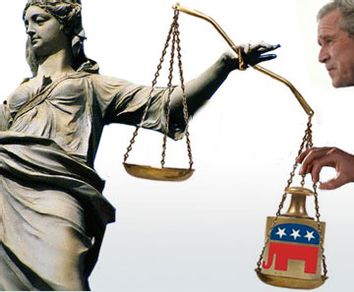
Since George Bush took office, his administration has been not so quietly dismantling the DOJ’s Civil Rights Division, which is responsible for enforcing the nation’s civil rights laws, and doing it for the same reason the eight federal prosecutors were fired: to use the enforcement power of the federal government for Republican gain. Instead of attending to the Civil Rights Division’s historic mission, addressing the legacy of slavery by enforcing anti-discrimination laws, the Bush administration has employed the division to advance the political agenda of a key GOP constituency, the Christian right and also, quite literally, to get Republicans elected.

Accomplishing these goals required a drastic change in personnel, which necessitated dismantling the hiring system, forcing out or silencing career (nonpolitical) staff, and replacing them with people without civil rights expertise but with demonstrated ideological and partisan loyalties. It was a project that took years to execute because several checks on such a scenario had long been in place, checks that earlier administrations of both parties had respected.

As it was happening, current and former employees tried to alert the outside world, with little success. But with the spotlight on the department and its attorney general, momentum may finally be building. Last week, a House Judiciary subcommittee held oversight hearings on the Civil Rights Division, and witnesses testified to the changes the Bush administration had effected there.

A principal witness at Thursday’s hearings was Joe Rich, a 37-year veteran of the division and former chief of the Voting Rights Section, who left in 2005. In his testimony, Rich charged that under the Bush administration, “the essential work of the division to protect the civil rights of all Americans is not getting done.” He also said that the connection between the current prosecutors scandal and what happened to the division should not be minimized, telling senators, “The political decision-making process that led to the questionable dismissal of eight United States attorneys was standard practice in the Civil Rights Division years before these recent revelations.”

The Civil Rights Division was established in 1957 by an act of Congress, with the mandate to enforce the nation’s few federal civil rights statutes. With the passage of the 1964 Civil Rights Act and 1965 Voting Rights Act, the division suddenly had a lot more work to do. Since 1957 and before the election of George W. Bush, there had been four Democratic and four Republican presidential administrations (counting Nixon-Ford as one).

The division is composed of 11 “sections,” eight of which do litigation: Housing and Civil Enforcement, Employment, Education, Disability, Special Litigation, Criminal, Appellate and Voting Rights. The division’s 700 employees, half of them lawyers, are spread out across several buildings in Washington. Long gone are the days when the whole Department of Justice and the FBI could fit into the art deco building on Pennsylvania Avenue known as Main Justice.

The leadership of the division — known as the Front Office — has always been appointed by the president. Most of those appointees have not been experts in civil rights law, says Brian K. Landsberg, a former division section chief and the author of “Enforcing Civil Rights: Race Discrimination and the Department of Justice.” That lack of expertise was compensated for by the core of the division, its career attorneys who have the sophisticated understanding of the law that civil rights enforcement requires, says Landsberg, now a law professor at the University of the Pacific. “Even if the political appointees did have that expertise, there aren’t enough of them to do the background work.” In addition to career attorneys providing the political appointees the expertise they might lack, the dialogue, partnership and mutual respect between the two have been credited with keeping the division above the partisan fray.

The Bush administration’s actions over the past six years seem almost prima facie evidence that it does view civil rights enforcement — which had traditionally been on behalf of African-Americans, women and other racial, ethnic and religious minorities — as a partisan matter. In perhaps a case of projection, it seems to have also expected career people to abuse their power on behalf of partisan goals.

Thus the administration sought to recast the division in its own image, by minimizing outside input, getting rid of career people and hiring loyal Bushies. Simply choosing John Ashcroft, a religious fundamentalist and political conservative, as the attorney general immediately indicated that Bush’s promises to heal and unite the nation after the 2000 election did not translate into Cabinet choices that would reflect the divided political mood of the country.

In an e-mail to his 125,000 employees on his first day on the job, Ashcroft promised to guarantee “rights for the advancement of all Americans.” But actions were soon speaking louder than words. Regular meetings of the division’s section chiefs and the political leadership were virtually discontinued. In a tradition dating to the 1950s, presidents have asked an American Bar Association committee to provide a confidential rating of the qualifications of judicial candidates before the nominations are sent to the Senate for confirmation. Ashcroft and then White House counsel Alberto Gonzales met with the ABA and then terminated the ABA’s advisory role. Once Ashcroft began hiring his own choices, career attorneys noticed that many of the new hires were members of the Federalist Society, a conservative legal group. Ashcroft himself was called an active supporter of the Federalist Society, and several of the top legal positions throughout the administration were all held by Federalist Society members.

Then, much the way some companies go green, DOJ under Ashcroft went Pentecostal. In correspondence, use of the word “pride” was forbidden because the Bible calls pride a sin; employees were also asked to never use the phrase “no higher calling than public service.” Ashcroft instituted prayer meetings, leading a Bible study at 8 a.m. sharp each day, some days even in his office, on others in a conference room at Main Justice. All department employees, regardless of their religious affiliation, were invited to attend, but in reality few did.

Against this backdrop, in the fall of 2001, the first real showdown between the Front Office and the division as a whole took place, over a little-known lawsuit against the Southeastern Pennsylvania Transportation Authority, which runs metropolitan Philadelphia’s mass transit system. For four years the division’s Employment Litigation Section had been pursuing charges that SEPTA’s hiring practices discriminated again women applicants by requiring results on a physical performance test that the division argued had little relevance to what was required by the job. Without talking to anyone involved with the case, the Front Office jettisoned it, citing a need to divert resources to the war on terrorism.

Though the Employment Section voiced objections, it carried out orders and withdrew from the case. But in what came to be seen as retaliation for voicing that dissent, the Front Office stripped the section chief, her deputy and the lead counsel of their duties and exiled them to a newly created task force in the Civil Division with no real responsibilities. The retaliation was so unprecedented that the other section chiefs, out of fear, stopped their informal monthly meetings, which they had long used to keep the components of the far-flung division connected.

In the past, disagreement between career attorneys and the Front Office, whether under a Democratic or Republican administration, was not unexpected. Dialogue between the permanent staff and the political appointees served as a check and balance between the political goals of any one administration and a goal that was not regarded as political — the enforcement of federal civil rights laws. By the end of 2001, it was clear that the old give-and-take between the staffers and their politically appointed bosses was now viewed as unforgivable insubordination.

Career staffers began to leave. As their ranks thinned, and as the survivors were effectively neutralized, the Bush administration, in its effort to minimize any resistance to its agenda for the DOJ, sought to replenish the division with loyal hires.

Hiring decisions had always been subject to political staff’s approval, but the judgment of the career core of the division had historically been trusted. The Front Office stopped consulting the careerists. Résumés had once flowed up from the sections to the Front Office; now the flow was reversed. The divisions, starting under Ashcroft and continuing under Alberto Gonzales, were told whom they could hire and whom they could promote.

The numbers show what has happened to the division’s staff since 2001. A Freedom of Information Act request in the summer of 2006 by the Boston Globe for the résumés of successful applicants since 2003 also showed that among the new hires were people who had worked for prominent conservatives, belonged to the Republican National Lawyers Association, had volunteered for the Bush-Cheney campaigns, and had limited civil rights experience. The résumés showed that only 42 percent of lawyers hired since 2003 have civil rights experience, compared to 77 percent in the two years prior, when career attorneys were primarily responsible for hiring. Almost half of those new hires with “civil rights experience” had gained it by either defending employers against discrimination suits or by fighting against affirmative action policies.

Career lawyers say the new hires are increasingly white males with Federalist Society or Christian Legal Society credentials, even though many of them are shocked to find themselves in the Civil Rights Division. Richard Ugelow, a former employment deputy chief who now teaches at American University, says his students who ranked other divisions in the Department of Justice as their preferred choices for placement found themselves called to interview in the Civil Rights Division. One thing about those students’ résumés stood out: They were members of the Federalist Society.

What was this newly conservative incarnation of the Civil Rights Division being asked to do? From the beginning, part of the Bush administration’s purpose was advancing the Christian right’s agenda, and one element of that agenda was the erosion of the wall between church and state. At the same time, in a five-year period beginning in 2001, the division brought no voting cases on behalf of African-Americans and only one employment case on behalf of African-Americans.

John Ashcroft, devout son of a Pentecostal minister, became infamous for demanding modesty of a statue in the Main Justice building. The attorney general spent $8,000 in taxpayers’ money on a dark velvet curtain to completely hide the naked marble breasts of the “Spirit of Justice.” (After 9/11, the DOJ staff also received copies of the lyrics to a jingoistic song that Ashcroft had penned himself, “Let the Eagle Soar.” He asked staff to sing it at the beginning of the work day at his prayer meetings.)

But less overtly, the administration was harnessing the power of the division’s Appellate Section on behalf of certain religious groups, under a doctrine developed by the Front Office called “Viewpoint Discrimination.” One career attorney in the section, speaking anonymously, describes the doctrine as intended to “defend the rights of Christian Evangelicals to proselytize in public forums, like school.”

A former deputy section chief, also speaking on condition of anonymity, says that the administration has a very specific litigation strategy, and that is to “try to lower the wall of separation between church and state.” The former deputy section chief says, “These aren’t discrimination cases. These are free speech cases, at the end of day. They want to be able to wear T-shirts with religious messages and hand out fliers about church meetings at schools.” Under the Bush administration, the DOJ was suddenly suggesting a moral equivalence between protecting minorities from discrimination and enabling nonminorities to proselytize in public forums.

Meanwhile career lawyers in Appellate were blocked from working on civil rights cases. Instead, attorneys were given dockets with deportation orders of illegal immigrants to occupy their time. When they did write a civil rights brief, they were told to weaken their arguments by citing the opinions of conservative judges, even when those opinions were dissenting opinions, and by ignoring authoritative Supreme Court precedents.

“Instead of legal briefs,” says one current employee, “they want to file policy papers.”

Promoting the Christian agenda was meant to help the GOP at the ballot box. Often, however, the division was used to help Republicans win elections more directly. It was in the Voting Rights Section, which Joe Rich had headed from 1999 to 2005, that the Bush administration clearly saw a valuable tool for partisan gain. In his testimony last week, Rich charged that “the priority, indeed obsession, of this administration was not to protect the rights of American voters but with … politically charged pursuit[s].”

After each census, voting districts are redrawn to account for population changes. In the case of states with a history of voter discrimination, those states must submit their redistricting plans to the Voting Rights Section of the division, as per Section 5 of the Voting Rights Act. Given the nation’s history of racial discrimination at the ballot box, the question the section must consider in deciding whether to “pre-clear” any plan is, will this harm black voters?

First in Mississippi and then in Texas, the Front Office facilitated or directly approved redistricting plans that created net gains for GOP candidates, patently disregarding the recommendations of the analysts and lawyers of the Voting Rights Section. Though in both instances they counseled the Front Office that the law required the opposite actions, they carried out the Front Office’s orders.

Then, after Rich’s departure from the division, and under new Attorney General Alberto Gonzales, the section’s power was again used to the advantage of Republicans. A new law in Georgia required voters to present a government-issued picture ID in order to vote at the polls on Election Day. Staff had prepared a detailed and comprehensive memo analyzing the information provided by the state and other interested parties, and had concluded that the change would have a discriminatory effect on minority voters — they recommended that the law not be pre-cleared. The next day, the Front Office ordered pre-clearance of the Georgia law. After that case, the Front Office barred the Voting Rights Section’s staff attorneys from offering any recommendations on any cases.

Later it was exposed that a political hire in the Voting Rights Section, Hans von Spakovsky, who played a central role in approving the controversial Georgia voter identification program and who had been in charge of setting the section’s substantive priorities, had anonymously authored a law review article that endorsed the kind of system Georgia sought to enact. His attempts to hide his views may turn out to have violated Justice Department guidelines. Von Spakovsky left the division for the Federal Election Commission as a recess appointment. Similarly, the person who had been named as the senior counsel for voting rights in the section was a defeated Republican candidate for Congress.

In the past two years, as reporters for both Salon and the Washington bureau of McClatchy Newspapers have noted, the DOJ has dispatched ideologues from the Civil Rights Division to become U.S. attorneys. Alex Acosta, the current U.S. attorney for the Southern District of Miami, left the Civil Rights Division after serving as its assistant attorney general. Another former political appointee in the office of the assistant attorney general for civil rights, Matt Dummermuth, was nominated to be U.S. attorney in Cedar Rapids, Iowa, last December.

Most notably, Gonzales, as attorney general, appointed Brad Schlozman, former principal deputy assistant attorney general for civil rights, as interim U.S. attorney for the Western District of Missouri late in 2006. While deputy head of the Civil Rights Division, Schlozman had overseen the redistricting of Texas and Mississippi. He had also personally reversed the career staff’s recommendation that the Georgia voter ID law be challenged. In fact, he had penned an opinion piece for the Atlanta Journal Constitution supporting the law.

As U.S. attorney in Missouri last fall, Schlozman brought voter fraud indictments a week before the midterm elections against four individuals associated with a group registering poor and minority voters in Kansas City. Such timing contradicted Justice’s policy, Joe Rich told Salon in an interview, of waiting till after an election to bring indictments, lest an investigation unnecessarily affect the outcome of the vote. It was perhaps not irrelevant, though, that Nov. 7, 2006, promised to be hard on Republicans, and that the Republican senator, Jim Talent, was in a close race, and that Kansas City was full of Democratic voters.

Talent lost his seat to Democrat Claire McCaskill on Nov. 7, and the Democrats took control of the House and the Senate. Not long thereafter, the Bush administration finally lost its free pass to politicize the U.S. attorneys, the Civil Rights Division and the rest of the Department of Justice. The decision to fire eight federal prosecutors, most of them highly rated for their performance, attracted the attention of the new Congress. Six years into the Bush era, investigations have, at last, ensued.

History books will likely not be kind to the Bush administration. The consequences of the administration’s actions, however, extend far beyond the fate of any one elected official.

Optimists believe that once this administration’s term comes to an end in 2008, the division may once again be able to enforce the nation’s civil rights laws without regard to partisan motives. Others, like Joe Rich, are more pessimistic. “They can try to put Humpty-Dumpty back together again,” Rich told Salon, “but you’ve lost career people with the institutional memory to do that.” In his testimony on Capitol Hill, Rich asserted that only “vigilant oversight” would restore the Civil Rights Division and the Department of Justice to their historic role of leading the enforcement of civil rights and protection of equal justice under the law.

Similarly, if the Bush administration is not penalized by the voters or their elected representatives for treating the Department of Justice as a political tool, there is nothing to stop successive administrations — whether Republican or Democrat — from doing the same when it’s their turn in power.

Continue Reading Close

How Lebanon rescued me

I fled America for Beirut's cultural freedom. Now I watch as bombs destroy my refuge -- and the best hope for a viable Middle East democracy.

  • more
    • All Share Services

How Lebanon rescued me

In March 2003, I fled to Beirut, Lebanon, wanting to escape the made-for-TV war on Iraq, the monotony of Washington, and the man who had become my boss, John Ashcroft.

Naturally, in this era of pretexts, the convergence of those events was itself also just an excuse. Even if my job as a trial attorney in the Civil Rights Division at the Justice Department had not been increasingly meaningless under the Bush administration, I would have been fantasizing about returning to Beirut, as I had ever since it seduced me in the summer of 2000, when I first visited it as an adult.

So it was with irony, sadness, disbelief and anger that I watched thousands flee last month from Lebanon.

Of course, this is where we — in the collective American consciousness — had last left off in Beirut: a steady stream of wailing mothers clutching children under the watchful eyes of soldiers, menacing helicopters and merciful warships, as if Lebanon has been in perpetual evacuation since the 1970s.

The intermediary post-civil-war years were only occasionally memorialized and then often in publications and by writers desiring to be so hip as to discover what everyone else in the Middle East already knew: The former war zone was one movable party.

These writers, usually white men, were in constant awe that Lebanon’s women were beautiful and wore bikinis, that the liquor always flowed, and that the nightlife rivaled — according to the usual comparisons — that of South Beach or New York City. The bullet-pockmarked façades of several buildings lent gravitas to their writing and reporting on, essentially, hedonism.

Admittedly, Beirut’s famed partying had in part beckoned me to Lebanon; it provided a comfortable buffer to living in a part of the world incredibly fragile and scarred while affording me the chance to probe the nagging questions of what my life might have been had my parents stayed in the Middle East and whether its chaos was better for me than the United States’ contradictory offerings of comfortable assimilation and interminable alienation.

But I was also drawn by the intoxicating blend of antiquity, modernity, freedom and struggle with a history and culture that I could partly claim as my own. Though my parents are Syrian, my father’s roots were in Lebanon’s Bekaa Valley, and I had, coincidentally, been conceived in Beirut. While my parents had swallowed their regrets when they gave up family, friends and lives to try to make it in America, their nostalgia and longing were evident everywhere, from the Arabic names they gave their children to the Arabic cassette tapes they listened to, over and over, for years. And their cravings became my own.

So when straight from the airport I arrived outside the apartment building I would eventually call home, to find a crowd surrounding a minibus that had crashed into a popular snack shack — its tail end emerging almost organically from the concrete wall — there was no place else I wanted to be.

The driver had lost control of his vehicle, and it slid down the hill, gaining speed and smashing into the unmovable edifice, in much the same way that history slams into Lebanon, the way the sea has been pummeling its coastline for millennia, forming its geographic character, and the way I hoped that, in Beirut, my missing destiny would crash into me.

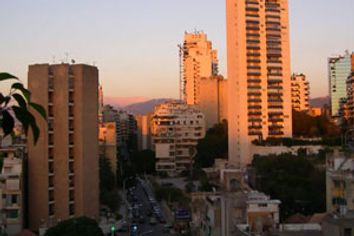
The room that I had come to see, perched on the eighth floor of a seven-story building, had clearly been an afterthought, one the elevator did not even reach. But it was nevertheless a profound postscript, a room that contemplated with a wall of windows Lebanon’s majestic geography, from the snow-capped tips of its mountains to the breaking waves of the Mediterranean to the sensual coastline that seemed to curve its way to infinity. The view also bore witness to the humanity that had saddled but not tamed Lebanon with an erratic pattern of buildings — urban planning was a casualty of war — echoed in the flickering lights of the surrounding hills.

The Lebanese woman who lived in the apartment’s other room and who would become one of my closest friends — a psychologist I could open up to in French, English and Arabic — won me over with her unruly golden curls that reminded me of Sarah Jessica Parker. When I asked her if she knew of the actress, she grinned, saying that “Sex and the City” was her favorite show.

The only thing I failed to notice at that dark hour was the minaret directly across the narrow street with its speakers pointed precisely in the direction of my windows and the mosque’s adjoining school, silent and barren of children at night. I would learn of both — the former at 4 a.m., when an off-tune imam called the faithful to prayer, and the latter just three hours later, when a school bell summoned its squawking flock.

My neighbor, a director of music videos who had a closetful of loose white-collared shirts he wore untucked over his jeans to complement his carefully cultivated tousle of hair, doled out history to me from his balcony, in between his flirtations. Overlooking the Green Line that had separated “Muslim” west Beirut from “Christian” east Beirut during the civil war, he explained to me that growing up, on some level, he had liked the war. It was what he saw in American TV shows and movies come to life. Though war had become his generation’s normalcy, school closings were still a happy occurrence, leaving them free to play, even if they were underground in dark bunkers.

Then one day, after a lifetime in war, he suddenly decided he wanted it to stop. He was sick of it. And almost as suddenly, the war was over. Others of our generation (now in their 30s) told me similar stories. Violence, terror, insecurity — from years of proxy wars, civil war and foreign invasion — are things the Lebanese can surmount. They’re just sick of having to do so.

Below our adjoining balconies, a quick twisting navigation of sloping one-way streets and dead ends gave way to Rue Monot, which lends its name to the area of nightlife so often celebrated by Western writers, perhaps because it is so much more accessible than the neighborhoods of abject and unsexy poverty. I frequently descended on Monot myself, stopping to tuck behind my ear a jasmine bloom from the abundant trellises cradling branches that would graze my head, even my shoulders, as I walked the narrow sidewalks, dodging parked scooters, cars and sun-ripened fruit so heavy it had marked the pavement with a splat.

Those articles often captured the thumping music, the oozing sexuality and the girls dancing on tabletops. But as I partook of Beirut’s nightlife, I realized the partying was not just like the atmosphere in South Beach or New York City. In that frantic pace were hints of trauma. There was something hysterical about it, an infectious hysteria, to be “out, out!” as if the time lost in bomb shelters must be matched by time spent going through the motions of having fun.

There were those who made their way to Monot every night of the week to act out, on some level, against those who would define them. Instead of devoting their lives to God and piety, or to solidarity and struggle, as many of their counterparts in other Lebanese social classes or Arab countries do, they chose to raise a bottle of Almaza, the Lebanese beer, in a middle-finger toast to their countrymen, their shared gods, and anyone else who demanded their submission to and participation in some imaginary pan-Arab nation or pan-Muslim umma (world or community).

Of course the nightspots are always packed because for the most part, 20- and 30-somethings, unlike their counterparts elsewhere, live in their parents’ homes and rarely have the opportunity to express themselves in spaces they can call their own, the way Americans try to find themselves in Pottery Barn or Crate and Barrel. The clubs and bars have become the unmarried generation’s collective space. But there is one happy consequence of not having to pay rent, and that has meant that so many Lebanese of the bourgeoisie can indulge their artistic and creative impulses, fueling a vibrant and pulsing cultural scene. Now with performances, exhibits and festivals canceled, this class is engaging its new reality; artists blog (see mazenkerblog, beirtutupdate and beirutlive) and art house movie theaters shelter some of the 750,000 newly homeless.

During my days in Lebanon, I headed in a different direction from Monot, taking the bus that runs to the southern suburbs, the ones that lie destroyed today, getting off well before them at the Lebanese American University, where I had been recruited to teach undergraduates Introduction to Human Rights. Of course, my students had already learned and lived lessons about human rights much more salient than anything I could teach, from the dispossession of Palestine to the oppressive collusion of Syrian dictators and their Lebanese co-conspirators, to the barbarism of the civil war’s militias and warlords, to the invasions and incursions of Israel, to the apathy of the West — all of which had played out in some way in Lebanon.

Around the same time, the then editor of the Daily Star, the Middle East’s English-language daily newspaper, himself a journalist who been interpreting the East and West for each other, recruited me to do the same on his pages. And so I began to write.

On days off, friends and family would whisk me to different corners of Lebanon’s environmental treasures, like the dense cedar forests of the Shouf, protected by the Druze during the civil war, and the Bekaa Valley, cultivated to produce wines that no doubt delight Bacchus in his nearby 1,856-year-old temple in Baalbek, where Israeli troops landed this week. Communing with Lebanon’s nature is a national pastime, enjoyed by all, regardless of class or religion.

The Lebanese understand that God has given them this bounty as a sweet bribe for living in a small land whose destiny and fortune are forever tied to the whims, aspirations and bullying of its neighbors and megalomaniacs.

And so adults in all sorts of bathing attire — from Speedos to veils — frolic in the water, whether at public or private beaches, or at restaurants like my favorite, Jamal’s, in the north, where tables are placed in alcoves near the sea so that adults can dine with the Mediterranean lapping their ankles.

And thankfully, there are more than just the beaches, a third of which today lay smothered under 15,000 tons of spilled oil after Israel bombed an energy plant. The forests and the mountains also cradle Lebanon’s rich and poor alike, who go there to ski, snowboard and picnic, or to take a drag from a water pipe in the company of trees and stars. But there are reminders even there that beauty and peace have their limits, parables told in both the thinned-out forests and the tree line where the mountains suddenly become bald, the cost for reaching so high, beyond where vegetation can exist. It seems ambitions — even if just for self-determination — must know limits as well.

There, in the refuge and caresses of Lebanon’s hysteria and triumph, pain and mad joy, in the infinity of the sea, in the fragility of Lebanese life, and in the ability of the Lebanese to appreciate and perpetuate beauty, I found the courage to forgo a legal career for one in writing. In D.C., it would have seemed a crazy gamble, but in Lebanon it made perfect sense. Yet my epiphany of sorts was quickly sobered by the realization that living those dreams would mean leaving Lebanon and returning home to Baltimore, where I knew I could lean on the strong shoulders of my family, as the Lebanese do in their country.

When I flew away, watching the airport and city streets recede below clouds, I comforted myself with promises that I could come back; tethering me to the airport was an invisible thread, which only recently snapped when that gateway was sealed shut by Israeli missiles.

Only when the season of car bombs returned to Lebanon in 2005, heralded by the loud boom of Rafik Hariri’s assassination, did I understand the complete and frantic abandon of the Lebanese to living life. I finally saw that they were trying to outrun the potential truth in what poet Mahmoud Darwish expressed in “Memory for Forgetfulness” (a tour de force on Israel’s 1982 siege of Beirut, eerily relevant today) and restated in an interview a few years ago: “Beirut was an island of freedom, destined to drown.”

I was not the first to seek refuge in Lebanon’s freedom; the country’s history is rife with the stories of others who have come before me: from the religious minorities — particularly the Maronites and the Druze — who had taken to different mountains to escape the persecution they faced within Christianity and Islam, respectively; to the Armenian victims of Turkish genocide; to the Palestinians, dispossessed by the founding of Israel; to the Syrian, Egyptian, Iraqi, Jordanian, Palestinian intellectuals and artists of the 1960s and ’70s, repressed by Arab regimes; to the southern Lebanese escaping Israel’s 1982 invasion, which birthed Hezbollah; to the returning Lebanese expatriates and Arab-Americans flocking to find their roots after the civil war ended; to the refugees from Sudan, Iraq, Somalia and Sierra Leone who work in Lebanon’s black labor market while the United Nations decides on the worthiness of their suffering; to today, as another generation of displaced, homeless, villageless southerners have filled Beirut’s churches and schools, including the noisy one underneath my old window.

But this freedom has historically also had its limits; Lebanon could not protect the mountain minorities from famine, and in 1860 they began pouring from their villages to ships that carried them to the Americas, flinging them from Birmingham, Ala., to São Paulo, Brazil. Lebanon could not protect its residents, citizens or refugees from Israeli invasions, Syrian repression, Phalangist murders, or even from each other, so now more Lebanese live outside Lebanon than in their tiny country.

Today, who threatens Lebanon’s freedom — Israel, Iran, Syria, Hezbollah or some toxic blend — is debated endlessly. But who has betrayed Lebanon’s freedom and its civilians is clearly the United States, which has failed to understand that what was born of the birth pangs of the 15-year Lebanese civil war, the 18-year Israeli occupation of its south, the 14-year presence of Syria, and the ongoing domestic reconciliation process since Hariri’s death, was a fragile yet functional coexistence that could have proved to be the viable model in the Middle East that Iraq will never be.

The perpetual exodus of Lebanon’s people was echoed in the song, “Waynoun?” (“Where Are They?”), by the chanteuse Fairuz, the voice of Lebanon and at times of the entire Levant. Though written about an ancient time and penned in 1972, on the eve of the wars in Lebanon, it would soon become relevant again. She sings without accusation but only sadness:

Where are they?
Where are their voices,
Their faces?
Now there’s a valley between us!

They fled in the arms of oblivion,
They left their children’s laughter
Abandoned on the walls.

Lovers in the streets went separate ways,
No words, no promises.
I’m the only voice in the streets;
I’m the only lantern of sorrow.

Where are they?

Today Fairuz is perhaps singing to those dual and foreign nationals who fled Lebanon, leaving the Lebanese to face alone a fate Europe and the United States would not tolerate for its own citizens, evacuated on warships within view of the Lebanese left behind. Perhaps she is singing to those whose conscience has yet to be riveted out of slumber. Her inquiry plays on a loop in my mind, and I, again, want to flee to Lebanon.

Continue Reading Close