Asra Q. Nomani
Who really killed Danny Pearl?
U.S officials now say the killer is the mastermind behind 9/11. But, says the reporter Pearl was staying with, certain American allies need to be investigated as well.
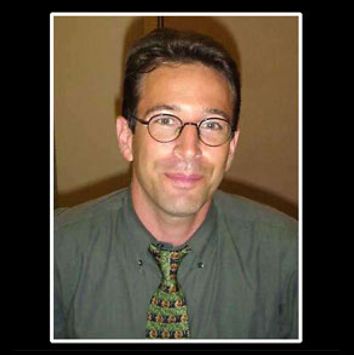
Last Thursday, a senior White House official called Mariane Pearl and Paul Steiger, the managing editor of the Wall Street Journal, to report a new, key development in the investigation into the death of Mariane’s husband, Journal reporter Daniel Pearl. “We have now established enough links and credible evidence to think that Khalid Sheikh Mohammed” — the mastermind behind the 9/11 attacks — “was involved in your husband’s murder,” the official told Mariane.
“What do you mean ‘involved’?” Mariane asked.
“We think he committed the actual murder.”
To those following the case closely, this is not a huge surprise. “We’ve known all along that al-Qaida was involved,” Mariane told me Wednesday. “We just didn’t know how.” After initial relief at having Mohammed’s involvement confirmed, her reaction shifted back to impatience at the slow pace of unraveling the ties between the shadowy figures responsible for Danny’s kidnapping and murder. “We have worked so hard to find the truth,” Mariane says. “We have to continue.”
My interest in the investigation is more than a professional one. At the time Danny was kidnapped, he and Mariane, then pregnant with their first child, were staying with me at a house I had rented in Karachi, Pakistan, while writing a book. I had traveled to Pakistan for Salon, to cover the aftermath of the Sept. 11 attacks, and was happy to host the Pearls when Danny came to Karachi to interview a local Muslim cleric who was said to have ties to alleged “shoe-bomber” Richard Reid. He was pursuing other investigative threads, as well. When he didn’t return from the interview on Jan. 23, 2002, Mariane and I alerted U.S. officials and his Wall Street Journal editors, from the desk where Danny had left his laptop. We transformed my home into the investigation’s headquarters. For five weeks, we worked closely with U.S. and Pakistani investigators to find Danny; after investigators discovered he had been murdered, I left Pakistan, and moved to Paris to welcome Danny’s son, Adam, into the world, and later returned to the United States. I have remained close friends with Mariane, and have helped her follow the investigative threads in the case, talking with investigators and gathering information.
The confirmation of Mohammed’s involvement, make no mistake, is a serious breakthrough. According to American officials, Mohammed was one of three Arab men known to have arrived with video equipment and knives at the location where Pearl was held after his abduction in Karachi that day. We all know what followed: They videotaped him answering questions about his Jewish ancestry as he kept his composure, showing his classic irreverence for authority. A final image of the video showed him having his throat cut.
Mohammed’s bleary-eyed image was splashed across newspapers worldwide after he was captured by U.S. and Pakistani intelligence agents this past March. Although American officials first denied that Mohammed had anything to do with Pearl’s killing, this week they confirmed that they now believe he was responsible. But that revelation raises more questions than it answers. The full investigation into Danny’s death could well proceed in directions that will make both Pakistan and U.S. investigators uncomfortable.
Until now, Omar Saeed Sheikh, the young Pakistani London School of Economics dropout who was sentenced to death in July 2002 for organizing the Pearl kidnapping, had been identified as the ringleader of a carefully assembled alliance of extremist Muslim militants working in at least four different terrorist cells. Mohammed would link Omar Sheikh more explicitly to the wider and more sinister al-Qaida network. The question, though, is whether this will lead to an even more troubling connection: between al-Qaida and Pakistan’s intelligence agency, the ISI, which has been linked to Omar Sheikh.
As Mariane says, “When the Khalid Sheikh Mohammed name first came up, the obvious questions were what was his link to Omar Sheikh and what was his link to ISI? Those are the questions we have to answer now, and there are more. What is the direct link between Omar Sheikh and 9/11? Is Omar Sheikh a main player in 9/11? Should there be more charges against him? How much was al-Qaida involved in planning Danny’s kidnapping? What was the role of Saudi Arabia?”
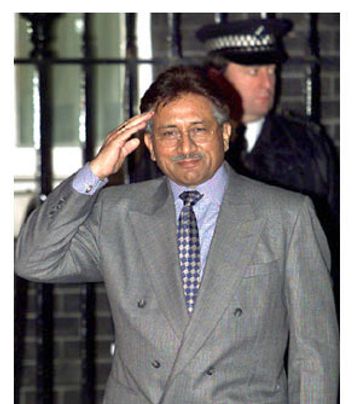
Pakistan’s possible link to terrorism is already an extremely volatile subject. Pakistan, struggling to maintain its position as an ally of the U.S., bristles at any suggestion that the Pearl kidnappers had relations with the ISI. The allegation by French philosopher Bernard-Henri Lévy that Sheikh was an ISI agent, contained in his book “Who Killed Daniel Pearl?” sparked a harsh rebuke from Pakistani President Pervez Musharraf last month. “ISI involvement in the killing of this young man is unthinkable,” the president insisted.
But of course it is quite thinkable, because of the shadowy way the ISI operates. Musharraf himself struggles constantly against the former generals who run the intelligence arm, which has historically maintained close relations with many of the country’s rogue terrorist groups, and seems to operate independently of the president’s authority. U.S. officials, because of their own need for a close ally in Musharraf, also struggle to hide their frustrations with his unruly intelligence arm. Deputy Secretary of State Richard Armitage, during a meeting a few weeks ago with members of Congress, implied as much when he said he did not believe “affection for working with us extends up and down the rank and file of the Pakistani security community.”
And no one symbolizes the ISI’s shadowy relationship with terrorist operatives better than Omar Sheikh.
A judge in an anti-terrorism court in Pakistan sentenced Sheikh to death for his role as the ringleader in Danny’s kidnapping and murder last July. An appeal has been pending ever since with countless postponements. Throughout his trial last year, Omar Sheikh maintained that — although he knew how, and by whom, Danny had been killed — he was not himself responsible. The judge sentenced three other young Pakistani men to life sentences for their roles in facilitating the kidnapping and disseminating hostage letters, including digital photographs of Danny in captivity, via the Internet.
When Pakistani police investigators traced the kidnapping plot to Sheikh on Feb. 5, 2002, Sheikh reportedly turned himself in to the custody of a former ISI official, who was then home secretary of the state of Punjab, based in Lahore, where Sheikh’s family lived. He remained in the protection of intelligence agents for one week, until Feb. 12, when he was handed over to Pakistani police. But his connections to the ISI didn’t begin or end there.
Sheikh was arrested in 1994 in New Delhi, India, for kidnapping American and British tourists, and was imprisoned pending trial in India’s maximum-security Tihar Prison. But Sheikh, a British national of Pakistani origin, was one of three militants horse-traded for the hostages of an Indian airline hijacked to Afghanistan in December 1999, by the terrorist group he previously belonged to, Harkat-ul-Ansar. The Indian government released Sheikh to Afghanistan. From there, and reportedly under ISI protection, he went back to Pakistan before returning to London to reunite with his family. He remained involved in the activities of militant Muslim groups in Pakistan, but stayed out of the news until his arrest for Danny’s kidnapping and murder. Sheikh laid the trap for Danny in Karachi, but left for Lahore before the actual abduction, by all accounts. It isn’t clear if Khalid Sheikh Mohammad was in the loop by then.
The trail for Mohammed included a Sept. 11, 2002, raid on a Karachi hideout. During an exchange of fire lasting about four hours, Mohammed allegedly escaped, but Ramzi Binalshibh was allegedly captured and airlifted out of Pakistan for interrogation. German and U.S. investigative and intelligence agencies had been hunting for Binalshibh since September 2001; U.S. officials identified him as the 20th hijacker who couldn’t join the 9/11 attack because he was unable to secure a visa into the United States. He was a member of the so-called Hamburg cell, which played a leading role in the planning, financing and execution of the Sept. 11 attack. Binalshibh is believed to have handpicked Mohammad Atta to lead the group of hijackers that flew planes into the World Trade Center.
Speculation about whether Mohammed was involved in Danny’s kidnapping and murder began immediately after his capture. The three men who arrived on Danny’s last day of captivity had been described to police as being of Yemeni origin. (There is some confusion about Mohammed’s nationality, however; he has been described as a Kuwaiti-born and U.S.-educated Pakistani.)
Yet the news that Mohammed killed Pearl doesn’t explain his motive. What would make al-Qaida target the Wall Street Journal’s Asian bureau chief? There are several theories. Robert Baer, a former case officer with the CIA’s directorate of operations, believes Pearl had begun to pursue Mohammed as a story for the Journal. Baer says Pearl called him the day after the Sept. 11 attack to talk about possible culprits, and that he told the reporter about Mohammed’s role as a key aide to bin Laden going back to 1997. He also told Pearl, Baer says, that the government of Qatar protected Mohammed and would have information about his activities. After Danny’s murder, Baer said that an official in the Qatar government told him that Danny had called the Foreign Ministry for information about Mohammed.
But Mariane and I weren’t aware that Danny was pursuing a Mohammed story at the time of his kidnapping. He had come to Karachi to interview a Muslim cleric called Sheik Mubarek Gilani. He was investigating whether there were any ties between Gilani and Richard Reid, the alleged shoe bomber, who was seized on a Boston-bound American Airlines jet from Paris allegedly trying to ignite explosive in his shoes. But there is always the possibility that Danny was reporting on additional leads he gathered about the shadowy networks with al-Qaida ties. The French philosopher Lévy claims in his book that Danny was killed for reporting that Pakistan was sharing nuclear secrets with North Korea. But there is no evidence he had made any such links between the two countries.
Mohammed’s involvement, however, does renew questions about possible links between Saudi Arabia and the kidnapping and murder because of well-known ties between individuals in Saudi Arabia (including, of course, 15 of the 19 9/11 hijackers) and al-Qaida. At one point, U.S. investigators were pursuing leads that linked a mobile phone number in Riyadh to phone calls to the web of militants involved in the plot to kidnap and kill Danny. In addition, law enforcement investigators traced the first known public distribution of the video in May 2002 on the Internet to Riyadh. (At the time, Mariane and I received a phone call in Paris. “It’s bad news. The video is on the Internet,” said the voice on the other end. For two days, Mariane and I maneuvered between officials from Lycos U.K. to Scotland Yard to track the source of the video’s posting. “An office building in Riyadh,” we were told. We couldn’t get any more information, and the investigation seemed to reach a dead end.)
But for the time being, the immediate questions that need to be answered are in Pakistan. And getting straight answers from anyone in ISI — protected by proxies in the press — will be difficult.
Inside Pakistani media circles, journalists refer to “agency reporters” who loosely work for two bosses: their editors and Pakistani intelligence agencies. In her book, “A Mighty Heart,” Mariane Pearl singled out Kamran Khan, a journalist for the English-language News in Karachi and a Washington Post stringer, who wrote the first story that identified Danny as a Jewish reporter, information that Mariane has equated to a “death sentence” in Pakistan. Khan recently told the Washington Post that he was simply pursuing the story aggressively and didn’t mean any harm.
Khan also published intelligence agency efforts to link India to the kidnapping by raising the possibility that I was a spy for India, claiming that I was Danny’s “full-time assistant,” identifying me as an “Indian journalist” (I was born in India, but have a U.S. passport and was raised a Muslim in the United States since the age of 4) and reporting falsely that Danny had brought me into Karachi to work with him. He also raised questions about why Danny would travel to Karachi from India, where he was based, saying “officials” were “intrigued as to why an American newspaper reporter based in Bombay would also establish a full-time residence in Karachi.” Anyone familiar with the fractured relations between Pakistan and India can understand how this sort of characterization could tarnish Danny’s reputation in Pakistan and weaken public outrage about his brutal killing, a goal some ISI officials might have wanted.
After Danny originally went missing, Mariane and I hunted through the house looking for clues. I found a photo on Danny’s computer of us, shortly after we all met up in Pakistan. He had a particularly befuddled look on his face, and had created an appropriate caption for the photo: “Clueless in Karachi.”
It turned out to be an apt description of all of us in Karachi, and of the complicated nature of relationships between Muslim extremists and their political and financial sponsors that Danny stumbled into. That is what must be explored further in order to learn who planned, financed and pulled off the kidnapping and murder of Danny. Even with the apparent admission of Khalid Sheikh Mohammed, the job is not done.
My crush on Musharraf
With his dogs, drinking, frameless glasses and Armani suits, he's reviled by extremists.
Uzma Asim, 35, is a modern Muslim woman, a vice president of operations of Anmar Associates, a garment exporter. Her office is replete with glass tables, leather sofas, just ordered-in Kentucky Fried Chicken and a quiet room for women to pray, with rugs folded neatly on the floor. She sweeps before me, a burst of energy in a modest white cotton shalwar kameeze with black block print.
A mane of curly, raven black hair descends upon her shoulders, a thin line of kajal flutters upon her upper eyelid and her eyes sparkle when she talks about her president, Gen. Pervez Musharraf.
Continue Reading CloseAnthrax? Big deal
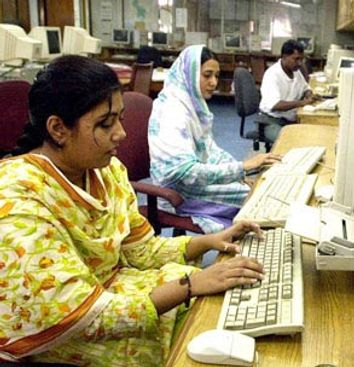
While a quaking American media blathers obsessively about being on the front lines of bioterrorism, a Pakistani newsroom goes calmly about its business after its own spore scare.
During his radio address over the weekend, President Bush urged the American public to remain calm in the face of current anthrax attacks.
For a lesson in calm, I met four uniformed sixth grade girls from Miss Saeeda’s class, 6A, at Karachi Public School. It’s Saturday afternoon, and they’re standing outside the school library, where Shakespeare’s “Romeo and Juliet” sits on the shelves. News broke here about the first discovery of an anthrax-laced letter delivered outside America, and it was delivered just down the road from these children’s school to the office of the country’s leading Urdu newspaper, the Daily Jang.
Continue Reading CloseThe Taliban’s ladies auxiliary
A revival of conservative Islam among educated Pakistani women has many doing whatever they can to support the war against America.
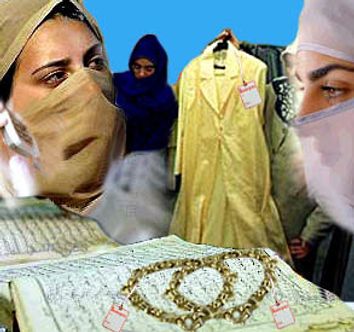
Thabasum Mufti sits in her tidy sitting room in a middle-class neighborhood and pulls out a neatly folded jersey velvet fabric in rich red and black colors from a black leather suitcase labeled “Carlton International.” A tag is stuck into the green velvet fabric with a straight pin: “1,000 rupees” ($15.87).
With her collection of fancy fabrics for sale, Mufti is a sitting-room soldier in the cause to raise rupees for the mujahedin fighting in Afghanistan. Beside her is another suitcase filled with fabric, donated by a friend from her “jahaze,” a trousseau of sorts meant to keep a new bride in high fashion for many days.
Continue Reading CloseJournalist or bride?
I get a marriage proposal, get compared to "Hanoi Jane" and plan a trip to Afghanistan on a prayer.
It’s been almost a month here. A war began. Children here have already thrown a Halloween party two weeks early. I ordered the No. 1 special at McDonald’s in Lahore. Today, I applied for an extension on my visa, and am again reminded there is a war across the border. War, what war? While interviewing this very lovely family, which includes a very eligible 34-year-old son, I have to try to explain that I won’t be a good bahu, daughter-in-law. I don’t know how to knead dough to make roti. The teenage son will learn, the mother responds, her jaw stiff and earnest. They give me a cloth, hand-embroidered by the youngest daughter. “Lazy Daisy,” it reads, in Urdu.
Continue Reading CloseA would-be martyr
Qaiser Nadeem, 20, longs for the day he is called to leave his video store and join the jihad -- fighting the U.S.-led coalition in Afghanistan.
“Seventy-five paisa,” the soft-spoken, bespectacled young man says from behind the photocopy machine.
At first he claimed it was a rupee a page, but after I gently raised my eyebrows, he immediately lowered the price. I later confirmed that 75 paisa is at the bottom end of what’s charged around here for a decent photocopy, using the thinner, Pakistani A4 paper (imported paper starts at one rupee a page).
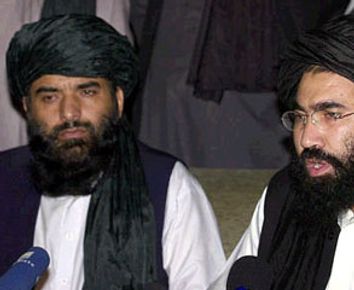
I’m making photocopies to show my stories to some of my sources and family here. He observes a photo of Sohail Mohammad Shaheen, the Taliban’s deputy ambassador in Islamabad, on a story I wrote about a recent visit with Shaheen and his two wives at their house.
Continue Reading ClosePage 1 of 2 in Asra Q. Nomani