Barbara Card Atkinson

Beetle on the wing

Ernest Rogers' aerodynamic Volkswagen is a conservationist's dream. But people don't seem to care about that -- they like it because it's sexy.

  • more
    • All Share Services

Beetle on the wing

Ernest Rogers, retired aerospace engineer and active inventor, is driving along, running routine car tests west of Salt Lake City, when it happens. A car appears behind his and stays in position, close behind. Then the car pulls up alongside and a passenger leans out her window, camera in hand. She shoots a number of photos of Ernie’s car, then shoots more as the car pulls forward and slows. Finally, apparently satisfied, the driver accelerates away while the photographer gives Ernie a thumbs up and a big smile.

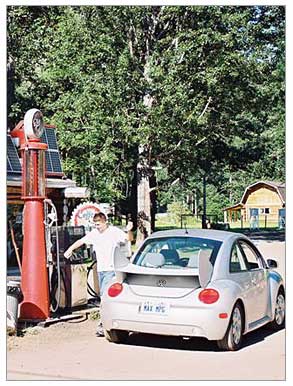
Was Rogers driving some kind of sleek, rocket-boosted dragster or gloriously refurbished classic car? Nope — his vehicle was something far more relevant to the average consumer — a new model Volkswagen Beetle, with a twist. This Beetle had a “wing” sticking out the back with two side protrusions. It resembled a silver ladybug. It looked adorable.

Rogers says he likes working on big scientific or engineering problems where he can have a significant effect. Reinventing cars so that they make more efficient use of energy resources is one of those problems.

“The VW Beetle TDI was purchased as an excellent engineering test bed to experiment with because of its inherent high efficiency,” says Rogers. “But I couldn’t get the best out of this car until I settled a fairly minor problem for it: the fact that its aerodynamic drag is unusually high. I decided to go ahead and fix this problem first because I could see that it has a fairly simple and inexpensive solution. So, the Beetle ‘wing’ was born.”

“I frankly built it for my own selfish use,” he says. Then it hit him: Perhaps there was a market for this wing. “Maybe it can start a trend toward making cars that are popular because they are efficient. The Prius [hybrid] has shown that this is a valid concept.”

This July, Rogers and his grandson, Kai, drove from their home in Salt Lake City to Anchorage, Alaska, in their VW, with the aerodynamic wing attached to the rear trunk lid. The drive was a success, albeit a slightly more fraught adventure than they had anticipated. They were swept up in the wildfire-driven evacuation of Watson Lake in the Yukon Territory. The conflagrations fueled Rogers’ sense of urgency to develop greener energy solutions.

“We drove through about 800 miles of smoke from hundreds of fires burning throughout the western Yukon and eastern Alaska, the result of unusual, very hot and dry spring weather,” Rogers wrote in his trip journal. “Everyone up here is talking about the impact of global warming upon the environment.”

Rogers, a prolific environmental inventor, has one patent for an oil-water separator for spill cleanups and another for a wind turbine. He once held the position of guest scientist at the National Bureau of Standards (now the National Institute of Standards and Technology). He’s long been interested in aerodynamic design as a way to increase the fuel efficiency of vehicles.

“I am very concerned with the senseless waste of energy by cars,” Rogers wrote in an e-mail. He believes three areas need attention:

  1. “Power generation and delivery to the wheels”
  2. “Rolling resistance between the wheels and the road”
  3. “Aerodynamic resistance between the air and the car”

He continues: “These energy concerns, at the first level, are matters of efficiency. Other views are our expectations on what a ‘great car’ should do (we all want a great car), the effects of our energy use on ourselves and the rest of the world, and the environmental, social, and economic legacy we will pass on to the future.”

While the wing is extremely efficient, it isn’t a simple cure-all.

“The Beetle wing only works on the Beetle,” Rogers says. “The principles are applicable to all vehicles, but they can look quite different when used elsewhere, for example, on a pickup truck … In particular, the same drag problem of the Beetle is also present in every big diesel truck. Applying the same concepts there can make a very big impact on our country’s energy use.”

Indeed, a focus on the trucking industry could have a substantial impact on energy consumption and, consequently, carbon emissions. According to the U.S. Bureau of Transportation Statistics, more than 2 million semis were in operation in 2001, traveling a combined 135 billion miles on U.S. roads and consuming more than 25 billion gallons of fuel.

It reads like a middle-schooler’s math word problem: Most of those 25 billion gallons of fuel were consumed by a small number of trucks that each travel more than 150,000 miles per year. Each of these trucks burns through roughly 35,000 gallons of fuel per year, for a combined total of about 20 billion gallons per year. If there is a 30 percent reduction in drag, which Rogers feels is easily achievable with his wing, the calculated increase in fuel economy is 10 percent, a savings with a value of approximately of $3 billion per year.

This estimate is supported by research by the U.S. Department of Transportation, which has projected that implementing an effective drag reducer at the rear of semis could save at least 1 billion gallons of fuel a year. “We can make cars and trucks that do the same job we have always expected, but with far less fuel,” says Rogers. “Let’s do it now.”

Before he modified his VW, Ernie approached several manufacturers and potential investors to apply a version of his wing to long-haul trucking but was met with little enthusiasm. He was told that this simple design brought up issues too complicated to pursue: loading-dock concerns, manufacturing costs and worries about the wing’s durability.

Undeterred by his inability to catch the automotive industry’s eye and eager to see if his wing did what he expected, he decided to test the design on his own car. He added his carefully engineered wing to the back trunk lid. It wasn’t an expensive design: basically three pieces of material and some bolts.

Before and after comparisons demonstrated an improvement of at least three miles per gallon. But Rogers expected that. What he didn’t count on was the public reaction to his modified vehicle.

No one shouted “What sort of mileage are you getting?” as he made his way home, but an awful lot of folks asked him where they could get something like his to make their cars “cute.”

“It seems the perception in the accessory marketing business is that the buyer only cares about looks and power, and not about any moral or practical benefit,” Rogers says. “Maybe some time soon, ‘I look cool’ will have a more significant meaning.”

When Rogers pulled into a gas station in Pleasant Grove, Utah, after driving 3,000 miles from Anchorage, Alaska, he recalls, “The customer at the adjacent pump came over and asked where he could get a wing like mine. I had to tell him that they just weren’t available. He was somewhat disappointed. Then I told him I had just calculated my fuel efficiency at 63 miles per gallon, and watched the behavior that followed. It was entertaining.”

What wasn’t so entertaining were several anonymous, slur-heavy notes left under the Beetle’s windshield wipers, accusing Rogers of tampering with a car-cult favorite. Apparently, even the wing’s detractors didn’t think there was anything more than “pop car” aesthetics involved.

Rogers’ experience driving across the country raises some troubling questions about American attitudes toward conservation. Does the general public simply not take the issue seriously, trusting that there are enough fossil fuels to get them to the mall and back again forever?

“I think a closer guess to reality is that too much of our corporate structure is built on cars that consume lots of fuel,” Rogers says. “They are doing all they can to convince us that nobody really wants those ‘little’ cars. At least until they announce that they have a thrifty car we need to buy … It’s just marketing.”

This issue of the straightforward practicality of conservation versus the ability to catch the public with “green” eye candy is clearly illustrated in Rogers’ inability to sell the utilitarian use of the wing, while people on the street are stopping him to ask where they can purchase one because of how it adds to the Beetle’s funkability.

According to Autobytel, an Internet automotive marketing data source, purchase requests for SUVs and trucks dropped considerably during spring 2004. Requests for the Hummer H2 fell by 47 percent, and those for the Ford Expedition dropped by 25 percent, from first quarter 2004 sales. Still, minivans bucked the downsizing trend and showed an increase in sales, by as much as 67 percent in the case of the Ford Freestar, so while fuel consumption may indeed be an issue, so is roominess.

If the public won’t come to conservationism, then conservationism, it seems, will have to come to them, and it will need to arrive in an extremely inviting package.

Falling down

We were both professionals. Now I'm sweeping up popcorn, my husband is selling motorcycles, and our house is on the block. There are a lot of us these days.

  • more
    • All Share Services

Falling down

Several months ago, my husband and I received two rebate checks simply for having children, all part of the Jobs and Growth Tax Relief Reconciliation Act of 2003, an economy-stimulating incentive. Congress approved this quickie tax cut so we’d all go out and buy Pottery Barn lamps and Gap boot-cut trousers and then presumably the economy, and we, would be saved. Instead, I cashed the checks, paid off some bills, and then tucked my dignity under my arm and went to file for food stamps.

The Department of Transitional Assistance is maybe a mile from my house. It’s in the basement of a nondescript brick building in a college neighborhood, seated next to an independent movie theater and a funky coffee shop. It’s a well-trafficked area for the people of my demographic, the post-hip Suburban parent. I kept my head bowed low walking in and hustled down the flight of stairs. I didn’t want any of my neighbors to see me.

To apply for food stamps, one needs to fill out a form and show four consecutive pay stubs, mortgage or rental payments, utility bills, home insurance costs, phone bills — the flotsam of daily life. I brought my paperwork neatly filed in a manila envelope, shoved at the bottom of a backpack, next to my cellphone and a wallet full of maxed-out credit cards. I wrote my name down on a slip of paper and sat on a plastic chair next to a 60-something woman wearing glittery, plastic high heels, a frayed knitted skirt and an unfortunate tube top. Nearby an agitated woman in her mid-40s stood clutching a rolling luggage cart with both hands, muttered about filing a complaint with the governor for not being comped a bus pass to medical school. I wondered if I had turned off my cellphone. Was it immoral to even own a cellphone and still be applying for food stamps? Such is the current dichotomy of our lives.

In my 8-year-old daughter’s backpack last night was a notice from the school’s volunteer committee asking parents to help teach art this year. The committee is new, formed to bridge the gap left by the extreme budget cuts made by our town this spring. Included in the cuts were art education, both enrichment and remedial instruction, and all counseling services, as well as drastically reduced time spent in the gymnasium, at the computers, and in the library. The principal is asking us, the parents, to step in as much as possible. I’m signing up to be a lunch lady at the cafeteria on the days my 3-year-old is in preschool and eyeing the “wish list” request for supplies from her teachers. I’ve been told they need pencils.

According to numbers released by the Federal Reserve in August, there are approximately 9 million people currently unemployed in the United States. My husband and I are lucky to not be among them. InvestorWords.com, which calls itself a leading Web-based glossary for financial terms of art, defines our condition as underemployment, “a situation in which a worker is employed, but not in the desired capacity, whether in terms of compensation, hours, or level of skill and experience. While not technically unemployed, the underemployed are often competing for available jobs.” My husband, Andrew, and I, motorcycle salesperson and movie-house concession bitch, respectively, embody all the features of the definition.

Before his current inability to be employed in his “desired capability,” Andrew worked at a software start-up. Prior to my scraping gum off the bottoms of chairs and reheating popcorn, I was a Web writer for a multimedia dot-com corporation. It’s been like this for 16 months, the two of us struggling to make ends meet, to emotionally and financially support ourselves and our two young children while battling self-pity and overwhelming panic.

For me, being “underemployed” has been a wake-up call of enormous proportions. I have a college degree, I’ve been in the corporate world, I don’t frighten people away with hideous personal hygiene or dubious philosophical rants, but it seems my work skills are just outdated enough to put me at the end of every interviewing queue. In the early ’90s, I paid my way through college by temping for consulting companies, generating experience in what was quaintly referred to as “desktop publishing.” This was back when knowing computer applications was considered being highly skilled, before everyone and his mother could produce prefab presentation/newsletter/annual-report templates with each new installation of MS Office software. I stopped temping after college, had my children, and during their naptimes wrote articles for a media Web site, employing then-hip “Buffy” references as roguish punctuation. It wasn’t a huge career, but it was writing and it let me be home with the babies while still contributing to our household finances. Then there was a merger and 90 percent of the media conglomerate’s Web sites were folded up, and I suddenly found myself without a job. Andrew was an executive making a six-figure income. It wasn’t how we planned it; when we met during our college years, he was going to run a theater company or a progressive newspaper and I was going to write arch screenplays, but hey, being financially comfortable worked, too. We bought a house in a Boston suburb and while we lived with cat-damaged couches and 10-year-old cars, we also bought mochaccinos and Indian takeout whenever we damn well wanted.

When Andrew’s company went bankrupt, it quickly hit us that I had to get a bona fide job. At first I applied only to temp agencies, sure that Andrew would quickly land on his feet. But out of the dozen or more agencies I contacted, I was called in for one interview. After the typing and spreadsheet tests, I was told my computer proficiency was only passable and I should think about updating my skills.

I created five versions of my résumé, each weighted with a set of skills that I hoped would help eclipse the empty years since I had been in a “real” office setting. I applied for anything that I could conceivably do, despite my lack of recent experience and relevant expertise.

My second interview was for a position as an e-book proofreader at a large publishing company. Though the work appeared to involve air traffic controller-like information management, it offered glorious full-time hours for a finite three months, at which point, I naively believed, I would be needed back home. I left the interview sure I had cinched it and sent a glowing thank-you note. I never heard from them. I was told by a mutual contact, months later, that they had instead hired a brilliant 25-year-old who left after one month to follow her boyfriend’s band.

The third interview was the one that got away: consumer care specialist for a toy company. What could surpass answering customer e-mails from home in my sweats at 11 a.m. as well as getting to try out boutique board games? I practically crawled into the interviewer’s lap like a retriever puppy; I was so desperate and eager, I was sure that no one was going to hire me. There were Aunt Bea-like candidates coming out of the woodwork for this job; sturdy, dependable, smartly ironed women who could take customers by the virtual hand and project studied warmth while all I wanted was to get back to my old, vain, lazy life — and it emanated from me like a cloud.

My fourth interview was at the local second-run movie house. It was the only place in town with a Help Wanted sign in the window, and I had been responding to newspaper and online ads for four fruitless months. I was given an application to fill out, which I attempted to do in the lobby while a profusely sweating woman, apparently not an employee, repeatedly muttered at me, “You fucking little motherfucker,” as she tried to pry the movie posters from their cases. The interview consisted of my writing down the same reference numbers twice, then fumbling through an apology. I was hired on the spot.

The theater is a landlocked version of the Island of Misfit Toys, a waiting room for those who don’t have anywhere else they’d rather be. The employees are either psychically damaged or determinedly apathetic in some way, which keeps them from being in a workplace where more is asked of their intellect, their creativity. Sure, some of the 16-year-olds work there because it’s after school, a simple first job. But then there are the lifers: 32-year-old Rowan, the post-goth girl who was training to be a ballerina before she burned out at 19, or 24-year-old Lynn, a fanzine writer who regularly bursts into tearful mini-rages when patrons want more soda or ask for directions to the bathroom. Cheryl, the Tufts grad, maybe wants to go into medicine and maybe wants to be a painter, unable for years now to choose and move forward.

For a while I was different from them, trapped, I was sure, only by my peculiar circumstances rather than by some choice or inability on my part, but now I know better. No one is interviewing my husband for a desk job. The country has gone through two wars, with more international hideousness looming. We watch the manic-depressive fluctuation of the financial data and markets, but there’s no solid economic upswing in sight. I keep applying for other jobs, but no one is hiring me, either, so I’m also peripheral, a worker with faded expertise, whose business acumen ends with the first Bush presidency. It seems we’re all “underemployed”; we’re all scrambling to do a lot more, be a lot more, than anyone is asking of us.

One Saturday night I was on “post,” which means ripping tickets in half, handing back the stub and pointing patrons to the correct theater, restroom, napkin dispenser — not such a demanding task even if one is hung over or seething with barely contained hostility. A much older gentleman stopped, looked at me and said, “Young lady, did you go to college?” I smiled and said yes and handed him his stub. He shook his head and walked away. I was, to him, not just another slacker, but one with graying hair. I wanted to run after him and recite my C.V., list my accomplishments, and then push him down the stairs. I wanted to scream at him as he walked into a show, “It’s not me, it’s the economy!” and then shove him, hard, in the back.

I walk in the door as my husband walks out. Sixteen months ago he was a senior executive and now he’s selling motorcycles, only no one’s buying. He isn’t trained to be a salesman and doesn’t own a motorcycle himself, but this was the single job he’s been offered in over a year. He’s not alone — none of his former co-workers are back in the corporate grind. It seems we’re part of a new demographic cohort: the Foreclosure Generation.

What does our financial future hold, when we’ve lost not only our 401Ks and our children’s college funds, but also our credit and soon our home and certainly our emergency savings? My parents have invited us, repeatedly, to move in with them, to weather the financial storm in their rent-free harbor. We’ve talked about it, moving the children and the dog and the effluvia of our lives across the country and into two rooms with bunk beds and a well-stocked fridge, but we’re hovering, indecisive, waiting for that last-minute rescue call. We’re faced with a host of questions brutal in their simplicity, ridiculous in their repetition: Do we sell our home, take the equity left after debts are paid, and jam in with family? Do we sell and move somewhere cheaper, so that our low-wage jobs will help ends meet until a healthier economy rolls around again? Will the economy be better by the time our money runs out, and what do we do if it isn’t, when we have nothing left to sell? What sort of training can we start immediately that will help pay the bills, if not tomorrow, soon after tomorrow?

We’re on either edge of 40, my husband and I. How can we concede, retreat, at what point do we label ourselves the defeated in this battle and then grimly hope to someday start anew? If 20-somethings who can’t find work and return home after college are called “re-nesters,” what do you call 40-something professionals who can’t feed their kids on fast-food wages? Besides losers?

My neighbors in the middle-class town where I live all know our plight; several of them have confessed they are headed down the same path or are watching family members slide into bankruptcy and ruin. I wait to pick up my daughter outside her elementary school playground with the other parents; we mill on the blacktop. Folks I barely consider nodding acquaintances sidle up to tell me about food banks, lunch vouchers, clothing exchanges. It seems there is this great open secret, how broke so many of us are, and how frightened we are of where it will end.

Andrew and I work to stay upbeat around our children in between the long shifts and our late-night, last-minute financial schematics. We take pains to make sure they don’t feel our stress, or just the little that leaks out when we drop our vigil, but our daughter, 8, has recently stopped her weekly wheedling for extra allowance, or any allowance at all. She has started carrying around a small wallet crammed with her few crumpled bills, “just in case I need something,” she says. She offers to eat the leftover triangles of sandwiches discarded by her finicky 3-year-old brother, although it’s readily apparent she doesn’t actually want them. She has, suddenly, that wide-eyed worried look little kids get when they know something big is afoot, an expression I recognize from my own childhood. I was raised by a hard-working single mother and we made ends meet for a while on government assistance. Now I’m unable to replace the malfunctioning stereo system, the groaning dishwasher, the broken porcelain dental caps, the rattling exhaust system; and as the trappings of our middle-class life fall to the wayside, I see it all come full circle.

In between our gigs, we continue our search for anything better, the elusive job that will surely save us. I scan the papers and job Web sites and send out new résumés with the euphemism “customer service skills.” Every evening after the children are in bed, Andrew starts his second job — looking for work. It makes sense that I would have trouble finding gainful labor in a down economy when I was in direct competition with folks much better suited to the positions available, where being a stay-at-home mother had kept me out of the marketplace. But that doesn’t apply to my husband. He was in the midst of a well-connected, cutting-edge world, in the eye of the technology maelstrom and then suddenly he wasn’t. It’s like watching someone try to get back on a wave when the sea has gone eerily calm, horrifyingly silent.

Roughly 25 million Americans with children will be getting one of the $400 checks we received.

I wonder how they’ll spend the money.

Continue Reading Close