Bill Katovsky

Daniel Ellsberg: Still blowing the whistle

The legendary activist who leaked the Pentagon Papers says officials need to speak out against administration lies now.

  • more
    • All Share Services

Daniel Ellsberg: Still blowing the whistle

Daniel Ellsberg is perhaps the most famous whistle-blower in American history. In 1965, the former Marine and Pentagon analyst went on a State Department fact-finding mission to Vietnam. During that mission, which lasted 17 months, Ellsberg realized that the official line on Vietnam was false. Villages were not being “pacified,” “hearts and minds” not won over. Field reports were being doctored, enemy casualties inflated. Furthermore, the South Vietnamese government was riddled with corruption, and its army suffered from low morale.

Two years after he returned to the United States, Ellsberg found himself living a double life. He was a Pentagon insider briefing top officials, including National Security Advisor Henry Kissinger — and a participant in antiwar gatherings. Finally, Ellsberg decided he had to act. In his office safe was a 7,000-page top-secret Pentagon study — commissioned by Secretary of Defense Robert McNamara, who ordered the study because of his own increasing doubts about the war. The study, which came to be known as the Pentagon Papers, documented a consistent pattern of exaggeration and deliberate falsehoods about Vietnam policy dating back to the Truman administration. Ellsberg copied the report. “I saw [Vietnam] first as a problem, next as a stalemate, then as a moral and political disaster, a crime,” he writes in “Secrets: A Memoir of Vietnam and the Pentagon Papers,” which won the 2003 American Book Award for nonfiction.

At first, he tried to get antiwar senators like William Fulbright interested in the Pentagon Papers. After being rebuffed on Capitol Hill, Ellsberg went to the press.

Did the papers’ publication shorten the Vietnam War? At the outset, they became the center of an intense freedom-of-the-press struggle. The Justice Department sought an unprecedented injunction to prevent the New York Times from printing them. When the Supreme Court voted 6-3 in favor of the Times, it was a victory for the First Amendment, though their continued publication in the Times and 18 other newspapers failed to generate the impact Ellsberg hoped they would have. He explains why in “Secrets”:

“Starting the day after Christmas 1971, [Nixon] launched a thousand U.S. bombers during five days of bombing against North Vietnam, in the heaviest raids since 1968. Thus, six months later after the publication of the Pentagon Papers, when people asked me at the end of the year what I thought I had accomplished, I said, ‘Nothing.’ Nothing in regard to the war, my overriding concern. It wasn’t public opinion I had been ultimately seeking to change. It was the bombing, the war, Nixon’s policy. None of those had been influenced by American public opinion since the start of his term in office, as far as I could see, or by the release of the papers. Most Americans in truth had wanted out of the war long before the papers were published; a majority had come to regard it as immoral. In the face of that majority sentiment, the president had kept the war going by reducing ground troops, while he increased the bombing, and by recurrently convincing the public that he was on the verge of a settlement.”

While the papers stopped short of covering the years of his own presidency, Nixon feared that Ellsberg or others might come out of the woodwork with potentially damaging evidence. Nixon wanted to plug these leaks. This led to the creation of a new cloak-and-dagger unit called the Plumbers. Its first covert mission was breaking into Ellsberg’s psychiatrist’s office to find dirt to use against Ellsberg. It was this same group — Cuban exiles working for E. Howard Hunt — who later bungled the break-in of the Democratic National headquarters at the Watergate Hotel.

Ellsberg’s trial for leaking the papers lasted five months. He faced 115 years in prison if convicted on all the charges. But on May 11, 1973, the judge dismissed Ellsberg’s case outright. He cited “improper government conduct” (illegal wiretapping and evidence tampering came to light). On that very same day, Nixon sat down with his chief of staff, H.R. Haldeman, in the Oval Office and vented his fury. An excerpt from that secretly taped conversation appears on the last page of Ellsberg’s memoir:

“For example, on this national security thing, we have the rocky situation where the sonofabitching thief is made a national hero and is going to get off on a mistrial. And the New York Times gets a Pulitzer Prize for stealing documents. They’re trying to get at us with thieves. What in the name of God have we come to?”

The Senate Watergate hearings commenced the following week. It was the subsequent cover-up, not the crime itself, which set into motion Nixon’s resignation. (The articles of impeachment that were then being drafted included the Ellsberg break-in.) The war ended on May 1, 1975, under President Gerald Ford. Would the Plumbers unit have been formed if Ellsberg hadn’t pulled off one of the most important whistle-blowing acts in American history? Would there have been a Watergate scandal? How much longer would the war have lasted? How many lives were ultimately saved?

In a Sept. 28, 2004, New York Times Op-Ed piece called “Truths Worth Telling,” Ellsberg encouraged officials in the Bush administration to step forward with documentation detailing how the White House had misled the American public into supporting the Iraq war. Citing himself as an example who had failed to act until it was too late, he described a conversation he had had in 1978 with Sen. Wayne Morse of Oregon, one of the two senators who had voted against the Tonkin Gulf resolution:

“Seven years and almost 50,000 American deaths later, after I had leaked the Pentagon Papers, [Morse told me that] if I had leaked the documents then, the resolution never would have passed. That was hard to hear. But in 1964 it hadn’t occurred to me to break my vow of secrecy. Though I knew that the war was a mistake, my loyalties then were to the secretary of defense and the president. It took five years of war before I recognized the higher loyalty all officials owe to the Constitution, the rule of law, the soldiers in harm’s way or their fellow citizens.”

Today, Ellsberg — who was the subject of a 2003 FX cable movie, “The Pentagon Papers,” starring James Spader — lives in Kensington, Calif., just north of Berkeley, with his wife, Patricia. He continues to be outspoken, giving antiwar lectures, attending peace rallies and mentoring government whistle-blowers like former FBI translator Sibel Edmonds. He has been arrested 70 times.

- – - – - – - – - – - -

James Spader doesn’t look like me in the movie, but he caught my intensity. Patricia and I watched it hand-in-hand. We loved its love parts. I asked her, “Did I really look that good?” And she said, “Better.” I have one child with Patricia. Michael is now twenty-eight. He’s a writer actually. He is up most nights writing. He is writing a memoir, of all things. His growing up. Various intellectual and emotional concerns. He is a very good writer. And a savage editor. Michael slashed “Secrets” almost in half. He calls himself Jack the Ripper. My older son, Robert, is editor-in-chief of Orbis Books. He did a lot of editing on my book. In the movie, Robert is running the Xerox machine, and my daughter, Mary, who was ten, is cutting the “Top Secret” off the documents. That really happened.

FX never approached me when they made the film. I am sure one reason was not to pay me any money. The other was probably to not get any interference from me — which I would have almost had to do because every scene was wrong essentially. My former wife did not come to the place where we were copying documents and confront me.

At the beginning of “Pentagon Papers,” Spader is speaking to the camera and more or less quoting a description in an essay that I wrote in which I quoted from “Toilers of the Sea,” by Victor Hugo, about people walking into quicksand. As usual in that movie, he gets it almost exactly backwards. My essay is called “The Quagmire Myth and the Stalemate Machine.” It got a prize for the best paper presented at the American Political Science Association in 1970. Its thesis was that the notion we got into Vietnam as into a quagmire — without noticing that we were getting deeper in and it was harder to get out of — was a myth. Whereas the movie says that is how we got into Vietnam. What I said in my paper, which has been reprinted a lot, is that it’s a very arresting image and very plausible, but is wrong in every respect. It is nothow we got into Vietnam. It may have been how the public thought we were getting into Vietnam. It was told that we were about to win any day. But inside the White House, the president was never told that. Never. Never told it was gonna be quick or easy or cheap. Nor that the next step would be sufficient to win.

I was also rather furious at the movie’s end. It ends by my character saying, “If my greatest act of patriotism was an act of treason, so be it.” Two or three times in the movie, I’m heard using the word “treason.” “Gee, this is treason.” And “I’ll be tried for treason.” I was, of course, not indicted for treason. I did not expect to be indicted for treason. I really don’t appreciate people legitimizing the idea that what I did was treason. When people do say it, I correct them. So for my character in the movie to say it was an act of treason again reverses my actual attitude.

As we approached going to war in Iraq, I realized that whistle-blowing by officials was really very urgent, as it had been in Vietnam. My message was: “Don’t delay telling the truth to Congress and the press. Not just Congress, because without pressure from the press, Congress doesn’t move on these truths. They just hold them to themselves and keep silent about them. Don’t wait years into a war. Don’t wait until the bombs have been falling. Don’t wait until thousands more have died, if you know that the administration is lying to the public, is deceiving the public, is leading them into a wrongful, unnecessary war.”

When I released the Pentagon Papers, I was trying to avert a disaster. It has nothing to do with wanting to be a martyr. And in my case, of course, Nixon failed in his efforts to martyr me. You might say, I didn’t suffer any major loss. There was the loss of friendships; my friends having had security clearances. That was a loss. But it wasn’t what Nixon had in mind for me. What he had in mind was 115 years in prison, or even before that, beating me up. Slandering me. But he didn’t succeed in any of that.

I am not claiming to be totally prescient about the Iraq War. But within a couple of months, I could see that this was going to develop like Vietnam. Which is a thoroughly stalemated war. It is a quagmire. It’s not a question of our being driven out, but of it being impossible for us to eliminate the insurgents. As was true in Vietnam. We got into Vietnam with our eyes open internally as to how bad it would be. In this case, the military could see that there would be a terrible occupation problem. General Shinseki, of course, was strongly rebuked as chief of staff of the Army for saying that it would take several hundred thousand troops to occupy instead of the 130,000 that they were sending over. Wolfowitz said that’s wildly off the mark. And Shinseki’s replacement was announced. He didn’t retire immediately, but was made into a lame-duck general. Now, looking back, I’m sure that Shinseki had a six-foot-high stack of studies telling him why you needed several hundred thousand troops. I wished he would have released those at the time. They are documents that need to be leaked.

The blitzkrieg part was done very competently. Very effectively. And it was a Nazi-like blitzkrieg. Very well-executed war of aggression. To look back at what my judgments were in May 2003, I wouldn’t know one way or another how Iraq was going to develop. By the fall, I could see that the insurgents had an effective tactic here — the suicide bombing. Effective in a military sense. That’s not to excuse terrorism when it’s targeted on civilians, which is murder. Suicide bombing is like precision-guided munitions. Where you want it. And it is very hard to stop. It was also very clear to me right away that we were not getting intelligence from the people who knew about those ambushes. In other words, we were facing the same ambush problem that the French faced and we faced in Vietnam. The Iraqis weren’t prepared to give information to a foreign occupier in order to save any of the lives of the foreign occupiers. My Vietnam experience prepared me to think, “Okay, this is a war that can go on forever.” People say, “Oh, you’re prejudiced. You’re just looking through the lenses of the past.” Well, I was using my own experience, but I wasn’t confined by it. I was just ready to perceive similarities. People ask me, “But aren’t there differences?” I say, “Sure. It’s a dry heat. The language we don’t speak is Arabic rather than Vietnamese. And the ambushes are in the city rather than the countryside.” But the similarities are more important than the differences.

It was obvious to me that we were being lied to about the reasons for going to war. Even though I did think they had WMDs. Trying to say that Saddam Hussein, after ten years of sanctions, is the number-one threat to the U.S. and world security was an absurd statement. It was just ridiculous. In a world where Russians have loose nuclear weapons, and with India and Pakistan facing each other with nuclear weapons, to say that Saddam was the number-one threat, I could not believe Powell believed that. I felt he had to be consciously lying.

The press had been compliant right along. They are getting a little critical now. There is a synergy between public dismay and disillusion and the press. When there is more unrest in the public, the press gets a little nerve to criticize the president. But they have been very dismayingly compliant — and essentially passing on government handouts and cheering things on.

It was the same thing with the Democrats in Congress. They were afraid of being called names. The fear is a well-justified expectation that they would be called unpatriotic by the White House. Dick Armey was calling Tom Daschle unpatriotic and giving aid and comfort to the enemy by criticizing the president or questioning strategy.

People like Bill O’Reilly and Ann Coulter and others are great name callers. Coulter writes a book with the title “Treason.” And I am in that book not only as a traitor like everybody else, but she also describes me as a felon. That is interesting. Isn’t Ann Coulter supposed to be a lawyer? You don’t have to be a lawyer in America to be aware that you are not a felon if you haven’t been convicted of anything.

I don’t want to label Republicans in general, but these people are extreme slanderers. They are very vicious. These people are unusual. In many respects we have a White House now that is extremely dangerous. And among other things, I would say very anti-democratic. They don’t believe in democracy, in my opinion. And that’s why I am very, very concerned that they will exploit the next 9/11. I expect there to be another 9/11. They will use that as a Reichstag fire to close down democracy very seriously in this country. I don’t use that analogy lightly either. We really are in a pre-authoritarian situation here.

This is the time for people to show courage. People have more courage than they realize. It is the situation that challenges them. I think a lot about what happened in Germany in 1933 and I also wonder what people could have done in ’32 to try to avert that in Germany. With each year it got much harder, and after that it was very hard to do anything about it. It took increasing courage. Now is the time for people to show that courage, and one thing specifically that I would like to see is a lot more whistle-blowing.

For the past three years, I have been calling for whistle-blowing and truthtelling within the government. One obvious example was the Downing Street memo, which was leaked to the British press. It revealed that Prime Minister Blair had been briefed in July 2002 that President Bush had decided on a war against Iraq and that intelligence was being fixed around the policy. It got almost no attention over here. Nearly a month went by before anybody even mentioned it. The New York Times eventually gave it a certain amount of discussion. But very little from the media. It almost blanked out. Second, the Downing Street memo was written in July of 2002. If it had been leaked then, instead of several years later, that probably could have prevented the British participation. Although Bush was so determined to go in, he would probably have gone in alone even without the British. The same is true of a lot of the stuff that came out from Richard Clarke in his book, “Against All Enemies.” Or Mike Scheuer of the CIA who wrote a book under the name “Anonymous.” Both are good books and definitely worth having even at this late date. But there is nothing in them that they could not have told back in 2001! Let alone in 2002. If they had put out documents that backed up what they later said in those books, I believe either one of them would have prevented this war. They probably would have gone to prison if they had put out those documents. But you can’t tell somebody, “You should give your life. You should go to prison. You should do this.” But I do tell people you should consider doing that when there are so many lives at stake. And I wish they had.

When Clarke was speaking before a congressional committee, someone asked him, “You told us a year ago that the president was doing a great job against terrorism. Now your book is saying he wasn’t doing anything that needed to be done, that he was tremendously incompetent and wrongly directed. Which should we believe? How can we believe you now?” And so Clarke said, “Well, I’m not an official now. I’m not being told what to say. If I had told you then what I am saying in my book, I would have been fired before I got back to the office.” That’s probably true. But given the stakes, should that have been an absolute bar to telling the truth?

I don’t begrudge him the money he got from the book. But I do wish that it occurred to him to put the book out before the war, rather than wait all that time. I’m not being invidious when I say that, because I behaved the same way in ’64, ’65. I had information in my safe in the Pentagon from the weeks I started in August of 1964. I had information that we were being lied into a war. Although I was not against the war at that point, I was very much against the way I saw it was going to be prosecuted by heavy bombing. From the very beginning, I was against the bombing of the north. Again, I didn’t object as I might have, because the president was facing a candidate, Goldwater, who in all sincerity was calling on us to enlarge the war. So I thought it was important that Johnson beat him, and it wouldn’t have occurred to me to undercut the president at that time by exposing him as a liar. That’s the way I felt.

But I don’t admire my actions in retrospect. My conscience and prudence about my career told me to keep my mouth shut. But I was wrong. What I am saying is that conscience is so much socially constructed that even your own conscience should be looked at skeptically in situations of life and death. If you find you’ve been wrong, change the decision you made there. Change direction.

As I get older, I realize that people act according to their conscience most of the time. And it isn’t always the right way to act. One’s conscience is very much shaped by society. Very often people put obedience at the height of their conscience and values. Obeying the president as a matter of conscience. Keeping a promise, even when that promise turns out to involve you in participating in great social evils and war. Promises to keep secrets — which of course are made many times in the government, and which I ultimately broke.

I have done a lot of lecturing — for thirty years — but for a long time, I didn’t speak about whistle-blowing specifically because it seemed as though I was blowing my own horn. I was being defensive about what I did, or in effect, saying, “Do what I did.” Most people in my audience were not in a position to be a whistle-blower ready to go to jail. But then I realized it is one of the most important actions a person can be called on to make. I now like to complicate the lives of people who hear me speak by encouraging them that they should not regard promises or expectations of obedience or silence as absolutely obligatory. The meaning of whistle-blowing is to warn people. Policemen were equipped with whistles. If there was a wrongdoer in the neighborhood, the policeman would shout, “Help me get him! Stop this man! Don’t let him get away! Watch out! You’re in danger!”

The thing that keeps people in line is very much like what they used to say to us in the Marine Corps: “You volunteered. You stepped over the line. Now you have to stay. That is the price of signing up in the Marines.” I did observe combat enough. I was with the State Department in Vietnam using my Marine training. I walked with troops under fire in combat. And you see great courage all around you. Routinely. And that’s taken for granted. A very small percentage of people get medals for it. Civilians somehow seem to think it is almost not right for them to risk their careers. Or to risk their family’s livelihood and security.

To a large extent that silence is dictated by conscience. It’s wrongful silence. But people say, “I signed an agreement.” People really feel they are doing the right thing when they keep their mouths shut even when they see these things going on. They think that it would be bad for their company, or the president, if they exposed any of that. They are not lying with a guilty conscience to protect these people. They are doing it because they feel it is the right thing to do. So conscience isn’t a totally reliable guide either. Where do you turn then? For example, Bush said, “God told me to strike the Taliban. And I did. God told me to attack Iraq and I did.” My opinion on that is, “That wasn’t God. It was a wrong connection.” When you hear the voice of God telling you to do something — in Bush’s case, an unprovoked attack on another country — get a second opinion. Look skeptically. Paradoxical as it may seem, even your conscience is not the last word, especially when it tells you to be obedient to leadership that is leading you astray or to keep their secrets.

Frankly, we’ve reached the point where it would be very hard to change under this current administration, though we need to get Bush out of office before 2008. That is too long. Impeachment is well deserved but not possible under a Republican Congress. I was not exactly surprised by the government response to Hurricane Katrina. Its performance shows the same priorities that underlie Bush’s policies start to finish — which include a great disdain for the poor of the world. He initially referred to people in the Gulf coast region as “people in this part of the world” as if he were speaking of a Third World country. He didn’t seem to feel any identity with them, even if they lived in his own country.

Lately, I have been doing a lot of thinking about how wars are so much a part of human experience. As a species, we are given to mass violence and war and empire. How easy it is for our species to be fooled, and to fool each other. There are two primates which regularly kill their own species. While ants have wars actually, as for primates, it is chimpanzees and humans. If a group of chimpanzees catches a single, isolated male of a different tribe in its territory, it will kill him by beating him. Everyone beats him. Or it will even raid into a neighboring territory. Apparently, its evolutionary function is by reducing the number of males in a neighboring tribe, it restricts the feeding area of the neighboring tribe and enlarges its own. What about the other 4 percent genetic inheritance that we don’t share with the chimpanzees? There’s our speech and walking upright. Specifically we are the only animals that use weapons. Tools to kill with, thanks to our opposed thumb. We are the only ones that throw rocks. Chimps do a little throwing, but not accurate or strong enough to kill.

We are the only animals that kill at a distance beyond our own arm length. And to kill, we need weapons. Not 100 percent of the time, as chimpanzees show. But we can kill at a distance. Our ability to be concerned about the harmful effects of our actions on other humans especially falls off very quickly with physical and social distance and visibility. With the rock and spear and club and knife, we are still pretty close in. With the bow and arrow you definitely get a lot of distance. When you are talking about the longbow, you are killing people you can barely see. That’s the start, of course. With bombing and missiles, you’re harming people you don’t see — and that is very easy for humans.

I’m not aware of any bomb crews in the Second World War having a problem with bombing through clouds when they got to radar bombing. In fact, the people who had the most problems were those flying low over Tokyo. They could see the fires. The updraft from the smell of burning human flesh below hit their nostrils and made them throw up. It smells like roast pork.

Unlike other animals, we have the capability of foreseeing long-term consequences, and even being concerned about them. We have the ability to act on them, and God knows, we have a unique ability to cause long-term consequences. The chimpanzees don’t do that, let alone any other primate. They don’t threaten themselves and they don’t threaten other species the way we do. And so, we have this ability to cause harm in the long run and at a distance, and this ability — if we used it — to foresee that harm. Yet we don’t worry that much about the long run or distant victims. So if the victims in wartime are foreigners, we talk about collateral damage as if we were not sure what would happen. That it’s just an accident.

And here, I think, other things come into play for people in power. The first is their tendency not to look beyond the next election or to look beyond to the long run. Another thing is their willingness and determination to keep their jobs. Men in power are willing to gamble with any number of human lives in order to keep power. There is virtually no limit to the number of people they will risk killing in the future in order to keep their jobs. There is no real limit to it.

When I say there is no limit, I am ultimately referring to nuclear war. The willingness to contemplate the use of nuclear weapons is the willingness to contemplate something that goes beyond what any earlier humans or any earlier species had any reason to contemplate. There would have been a genuinely inadvertent and unforeseen effect if the U.S. government had carried out its plan for general nuclear war while I was in the government, say, during the Cuban Missile Crisis. There would have been nuclear winter. Bombs would have hit every city in Russia and China. They would have caused so much smoke to rise that all highly complex life on Earth would have been wiped out.

Well, I hope to live another ten to twenty years — I could die anytime — but my father lived to be ninety-six, and I’ll be very surprised if there are not some more Hiroshimas during that time. Really surprised. In fact, I would say within ten years. The promise made to the dead of Hiroshima — “Let all the souls here rest in peace, for we shall not repeat the evil” — is not going to be kept. At this moment, I think that it will probably be a terrorist weapon. Katrina is a pretty good taste for what will happen when we lose a city. Of course, the death rate will be much bigger.

Let’s say a small terrorist weapon goes off, and because Bush has done his best to cut funds for safeguarding Russian nuclear materials, that action is exactly comparable in its irresponsibility to flood control in New Orleans although the effects will be much greater. After all, if a hole occurs in that dike around Russian nuclear materials, there’s really no limit to what can come out of it in the way of plutonium and uranium. Which takes us back to the market theory. If terrorist organizations can’t use Saudi money and drug money to buy a Russian nuclear warhead, then Adam Smith’s theory of markets can be almost discarded. If you can’t buy warheads that are guarded by people who are raising vegetables in their back gardens for the nourishment of their families, then the notion that everything has a price can be decisively refuted. I think they are going to get that material. And who knows how long it will be before Pakistan or North Korea will sell full warheads?

Practically speaking, can it be said that this country is likely to prevent these things? No. That can be said very quickly. Is it impossible that we will? No. Nothing’s impossible. Can other countries prevent proliferation? Can they hold the tide back entirely? You see, I am plagued with the kind of knowledge that almost nobody has. I’ve read some secret documents. Almost nobody else has actually seen these actual plans and the calculations that go with them. When I say that our plans called for killing 500 to 600 million people, nobody knows that. Nobody has seen such calculations. But I held that piece of paper in my hand. They all called for simultaneous attacks on China and Russia. So take the notion of attacking North Korea, which I am sure the current administration is still entertaining, though they may have rejected it for the moment. It quickly involves possible nuclear weapons. Here’s my guess. If they decide for whatever reason to attack North Korea, it will be proposed to the president and he could well accept it that he must use airburst tactical weapons in rather large numbers against their artillery that threatens Seoul, that nothing else will prevent the embedded artillery pieces in their concrete emplacements from coming out. They are arranged so that they can pop out and fire. To destroy them, you need nuclear weapons. And if you can’t get rid of that artillery, you can’t attack because you will lose Seoul. Now could the president take that gamble? And perhaps lose Seoul? Well, yes. That’s what humans do, in power, under various circumstances. And we have made gambles like that in the past.

North Korea is one case. What if Saddam had WMDs? I am sure the White House did believe he had them. And what if he’d used them? There would have been a good chance we would’ve replied with nuclear weapons. Not against Baghdad probably. Unless it was the Israelis replying. But against their supposed underground sites. Of which we found that they didn’t have any. But we believed we knew where they were and that they were underground and we needed nuclear weapons to attack them. A former CIA agent, Philip Giraldi, has said that there are plans to hit underground sites for nuclear materials in Iran with our tactical nuclear weapons. Under what event? The next 9/11? Well, our response will be, among other things, to attack Iran even if it wasn’t responsible just as our response after 9/11 was to attack Iraq, which had nothing to do with 9/11. But that is where the White House wanted to attack.

Most of my civil disobedience arrests have been in connection with nuclear weapons demonstrations of various kinds. Except for the Pentagon Papers during the Vietnam War, my first act of civil disobedience was in 1976, just after the war. It was at the Pentagon at the end of the Continental Walk for Peace and Social Justice, which was really an anti-nuclear weapons walk across the country. I’ve been arrested at various nuclear test sites and laboratories. My oldest son was arrested with me at Rocky Flats outside Denver. That was very nice. To feel it’s a family business, you know. It was very bonding. My younger son was arrested with me outside the U.S. Mission to the United Nations before we invaded Iraq.

I continue to do civil disobedience against the Iraq War. The latest was in Crawford, Texas, where Cindy Sheehan took her stand. I like to take part and encourage other people as well. Each person has the ability, though they may not know it, to encourage others to speak out or to take a stand or to go beyond what they’ve done before. So there is a kind of chain reaction here. That’s essential.

Katrina reminds us that large dangers are not just hypothetical. They are not all in the distant future. They are not to be shunted aside simply because they are uncertain and we don’t know exactly when they are going to happen. There is a great gap between what we are capable of and what we actually do to avert dangers and to help other people.

We are in a crisis in this country, and the world is in a crisis right now, in large part because of our country. It calls for fast change in many respects. To a large extent we as a people do share the responsibility, though we are not all equally responsible. But President Bush is very responsible. I would despair of changing Bush’s behavior very much in itself. To think that our Democratic leadership right now would do an adequate job of dealing with these problems is absurd. Reid, Hillary, Lieberman, and Biden are all calling for more troops in Iraq and a more muscular reaction to North Korea and Iran. That’s predictable and outrageous, and we Democrats cannot allow that. It is up to us to get different leadership in there.

While I am going to continue working against the war in Iraq, it is not with the hope or belief that it will change quickly. But we do need to see how all the global issues go together. We need to look at the world as a whole, rather than disclaiming our miserable commitment to 0.7 percent of our GNP for developing countries. That’s not acceptable. That’s not tolerable. We need to address the issues of poverty, the issues of empire, the issues of nuclear weapons, the issues of health and of education — which, of course, means sex education and health education and AIDS education. It is not acceptable that we should be coercing countries like Uganda to turn away from the free distribution of condoms in order to pander to a crazy fundamentalist Christian sect here in America.

Now, is anything going to change right away? No. Actually it isn’t. We’re dealing with powerful institutions. But that’s why we’ve got to be trying to change. And not just the Iraq War. I’m going to do whatever I can. My wife says, “You’re not up to that.” There’s the lectures, meetings, and rallies. It’s too much traveling. Jet lag is hard on me. I don’t sleep well. But at this moment I have to do whatever I can — which virtually requires getting a Democratic majority in the House in 2006.

Excerpted with permission from “Patriots Act: Voices of Dissent and the Risk of Speaking Out,” by Bill Katovsky. The Lyons Press.

Rounded up

Nineteen-year-old Nadin Hamoui and her family were arrested and jailed for nine months after 9/11. Their visa had expired, but their real crime was being Syrian.

  • more
    • All Share Services

Rounded up

The roundups and detentions began shortly after 9/11. Using a rigorous and selective enforcement of immigration law, the U.S. government targeted foreign nationals as the cornerstone of its anti-terrorism offensive. The majority of people caught in this dragnet were from Arabic-speaking countries. Many were deported or arrested. Detainees were kept isolated in twenty-three-hour lockdown with limited access to the outside world, making legal representation almost impossible. They were considered guilty of having ties to terrorism until they could prove their innocence. They were denied bail. They were known as “the disappeared.”

Attorney General John Ashcroft championed this draconian new policy in an address before the U.S. Conference of Mayors on October 25, 2001: “Our antiterrorism offensive has arrested or detained nearly 1,000 individuals as part of the September 11 terrorism investigation. Those who violated the law remain in custody. Taking suspected terrorists in violation off the streets and keeping them locked up is our clear strategy to prevent terrorism within our borders.”

By manipulating immigration law to suit his public-relations agenda, Ashcroft was seeking to reassure Americans that the government was making substantial progress in its fight against terrorism. Each week, the attorney general’s office would proudly announce a running tally of arrests and detentions. But this practice stopped after critics started questioning why the Department of Justice refused to release detainee names or the crimes these foreign nationals had allegedly committed. In early 2002, Ashcroft signed into law the Absconder Apprehension Initiative, which concentrated on 2 percent of the 300,000 foreign nationals who were living in the U.S. despite outstanding deportation orders. This new crackdown specifically went after 6,000 people from Arab and Muslim countries.

“All the detainees were presumptively treated as terrorists,” writes David Cole in “Enemy Aliens: Double Standards and Constitutional Freedoms in the War on Terrorism.” “They were denied bond even where the government had no evidence that they posed a danger or flight risk, and held for months while the FBI satisfied itself that they were in fact unconnected to terrorism. Many immigration detainees were initially arrested on no charges at all. The government’s policy was to lock up first, ask questions later, and presume that a foreign national was dangerous even where there was no basis for that suspicion.”

The Immigration and Naturalization Service managed to bypass public scrutiny because immigration law avoids constitutional safeguards guaranteed to defendants in criminal court. Cases could be heard in secret. Detainees were deprived of due process. The slightest infraction or technical violation, such as overstaying one’s visa, could lead to immediate deportation or indefinite incarceration.

And just how successful were the attorney general’s anti-terrorism policy measures? How many al-Qaida sleeper cells were uncovered? Were Ashcroft’s confident expectations met? The 9/11 Commission found that this immigrant detention policy had failed to nab a single terrorist. “Sadly, this program has been a colossal failure at finding terrorists,” writes Cole. “Of the more than 5,000 persons subjected to preventative detention as of May 2003, not one had been charged with any involvement in the crimes of September 11.”

It wasn’t merely a question of what went wrong along the way that made a mockery of Ashcroft’s boast to American mayors that he was “taking suspected terrorists off the streets.” The entire program was excessively punitive. It was ethnically discriminatory. And its impact on detainees was severe.

One celebrated case was the Hamoui family in Seattle. The father, Safouh, 52, owned a popular Mediterranean grocery store in Seattle. He had been a pilot in the Syrian Air Force. He came to this country in 1992 seeking political asylum. The early-morning knock on Safouh’s front door by INS and FBI agents came on February 22, 2002. With their guns drawn, a swarm of agents arrested Safouh, his wife Hanan, and daughter, Nadin, 19. The family was taken to an INS detention center in downtown Seattle. The two Hamoui women remained in lockdown custody for nine months before being released. Safouh was freed one month later. The Hamouis still live in Seattle, but Safouh was forced to close his grocery store due to the extended business interruption. He now manages a gas station. The family is seeking permanent resident status, which is a necessary step before full U.S. citizenship can be granted.

“A family cannot recover from the trauma of the government’s unconstitutional civil jailing of the parents and the beloved second daughter,” says Bernice Funk, who became the Hamouis’ attorney after they were detained. “Fortunately, the Hamouis are a family of strong faith and keen intelligence, and a love of people — which is why the local community supported this family. If the family had had competent legal counsel, they would have been granted asylum in 1995 and been spared the pain, suffering, and trauma. When this information was brought to the government in early 2002, the reaction was unreasonable, and the anti-Arab, anti-Muslim prejudice was clear.”

Here is Nadin’s story in her own words. Her English is lively, spirited, and without any trace of a foreign accent. She sounds like any other twentysomething American with great dreams for the future. Energetic and ambitious, she currently works as a legal secretary at a large national law firm, but plans to enroll in a school for training in diagnostic ultrasound. “I always wanted to be famous,” says Nadin. “But not because I was illegally imprisoned. Rather because I am a good dancer. You’ll see me in Hollywood some day. That is my hope.”

- – - – - – - – - – - -

I was born in Damascus, Syria. I lived there until I was ten. Quite honestly, I don’t recall my childhood there at all. I don’t know why. I have no idea. There is no reason for this. My mother left Syria with me and my two sisters, who were five and twelve, and my two brothers, who were three and fourteen. We then lived in L.A. with my mom’s brother for about six months. We then moved to Seattle to join my father who came to America later.

My mother had to leave Syria because my dad was a pilot and there was an incident. We didn’t know of any of these problems while growing up. My dad wanted to keep us from knowing. We didn’t hear about it until 2000. I knew he was a pilot. But I didn’t know anything more. I just thought he had to stay behind because of his job. He wanted to shelter us from the fear. The Syrian government would torture your children and wife in front of you. It’s been martial law there for over 40 years. We were Sunnis and so was the government, but they worked very hard to clear everybody else out — the Christians, the different political parties.

My dad used to be a pilot in the Syrian Air Force. He held a position of high prominence. Lots of people worked underneath him. If you wanted to be a pilot, my dad was the only person who could let you go through. If my dad didn’t approve you, then you couldn’t be a pilot. He was very trusted and very respected, for twenty-two years. Then in 1991, he was flying the Syrian vice president to Riyadh, Saudi Arabia, in a Russian airplane. There was bad weather. A lesser pilot could not have landed the plane at Riyadh. So the plane came down and lost its landing gear. Nobody was hurt. But my dad was falsely accused of trying to assassinate the vice president and people on board, even though he saved everybody.

The Syrian government locked him inside a prison cell for twenty-five days. The guards would bring him food. If they didn’t, he would be without food for days. I know that they treated him very badly. He feared for us. I don’t even know how he escaped. That is what I really don’t care to know about either. He never went into any details with us. But he got out. And he came here to America. For our family, it was a life-or-death situation.

Once we were all in Seattle, we were never treated any differently. We never acted any differently. We were like all the other kids at school. We are Muslim. I didn’t wear the head scarf to school. My mom hadn’t worn it. She only started wearing it a few years ago.

My mom has Crohn’s disease. It starts out with irritable bowel syndrome and can eventually turn into colon cancer. You have to have the affected part of your intestines cut out or you die because everything you eat ends up coming right out. She lost a lot of weight. It was hard on her. She once had a seizure. We took her to the hospital. She was there for about a month. She could have died. Afterward, she starting wearing the scarf.

She’s a very strong woman. She is really tough, a courageous woman. I don’t even know a lot about her life, but I do know how my mom and dad met. She was sixteen and a half. She was standing at the window; there were some bars on the window. My father was walking with his mom. They still believed in arranged marriages. They saw each other between the bars, and their families made marriage arrangements.

Here in America, my father couldn’t get a job as a pilot. So he opened up a grocery store called Seattle Middle Eastern Market. It was the first Middle Eastern market in the greater Seattle area. He was well known. Everybody knew my dad. He was popular. We had a lot of friends. He was also an authorized dealer for the Dish Network, so he provided satellites for everybody.

Even though we lived at the same address for 12 or 13 years, we were still here on a tourist visa. My dad had applied for asylum. We had some bad attorneys working on our immigration application papers. But I didn’t know anything about this at the time because my dad still wanted to protect us. Right after September 11, 2001, my dad called one of the attorneys and wanted to know if we should be concerned. The attorney said, “Just keep living your life. Don’t let it stop you.” We had put all our faith and trust in the lawyers.

Then on January 26, 2002, Attorney General John Ashcroft signed an executive order. It was called the Absconder Apprehension Initiative. Why would you come up with such a long-ass name? Why couldn’t you just make it a name that immigrants would understand?

February 22nd was the day when we were picked up. It was Friday, a religious day. That is when we do prayers. It was also the first day of Eid, which is our high holy day. You’re supposed to fast during the day. My mom was up until four o’clock that morning, cooking and making special meals. At six o’clock in the morning, she heard a knock on the door. She woke my dad. They thought they were just friends of my brother or sister. So he went to the door and opened it, and these armed men just rushed him. There were about fifteen of them: three Immigration and Naturalization Service agents and the rest were FBI, police, and United States Marshals.

I was in my bedroom. I didn’t know where the noise was coming from or who was in my house or what. I was half-asleep. It’s like when you think you’re dreaming but really the phone is ringing. So I got up. I was kinda sleepwalking. I was in the hallway, and I hadn’t turned on the light. I then went around the corner, and this guy scared the crap outta me. All I see is this gun in my face. I am five foot and weigh ninety pounds. I put my hands up because that’s all you know what to do. Not that I’ve been through the situation before. But you see it on TV. You throw your hands up. He asks, “Who is upstairs?”

My mother was in her bedroom. Not that she didn’t want to come out. She just wanted to put on her scarf. And this guy is yelling at me, “What is she doing? Does she have a gun under her pillow?” He then went in there, and he walked her to the closet and watched her put the scarf on. She got really mad at that. He overstepped the boundaries.

My younger sister and brother were left at home with my uncle, while my mom and dad and myself were taken to the INS detention center in downtown Seattle. When we got to INS, they wanted my mom to take her scarf off again. They argued for a long time about the scarf, and she said, “Over my dead body. You will have to kill me first.” They said, “I’d rather you cooperate.” My dad replied, “Did you hear what she said?” They said, “Yeah, we heard what she said. And the scarf is coming off.” I don’t know what happened. My mother had a seizure after they stressed her. They finally said, “You can keep your scarf.”

Then, because she had her passport in the bank, they took her back there and made her get the passport. We didn’t know what we had done wrong. They wanted to put us on an airplane on Monday morning They didn’t want to waste any time or money on us. They wanted us gone, back to Syria. They didn’t interrogate us. Just my dad about September 11th. We weren’t allowed to see him.

My brother Sam was finally able to make a quick phone call to Rita Zawaideh who is president and cofounder of the Arab-American Community Coalition. He briefly explained what was going on. She’s very well known in Seattle. She owns a travel agency. She has great parties. Everybody goes to her house on July 4th. She was my dad’s customer. My mom used to cater for her parties. Rita then got into contact with attorneys Julia Devin and Bernice Funk.

I was held in a cell with my mother. We were secluded. They didn’t want people to know about us. Our front door had a tiny little peephole. I was able to be with her because they knew I’d be taking care of her. That if something were to happen to her, nobody knows her information better than her own daughter. If she were to have a seizure, I had her medical information. I knew all of it.

We didn’t see our dad for several weeks. We were the only family in Seattle to be arrested. Everyone else in the INS detention center had already committed a crime. They had been in actual prisons. The INS looked at them and said, “Okay, you already committed a crime. We will kick you out of the country.” And so, they were held at the detention center. But there was nobody else like us, who hadn’t done anything. It was just so out of nowhere. I truly believe that after September 11th, what triggered it was the fact that my dad was a pilot.

We were kept in our cell for nine months. I cried a lot. My mom didn’t stop crying. She prayed a lot. After a couple of months, I was staying up all night. The days were so much longer than the nights. There was nothing to do but stare at the walls. We had no books, no TV. I wanted paper so I could write. They wouldn’t give us any. They wouldn’t give us a pencil or pen because they thought I was going to stab somebody in the eye. I don’t know what they thought. I have no idea what their reasoning was. I have no idea what any of it was about. The guards were trained not to have any kind of emotion. They can’t get involved. They can’t feel. They can’t talk back to you. They’d get fired. They have to follow the rules.

There were Chinese girls locked up next to us. Some of them put paper through the cracks in the door, on the bottom. They showed us through the window how to do origami. The guards finally gave up and allowed us to have paper because they didn’t want to fight with us anymore about it.

We had no idea when we were going to get out. We had already watched so many people come and go that it was starting to hurt. I also had kidney stones. It was very painful to pass them — the closest to giving birth in terms of pain. My mom was also sick a lot. An ambulance came out six times and took her to the hospital. They put her in handcuffs at first. She said, “I’m not going anywhere. I can’t go anywhere. I’m not running. I’m not doing anything.” They didn’t get the concept of Crohn’s disease and how bad it could be and that it’s stress-related.

My mom had so many fevers. The last one was almost deadly. The officers were crying because my mom stopped breathing. There was nothing anybody could have done. I think they realized that she might never come out alive from jail. They were worried about all the local protests and that we now had great lawyers with Bernice and Julia.

On November 18th, 2002, some officers came in and told us to pack our bags. They were looking at my mom. I’m thinking that they were going to send her out by herself. They said, “You’re going outside. You’re being released.” She asked, “What about Nadin?” They said, “We didn’t hear anything about her. We only heard about you.” So she started crying. “I’m not going without my daughter,” she said. I’m also crying. I said, “Mom, please go. I don’t want to watch you die in jail. Get out of here before they change their minds.” It was all this huge chaos. About forty-five minutes later, they told me I was also to be released.

The INS people called the press and told them that the mother and her daughter were being released today — because, honestly, they wanted to look like the good guys. The press was waiting for us in the front of the building. But we were snuck out the back. My brother drove around to the back of the building and picked us up. As soon as we drove around the front, we started honking and the press saw us. We were later interviewed by reporters from NPR, AP, and the local media. My dad was released one month later. The delay was never explained to us.

I still consider America my home. I probably will always feel it. Especially if you are like me, and you can’t remember your own country. What would you call home? Don’t get me wrong. I still have pride of Syrian heritage and I always will. But I do not belong in Syria. I don’t want to go over there. I don’t like what they did to my dad. I don’t like how they treated him. I don’t like how they betrayed him. I don’t like how they hurt him. People in Syria, they want to kill you. Are we not supposed to be in America? Do we not belong anywhere? I am proud to be an American. But they wouldn’t let me be one.

I was invited to Washington, D.C., by a coalition of community groups including Council on American Islamic Relations, Hate Free Zone, and National Lawyers Guild National Immigration Project. I went with Julia. I spoke at a forum with congressional leaders on Capitol Hill. I got to meet Senator Ted Kennedy. I was in Washington for two days. I was seriously praying to God that I would run into some higher official from the INS or Justice Department and just have him look me in my eye and hear my story — not read about it or see it on TV or hear it from somebody else.

On my way to Washington, I wrote a poem called “February 22, 2002.” Part of it goes:

Is the day I will never forget
Is the day my family and I were degraded and discriminated against
Is the day we were presented with cruelty, suffering, & heartache
Because we happen to speak the same language as the terrorists
Had we really been one of them?
Or had Bush just been really mad at Bin Laden?
I am an Arab and I am Muslim.

Not only were we treated as criminals
But also as people with no principles
Six in the morning and people pounding on the door
I swear my heart could have fallen to the floor
I’d like for one night to sleep in peace and not fear
That somebody’s at the door, their guns cocking I hear
I am an Arab and I am Muslim.

Excerpted with permission from “Patriots Act: Voices of Dissent and the Risk of Speaking Out,” by Bill Katovsky. The Lyons Press.

Continue Reading Close

“I’ve been in combat too long”

Former Sen. Max Cleland blasts the "total folly" of Iraq -- and says he still hasn't gotten over the GOP smears that ended his political career.

  • more
    • All Share Services

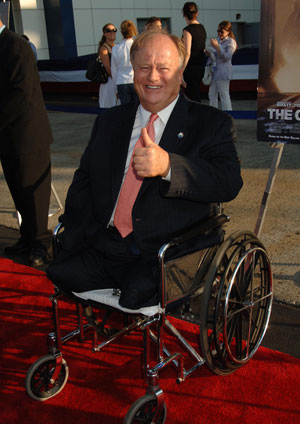
Senator Max Cleland attends the special screening of The Great Raid, held at The Intrepid Sea, Air & Space Museum, Wednesday, August 10, 2005 in New York. (AP Photo/Jennifer Graylock)(Credit: Jennifer Graylock)

Max Cleland grew up in Lithonia, Georgia. After graduating from college he entered the Army as a signal officer and was given a desk job, but requested a transfer to Vietnam. During the siege of Khe Sanh, after surviving five days of point-blank rocket attacks on his hillside position, Cleland boarded a Chinook helicopter to set up a new communications post. Upon leaving the aircraft, he saw a grenade at his feet. Thinking that it was his, he reached down to pick up the grenade. It exploded. It was April 8, 1968.

“When that grenade went off, I was totally conscious. Totally,” Cleland recalled. “Saw the bone sticking out from my right arm. Body was on fire, filled with hot shrapnel. The flash burns seared my flesh and was the only reason I didn’t burn to death right there. I was bleeding to death. Three men ran to me after the smoke cleared. I was burning. I was literally smoking, dying, and bleeding to death. They staunched the bleeding. Called in a chopper. Put me on the chopper and medevac’d me 50 miles to a hospital. A Quonset hut. I was just about to pass out by then. I said, ‘Do what you can to save my leg.’”

“Every time I think about the incident,” Cleland writes in his autobiography, “Strong at the Broken Places,” “I blamed myself for getting wounded, for not coming back from the war whole, for somehow ‘screwing up.’ For thirty-two years, I had carried around the weight of that uncertainty. When I was having a bad night, the lingering self-doubt could keep me awake for hours.”

In 1999, Cleland received a phone call from a former Marine who had just watched a History Channel show on combat medics in which Max was interviewed. The caller, David Lloyd, had been in the helicopter with Max. He was also the first to come to his aid, tying off the bleeding on one of his legs with a tourniquet fashioned from strips from Max’s uniform and web belt. Lloyd then attended to a young soldier who was wounded by the blast. The soldier kept crying, “It’s all my fault!” Fresh out of basic training and only in-country for several days, he had foolishly straightened out the pins of his grenades for quick access. That made them live grenades. When one fell loose from his pack, it exploded.

Lloyd’s call changed Cleland’s life. “David had given me an invaluable gift, the gift of peace of mind,” Cleland said. “Finally, I can say, ‘It was not my fault.’ That is a great burden off my shoulders. It makes all the other burdens in my life seem less significant and more manageable.”

Facing life as a triple amputee, Cleland sunk into despair. Politics pulled him out. At 28, he became the youngest member of the Georgia State Senate. Picked by President Jimmy Carter to head the Veterans Administration, Cleland created veterans’ centers across the country and worked to create the diagnosis of post-traumatic stress disorder, a revolution in veterans’ health care. He ran successfully for the U.S. Senate in 1996.

In 2002, what Cleland calls “the second big grenade in my life” blew up in his face. Running for reelection to the Senate, he was confronted by a Republican challenger, Saxby Chambliss, who used the George Bush/Karl Rove playbook to smear him as a weakling on national security. Chambliss (who sat out the Vietnam war with a bad knee) ran a commercial that depicted Cleland’s face morphing into that of Osama bin Laden. Cleland lost the election, a blow from which he says he still hasn’t recovered.

Since then, Cleland has thrown himself into working for Iraq veterans. He campaigned on behalf of Tammi Duckworth, who recently won the Democratic nomination for an Illinois Congressional seat. Duckworth is an Iraq war vet who lost her legs in 2004 when a rocket-propelled grenade downed the helicopter she was flying.

Asked by NPR what it was in Duckworth that reminded him of himself, Cleland said, “Her sense of having been blown to Hell and back. And that, coming back to this country, you know that you’re not going to sit on your rear end. You’re not just going to collect a retirement or a pension. You’re going to fight like hell for a new life, a new job, a new career and one in public service.”

- – - – - – - – - – - -

I find myself today, going on sixty-four, a washed-up, dried-up prune of a military veteran who has been thrown on the scrap heap of time and looking back wistfully and saying, “I wished I’d done more to prevent the current disaster in Iraq that’s exactly mocking the first disaster in Vietnam that I was personally a part of.”

I go to Walter Reed Hospital now for trauma counseling. For my own self. Because it never ends. I’ve got post-traumatic stress disorder. Didn’t know I had it. Anxiety and fear and all that crap. And it never goes away. But you can submerge it into a higher cause like politics.

So here I am, back at Walter Reed, thirty-seven years later, dealing with the trauma of Vietnam. I never got the counseling back then. But I look down the hall, and it’s still 1968. Seeing all these young Iraq War veterans blown up, missing arms and legs and eyes, I just can’t stand it. It triggers all of my stuff from Vietnam. And these young men had the same grit and courage that we had going off to war. You go up to ‘em, and say, “How ya doing, son?” “Fine, sir!” they answer. But years later, it will take its toll. They just don’t know yet.

I’m seeing the full circle of the Vietnam experience. What’s happening today is that a certain number of young Marines and Army guys are doomed to get killed and blown up and have missing arms and legs and eyes, and maybe they’ll be on the phone twenty to thirty years later talking to some guy writing a book about them. I have seen this movie before. I’m terrified that I’m seeing Vietnam all over again in my lifetime.

Iraq is Vietnam on steroids. I recently had a phone call from a friend of mine who was in the same infantry battalion that I later went into. He wrote the history of that battalion in a book called “The Lost Battalion.” His name is Charley Krohn and he teaches at the University of Michigan. He is a hard-core Republican, but he transcends his party. He says, “We have the worst of both worlds in Iraq.” Charley knows combat. His squad lost over half its men — over twenty men — in the woods outside Hue during the Tet Offensive.

Anybody who understands Vietnam or went through it, like me and Charley and others, sees this war in Iraq as nothing other than total folly. Its impact on me has been profound. It got me involved in the Kerry presidential campaign. It attracted my fellow Vietnam veterans who understood the arrogance of power and were wounded by it. When I speak with soldiers back from Iraq, they have the same deep, mixed feelings that we had when we came back from Vietnam. They are proud of having served their country. But then again, they are disgusted and angry with the way they were used and finding themselves in a situation where they get blown up and maimed and worse.

Bush has created a war that didn’t have to happen. As Richard Clarke put it, “Invading Iraq after 9/11 was like invading Mexico after Pearl Harbor.” Instead of going after bin Laden and all of his terrorists in the mountains, Bush transferred those resources and those men on the ground to Iraq. We now see a new generation of terrorists willing to blow themselves up to take out a bunch of Americans. And you add the Iraqi people. What you have is an absolute disaster.

Bush has gotten young Americans killed and wounded and blown up in a shooting gallery in Iraq. In a way, that is criminal. It is grinding the American military down. People are going back for their third tours. We have in effect thrown in everything we’ve got. And it ain’t working. It’s getting worse. There’s continued killing. And sooner or later either the people or Congress is gonna ask, “Is it worth it?” And they are gonna answer, “No!” And then where are all these young men and women who have lost legs and arms and eyes going to be? That’s called Vietnam.

The main problem is that there is no exit strategy to win in Iraq. What was our exit strategy in World War I and World War II? My answer was to win. Former Army Chief of Staff General Shinseki requested 250,000 to 500,000 troops for Iraq. These additional troops were necessary to secure the population. Bush didn’t want to go with that number. So there are not enough troops on the ground to win. We are trapped in the quagmire. And the American people will ultimately reject that. As a matter of fact, the majority of Americans think it is not worth it anymore. I knew it would happen. It took the American people about two years to come to that realization.

Sooner or later, the U.S. will ultimately withdraw from Iraq. What they have created in Iraq is a terror haven, a civil war that has no end. We destabilized Iraq. It had a stable government. We didn’t like it. We had Saddam Hussein in a box. But this president went in and took Saddam Hussein out and thought that was gonna be the end of it. He didn’t listen to Secretary of State Colin Powell, who said, “Mr. President, do you understand the consequences?” Of course he did not. Not only didn’t he know the consequences of those decisions, Bush wanted to be macho and be better than his daddy.

The people who got us into this war didn’t want to learn from history. Of the 550,000 who served in Vietnam, 100,000 were foxhole strength. So Defense Secretary Rumsfeld wanted to go in on the cheap. The original Pentagon Plan for the invasion of Iraq called for 500,000. That’s the first plan Bush was shown, because the Army has about 131 indices on a matrix that says: Given the terrain, given the forces, given the population, if you are going to invade the country and do regime change and have to occupy and secure the population and control the terrorists, then take all these factors and you come out with the X factor, which was 500,000 troops. Rumsfeld and Bush wanted to go in and do it on the cheap in a running start — not as Colin Powell did in the first Gulf War and send 500,000 people in there at one time. Your ground war lasts ten hours and it’s over. No. Not this crowd. They had no idea what they were doing. So the problem is that another generation of young Americans will come to grief over war. Under Bill Clinton, General Hugh Shelton, chairman of the Joint Chiefs of Staff, used to say, “American military is the great hammer. But every problem in the world is not necessarily a nail.”

John Kennedy once described himself as an idealist with no illusions. In conflicts outside the boundaries and waters of the United States, you better be a realist. The history of the world teaches us that no foreign power is going to invade some country without tremendous opposition. We ran up against the Oriental mind-set in Vietnam. In the Middle East, they think in thousands of years: “Though it takes a thousand years for revenge, I’ll get ya.”

Sooner or later, the impact of the politics of unmitigated war in the Middle East will be felt here in America. But it will take time as the impact of these policies is felt in our pocketbook, in the gut, in the minds and hearts of American people. There is a great line by Benjamin Franklin. Coming out of Constitution Hall in Philadelphia, a lady asked, “Dr. Franklin, what kind of government do we have?” And he said, “We have a Republic — if you can keep it.” So this sense of an American experiment is not a given thing.

I’ve run across people — young people, old people — who want to continue the fight for what they perceive as the defense of democracy in our country. I met this lady who worked for former Senator Tom Daschle. They were clearing out his office on Capitol Hill. She said that she initially wanted to leave the country and move to Costa Rica. She then quoted something from Thomas Jefferson, and I will paraphrase: “Every generation has to decide anew whether it wants to continue this democracy.” One of Kerry’s campaign speeches used a quote from President Kennedy. It went: “Every man can make a difference. And all of us should try.” That is what inspired me to get involved in politics.

When I had gone over to Vietnam, I was thinking it would be like South Korea. Finger in the dike. Stop the bad guys from taking over the south. You know, we are the good guys. They are the bad guys. I bought the whole premise. But then each week, each month that went by, I saw that we were more motivated than the South Vietnamese troops. Then I ran across a friend of mine who was an adviser to the Vietnamese. He was an Army captain. He said, “We are on the wrong side.” The situation on the ground was completely different than we had been told. The Viet Cong went after us with dynamism, and they did so with such ferocity that they were looked upon as patriots. The Viet Cong swam in the sea of the people. They could not have existed had the public not supported them. So we became the new French.

I wound up being retired from the United States Army the day before Christmas Eve 1969. I was sitting in my mother’s living room in my little hometown. No future. No hope. No job. No income. No apartment. No car. So the decade which had dawned with such promise in January 1961 and with such great words — “Ask not what your country can do for you; ask what you can do for your country” — ended up with me biting the whole bait. I went with the whole program. In Georgia, nobody would give me a job. Nobody was coming around and saying, “Oh, you’re a great American hero.” I’d have a friend take me to Atlanta and we’d get drunk. I’d come back and think, “What the hell kind of life is this?” So I decided to get back into politics. I really had no other alternative if I wanted to get out of all this pain and sorrow. Running for public office was something that would give me a sense of meaning and purpose and direction. It was something I could do to make a contribution. I had been interested in running for Congress, but I didn’t think I could win as a fresh face. I looked at the State Senate, which included my hometown in the district. I thought, “Well maybe if I ran a good campaign, I could win.” And so I ran and raised my own money.

After I got elected to the Georgia State Senate in 1970 and Jimmy Carter was elected governor, I put forward a resolution in the State Senate for the withdrawal of our ground forces in exchange for our POWs. Although I had never joined Vietnam Veterans Against the War, what began to sink into my mind, as I saw more and more casualties coming home with arms and legs lost, was, “This has got to stop.” The only thing that I thought could get us out of Vietnam was to get our POWs back.

When he became president, Jimmy Carter took a big chance on me to run the Veterans Administration, because I was only thirty-four and I had never run anything bigger than a platoon. He put me in charge of a department larger than eight cabinet departments combined. And it was a glorious experience. Tremendous stress. Tremendous pressure. But we were highly focused. We were highly motivated. Because we had to take care of these Vietnam veterans coming back.

We created a diagnosis for PTSD — post-traumatic stress disorder. The former chairman of the Veterans Affairs Committee in the House of Representatives thought Vietnam veterans were crybabies. World War II guys didn’t believe all this stuff. So, PTSD was created as a diagnosis. I created the vet center program with Senator Alan Cranston and Jimmy Carter. The first vet center I dedicated personally. It was in Van Nuys, California. It was me and two guys. No band. No flag. No flair. Nothing. Now there are twenty vet centers in the country. And they are swamped — not only by veterans of the Vietnam era, but also from the Gulf War. Now more and more are from the Iraq War.

In four years, we also were able to create a new vocational-rehabilitation program, which had not been updated since World War II. We were able to do a helluva lot. But after Jimmy Carter lost the election in ’80, I only got one phone call the next day. It was from a low-level guy in one of the veterans organizations. That was it. He said that I had the most thankless job in Washington.

I put my stuff back in a truck and hauled it back to Georgia. I moved in with my mother and daddy again for two years. And I then ran for Georgia’s secretary of state. Won that. I was secretary of state for twelve years. I probably shoulda stayed there. But U.S. Senator Sam Nunn walked away from his seat. And Clinton was in office. It looked like good things were happening. I figured that the only reason I’d go to Washington would be to take Sam Nunn’s place on the Armed Services Committee. So I ran and won. I thought that if I just worked hard and did a good job — I looked after our troops and cared about Georgia — that I would be re-elected and carry on Sam Nunn’s legacy.

What I didn’t reckon on happening was George Bush winning in 2000 and Karl Rove coming in and teaming up with Ralph Reed. And then in 2002, with the impact of 9/11, the Republican Party began trashing everybody as if they were un-American. I was actually an author of a homeland security bill along with Joe Lieberman. But the Chambliss campaign ran an ad saying that I voted against George Bush and homeland security. Well, I voted against some amendments while the bill was in committee. They just did their normal fear and smear job. And yet, I had voted for Bush’s tax cut and I voted for the war, which is the worst vote I ever cast.

Looking back at my six years in the U.S. Senate, I take pride in the accomplishments during the early days. The expansion of NATO in Western Europe, in Poland and the Czech Republic and so on. It was literally the expansion of freedom. The march of justice and freedom expanding through the Western European theater and into some old Soviet-dominated areas.

Then came Clinton’s impeachment. The trial in the Senate was the most awful experience you can possibly imagine. I was sick as a dog. Not just politically but personally. I had mononucleosis and didn’t even know it. Viral infection in my sinuses. I just thought I was gonna die.

I voted not guilty. While Clinton lied and so forth, it certainly was not an impeachable offense. But it brought down the Democratic progress, and it activated the radical right. It gave them something to beat the Democrats over the head with in the elections of 2000. Which is one reason Bush won.

In the Senate, I also tried to push for families qualifying under the GI Bill to take care of the troops. After 9/11, under the flag that was flown at election time, good works seem to not matter. That is one of the powerful discouraging things about politics today. It’s not what you produce or the good works that you do. It’s whether or not you’re able to withstand a thirty-second negative ad and if you’re willing to go out and trash the other guy or gal just as badly. It’s all character assassination politics now. It seems to carry the day. That’s the sad part about it.

Personally, after my Senate loss on election night 2002, it went downhill from there. I still haven’t emerged from that loss. In Robert Caro’s book about Lyndon Johnson, LBJ said that he lost the South after the Civil Rights bill. By 1968, Nixon had embarked on the Southern strategy: “Go after the redneck boys on race. It’ll bring ‘em in every time.” You know, it’s become more subtle over the years. Certainly, it’s what Ralph Reed had used against me in my 2002 re-election campaign. The Confederate emblem on the state flag was the incendiary bomb in Georgia politics. And it hit the third rail. Which killed us all. It gave the hatchet to the right wing. They raised the issue that Democrats were trying to take away Georgia’s culture. The cultural war included the Confederate flag. That was their symbol. The Republicans were for the whites. The Democrats were for the blacks. They pulled the flag into their cultural issues of abortion, guns, gays, and God. Karl Rove got a lot of money to come down and push nothing but voter registration and turnout for white males. That’s what was coming off the charts in anger against all Democrats. There was also George Bush’s five visits to Georgia. They buried us with their strategy. It turned out an extra 140,000 angry white males who normally didn’t vote. And it turned the mid-term election. Governor Roy Barnes and I lost by approximately the same margin.

When I’m in public office and doing something worthwhile in a cause, I have a mission and a purpose. I can perform and do great things and enjoy it magnificently. When I don’t have that, I’m struggling with deep depression and discouragement and a sense of meaninglessness. When John Kerry announced his candidacy, he asked me to introduce him at Charleston, South Carolina.

With John Kerry, it looked like maybe the Vietnam War had produced a leader for the country who could translate that powerful negative into a very powerful positive experience, and with a new positive direction in our foreign policy. But that was not to be.

Today, there are no manners in politics. We’ve seen the viciousness with which the Republican crowd goes after people. They took out Senator John McCain in South Carolina in 2000; Senator Bob Smith in the New Hampshire primary, again a Vietnam War veteran; Chuck Robb in 2000 in Virginia; myself in 2002 in Georgia; John Kerry and Tom Daschle in 2004. The viciousness of their campaigns of character assassination has reached new levels. It’s obvious that they threw out any rules of law. Now it’s all about whatever it takes to win and devil take the hindmost. It’s getting kids killed in Iraq and our foreign policy is at low ebb. The economy is going down. The dollar is getting weaker. Increasingly we are just the laughingstock of the world.

I’m a Democrat, so I cite Thomas Jefferson. He said there were basically two classes of people: one that tends to leave authority to the select few and the powerful, and the other is one that wants to give the people control. Jacksonian Democracy is really the fulfillment of that. Andrew Jackson. Old Hickory. The hero of New Orleans. He had a great line that I used for John Kerry. “One man with courage is a majority.” I’ve been down to Andrew Jackson’s home. The Hermitage outside of Nashville, Tennessee. He ran for president once and didn’t make it. But he ran for president a second time and did make it. Ironic that such a man of the South represented Democratic ideals. Now, Democratic ideals are being shunned for the past twenty to twenty-five years in the modern South.

But anyway, the point is that the great history of the United States will ultimately triumph over any radical departure from real authentic American values which go all the way back to Plato and are echoed through Jefferson, Jackson, Benjamin Franklin, and a host of others. And that is the sense of wisdom and justice. And moderation and courage. In fact, with the phrase “equal justice under law,” you really don’t have an underpinning of law until there is a sense of justice. And what is justice? Life, liberty, and the pursuit of happiness. That one man’s life, liberty, and pursuit of happiness is just as valued as another man’s life, liberty, and pursuit of happiness. Therein lie your values of the democratic process.

This Republican crowd is a Trojan horse. They say one thing and do another. I don’t think you have to be false with people. You have to tell the truth and seriously connect with people. Average citizens thought they were doing the right thing by voting for Bush and this crowd. You need to be honest and straightforward and real with the American people. Ultimately, as Lincoln said, you can fool some of the people all of the time, and all of the people some of the time, but you cannot fool all of the people all of the time.

I have no more desire to return to politics. I still have tremendous desire for public service. I’m on the Export-Import Bank Board right now, but I want to stay involved in public service in Georgia. But I have no desire to put my name on the ballot. I won’t ever run for office again. I can’t handle it. Because it did me in. It’s too much physically and emotionally. So probably my best venue is out of the limelight. I’m like an old combat commander. I’ve been in combat too long. I was in combat for nine years, from October 1995 to just recently. I have known both military and political battles. I have been traumatically wounded by both. Winston Churchill said that politics is a lot like war, except in war, you get killed once. In politics you get killed many times.

Looking back on my career, I am proud of being the Veterans Administration head and dealing with the aftermath of the Vietnam War, in particular, putting together the program for veterans’ centers, which deals with the emotional aftermath of war for veterans and their families. Thank God for that program, because it is being swamped by a new crew of Iraq War veterans. They are dealing with depression, anxiety attacks — stuff like that. We have created a quarter of a million Iraq War veterans. In Vietnam, we had eight and a half million veterans. We are adding to that quarter of a million number every day. Walter Reed is swamped with bona fide casualties. Particularly amputees. The VA is swamped. They don’t have enough resources. Senator Craig, a hard-core Republican from Idaho who is on the Senate Armed Forces Committee, admitted that the VA medical program was about a billion dollars short. The private counseling program is where it is most short. That is what ought to be beefed up. With all these Iraq War veterans coming home, their families will also need counseling.

Instead of “American Idol” on TV, we ought to be focusing on the lives of these young kids coming back with injuries that would have killed them in Vietnam, like concussions to the brain, because 85 percent of the casualties in Iraq are due to explosive devices. That’s a shock and trauma to the system even if you survive it. It blows up your insides and your brain in a concussion that you won’t ever get over. It is just terrifying to come back and have to live with that the rest of your life. But these kids are so brave and so courageous that we ought to be focusing on them. Instead, many people put a sticker on the back of their car that says, “We Support the Troops,” and then they put a Bush/Cheney sticker on the other side. And think that that’s America.

Meanwhile, the Democrats are trapped in a mixed message. Anytime you have troops at war, you are reluctant to criticize it. Because then you are attacked as un-American and unpatriotic. So it’s hard to stand up and speak the truth. Those who do get trashed. They get attacked by the Slime Machine. The price to go up against them is awful. I was on the 9/11 Commission, but I resigned after a year because we would never get access to all of those presidential daily briefs. Ten, twenty years later you’ll have another commission and go into this thing in depth. But right now, it’s all part of this massive cover-up that somehow we are fighting the war on terrorism in Iraq.

The current political situation is enough to kill everybody’s spirits. We are in a deep dark time in American history, but the American character is wonderful. Arthur Schlesinger, Jr. recently told me that the great thing about our democracy is that it is self-correcting.

Excerpted with permission from “Patriots Act: Voices of Dissent and the Risk of Speaking Out,” by Bill Katovsky. The Lyons Press.

Continue Reading Close

Mr. Ruckus

John Sellers climbed the Sears Tower to protest nukes and unfurled an anti-logging banner over the Golden Gate. The left's Merry Prankster talks.

  • more
    • All Share Services

Mr. Ruckus

John Sellers is a master of the larger-than-life political gesture. He’s climbed the Sears Tower, unfurled a giant banner over the Golden Gate Bridge and sneaked onto the roof of the World Bank building, all to get media attention for various progressive causes. Sellers, 39, is the executive director of the Oakland-based Ruckus Society, which offers disciples of nonviolent direct action state-of-the-art training in blockading, urban-building climbing, radio communication, and other skills. In 1999, Ruckus achieved international notoriety as one of the key organizers behind the anti-World Trade Organization demonstration in Seattle where 50,000 activists surrounded the WTO meeting site. Sellers blames the violence on the Seattle police, saying, “When people talk about the riots in Seattle, it was the cops who had the riot. It was a full-on cop riot. They just completely lost their shit.” For his part, Sellers sees himself as following in the footsteps of such civil disobedience heroes as Gandhi, Dr. Martin Luther King, Jr., and Rosa Parks — with an updated, media-savvy spin. Sellers met his wife, Genevieve, during the Golden Gate Bridge protest; they have twins who were born on election day, 2004. He has lost exact count of the times he’s been arrested during his career, but he estimates it’s between 30 and 40.

- – - – - – - – - – - -

I grew up in a little town in Pennsylvania called Phoenixville — old steel town, probably one of the first. Made the steel for the Brooklyn Bridge. The steel mill closed when I was a little kid. My mom was a fourth-grade teacher, and my pop made tires in a rubber mill for Goodrich Tires.

I remember this one big family road trip we took to the Everglades. I had an environmental epiphany there. I was eight or nine years old. This beautiful park ranger was giving us an ecology tour. She took us out in this marsh and had us all take our shoes off and walk into this marsh. The mud was squeezing between our toes as she talked about how this ecosystem was dependent on the water that flowed. The Everglades was this giant, wide, slow-moving river. This marsh supported the darter snail, which was the staple food for the whooping cranes, these unapologetic, uncompromising birds that wouldn’t eat anything else. They flew across the planet when they migrated, and this was an important stop for them. Because industry was carving up the Everglades, the darter snails were getting fewer and farther between, and that was impacting these whooping cranes. I guess a light bulb went off in my head. My sister was also inspired by what she was hearing. When we got home she totally shamed me by writing to our senator. A couple of years afterward, I was lying on the floor of the den and watching 60 Minutes and there was this piece on Greenpeace. I watched these crazy hippie commandos put themselves in front of grenade-tipped whale harpoons in their little boats and hang from oil rigs and sail in nuclear-test zones. I could feel the hair standing up on my arms and the back of my head. And that is when I decided what I wanted to do when I grew up.

During my first couple of years in college, I had the zeal of the recently converted. I was such a self-righteous shit. My dad once took me out for a nice prime rib dinner, and I was such a little smartass as I tried to break down capitalism for him. I wanted to make him understand how he was a puppet of the system by working in the tire factory. Yet here was my dad working twelve-hour days from midnight until the afternoon and busting his ass to get me to college, and I gotta tell him that he was part of the exploited proletariat. We definitely had some awkward years there for a while.

After graduating from college and working in Australia, Sellers returned to the United States, where he got a job canvassing for Greenpeace.

After about two or three months in the Philadelphia office, I got fast-tracked and became a field manager. I was now driving a van full of canvassers. They were mostly white kids. One of the women in the office was an Amish girl who had defected from Pennsylvania Dutch culture. There was a Quaker girl who practiced witchcraft. There was a lot of turnover in this canvassing world. Lots of drinking and partying. The whole reason that I was willing to canvass was that I wanted to do direct actions for Greenpeace. I wanted to sail with their ships.

Greenpeace at that time had a nonviolent action team. Still does. There was this cement kiln facility in Bath, Pennsylvania, which was not too far from Philly. They were using toxic flammable waste to fire the kiln. They had actually received a commendation from the U.S. government for creatively disposing toxic waste. They had expanded their permit so they could burn chlorinated compounds. Our toxics campaign targeted this place, but in order to scout the facility, Greenpeace asked me and another guy to drive out there and pose as documentary filmmakers from Temple University. We told the company that we were making a documentary on the re-emergence of industrialism on the East Coast. We actually got the company president on film. He took us inside, bragged about his government award. The guy was just totally delighted and honored to be in the film. We mapped out the whole facility, drove around it, filmed it, looked at all the entrances where the actual waste trucks were coming in. Really dialed it in. I think we did a real thorough job. Greenpeace’s East Coast action coordinator was so impressed with our scouting job that I was invited to be in the actual action itself. So that became my first action.

We went to a farm in upstate Pennsylvania and trained for three or four days. Our plan was that we would deploy a cargo truck at the most important entrance where the toxic waste came into the facility. We’d block that entrance and jump out of the truck and cover it with banners explaining the toxic-waste issue. We’d then chain ourselves up under the truck. I was working with another woman who was a toxics campaign intern from New York. She was going to be my partner. It was late fall and we wore big padded union suits. We cut sleeping bag pads to fit inside our suits so that we could lay on the cold ground for hours. We were wearing diapers. We also had a long steel tube to lock our arms in. It was cut at a right angle and welded together so that it could go over the axle, and we would each place one of our arms inside the tube from opposite directions.

We ended up pulling off the action and chaining ourselves under the truck. Because we each had an arm up over the rear axle of the truck, we were on both sides of the tire; they couldn’t move the truck without running one of us over. It took them about eight hours to cut us out. They had to remove the floorboards from inside the truck. The president came out and recognized me. He was so pissed off. The state troopers were playing good cop and bad cop. At the end of the day we got arrested. It was amazing and inspiring to have crossed that line, to do something where you are heeding a higher moral calling. The U.S. toxics campaign at that time was just really kicking butt. And they actually got a full-blown moratorium on the construction of any new incinerators. That particular cement kiln was later declined a permit to burn even more dangerous compounds.

Anyway, after we did this action at the kiln, Greenpeace fast-tracked me toward more responsibility and more action training. I got invited to what turned out to be the last action camp that Greenpeace ever did. It became the model that Ruckus stole or borrowed. It was held outside of Silver Springs, Florida, at a children’s camp. The action camp was just remarkable. There were 150 people from all over the world. We practiced urban-climbing techniques and banner hanging on scaffolding four or five stories high. There was a lake where we practiced boat-driving skills with inflatable Zodiacs. Some of the old dogs were there, the people who had inspired me when I was ten years old. I met Mike Roselle, who is the main founder of Ruckus. He was my nonviolence trainer. He talked about mass civil disobedience in which they would get hundreds or even thousands of people arrested, and then the action would continue into the jails and clog up the system itself. It was an awe-inspiring nine days.

One of my biggest climbing actions was the Sears Tower in 1992. A friend of mine, Claire Greensfelder, who worked in the No Nukes campaign for Greenpeace, started thinking about the fiftieth anniversary of the first sustained nuclear reaction, which happened on December 2, 1942, at the University of Chicago underneath the squash court. We knew that the Nuclear Regulatory Commission and nuke advocates from around the world would be in Chicago to celebrate fifty years of nuclear energy. There was no way we were going to let their pro-nuke pep rally go off unchallenged. We wanted to metaphorically piss on their atomic bonfire. Because Chicago’s symbol to the world is the Sears Tower, we decided that we would climb it and hang a banner.

We started training one month out. In most building-climbing situations, you try to sneak up to the roof and then rappel down. But in this climb we decided to work with these crazy engineers. The coordinator of this climb was Dave Hollister, who designed some aluminum devices that we would use as cams inside the window-washing tracks. This would allow us to start at the base of the Sears Tower and climb up the outside of the building. It is 110 stories. We had no illusions that we were going to climb up the whole side of the building, although you could with these devices. If we climbed the whole building and hung the banner at the top, nobody would have been able to see it. So our strategy was to climb about thirty floors up, or about 400 feet off the ground.

There were four of us. We actually built a piece of window-washing track in Washington at the Greenpeace equipment center where we practiced climbing. Because we were going to be climbing the side of the Sears Tower in one of the windiest cities in the United States in December, and in the freezing cold, we bought $3,000 worth of cold-weather gear at REI. Once in Chicago, we got a big team to help us with deployment. We got to the side of the building about 5 A.M. It was pitch dark. We looked like spacemen in all our gear. We brought along these big stoppers to stop the window-washing carts from coming down — because this French climber guy nicknamed Spider Dan had gone up the Hancock Building, and the police came down on the window-washing cart and used high-powered hoses to try to blast him while he was free-climbing the building. The mayor of Chicago had to come out and basically save this guy’s life by telling these cops not to blast him off the side of the building. We were painfully aware that we did not want any kind of dynamic confrontation while we were on the side of the Sears Tower.

We put our devices in the window-washing track and started to climb. Right around the first or second floor — we are just twelve feet above the ground — all of us start getting stuck in the track, because it was a slightly different design than the track we had been using. We had to take these screws out of our devices. Three of us got unstuck. I am lifelined to the woman next to me. Her name is Nadine Bloch. We have a rope between us in case one of us falls. Bill Richardson is our pack horse. He is carrying a seventy-pound pack up with the banner, a 2,500-square-foot banner. It’s massive. He starts climbing. Diana Wilson is the fourth climber. She literally got stuck for the entire day. She could not get her device free. So she spent the day outside the second floor.

Right around the sixth floor, I get stuck again because the track is a little too narrow. The pins are stopping me from ascending. Just then the firemen roll up in a big ladder engine. I needed to get up around the eighth or ninth floor before the ladder gets there. I am wailing with one device on the side of the building. I took an industrial suction cup, which we all carried as a third point of protection, and placed the cup on the glass. I set it and then tied myself off to it so that I could safely take my cams out of the track. I finally got the damn pins out and I start moving. The ladder is coming up the building. I’m just humping it up the side of the building to get out of harm’s way. I end up getting away. I tied back on to Nadine so we would be lifelined to one another. We went up to the thirtieth floor and began deploying the banner. We now are working with three different ropes to hold the banner down and secure it to the side of the building. It’s about twenty below zero with the wind-chill factor. It starts to snow and it’s blowing a gale. Snow is flying up the side, kinda going up into your nose. We have been up there for several hours now. We are trying to pull the banner down and deploy it on the side of the building. All the different ropes are just spinning around below me in the wind; they were all going through one carabiner on my harness. This gust of wind blows up the side of the building and catches the banner like a giant sail. Kind of like parasailing. As the banner fills with wind, it blows the ropes up and they all get stuck in this carabiner, and I literally start to sail off the building. My climbing devices were designed to keep me safe by my weight pressing them down in the track. All of a sudden my weight is coming off the devices and I am going in reverse, up the building. That was the scariest moment in my life. I could have been pulled right off the building. I didn’t know what was going to happen. A 2,500-square-foot sail pushes a really big boat through the water. It was probably catching a thirty-knot wind in it. I was paralyzed with fear. Nadine was screaming, “Get that goddamn carabiner off your harness!” For a split second the wind died down and I was able to take the carabiner, unclip it, and untangle myself from the whole rats’ nest of ropes and carabiner. Ten minutes later, we were deploying the banner. Pulling it down nice and taut and tying it onto the building. It was an incredible moment.

The story went global. It made the front pages of newspapers in Japan and China and Australia, with the image of our huge banner. It was a giant, ominous-looking mushroom cloud with a skull peering out of it. Below the mushroom cloud were missiles and radioactive casks of waste. It said: “End the 50 Year Nuclear Nightmare. Nuclear Free Future Now!”

There were a thousand people gathered underneath us. This was spontaneous. We hadn’t called for a rally. People were chanting, “Go Greenpeace! Go Greenpeace!” We did a bunch of phone interviews with TV and radio stations while still hanging off the side of the tower. I talked to people inside the building. The windows weren’t open. We were just yelling to one another. One of the women called my fiancée at the time and said, “Hey! Your fiancé is right outside the window of my office. I happen to work on the twenty-fourth floor.”

Throughout the day, we had been communicating with the police by radio. We had a coordinator on the ground who allowed the cops to use our radio system to communicate with us. They had told us that we’d be arrested. We said we understood that. We were willing to take that responsibility. We had done everything possible to ensure both our own safety and the safety of everyone else. We had lanyards on everything so we wouldn’t drop anything. We told the cops that we would be down by the end of the day, that they could arrest us then. We asked them not to endanger firefighters by sending them after us. By the end of the day, the banner had been shredded by the high wind. We stuffed it into different packs and climbed down. Oh man, I was exhausted when my feet touched the sidewalk after hanging out in the freezing cold for eight hours.

After discussing his role in the WTO protests in Seattle and the anti-old-growth logging Golden Gate Bridge action, Sellers talked about his experiences at the 2004 Republican Convention.

For the 2004 Republican National Convention in New York, we worked with a super-cool local businessperson who allowed us to take over his office live/loft space in Chinatown. We brought along our state-of-the-art communications infrastructure. We had all kinds of scanners for scanning tactical police frequencies. We had this amazing network of cell phones using text messaging. We had a network of 900 cell phones that was coordinated with groups that had another 7,000 cell phones in networked loops, so that we could instantaneously communicate with all these people on the street and receive intelligence from those 7,000 people. We had encrypted chat rooms on-line. We had just an incredible communications hub — helping people stay safe and be strategic and know where Republicans were having their corporate pep rallies at any time. We went there mainly to test-drive a bunch of technology we were working on. These emerging cell phone technologies are being used by citizen activists all over the world. Folks used text messaging in Spain after the 2004 train bombing to organize opposition overnight to the pro-war ruling Spanish party. It’s the preferred method of communications for Chinese dissidents. There are billions of text messages being sent in China. It is really a hyper-democratic form of communications. Unlike computers, cell phones cross the digital divide because they are cheaper than landlines.

While we helped provide communications assistance to a lot of the folks who were doing different actions in New York, I was mostly staying off the streets. During the convention, my photo was flashed on ABC’s “Nightline” by Ted Koppel as “one of the twenty most dangerous anarchists in the country.” I ended up going on an unpermitted People’s March from the United Nations on the East River over to the Republican convention at Madison Square Garden that was sponsored by Kensington Welfare Rights Union of Philadelphia. We helped do some of their communications. The march started out with probably about 2,000 people. By the time it went around the city to the Garden itself, it was probably only about 1,000 people. It was getting pretty crazy, and the cops were getting more and more provocative and aggressive. It was not a good scene. The cops didn’t play fair. They would pen people inside these plastic mesh barriers, and then you had to defend yourself later in court. Hundreds of people were arrested just for being in the wrong place at the wrong time. I remember walking away when I overheard two plainclothes cops talking. One said, “Who is that long-haired guy with John Sellers?” I realized we were under surveillance. And so we ended up putting a team in place to do counter-surveillance.

The cops saw that we were watching them. The streets were just crawling with different people. The feds were watching us. It was crazy — snipers on roofs, pointing. We were waving to the snipers on the roofs. On the last night, I had taken a cab back to Chinatown and I was about to walk into the place where I was staying when some of our own counter-surveillance folks who were coming in behind me waved to the undercover cops in a van parked nearby. To their surprise, the cops rolled down the windows and said, “Hey, we want to meet Sellers. Come on, it’s all over.” So my friends came up to me and said that the undercover team of New York’s finest who were watching me all week wanted to meet. The guys started yelling out of the van, “Yo, Sellers! C’mon, ya chickenshit!” I was like, all right. So I walked down there. I got in their van and we ended up having a great conversation. The guy in charge of the team was this really scrappy, funny Italian guy. He said, “Yo, John, I had a lot of money riding on you, dude. You were supposed to destroy this whole city.” I asked, “What are you talking about, dude? I am a nonviolent guy.” He said, “C’mon. You were supposed to destroy the whole town.” I was like, “I dunno what you are talking about.” It was pretty clear that they didn’t know anything about me or Ruckus at all. I think they just got handed a file by the feds. They realized by the end of the convention that they had been given a bunch of bullshit by the feds. I’ve been convicted of a bunch of stuff. But it’s all stuff I’ve been proud of. I have never been convicted of a felony. I’ve been charged with a bunch of felonies. A lot of times that is what they see when they get your record. They can say, “You’ve been charged with seventeen felonies.” It doesn’t mean you’ve been convicted of them. They try to make it sound as bad as they can. And so, these undercover cops wanted to know who we really were. We ended up hanging out for several hours.

In recent years, Ruckus has been requested to get involved with campaigns all over the world. But our focus at Ruckus is North America, not global. We live in the belly of the beast. We resist the urge to take our show internationally, because we have a responsibility living in America to work on the handles of power right here in this country. We feel that the rest of the world will benefit by making the United States a more democratic and just place, because America imposes its will on the world. We are certainly willing to share our stuff internationally. We’ve made our training manuals available online and open source so people can grab the information and use it.

In the short term, I am stepping back from the edge as far as risk-taking and jeopardizing my personal freedom. I’ve been in jail for decent stretches of time. I can imagine what it would be like to spend six months or a year or two in jail. I am not scared of that. But I am scared of not being with my children, especially right now. It is just so amazing to see them develop their little brains and watch their consciousness grow. I want to be around for that. I have a responsibility to them now.

Meanwhile, I think nonviolent civil disobedience has really been maligned. Even during the civil rights movement, profound violence was being done to nonviolent protesters. Oftentimes the violence done to people of nonviolent means is then turned around and projected back onto them, so it looks like they deserve what they got. That is certainly happening with the global justice movement. Then it’s easier for protests to be dismissed or marginalized by the media, making it look like we are the ones who are unreasonable or criminal or violent in our tactics and purposes.

The people who leave the United States to go fight in our wars are often seen as patriots and heroes. While this is certainly true, I’ve felt for a long time that you don’t have to kill to fight for your country. You don’t have to leave the borders of your country to fight for your country. In fact, the people I have the greatest respect for are people who nonviolently fight for the heart and soul of this country from within its borders. They stay here and fight for democracy in the United States, because we now live in a country that is ruled by unaccountable corporations that are buying up our elected officials and are literally buying up election day itself. All of this corruption to our democracy is going on unfettered. There is a tremendous amount to lose if we allow our democracy to continue being undermined and corrupted. And so, I think the true patriots are here within our borders fighting for the promise of America. They are doing it creatively and nonviolently, exposing themselves to incredible repression and violence to fight for the true ideals of democracy that can and should exist in this country — but don’t.

If I can help in that struggle and do my small part, I love it. It’s what I’m called to do. It’s what I enjoy doing. It’s incredibly satisfying and rewarding. I can’t imagine myself doing anything else. I guess I’m a lifer. I am addicted to struggling with my friends for what we believe in and the values that we hold dear. I hate being framed as a protester by the corporate media which likes to really confuse things. I’m not just against things. I like to be talked about in the context of what I am for. I want a more democratic, more responsive government. A cleaner, healthier, more nurturing environment. A real sense of respect and justice from our legal system for everyone. Those are things that are worth fighting for.

Excerpted with permission from “Patriots Act: Voices of Dissent and the Risk of Speaking Out,” by Bill Katovsky. The Lyons Press.

Continue Reading Close