Bjoern H. Amland

Terror Indictment Unveiled For Norway Massacre

  • more
    • All Share Services

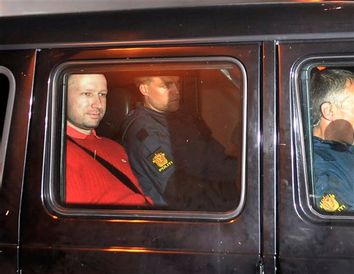
Terror Indictment Unveiled For Norway MassacreFILE - This is a Monday, Feb. 6, 2012 file photo of Anders Behring Breivik, a right-wing extremist who confessed to a bombing and mass shooting that killed 77 people on July 22, 2011, as arrives for a detention hearing at a court in Oslo, Norway. Norwegian prosecutors on Wednesday March 7, 2012 indicted Anders Behring Breivik on terror and murder charges for slaying 77 people in a bomb and shooting rampage but said the confessed mass killer likely won't go to prison for the country's worst peacetime massacre. Prosecutors said they consider the 33-year-old right-wing extremist psychotic and will seek a sentence of involuntary commitment to psychiatric care instead of imprisonment unless new information about his mental health emerges during the trial set to start in April. (AP Photo/Heiko Junge, Scanpix Norway, File) NORWAY OUT(Credit: AP)

OSLO, Norway (AP) — Anders Behring Breivik was indicted Wednesday on terror and murder charges for slaying 77 people in a bomb and shooting rampage, but prosecutors said the confessed killer likely won’t go to prison for Norway’s worst peacetime massacre.

Prosecutors said they consider the 33-year-old right-wing extremist psychotic and will seek a sentence of involuntary commitment to psychiatric care instead of imprisonment, unless new information about his mental health emerges during the trial set to start in April.

As expected, they charged him under a paragraph in Norway’s anti-terror law that refers to violent acts intended to disrupt key government functions or spread fears in the population.

Breivik has confessed to the July 22 attacks but denies criminal guilt, portraying the victims as “traitors” for embracing immigration policies he claims will result in an Islamic colonization of Norway.

The indictment listed the names of the eight people killed when a bomb exploded in downtown Oslo and the 69 victims of a shooting spree on Utoya island outside the capital, where the youth wing of the governing Labor Party was holding its annual summer camp.

Reading from the indictment, prosecutor Inga Bejer Engh said 34 of the victims at Utoya were between 14 and 17 years old, 22 were aged 18-20, six were between 21 and 25 and seven were older than 25.

She said 67 died of gunshot wounds, and two died of fall injuries or drowning.

The indictment also listed the names of 33 people wounded in the shooting and nine people who were seriously injured by the explosion in Oslo’s government district.

Police spokesman Tore Jo Nielsen told Norwegian broadcaster NRK outside Oslo’s Ila prison that Breivik had been “totally calm” when he was read the charges.

The terror charges carry a maximum penalty of 21 years in prison but prosecutors are working under the assumption that Breivik is legally insane and therefore unfit for prison. However, they said that this assessment could change during the trial.

“We’re keeping the possibility open that there could be things during the presentation of evidence that may change our view,” Bejer Engh said.

A second, court-ordered psychiatric evaluation of Breivik is ongoing after an initial review — which concluded he was a paranoid schizophrenic — met widespread criticism. Some experts questioned whether someone suffering from a grave mental illness would be capable of carrying out attacks requiring such meticulous preparation.

Breivik himself has rejected the diagnosis and his defense lawyer Geir Lippestad told Norway’s TV2 that his client was “disappointed” that it was included in the indictment.

Breivik also rejects the authority of the Norwegian legal system, calling it a tool of the left-leaning elites he claims have betrayed the country.

Investigators haven’t found any indications to support Breivik’s claims that he belongs to a secret anti-Muslim resistance movement plotting to overthrow European governments and replace them with “patriotic” regimes.

Tove Selbekk, a member of a support group for those affected by the massacre, welcomed the indictment but said many survivors and families of victims are dreading the start of the trial, set for April 16.

“We’re very clear on the fact that it will be tough … to hear him explain himself and to hear about all those who passed away and how they passed away,” said Selbekk, whose daughter survived the Utoya massacre. “But this is something we need to go through.”

___

Associated Press writer Louise Nordstrom in Stockholm contributed to this report.

Terror Indictment Unveiled For Norway Massacre

  • more
    • All Share Services

Terror Indictment Unveiled For Norway MassacreFILE - This is a Monday, Feb. 6, 2012 file photo of Anders Behring Breivik, a right-wing extremist who confessed to a bombing and mass shooting that killed 77 people on July 22, 2011, as arrives for a detention hearing at a court in Oslo, Norway. Norwegian prosecutors on Wednesday March 7, 2012 indicted Anders Behring Breivik on terror and murder charges for slaying 77 people in a bomb and shooting rampage but said the confessed mass killer likely won't go to prison for the country's worst peacetime massacre. Prosecutors said they consider the 33-year-old right-wing extremist psychotic and will seek a sentence of involuntary commitment to psychiatric care instead of imprisonment unless new information about his mental health emerges during the trial set to start in April. (AP Photo/Heiko Junge, Scanpix Norway, File) NORWAY OUT(Credit: AP)

OSLO, Norway (AP) — Norwegian prosecutors on Wednesday indicted Anders Behring Breivik on terror and murder charges for slaying 77 people in a bomb and shooting rampage but said the confessed mass killer likely won’t go to prison for the country’s worst peacetime massacre.

Prosecutors said they consider the 33-year-old right-wing extremist psychotic and will seek a sentence of involuntary commitment to psychiatric care instead of imprisonment unless new information about his mental health emerges during the trial set to start in April.

As expected, they charged him under a paragraph in Norway’s anti-terror law that refers to violent acts intended to disrupt key government functions or spread fears in the population.

Breivik has confessed to the July 22 attacks but denies criminal guilt, portraying the victims as “traitors” for embracing immigration policies he claims will result in an Islamic colonization of Norway.

Eight people were killed when a bomb exploded in downtown Oslo and another 69 people died in a shooting spree on Utoya island outside the capital, where the youth wing of the governing Labor Party was holding its annual summer camp.

Reading from the indictment, prosecutor Inga Bejer Engh said 34 of the victims at Utoya were between 14 and 17 years old, 22 were aged 18-20, six were between 21 and 25 and seven were older than 25.

She said 67 died of gunshot wounds, and two died of fall injuries or drowning. In addition, 33 people were wounded by bullets, but survived.

Police spokesman Tore Jo Nielsen told Norwegian broadcaster NRK outside Ila prison in Oslo that Breivik had been “totally calm” when he was read the charges.

The terror charges carry a maximum penalty of 21 years in prison but prosecutors are working under the assumption that Breivik is legally insane and therefore unfit for prison. However, they said that this assessment could change during the trial.

A second, court-ordered psychiatric evaluation of Breivik is ongoing after an initial review, which concluded he was a paranoid schizophrenic, met widespread criticism. Some experts questioned whether someone suffering from a grave mental illness would be capable of carrying out attacks requiring such meticulous preparation.

Breivik himself rejected the diagnosis. He also rejects the authority of the Norwegian legal system, calling it a tool of the left-leaning elites he claims have betrayed the country.

Investigators haven’t found any indications to support Breivik’s claims that he belongs to a secret anti-Muslim resistance movement plotting to overthrow European governments and replace them with “patriotic” regimes.

Continue Reading Close

Terror Indictment Unveiled For Norway Massacre

  • more
    • All Share Services

Terror Indictment Unveiled For Norway MassacreFILE - This is a Monday, Feb. 6, 2012 file photo of Anders Behring Breivik, a right-wing extremist who confessed to a bombing and mass shooting that killed 77 people on July 22, 2011, as arrives for a detention hearing at a court in Oslo, Norway. Norwegian prosecutors on Wednesday March 7, 2012 indicted Anders Behring Breivik on terror and murder charges for slaying 77 people in a bomb and shooting rampage but said the confessed mass killer likely won't go to prison for the country's worst peacetime massacre. Prosecutors said they consider the 33-year-old right-wing extremist psychotic and will seek a sentence of involuntary commitment to psychiatric care instead of imprisonment unless new information about his mental health emerges during the trial set to start in April. (AP Photo/Heiko Junge, Scanpix Norway, File) NORWAY OUT(Credit: AP)

OSLO, Norway (AP) — Norwegian prosecutors on Wednesday indicted Anders Behring Breivik on terror and murder charges for slaying 77 people in a bomb and shooting rampage but said the confessed mass killer likely won’t go to prison for the country’s worst peacetime massacre.

Prosecutors said they consider the 33-year-old right-wing extremist psychotic and will seek a sentence of involuntary commitment to psychiatric care instead of imprisonment unless new information about his mental health emerges during the trial set to start in April.

As expected, they charged him under a paragraph in Norway’s anti-terror law that refers to violent acts intended to disrupt key government functions or spread fears in the population.

Breivik has confessed to the July 22 attacks but denies criminal guilt, portraying the victims as “traitors” for embracing immigration policies he claims will result in an Islamic colonization of Norway.

Eight people were killed when a bomb exploded in downtown Oslo and another 69 people died in a shooting spree on Utoya island outside the capital, where the youth wing of the governing Labor Party was holding its annual summer camp.

Reading from the indictment, prosecutor Inga Bejer Engh said 34 of the victims at Utoya were between 14 and 17 years old, 22 were aged 18-20, six were between 21 and 25 and seven were older than 25.

She said 67 died of gunshot wounds, and two died of fall injuries or drowning. In addition, 33 people were wounded by bullets, but survived.

Police spokesman Tore Jo Nielsen told Norwegian broadcaster NRK outside Ila prison in Oslo that Breivik had been “totally calm” when he was read the charges.

The terror charges carry a maximum penalty of 21 years in prison but prosecutors are working under the assumption that Breivik is legally insane and therefore unfit for prison. However, they said that this assessment could change during the trial.

A second, court-ordered psychiatric evaluation of Breivik is ongoing after an initial review, which concluded he was a paranoid schizophrenic, met widespread criticism. Some experts questioned whether someone suffering from a grave mental illness would be capable of carrying out attacks requiring such meticulous preparation.

Breivik himself rejected the diagnosis. He also rejects the authority of the Norwegian legal system, calling it a tool of the left-leaning elites he claims have betrayed the country.

Investigators haven’t found any indications to support Breivik’s claims that he belongs to a secret anti-Muslim resistance movement plotting to overthrow European governments and replace them with “patriotic” regimes.

Continue Reading Close

Terror Indictment Unveiled For Norway Massacre

  • more
    • All Share Services

Terror Indictment Unveiled For Norway MassacreDefence lawyers Tord Jordet, left, and Odd Ivar Groen arrive outside Ila prison near Oslo Wednesday March 7, 2012 to visit their client Anders Behring Breivik before he was presented with the indictment. Prosecutors will unveil the indictment against confessed mass killer Anders Behring Breivik, who is expected to face terror charges for a bombing in downtown Oslo and a shooting massacre at a political party's youth camp. (AP Photo/. Eivind Griffith Braende, Scanpix Norway) NORWAY OUT(Credit: AP)

OSLO, Norway (AP) — Norwegian prosecutors on Wednesday indicted Anders Behring Breivik on terror and murder charges for slaying 77 people in a bomb and shooting rampage but said the confessed mass killer likely won’t go to prison for the country’s worst peacetime massacre.

Prosecutors said they consider the 33-year-old right-wing extremist psychotic and will seek a sentence of involuntary commitment to psychiatric care instead of imprisonment unless new information about his mental health emerges during the trial set to start in April.

As expected, they charged him under a paragraph in Norway’s anti-terror law that refers to violent acts intended to disrupt key government functions or spread fears in the population.

Breivik has confessed to the July 22 attacks but denies criminal guilt, portraying the victims as “traitors” for embracing immigration policies he claims will result in an Islamic colonization of Norway.

Eight people were killed when a bomb exploded in downtown Oslo and another 69 people died in a shooting spree on Utoya island outside the capital, where the youth wing of the governing Labor Party was holding its annual summer camp.

Reading from the indictment, prosecutor Inga Bejer Engh said 34 of the victims at Utoya were between 14 and 17 years old, 22 were aged 18-20, six were between 21 and 25 and seven were older than 25.

She said 67 died of gunshot wounds, and two died of fall injuries or drowning. In addition, 33 people were wounded by bullets, but survived.

Police spokesman Tore Jo Nielsen told Norwegian broadcaster NRK outside Ila prison in Oslo that Breivik had been “totally calm” when he was read the charges.

The terror charges carry a maximum penalty of 21 years in prison but prosecutors are working under the assumption that Breivik is legally insane and therefore unfit for prison. However, they said that this assessment could change during the trial.

A second, court-ordered psychiatric evaluation of Breivik is ongoing after an initial review, which concluded he was a paranoid schizophrenic, met widespread criticism. Some experts questioned whether someone suffering from a grave mental illness would be capable of carrying out attacks requiring such meticulous preparation.

Breivik himself rejected the diagnosis. He also rejects the authority of the Norwegian legal system, calling it a tool of the left-leaning elites he claims have betrayed the country.

Investigators haven’t found any indications to support Breivik’s claims that he belongs to a secret anti-Muslim resistance movement plotting to overthrow European governments and replace them with “patriotic” regimes.

Continue Reading Close

Nobel Peace Prize goes to women’s rights activists

This year's honor goes to three women who fought oppression in Africa and the Middle East

  • more
    • All Share Services

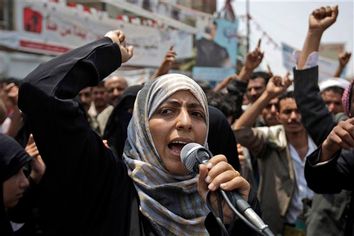
Nobel Peace Prize goes to women's rights activistsYemeni activist Tawakkul Karman chants slogans along with anti-government protestors, during a demonstration demanding the resignation of Yemeni President Ali Abdullah Saleh, in Sanaa, Yemen, in June. (Credit: AP/Hani Mohammed)

Africa’s first democratically elected female president, a Liberian campaigner against rape and a woman who stood up to Yemen’s autocratic regime won the Nobel Peace Prize on Friday in recognition of the importance of women’s rights in the spread of global peace.

The 10 million kronor ($1.5 million) award was split three ways between Liberian President Ellen Johnson Sirleaf, women’s rights activist Leymah Gbowee from the same African country and democracy activist Tawakkul Karman of Yemen — the first Arab woman to win the prize.

The chairman of the Norwegian Nobel Committee told The Associated Press that Karman’s award should be seen as a signal that both women and Islam have important roles to play in the uprisings known as the Arab Spring, the wave of anti-authoritarian revolts that have challenged rulers across the Arab world.

“The Arab Spring cannot be successful without including the women in it,” Jagland said.

He said Karman, 32, belongs to a Muslim movement with links to the Muslim Brotherhood, the Islamist group “which in the West is perceived as a threat to democracy.” He added that “I don’t believe that. There are many signals that that kind of movement can be an important part of the solution.”

Yemen is an extremely conservative society but a feature of the revolt there has been a prominent role for women who turned out for protests in large numbers. The uprising has, however, been one of the least successful, failing to unseat President Ali Abdullah Saleh as the country descends into failed state status and armed groups take increasingly central roles. In Libya’s and Syria’s uprisings, women have been largely absent. And while there were many women protesters in Egypt’s revolution, few had key leadership positions.

Karman is a mother of three who heads the human rights group Women Journalists without Chains. She has been a leading figure in organizing the protests against Saleh that kicked off in late January.

“I am very very happy about this prize,” Karman told The Associated Press. “I give the prize to the youth of revolution in Yemen and the Yemeni people.”

Citing the Arab Spring alone could have been problematic for the committee. Libya descended into civil war that led to NATO military intervention. Egypt and Tunisia are still in turmoil. Hardliners are holding onto power in Yemen and Syria and a Saudi-led force crushed the uprising in Bahrain, leaving an uncertain record for the Arab protest movement.

Jagland told AP it was difficult to find a leader of the Arab Spring revolts, especially among the many bloggers who played a role in energizing the protests, and noted that Karman’s work started before the Arab uprisings.

“It was not easy for us to say to pick one from Egypt or pick one from Tunisia, because there were so many,” he said. “And we did not want to say that one was more important than the others.”

Karman “started her activism long before the revolution took place in Tunisia and Egypt. She has been a very courageous woman in Yemen for quite along time,” Jagland said.

No woman had won the prize since 2004, when the committee honored Wangari Maathai of Kenya, who died last month at 71. 2004 was also the last year the prize went to an African.

Liberia was ravaged by civil wars for years until 2003. The drawn-out conflict that began in 1989 left about 200,000 people dead and displaced half the country’s population of 3 million. The country — created to settle freed American slaves in 1847 — is still struggling to maintain a fragile peace with the help of U.N. peacekeepers.

Sirleaf, 72, has a master’s degree in public administration from Harvard University and has held top regional jobs at the World Bank, the United Nations and within the Liberian government.

In elections in 1997, she ran second to warlord-turned-president Charles Taylor, who many claimed was voted into power by a fearful electorate. Though she lost by a landslide, she rose to national prominence and earned the nickname, “Iron Lady.” She went on to became Africa’s first democratically elected female leader in 2005.

Sirleaf was seen as a reformer and peacemaker in Liberia when she took office. She is running for re-election this month and opponents in the presidential campaign have accused her of buying votes and using government funds to campaign. Her camp denies the charges. The election is Tuesday.

“This gives me a stronger commitment to work for reconciliation,” Sirleaf said Friday from her home in Monrovia. “Liberians should be proud.”

Buttons from her presidential campaign say it all: “Ellen — She’s Our Man.”

Jagland said the committee didn’t consider the upcoming election in Liberia when it made its decision.

“We cannot look to that domestic consideration,” he said. “We have to look at Alfred Nobel’s will, which says that the prize should go to the person that has done the most for peace in the world.”

African and international luminaries welcomed the news. Many had gathered in Cape Town, South Africa on Friday to celebrate Nobel peace laureate Archbishop Desmond Tutu’s 80th birthday.

“Who? Johnson Sirleaf? The president of Liberia? Oooh,” said Tutu, who won the peace prize in 1984 for his nonviolent campaign against white racist rule in South Africa. “She deserves it many times over. She’s brought stability to a place that was going to hell.”

U2 frontman Bono — who has figured in peace prize speculation in previous years — called Sirlaf an “extraordinary woman, a force of nature and now she has the world recognize her in this great, great, great way.”

Gbowee, who organized a group of Christian and Muslim women to challenge Liberia’s warlords, was honored for mobilizing women “across ethnic and religious dividing lines to bring an end to the long war in Liberia, and to ensure women’s participation in elections.”

Gbowee has long campaigned for the rights of women and against rape. In 2003, she led hundreds of female protesters through Monrovia to demand swift disarmament of fighters who preyed on women throughout Liberia during 14 years of near-constant civil war.

Gbowee works in Ghana’s capital as the director of Women Peace and Security Network Africa. The group’s website says she is a mother of five.

“I know Leymah to be a warrior daring to enter where others would not dare,” said Gbowee’s assistant, Bertha Amanor. “So fair and straight, and a very nice person.”

Karman is from Taiz, a city in southern Yemen that is a hotbed of resistance against Saleh’s regime, and now lives in the capital, Sanaa. She is a journalist and member of Islah, an Islamic party. Her father is a former legal affairs minister under Saleh.

Long an advocate for human rights and freedom of expression in Yemen, she has been campaigning for Saleh’s ouster since 2006 and mounted an initiative to organize Yemeni youth groups and opposition into a national council.

On Jan. 23, Karman was arrested at her home. After widespread protests against her detention — it is rare for Yemen women to be taken to jail — she was released early the next day.

Karman has been dubbed “Iron Woman, “The Mother of Revolution” and “The Spirit of the Yemeni Revolution” by fellow protesters.

During a February rally in Sanaa, she told the AP: “We will retain the dignity of the people and their rights by bringing down the regime.”

The peace prize was in line with Norway’s development aid strategy, which is often focused on women’s rights. Norwegian Prime Minister Jens Stoltenberg called the award “important and worthy.”

In his 1895 will, award creator Alfred Nobel gave only vague guidelines for the peace prize, saying it should honor “work for fraternity between nations, for the abolition or reduction of standing armies and for the holding and promotion of peace congresses.”

The peace prize is the only Nobel handed out in Oslo, Norway. The other five awards — in medicine, physics, chemistry, literature and economics — are presented in Stockholm.

Last year’s peace prize went to imprisoned Chinese dissident Liu Xiaobo.

Krista Larson in Johannesburg, Robert Reid and Sarah El-Deeb in Cairo, Jonathan Paye-Layleh in Monrovia, Liberia and Ahmed Al-Haj in Sanaa, Yemen, contributed.

Continue Reading Close

Lawyer: Case suggests Norway suspect is insane

Shooter claims to be part of terror organization, but mental competency questions cast doubt on statements

  • more
    • All Share Services

Lawyer: Case suggests Norway suspect is insaneNorway's twin terror attacks suspect Anders Behring Breivik, left, sits in an armored police vehicle after leaving the courthouse following a hearing in Oslo Monday July 25, 2011 where he pleaded not guilty to one of the deadliest modern mass killings in peacetime. The man who has confessed to carrying out a bombing and shooting spree that left 93 people dead in Norway will be held in complete isolation for four weeks after a hearing in which he said his terror network had two other cells. (AP Photo/Aftenposten/Jon-Are Berg-Jacobsen) NORWAY OUT(Credit: AP)

The suspect in Norway’s twin attacks that left at least 76 people dead claims he is part of an organization with several cells in Western countries, his defense lawyer said Tuesday, but he added the case suggests his client is insane.

Anders Behring Breivik is not aware of the death toll or of the public’s response to the massacre that has rocked the country, but believes the “operation” is going according to plan, Geir Lippestad said. In an interview with The Associated Press, Lippestad said Breivik asked how many people he killed.

“This whole case has indicated that he’s insane,” Lippestad told reporters during an earlier press conference.

Breivik has confessed to last week’s bombing in the capital and a rampage at a Labor Party retreat for young people, but he has pleaded not guilty to the terrorism charges he faces, claiming he acted to save Europe from what he says is Muslim colonization.

“He expects that this is a start of war that will last for 60 years. but his mind is very… well, I don’t want to comment more on his mind, but that’s what he believes,” he told reporters. “He looks upon himself as a warrior. And he started this war, and takes some kind of pride in that.”

The suspect took drugs to be “strong, efficient, awake” Lippestad said. He claims he is part of an organization with several cells in Western countries, including two in Norway, Lippestad said. He said Breivik’s family has not asked to see him.

Asked at the press conference if Breivik was giving him instructions for his defense, Lippestad said he wasn’t and that he wouldn’t take such instructions. He confirmed he’s a member of the Labor Party but doesn’t know whether the suspect is aware, telling the AP he doesn’t know why Breivik chose him.

Earlier, Norway’s justice minister told reporters that employees from his department are still missing. Police plan to start publicly naming the dead for the first time Tuesday.

There is a particular focus on identifying the dead since authorities dramatically lowered the death toll Monday, apparently because they counted 18 bodies twice in the confusion following the massacre. They initially said 86 people died on the island site of the shooting massacre, but now say the figure is 68.

“The Justice Ministry has people who are missing, we have people who are very hard hit by this and we are without offices,” minister Knut Storberget told reporters.

Storberget also offered a defense of the police in response to a question about the mounting admissions of missteps.

Police have acknowledged that they took 90 minutes to reach Utoya island. They weren’t able to deploy a helicopter because the entire crew had been sent on vacation. Victims who called emergency services from the midst of the massacre reported being told to stay off the line because authorities were dealing with the Oslo bombing.

“I feel the police have delivered well in this situation. I also feel they’ve delivered especially well on the points where there’s been criticism raised,” said Storberget.

When asked if police would open an investigation into their conduct, Storberget indicated that such a probe was for the future.

“It’s very important that we have an open and critical discussion about how all sections of society handle a situation. … But there’s a time for everything, and we have been fully focused and continue to be focused on taking care of all those that have been affected,” said Storberget.

Breivik made his first appearance in court on Monday to answer the terrorism charges against him. He calmly told the court that he committed the massacre but pleaded not guilty because he acted to save Europe from “Muslim domination.” His plea guarantees him future court hearings and opportunities to address the public, even indirectly — a chilling thought given that he has claimed the killings were meant to serve as “marketing” for a 1,500-page manifesto.

Prosecutor Christian Hatlo said Breivik “seemed unaffected by what has happened.”

Norway has been stunned by the attacks and riveted by Breivik’s paranoid and disturbing writings. Hundreds thronged the courthouse Monday, hoping to get their first glimpse of the man.

Meanwhile, tens of thousands of Norwegians defied Breivik’s rhetoric of hate Tuesday to gather in central Oslo to mourn the victims and lay thousands of flowers around the city. Roses a few feet deep still covered the plaza in front of the cathedral a day later.

Police believe Breivik, 32, acted alone, despite his grand claims in the manifesto that he belongs to a modern group of crusaders. But they have not completely ruled out that he had accomplices.

Judge Kim Heger ordered Breivik held for eight weeks, including four in isolation, noting his reference to “two more cells within our organization.”

Authorities say Breivik used two weapons during the island attack — both bought legally, according to his manifesto. A doctor treating victims told the AP the gunman used illegal “dum-dum”-style bullets designed to disintegrate inside the body and cause maximum internal damage.

Breivik faces 21 years in prison for the terrorism charges, but he has told authorities he never expects to be released. While 21 years is the stiffest sentence a Norwegian judge can hand down, a special sentence can be given to prisoners deemed a danger to society, who are locked up for 20-year sentences that can be renewed indefinitely.

In Breivik’s court appearance, he alluded to two other “cells” of his network — which he refers to in his manifesto as a new “Knights Templar,” the medieval cabal of crusaders who protected Christian pilgrims in the Holy Land.

In the treatise, he describes being invited to join the group, which he says is dedicated to “anti-jihad,” and claims members held meetings in London and the Baltics. Afterward, he says, they vowed not to contact one another and to instead plan their “resistance” on their own.

But they were also to space out their attacks, he wrote. “We should avoid any immediate follow-up attacks as it would negate the shock effect of the subsequent attacks. A large successful attack every 5-12 years was optimal,” he wrote.

At one point, his manifesto briefly referred to an intention to contact two other cells, but no details were given.

European security officials said they were aware of increased Internet chatter from individuals claiming they belonged to the Knights Templar and were investigating claims that Breivik, and other far-right individuals, attended a London meeting of the group in 2002.

Associated Press writers Louise Nordstrom and Ian MacDougall and Louise Norstrom contributed to this report.

Continue Reading Close

Page 1 of 2 in Bjoern H. Amland