Brigitte Frase

“Labyrinth of Desire” by Rosemary Sullivan

Are the great heroines of literature caught in the grip of grand, glorious passion, or are they just women who love too much?

  • more
    • All Share Services

Love in the Western world has a notorious history and an irresistible hold on our imaginations. With its reputation for risk taking, law breaking, greed and unseemly hunger, its heedlessness of convention and readiness to suffer, it tempts even as it whispers: This way lies danger.

This is not the kind of love you bring home to the folks or submit to Ann Landers, who always recommends a friendly, estimable, true affection that leads to a happily ever after. (There’s no room for any other kind of amorous truth in her philosophy.) Wild love does not thrive in domesticity and it doesn’t do Valentine’s Day with its Hallmark card schmaltz, waltz and chocolate.

In “Labyrinth of Desire,” Canadian writer Rosemary Sullivan attempts to bring passionate, obsessive love into the cool light of everyday life, the better to see and demystify it. Eros inflames Anna and Vronsky, Tristan and Isolde, or even D.H. Lawrence and Frieda, Taylor and Burton. (No, not Wallis Simpson and her prince; they fell more for a pampered lifestyle than for each other.) People like you and I may also have grand passions, maybe once or twice a lifetime. Perhaps sexual lightning strikes because myth and literature have primed us for it. Possibly there’s even a biological component. Apparently, neuroscientist Steven Pinker thinks it plausible that we’re programmed for romantic love, though I can’t fathom what he might mean besides lust.

Sullivan’s meditation on extreme love begins promisingly — I’ll return later to the short story she offers in Chapter 1 as illustration — but then chickens out. Her voice, at first approving of ecstasy, becomes a feminist pursed-lip Viewing With Alarm. We get the boringly familiar pep talk on taking control of our love lives. Turns out it’s not passion we want at all, but to be “cherished, to be accompanied.” Stick to the subject, Rosemary; you said yourself that passion is not a civilized or kindly emotion.

She introduces the subject by evoking “hunger and longing, desperation and ecstasy.” Passionate love is obsessive: “It happens when life stops us suddenly in our tracks and we love in a way that we didn’t know was possible. Thinking/talking/ dreaming/obsessing — life is suspended on the thread of one other human being.” Intriguingly, she suggests that this kind of overwhelming love is “one of life’s necessary assignments. It cracks us open.” It is “a cataclysm breaking up the empty landscape.”

Although it feels like a bolt from the blue, it tends to happen at a turning point in our lives. We feel stale, trapped, without a clue how to escape and remake life. In a real way, we blaze a new connection to ourselves through ecstasies of the body and blown-awake emotions. I think Sullivan is on the right track here. At least, I can corroborate her intuition based on my own experience and that of three, four … let’s say a number of friends.

But her tiny chapters with big titles (“The Demon Lover,” Pleasurable Cruelty,” “Erotic Diabolism”) deliver no passionate news. They evade sexiness altogether and settle for a bright “Hey girls, listen up!” pajama party voice. Her scholarship is breezy. For example, she writes about Aristophanes and his theory that male/female, being once conjoined, then split apart, forever after to seek the original union; but she doesn’t seem to realize that this Aristophanes is not the historical playwright but a character in Plato’s Symposium.

Her analyses of literary texts from Dante to Flaubert to Jean Rhys all yield only the same thin tale of women who love too much, become trapped in illusion and end miserably. Sullivan hasn’t heard that real men, as well as fictional ones, are also subject to delirium, obsession, hunger, and that, for a full-blown passion to erupt, the desire must be mutual, at least at the start.

Some of her examples aren’t about passion at all. She tells the story of Simone de Beauvoir and Sartre, the grand philosophical couple of Paris in the ’40s and ’50s. At some early point in the relationship, Beauvoir became a sort of procuress to Sartre, who bedded his students and hers, insatiably. It’s a tawdry scene, but what has it to do with passion? The big deal in Beauvoir’s sex life was never Sartre. While “with” him, as she continued to be, she fell for the all-American tough guy writer from Chicago, Nelson Algren. That was her grand passion. A roman ` clef, “The Mandarins,” followed.

Charlotte Brontë, whose novel “Villette” was based on her experiences as a student at the Pensionnat Heger in Brussels, fell in love with Constantin Heger, who did not reciprocate but also never led her on. So Charlotte was left with an obsession for a fantasy; another tale that isn’t quite on point, but Sullivan doesn’t distinguish between very different sorts of love scenarios. She’s already forgotten her original subject and is now very sad about the psychology of women who fall victim to delusions. That is a much belabored story, and Sullivan wastes her labor.

Consider the short story, I suspect at least partly autobiographical, that opens the book. A young Canadian woman, bored with her life, goes to Mexico City looking for adventure. At a gallery exhibit, she notices a dark-haired man, not conventionally handsome but exuding “a kind of seductive arrogance.”

When she leaves, he follows her to a cafe. They share the stories of their lives. He shows her his studio and in no time they’re having fabulous sex. But a few weeks later, at a party, another woman greets him “as though publicly staking a claim.” Later that night, the same woman lets herself into his room and flees when she sees our heroine and her lover naked in his bed. He follows her and when he returns, everything has changed. He becomes cold, contemptuous, unreliable, evasive. When our desperate young woman confronts him, he reacts with disgust. Another guy who can’t commit.

Each of the chapters that follow is meant to deconstruct a strand of the story. But the story is not only trite, it’s a rigged case study. It does not feel psychologically true and what Sullivan teases out of the story is — surprise — exactly what she put in. Her tale is less about passion than about a woman making an ideal of a shallow man.

Nor can I detect any signs that the affair has broken the stalemate in the woman’s life. She goes home totally miserable and takes to her bed, feeling her “life shrivel.” But eventually she will learn, Sullivan tells us, that her passion was just a route to self-realization. The guy didn’t matter per se. Extreme love means having a man be your personal growth trainer? I always thought passion meant two people fully alive to each other.

There are so many sexy and fascinating questions that never occur to Rosemary Sullivan. She’s doing aesthetic philosophy, very lite, thinking readers will fancy a bit of high-toned talk but then want short sentences and paragraphs, and short ideas. Well, that’s putting thought as well as style on a starvation diet.

In one chapter, Sullivan brings up love at first sight. Her own parents, she adds, married on the strength of it. But what’s that all about, that recognition that occurs in life as often as in literature, and makes for long marriages as often as broken hearts? The Greeks thought of vision as a tactile sense. Your eyes can literally grope and enter me; I emit rays that enter your soul through your eyes. That’s one rich subject. Another is the tension between fullness and lack, overflow and longing. Both metaphors describe sexual passion and do so in many cultures and periods. I would have loved to hear more about them. And then there is imagination and excess. We dream and conceive of much more than we do. So the most tantalizing fantasy is to imagine bodies harnessed to the mind’s play, and then to try to make it real.

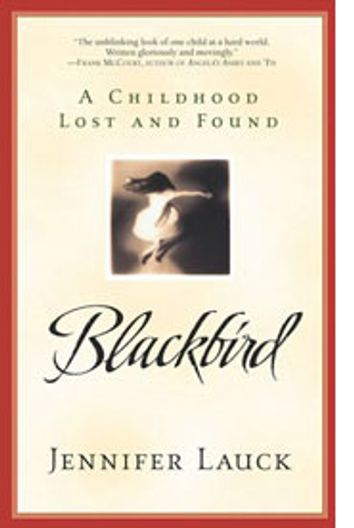
“Blackbird: A Childhood Lost and Found” by Jennifer Lauck

A memoirist who survived a childhood of neglect and catastrophe reinhabits her younger self, with powerful and harrowing results.

  • more
    • All Share Services

I don’t pay much attention to jacket copy. No matter how celebrated the blurbists — or should that be blurbers? — they’re often friends or former teachers of the author, or they’re people who write in the same vein and hope their praise of the baby book will remind readers of their own so recently hot commodity, now a little long in the tooth. Since good writers have a hard enough time finding good readers in the first place, trying for a little coattail ride is an understandable tactic, albeit wasted on reviewers.

So thank you, Frank McCourt, for being the first blurber (blurbist?) to provide me with the right praise, and the right description, to introduce “Blackbird.” McCourt calls it “the unblinking look of one child at a hard world. Written gloriously and movingly.” I would edit out the “gloriously” because it doesn’t mean a damn thing. (There you have one neat distinction between blurbing and reviewing.) Aside from that cavil, he’s right, and now it’s my job to tell you why.

Memoirs written from a child’s perspective are tricky to sustain for an entire book-length narrative. After a few chapters, I often find myself tiring of the limited scope of the narrator’s understanding, or I get annoyed by authorial intrusions, by the feeling that an adult voice is manipulating and ventriloquizing what the child knows. Jennifer Lauck reinhabits her child self, from age 5 to 11, with an amazing sureness and poise. One senses the adult woman’s tenderness and empathy toward the little girl but is at the same time aware of a musing, almost dispassionate narrative distance. That finely calibrated balance makes it possible for readers to absorb painful material and not be depressingly swamped by it. Quite the opposite: The book, despite deaths, betrayals and abandonments, is always hopeful, resilient, even exhilarating.

That’s because little Jenny is a curious and stubborn girl. She is one of those remarkable children Robert Coles studied some years ago, who bend under blows of circumstance but don’t break. Instead, they become more supple and inventive in will and emotion. Jenny Lauck has what I can only call a kind of genius for making a habitable life from shoddy or broken material.

In the first chapter, 5-year-old Jenny describes her house and her daily ritual. Every morning she and her two cats sit in front of her mother Janet’s bedroom door. “The rule is, no cats, no kids, not until the toilet flushes.” That’s when she walks the 18 steps to the kitchen and carefully assembles Momma’s breakfast tray. Always, there’s the reward, “that look in her dark brown eyes. It’s one of those special looks for special people.” Then, while Momma puts on her makeup, the two very seriously discuss beauty and fashion. If it’s a “bad day,” she stays in bed. “If it’s a good day, she pushes the covers back and puts her feet on the floor. Today is a good day.”

But Jenny, who has only indistinct memories of a time when her mother could walk like everybody else, has learned to read all kinds of signals. Janet has trouble standing. “When something’s wrong, really wrong, my skin knows first. It’s a prickly feeling at the back of my neck, over the top of my head, down my forehead, and into my nose.” Janet says she’s fine but “I look past her words and into her truth and I know it’s not such a good day after all.”

There will be fewer and fewer good days as operation follows operation for Janet’s disease-riddled body. The family moves from the house on Mary Street in Carson City to an apartment in Los Angeles to be close to UCLA Medical Center. Now the bedroom stinks of pee and feces, which Jenny cleans when her father is at work. The nightstand is covered with pill bottles. “Momma and me, pills and water, every day, forever. I don’t know any other way and I don’t care because she’s here.” A painful ritual is better than none. Just a few weeks earlier Jenny had watched her mother dump the contents of several pill bottles in her lap and then methodically swallow them. The child feels the wrongness but doesn’t know what to do. Momma holds green and red pills “and looks up, dark eyes steady, Snow White beautiful face … ‘Like Christmas,’ Momma says.”

Janet dies when Jenny is 7 and and her brother B.J. is 10. Their father is often gone and B.J.’s grief comes out in the form of anger toward everyone, including his sister. Then one day their father introduces them to a red-haired woman named Deb.” Deb and Daddy, and the way they are together, there’s something I don’t know, don’t understand … It’s knowing something’s up even though you don’t know what. It’s a bad feeling up my neck.” They move in with Deb and her three children and one day she and Jenny’s father get married in Las Vegas.

Jenny’s bedtime ritual used to be reading “Snow White” with her father. Now she often retreats to her room and examines the story’s pictures, as if looking for clues to her own life. She knows that Snow White is not safe, even with the dwarfs. Deb is a dangerous stepmother, manipulative, untrustworthy, unloving, possibly mentally unstable. There are new rules. “That’s just the way it is” becomes Jenny’s new refrain as she tries to adapt stoically. She learns about outward compliance and inner rebellion, the effectiveness of nonverbal resistance.

Deb tries to break her will. Jenny is sent to a summer camp where the swimming instructor throws her into the deep end of the pool over and over and tells her to “conceive” how to swim and then do it. Later, Deb banishes her from the house and sends her to live by herself, at age 10, in a communal house with transient strangers. (It’s 1971, the hippie era.) But here, as she has once before, she finds safety with good people. With a little girl named Zoe, she plays dress-up, just as if she were a child too. Max and Karen teach her to cook in the communal kitchen. When Karen gives birth to baby girls, Zoe and Jenny are present at the birth. Max plays “Blackbird” from the “Sgt. Pepper” album. “The whole room is full of wait and magic and no one has to tell me that this is the most important thing in the world.”

Jenny and B.J. are rescued at last, or so it appears. Jennifer Lauck is working on a sequel to “Blackbird.” I hope her broken wings will learn to fly there. Meanwhile, the lovely lyrics of the Beatles song run through my head. Snow White comes home again and the blackbird sings in the dead of night.

Continue Reading Close

“Vertigo” by W.G. Sebald

The tale of a strange quest, haunted by the ghost of Kafka, from one of the oddest great writers around.

  • more
    • All Share Services

W. G. Sebald is the oddest great writer I’ve ever encountered. Bear with me, because it’s going to be difficult to convince you how luminous and ultimately satisfying are his strange ways of composing a book. The narrator of “Vertigo,” a German who has lived for 30 years in east-central England, shares his biography with one Winfried Georg Sebald, but he remains somewhat out of focus; he is a haunted, keening, ghostly wanderer. Likewise, the photos of people, documents and places studding each chapter are even grainier and fuzzier than in Sebald’s previous books. They’re covered with the dust of unreliable memory, one of the themes of this novel-as-meditation.

“Vertigo” is Sebald’s third novel to be translated into English, but it is his first book, published in 1990. Like its successors, the exquisitely composed elegy “The Emigrants” and the serpentine historical meditation “The Rings of Saturn,” it is written under the sign of Saturn. Sebald’s melancholy doppelgdnger wanders the streets of Vienna, Venice, Milan, Verona and Innsbruck, and finally, rucksack slung over his shoulder, hikes across the Austrian border into Bavaria and the village of W. (very like Sebald’s birthplace, Wertach). Giving ourselves up to Sebald’s hypnotic prose, his musings and digressions, we accompany the narrator on a spiritual pilgrimage whose purpose is to raise the dead so that the living might interrogate them on the meaning of a life. Only long after one has closed the book and puzzled over it does a complex pattern appear.

The first section of “Vertigo,” “Beyle, or a Madness Most Discreet,” is a biography of French novelist Stendhal (Henri Beyle) and a commentary on his philosophical essay on love, “De l’Amour.” Stendhal, on a visit to a salt mine, is given a twig encrusted with salt that glitters like myriad diamonds in the sun. The miraculous transformation becomes an allegory “for the growth of love in the salt mines of the soul.” Like his fictional protagonists, however, he is unlucky in love and finally dies of syphilis.

The narrator, too, is searching for an allegorical crystallization as he moves from city to city and tries to find connections between the past and the present. He is fleeing an unspecified personal disaster and looking for a way out of his misery and depression. In one of his insomniac ramblings, he sees the poet Dante disappear around a corner and has his first attack of vertigo. “The outlines on which I tried to focus dissolved,” he tells us, “and my thoughts disintegrated before I could fully grasp them.” In the second chapter, “All’estero,” he has more moments of confusion. He sees Ludwig of Bavaria float by in a vaporetto in Venice, and in the Milan Cathedral “all of a sudden no longer had any knowledge of where I was … was unable even to determine whether I was in the land of the living or already in another place.” He sees an uncanny resemblance to Franz Kafka in twin boys he meets on a bus.

Next he’s in a Verona library researching newspapers from September 1913. Why? The third chapter, “Dr. K Takes the Waters at Riva,” is a vignette of Kafka in Italy that month. Like the narrator, he lies on his bed, arms crossed under his head, unable to sleep and seeing strange forms in the play of streetlights on the ceiling. He is writing letters to Felice (with whom he had a sweet, complicated, probably chaste relationship) but seems to be fighting homosexual impulses.

The chapter ends with the death of Kafka’s friend, who is transformed into the mythical figure of Gracchus the huntsman. The huntsman returns in new and mysterious forms in the final section, “Il Ritorno in Patria.” Nothing makes sense. The narrator puts pieces next to each other and can’t find any coherence, only odd coincidences and unexplainable doublings and repetitions of people and events.

Early in “Vertigo,” he remarks that however one recalls events or tries to reconstruct them, “in reality, as we know, everything is always quite different.” Near the end, his voice is more desperate. “The more images I gathered from the past … the more unlikely it seemed to me that the past had actually happened in this or that way, for nothing about it could be called normal: most of it was absurd, and if not absurd, then appalling.”

Sebald has created the bitter counterpart to the German Romantic ideal of the poet as wanderer, communing with nature and the gentle souls he meets as he ambles through sublime landscapes. Sebald’s narrator looks at the landscape from a train and finds it to be “that slightly greyish shade of white which has become the color of the nation.” And yet, as he hikes wearily into W. he remembers the road in “former times … Like a luminous ribbon, it had stretched out before one even on a starless night.”

This is a quest novel, but in a wary, suspicious mode. Despite its spiky, convoluted and unhappy journeys, it won’t depress you. There is something marvelous and bracing about wandering through a maze of unanswerable questions with an eccentrically brilliant guide. Sebald writes as if he’d never heard of the novel form, so he’s inventing it, again.

Continue Reading Close

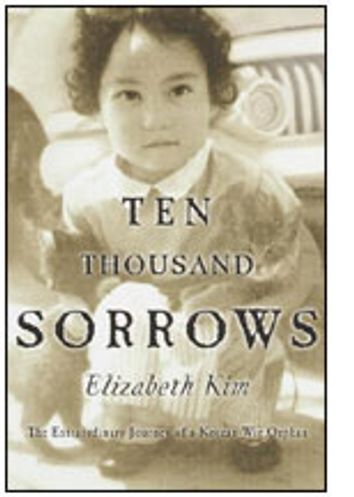
“Ten Thousand Sorrows: The Extraordinary Journey of a Korean War Orphan” by Elizabeth Kim

An immigrant's brutal and disturbing memoir of abuse at the hands of fundamentalist parents and a sadistic husband.

  • more
    • All Share Services

As a little girl walking with her mother, Elizabeth Kim hears herself called a “honhyol,” “a despicable name that meant nonperson, mixed race, animal.” Shortly after the end of the Korean War, the mother had returned from Seoul to her native village in shame, pregnant with a GI’s child. Mother and daughter live as outcasts in a hut at the edge of town, and from the moment she can walk, the child works alongside her “Omma” in the rice fields.

When the girl is about 4 — she will never know the exact year and day of her unrecorded birth — her grandfather and her uncle demand she be sold as a servant. When her mother refuses, the men string the woman up in her own house. Kim, a witness to this “honor killing,” still sees “those milk-white feet” twitch, as if in a dance, then grow still.

As a “honhyol, female, nameless, without a birth date,” she is a fourfold embodiment of shame. Dumped at an orphanage run by Christian missionaries, she joins the other forgotten children, “the product of brief liaisons between soldiers on their way through and women on their way to hell.” The kids are locked for hours at a time into cribs that look more like animal shelters. Occasionally, prospective parents peer into various cribs, looking for a cute specimen to adopt.

After hopeless months in her cage, Kim is finally adopted, sight unseen, by a missionary couple in central California. “Mom” and “Dad” are rigid fundamentalist Christians, and the girl they name Elizabeth begins a long sojourn in her own hell.

Although she learns English quickly and is bright and docile, a model child, she earns only scorn and an almost unbelievable cruelty. Treated more like a servant than like a daughter, she is punished for having nightmares, for being ill, for not smiling enough. The emotional abuse her parents devise — all in the name of the Lord, of course — is ingenious in its variety. They belittle her looks, insult her dead mother, make her sleep in a pitch-dark room to get over her claustrophobia. If she wakes screaming in terror, she is punished again for not trusting God’s plan for her. When she gets attached to a toy or a pet, it is immediately taken away.

Elizabeth absorbs her lessons well. She comes to hate herself and to believe that she deserves only pain and suffering. At night, she claws at her body, drawing blood with sharp fingernails.

At 17 she is married off to a church deacon, and her life goes from bad to unbearable. Her husband is a sadistic bully who, besides regularly beating her, is only aroused by seeing her in pain. He also likes to have sex with other women in the back seat of their car while she’s driving it. When she gets pregnant, he stomps on her belly.

He would probably have killed her sooner or later. But when he tortures and rapes her in their young daughter’s bedroom, she finally gets sufficient hold of herself to run away, realizing that her child is now in danger as well.

Living in a shanty at the edge of town, making a meager living as a reporter for a local newspaper, Elizabeth in a sense recapitulates idealized memories of life with a beautiful, strong and loving mother. She tries to create for herself and her daughter Leigh a cocoon of security and love.

The two of them do seem to achieve a loving relationship and a stable household, though Leigh must have felt the weight of being her mother’s only reason for living. (Leigh contributes some carefully worded paragraphs to her mother’s memoir.) She had to cope with Elizabeth’s increasingly dangerous sleepwalking, her claustrophobia, depressions and a recurrent longing for death that sharpened into a veritable lust for suicide.

This brutal memoir is haunting and disturbing, but for all the wrong reasons. I can understand that Kim had to write it, but it should never have been published. It is the account of a deeply damaged woman who has not been able to escape her traumatized childhood or to make any emotional sense of it. I was fascinated, appalled and finally ashamed, feeling more like a voyeur than like a reader.

Kim claims to have forgiven her parents, who in old age do seem to have mellowed. But her bitter account of them is a damning portrait of monsters; it is an act of revenge. In the sections about childhood and marriage, her writing has a matter-of-fact spareness that comes to feel more like numbness than unflinching honesty. The final chapter, in which she describes her continuing efforts to heal, through therapy and the practice of Buddhist meditation, is a stylistic mess. In a fervent childlike voice of belief, she trots out all the therapeutic clichis about “the healing process.” She makes declarations of love to herself and considers the possibility “that things could be okay. I believed that healing was just around the corner; wholeness was just a breath away.”

But she rambles, repeats herself and interrupts her ode to inner peace with painful memories that feel like flashbacks. Her psyche is still a battlefield where bombs fall and grenades go off. Her memoir is the work in progress of an unfinished woman. I have read it so that you won’t have to.

Continue Reading Close

Cassandra complex

Sven Birkerts says computers are destroying literature. He couldn't be more wrong.

  • more
    • All Share Services

Cassandra complex

Sven Birkerts stopped by our city last
year to sign his latest book,
“Readings,” and to bring his Save the
Book crusade to the Minneapolis Friends
of the Library. I went to hear him
because I consider myself not just a
friend but a devoted parishioner. I
think of libraries and bookstores as
lay-missionary posts, functioning as the
secular outreach program of the Church
of the Word. Also, I have a personal
stake in his subject because some years
ago I wrote a long review-essay on the
future of the book in the age of the
Internet and one of the sources I
consulted was, naturally, Birkerts’
book-length lament on the same topic,
“The Gutenberg Elegies.”

As I listened to Birkerts’ familiar
jeremiad, I found myself squirming in
the itchy discomfort I always feel when
I disagree with someone but find myself
tongue-and-mind tied, unable to
articulate what’s wrong. He says we are
losing the ability to read deeply. The
speed of the Internet speeds up our
minds. We race through sites, grabbing
snippets of data as we skip and skim
nimbly over oceans of information. The
time is always Now; hypertext
connections sizzle and evaporate.

It’s not just slow and immersive reading
we’re losing, Birkerts says. We’ve
reached a critical juncture in the
transition from print culture to screen
culture. We’re metamorphosing from
individual and private people to
fungible, Web-linked brain connectors in
a bright, buzzy, gregarious info-hive.

I empathize with his worries. I share
many of them, short attention spans for
example. And I share Birkerts’ love for
close reading, the attentive scrutiny of
chapter arcs, paragraph composition,
sentence structure, punctuation: all the
minutiae that undergird the gorgeous
scenes and portraits readers respond to
in books they love.

But now, Birkerts thinks, this new
technology, chatty and endlessly in the
know, is changing not only our reading
and thinking habits, but our very
selves. Human beings are so adaptable,
they’re sure to get with the digital
program: speedy information scanning,
our brains mimicking computers, all
data, no deep and complicated
conversions to knowledge, and no housing
anymore for a soul. I think he’s wrong,
in large part because his idea of print
culture is so shallow — what I distill
from it is a nostalgic image of a
reader, arms full of fresh books from
the library, ambling through the
tree-lined streets of a small town to
the comfy chair in a quiet room. This
has never been reality, as Birkerts
knows, but even as an ideal or a
standard for a civilized life it’s too
narrow to be inspiring.

I’ll begin by proving his point about
adaptability. This most human of
qualities is now, in Birkerts’ eyes, no
longer a positive trait. In adapting to
new reading and writing technologies, he
tells us we are leaving our souls
behind.

In cultural terms, I’ve gone from zero
to 60 mph in less than 50 years. My
childhood, in post-war Munich and then
in a farming village near the Czech
border, lacked the following: indoor
toilets, newspapers, magazines, radio,
bookstores, libraries and people who
minded their absence. I received two
books a year, Christmas and birthday.

Cut to the U.S after my family
immigrated. One of the first singers I
heard on our new radio was Elvis. I was
immediately smitten. Same reaction a few
years later to the Beatles. I traded the
“Niebelungenlied” and the Brothers Grimm
for Superman, Spiderman and Nancy Drew.
We got a TV. In high school, I wrote
papers in long hand, until my parents
bought me an Olympia manual typewriter
in my senior year. In the ’70s I started
using an electric machine; that was
followed by an electronic typewriter
with a one-line screen where I could
make corrections before committing the
words to the paper in the carriage. I
entered the computer age in 1990, and
toward the end of the century, I
embraced the Netscape browser,
AltaVista’s search engine and an e-mail
address. I’m a filament on the Web,
linked intricately to all the other
strands, all of us part of a humming,
roaming, free-associative consciousness.

There are literary Internet cheerleaders
– Bart Kosko, Robert Coover and George
Landow spring to mind — who
enthusiastically endorse this
progressive interactivity of minds and
chips. For them, and all the young
techies out there, the fully uplinked
brain is a teleology devoutly to be
welcomed.

Birkerts shudders. Will the solitary,
meditative individual die out? Will the
fully wired, electrified world have any
use for the reader, the dreamer, the
critic, the scholar, the poet, each
grappling with complex ideas, emotions
and questions in a quiet room alone? Or
will the last surviving reader and
writer someday close their books
forever, shut off the reading lamps and
fire up the screen?

I think the idea that we have to choose
between the screen and the page is a
false dilemma. They will co-habit, I
suggest, with reading lamp and screen
casting their different glows. All
right, I’m anticipating Birkerts’
rejoinder. We’re both old enough to
remember slower days, fewer media, the
feel of good smooth paper slipping
between our fingers. Our souls
are not in danger because we’ve been
raised by books. Our kids, however,
connected since kindergarten, are closer
to that fantasy of being uplinked, (or,
if you prefer, that nightmare of being
brainwashed and reprogrammed.) If
Birkerts is right, they’ll be going too
fast to actually read anything.

History, however, does not bear out his
argument. I agree with Birkerts that our
consciousness is undergoing a shift, but
it is not unprecedented, as he
maintains. In his essay “The Millennial
Warp” he offers as evidence the
testimony of “older people” who tell him
that things felt different in the past.
“Although changes came steadily in the
old days too (new inventions, changes in
the workplace) and sometimes with
unexpected force (the Depression, the
war), the line of continuity was never
ruptured.” According to Birkerts, before
the Internet age began, we had always
retained a connection to the past and
used it to relate new information to old
in order to arrive at some meaningful
knowledge.

Birkerts, the pessimistic humanist, is
as wrong to think that we are being
utterly transformed by technology as the
optimistic net-heads like Kosko are to
think that we will be made into a new
kind of creature. The truth is that
history accommodates ruptures here and
there while also just, well, continuing.
Ways of doing and thinking rearrange
themselves; at every moment or epoch the
very old and the very new co-exist.
Maybe, to use Stanley Fish’s term for
how humans manage all manner of
inconsistencies and paradoxes, history
works by “inspired ad-hoccery.” In other
words, the Internet will not replace the
printed book, just as the alphabet did
not drive out the image, nor the printed
book destroy religion.

The fear of radical supersession that
Birkerts speaks for today has an ancient
history. According to Plato, when Hermes
showed pharaoh his new invention,
writing, pharaoh worried that this
technology would destroy the individual
memory. Geoffrey Nunberg, in his
introduction to the 1996 anthology “The
Future of the Book,” sensibly reminds us
that the past is full of “an unbroken
stream of proclamations that man is
living in an epochal moment.” In that
context, Birkerts is just the latest in
a traditional line of prophets of the
exceptional present, ceaselessly
proclaiming “never before” or “never
again.”

Despite Birkerts’ warnings that
hypertext, speed and instantaneousness
are destroying resonance, depth and
contour, I think the human mind, for all
its nimble adaptivity, cannot do without
context. True, sometimes we just want a
bit of information, but more often we
want the stream of information to
cohere. Computers can arrange and
correlate huge amounts of data, make any
number of info-assemblages in response
to a curious search. But only the mind
of the seeker will be able to breathe a
life of meaning into them. Only someone
who wants to make sense of things would
be asking in the first place.

In his 1999 book, “Faster: The
Acceleration of Just About Everything,”
href="/books/log/1999/10/18/gleick/index.html">James Gleick offers href="/ent/movies/int/1998/06/05int.html">Terry Gilliam’s 1985 movie
“Brazil” as a likelier example of what
the future will look like. Gilliam
“created a glittery, sinister future
filled with ancient technology –
pneumatic tubes, teletype machines, desk
spikes. The effect was a dark hodgepodge
of the antique and the futuristic –
perfect, because when the future does
come creeping in, this is how it looks.
It is not shiny and gleaming, neatly
assembled in clean shrink-wrap. It comes
all mixed up like a junkyard, the old
and the new jumbled together.”

Reading “Faster”, it occurred to me that
the major historical and conceptual
rupture Birkerts describes isn’t the
current communications revolution. It
happened in our grandparents’ childhood,
at the end of the 19th century when
wristwatches became available. That’s
when our ideas of time and speed changed
radically. Accurate, standardized time
measurement led to railroad schedules,
assembly lines, efficiency experts and
global synchronization, to name a few
items on a list that could go on for
pages.

The wristwatch, which gave constant
access to the time on a individual
basis, also made it necessary to do
something about it. We spend time, waste
it, save it, manage it, have come to
believe that if we don’t use it, we lose
it. Time is now a commodity; if we
invest it well we’ll get big returns. So
both Birkerts and I and everyone who
still sits down with a book are also
watch-wearing members of a society
racing against the clock. The personal
computer just continues that tradition.

Birkerts also bemoans the loss of a core
individual identity, the kind of
identity that deep reading is founded
upon, in the expanding electronic hive.
I question his assumption that we ever
really had such a thing, even in the
good old days. Malleability is part of
our very nature as human beings, and a
self is not a unity but a mixture; each
is many. One can be a loving wife and a
neglectful mother, a mob hit man who’s
Catholic and pro-life. One can believe
in God and the explanations of physics.
If you’re a Freudian, you’re at the very
least a trinity of id, ego and superego.
I think the notion of an authentic
single self, expressed in such
clichis as “being yourself” and
“finding out who you really are” are
modern myths. If we’re finicky about
orderliness, we can try to integrate all
our personalities, incompatible ideas,
rhetorical styles; or we can accept the
ad-hoccery of our mental and emotional
makeup and learn to live with human
muttness.

As I visit online journals and
magazines, and the informal discussion
groups formed around specific interests,
it seems to me that, contrary to
Birkerts’ denunciations of the medium’s
senseless babble, the Web is reviving
the art of intelligent conversation.
Like intellectual Paris in the
Enlightenment, or New York in the
Partisan Review’s heyday, the virtual
city is fizzing with bright talk. It is
like visiting Madame de Stael’s salon to
discuss German philosophy, and then
finishing the evening at a Greenwich
Village party with the likes of href="/books/review/2000/03/08/kiernan/index.html">Mary McCarthy and Edmund
Wilson. If the people who love books
today often feel isolated in a world
smitten with mass media, then how can a
medium that brings them together to
share and foster that love possibly be
inimical to literature?

Passionate readers often make for
passionate writers, and vice versa.
E-mail has evolved, for many of us,
beyond business notes or forwarded
jokes, to genuine letters. I write and
receive a great many more of them now
than I did 10 years ago. (But here
again, the new hasn’t muscled out the
old; I have no intention of giving up my
fountain pen and good stationery.)
Casual pen pals turn into friends, and
old friends who live in far-flung
regions are still close.

Can the culture of the book really be
dying as Birkerts insists? Perhaps in
some cases it is, and perhaps that’s not
always a bad thing. Certain kinds of
books, like travel and restaurant
guides, almanacs, perhaps dictionaries,
encyclopedias and other reference works
– all the categories that need constant
updating — might well migrate into
cyberlibraries. The book as
artifact will probably have a
diminished role. There will be
beautiful, hard-bound editions of
certain genres like art books and
literary classics. The coffee-table book
will certainly continue to be produced.

For everything else, I predict, or at
least fervently hope, that we will be
downloading texts into e-books. Once you
let go of an atavistic attachment to
paper for its own sake, it makes a lot
of sense. College students will be
grateful not to have to buy all those
textbooks, as will devotees of mysteries
and romance novels. True, the current
e-book models are not friendly to
readers like Birkerts and me who like to
turn pages. But MIT scientists are close
to realizing an electronic book
“comprised of hundreds of electronically
addressable display pages printed on
real paper substrates. Such pages may be
typeset in situ, thus giving such a book
the capability to be any book.” ["The
Last Book," IBM Systems Journal] The
spine might have a small display and
several buttons that would call up a
card catalog. The last book, or
“reversible hardcopy medium” as it’s
called in technical parlance, will
eventually be the world’s greatest text
storehouse, a single-volume library that
could easily accommodate the holdings of
the Library of Congress and more.

What Birkerts doesn’t address is how,
increasingly, the paper-and-ink
publishing industry, by virtue of its
economic structure, is far from
literature’s best friend. If big changes
are coming, they may not be for the
worse. As Steven Levy gleefully
speculates in the Jan. 1 Newsweek, “When
publishers no longer have to focus on
moving pulped forests to distributors,
the business model will go bananas.”
When books are published and ordered or
rented online, there won’t be all those
remaindered tree products to worry
about, and publishers could well become
more willing to gamble on literary works
with smaller audiences.

When Birkerts talks about the
deep-reading experience, that immersion
that feels timeless yet somehow linked
to an accessible past, I know what he
means. But I also think he’s
romanticizing and he’s making a fetish
of language by identifying it with a
certain printed form. The word is not
the book; why should it die if that
particular house is remade?

And consider this thought-provoking
analogy in an essay called “The Talmud
and the Internet” by Jonathan Rosen (you
can find it in “The Art of the Essay
1999″ edited by href="/books/bag/2000/01/31/lopate/index.html">Phillip Lopate). “I have
often thought, contemplating a page of
the Talmud, that it bears a certain
resemblance to a home page on the
Internet, where nothing is whole in
itself but where icons and text boxes
are doorways through which visitors pass
into an infinity of cross-referenced
texts and conversations.” A single page
of text in this most revered and
literary of documents is already a
historical, multilayered compendium and
a continuing discussion. There are
stories, bits of history, anthropology,
legal disputes, biblical interpretation,
plus the commentaries, corrections,
asides, marginalia, reinterpretations of
generations of scholars and rabbis.

The e-book will allow us the best of the
old and new ways of reading. We can read
“Huckleberry Finn” or “The Duino
Elegies” from beginning to end and then
close the book, experiencing it as a
whole in itself, a finite world in which
we have dwelled for a while. But why not
then open the windows and doors to other
texts and voices? Perhaps it’s time for
romantic readers to give up the illusion
of closure and finitude. After all, only
the printed book-object is a finite
text; every writing is part of a
conversation with other writings, past
and present. The “last book” will widen
the contextual space in which reading
takes place, and beautifully complicate
its resonances. That’s a complex
richness devoutly to be welcomed by
friends of the book.

Continue Reading Close

“S.: A Novel About the Balkans” by Slavenka Drakulic

A fierce novel brings home the horrors of the Bosnian war -- rape, torture and the sexual slavery of Muslim women.

  • more
    • All Share Services

Just how easily my distracted sympathies flitter hither and yon, from Somalia to Kosovo to Chechnya, whenever the latest TV footage bids me turn my head was brought home to me by “S.: A Novel About the Balkans.” The book forced me to stare at an already half-forgotten horror: the Bosnian war of 1992-95, in which the Serbian minority laid siege to Sarajevo and began rounding up and massacring Bosnia’s Muslim population.

In 1993 Croatian journalist Slavenka Drakulic published “The Balkan Express: Fragments From the Other Side of War.” Like Martha Gellhorn in earlier wars, she sent dispatches from the home front describing the fragile texture of everyday life. She understands the woman who wants to buy high-heeled shoes in Sarajevo, where it’s become dangerous to be out at any time of day, and struggles to connect with a teenage soldier-killer who could be her son. And in every piece she takes readings of the seeping poison of ethnic hatred that is gradually permeating public and private discourse.


In “S.” she opens the trapdoors to the killing rooms of that war and shows us the raped, tortured and murdered bodies of civilians. The immediacy and power of the novel rise not from the unbelievable news it brings but from precisely the opposite: What’s unbelievable is that we are witnessing horribly familiar events. Fixated by the supreme example of the Holocaust, we don’t notice when it happens again, and again — never quite in the same way, of course, and not on the 6 million scale we can’t stop focusing on.

That’s when the narrative of one ordinary life becomes essential again, as a reminder that decency is frail and wars make monsters. Drakulic’s first chapter, set in March 1993, starts with the aftermath. In a maternity hospital in Stockholm, S., a refugee from the war in Bosnia, has just given birth to a boy. She regards him coldly; he is not a child to her but a tumor finally removed from her body, “the fruit of their seed.”

We go back with her to the beginning of the story, in May 1992. S., a 29-year-old schoolteacher in a small Bosnian village, wakens one morning to the sight of buses outside her window filled with soldiers. They herd the townspeople into the school gymnasium, then take the men away. After the last gunshots die out, the women and children board the buses for an unknown location.

For the next six months, the women are kept in a warehouse on a former industrial site that now serves as a concentration camp. They each receive a blanket and stake out a place on the concrete floor. And they quickly adapt to abasement and fear. “In a single day we had all been reduced to the lowest possible denominator, to brute existence,” S. thinks. She dissociates from herself, “forgetting” life before the camp, shutting down the self that hopes and plans. It is just as well, she thinks, that there are no mirrors: “There is no point at looking at your own face unless you can actually recognize it.” Using S. as a composite Everywoman, Drakulic dissects the terrible resilience of the human mind. One can bear anything if one is not quite present and hovers in the shallows of the moment.

Drakulic writes in the present tense, from S.’s point of view. That approach presents her with the problem of how to combine the story of a woman who can’t afford memory or self-consciousness with a reflection on the brutal experience she undergoes; she solves it by fusing her analytic consciousness with S.’s numbed condition. Indirect third-person narrative allows the writer to achieve the psychic distance necessary to meditate on the meanings of incomprehensible brutality.

Occasionally, S.’s unmediated voice emerges in italics as she lies remembering in her hospital bed. She has the drawing pad of a little girl in the camp with her. In the camp’s stagnant present, “S. does not yet know how important this ordinary notebook with its thin grey covers and drawings inside will become one day. It is the only proof I have that I was not dreaming, that I was in the camp.” In June, S., who had up to now managed to escape the guards’ notice, is ordered to an office where three soldiers rape and beat her. When she comes to, she is in the “women’s room … where female bodies were stored for the use of men.”

Every night the young women and girls listen for the sound of approaching footsteps, each hoping someone else will be picked. S. has forebodings when she sees the teenage A. go eagerly with a soldier who had been her brother’s friend. She comes back with crosses and Cyrillic letters carved on her body. (Drakulic wisely keeps graphic torture scenes to a minimum. Readers, like the victims, would go numb.) People survive or they die, not by fortitude or cunning but by sheer accident. After the war, someone tells S. she was lucky. “Lucky? … S. is tired of the chain of coincidences, of the sudden turnabouts in life, of the capriciousness of her situation which anyone can overturn.”

One of the most psychologically acute sections of the novel deals with how S. survives in the camp. The commander chooses her, the only educated urban woman, as his mistress. They have Saturday night trysts during which they discuss art and literature, creating a simulacrum of normal life. S. finds a makeup case and paints herself. The women accuse her of demeaning herself by choosing to be a whore, but S. (or more accurately, Drakulic) sees it differently, as a small claim on power:

Men want to be seduced … While pretending to seduce them, and pretending to enjoy it, she forces them to play by her rules. And in so doing she deprives them of their main source of pleasure. The feeling of superiority of a Serb raping a Muslim woman gives way to the superiority of a man satisfying a seductress.

The novel ends in hope tempered by a healthy respect for ambivalences, uncertainties, irresolutions. How will S. cope with the bland world, “with its regularly flying planes and smiling flight attendants,” a world that coexisted with the “women’s room”? And what about the baby? Will that boy need the truth about his conception — or a made-up story about the kind of regular father so many war orphans lost?

Continue Reading Close

Page 1 of 2 in Brigitte Frase