Cara Anna
A look at dissidents who have left China
Why would the blind legal activist who fled house arrest in China want to remain there instead of seeking asylum, as some of Chen Guangcheng’s friends have said?
Leaving China isn’t easy for its dissidents, who know their influence can fade. They also face the possibility of never coming home, even to visit family or attend funerals.
Some plead with the Chinese government for a chance to even briefly return. In an open appeal last month, six exiles who participated in the Tiananmen Square pro-democracy uprising in 1989 again asked for permission to visit. “We believe that returning to one’s motherland is an inalienable right of a citizen,” Wang Dan and the others wrote.
Some activists inside China believe they can do more to defend human rights by staying there. But waves of abuse from authorities have driven several high-profile activists out of China over the years. Here are some of them.
FANG LIZHI: China’s leading astrophysicist sought refuge at the U.S. Embassy after China’s 1989 crackdown on pro-democracy demonstrations at Tiananmen Square. Authorities said Fang’s speeches to students helped incite the protests, and he and his wife were named in warrants that could have carried death sentences upon conviction. The two stayed at the U.S. Embassy for 13 months while China and the U.S. discussed them. China allowed them to leave in 1990. Fang died last month in the United States at age 76 after teaching at the University of Arizona.
WEI JINGSHENG: The democracy activist was a soldier and electrician whose faith in China’s communist order was shaken by Mao Zedong’s ruinous policies. Wei spent a total of 17 years in prison for urging reforms. He was released in 1993 as China pursued the chance to host the 2000 Summer Olympics, but he was arrested again after Beijing’s bid failed. The U.S. negotiated his release in 1997, and Wei was granted a medical parole. He lives in Washington.
REBIYA KADEER: Kadeer was once considered a success in modern China: an ethnic Uighur from the troubled far western region of Xinjiang who became a millionaire entrepreneur with a prestigious post in the Communist regime. But she was arrested in 1999 and sentenced to eight years in prison for mailing newspaper reports of anti-Chinese unrest to her husband overseas and for trying to give a list of political prisoners to U.S. congressional staff. She was released in 2005, shortly before a visit to China by then-U.S. Secretary of State Condoleezza Rice. Kadeer now lives in the U.S.
WANG DAN: Wang was on China’s list of most wanted student leaders after he helped lead the 1989 pro-democracy demonstrations at Tiananmen Square in Beijing. Wang also was released from prison in 1993 as China pursued the chance to host the 2000 Summer Olympics and detained once more when the bid fell through. He was released on medical parole and left for the U.S. in April 1998. Wang graduated from Harvard University with a doctorate in history in 2008 and moved to Taiwan.
WU’ER KAIXI: Wu’er was also on China’s list of most wanted student leaders for the Tiananmen Square demonstrations. Wearing pajamas, the young hunger striker drew attention when he harangued then-Premier Li Peng during a televised meeting with protesters. Wu’er fled China with the help of a secret network that helped numerous Tiananmen protesters leave the country through Hong Kong and Macao. He lives in Taiwan, where he is a businessman and political commentator. He made headlines in June 2010 when police in Japan arrested him for allegedly trying to force his way into the Chinese Embassy in Tokyo on the anniversary of the Tiananmen crackdown.
LIAO YIWU: The writer and former political prisoner fled to Germany last July after a secretive journey with stops in Vietnam and Poland. Authorities had been especially harsh on his previous efforts to leave China for literary festivals and other events, blocking him from traveling overseas more than a dozen times. Before he fled, he said police had warned him several times that if he published anything overseas again, he would be jailed. He is known for “The Corpse Walker,” a published series of interviews with people on the margins of China’s society.
WAN YANHAI: Wan founded a prominent AIDS advocacy group in China but fled to the U.S. in 2010, leaving during a business trip to Hong Kong with his wife and child. Tighter regulations on overseas donations to Chinese aid groups had hurt his work, and he said he received dozens of phone calls from police in a single day shortly before he fled. In the past, the former Health Ministry official had been detained for up to weeks at a time for advocacy work that included publicizing an AIDS scandal among poor villagers in the 1990s.
YU JIE: Yu wrote a book critical of the premier called “China’s Best Actor: Wen Jiabao” and helped found the Independent PEN Center in China, which fights for freedom of expression. He left in January for the U.S. after being detained several times last year and being beaten so badly that he passed out. Yu has said he doesn’t plan to return to China for a few years, but he thinks authorities won’t let him return because he accused them of torture. When he left China, the Global Times newspaper taunted him with a commentary headlined, “Self-imposed exile reflects one’s waning influence.”
First details on China oil spill’s cause emerge
Environmentalists urge government to do more to warn residents of potential danger of country's largest spill ever
The first details emerged Friday on the cause of China’s largest reported oil spill, while environmentalists urged the government to do more to warn local residents of potential danger, saying children are playing still off nearby beaches.
Chinese authorities gave no update Friday on the size of the oil spill, which had spread over at least 165 square miles (430 square kilometers) of water after a pipeline at the busy northeastern port of Dalian exploded a week ago.
The disaster has caused China to take a hard look at its ports, some of the busiest in the world.
Continue Reading CloseGrowing China oil spill threatens sea life, water
Though dwarfed by the BP catastrophe, the mess in the Yellow Sea had more than doubled by Wednesday
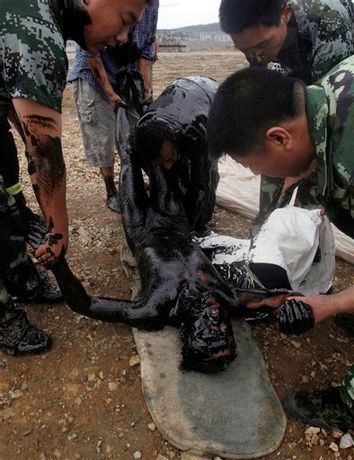
In this photo released by Greenpeace, a firefighter who was submerged in thick oil during an attempt to fix an underwater pump is brought ashore by his colleagues in Dalian, China on Tuesday, July 20, 2010. Crude oil started pouring into the Yellow Sea off a busy northeastern port after a pipeline exploded late last week, sparking a massive 15-hour fire. The government says the slick has spread across a 70-square-mile (180-square-kilometer) stretch of ocean. (AP Photo/Jiang He, Greenpeace) ** NO SALES NO ARCHIVE **(Credit: AP) China’s largest reported oil spill had more than doubled by Wednesday, closing beaches on the Yellow Sea and prompting an environmental official to warn the sticky black crude posed a “severe threat” to sea life and water quality.
Some workers trying to clean up the inky beaches wore little more than rubber gloves, complicating efforts, one official said. But 40 oil-control boats and hundreds of fishing boats were also deployed in the area.
“I’ve been to a few bays today and discovered they were almost entirely covered with dark oil,” said Zhong Yu, a worker with the environmental group Greenpeace China, who spent Wednesday on a boat inspecting the spill.
Continue Reading CloseDozens of outspoken, popular blogs shut in China
Twitter-like "microblogs" are the government's primary target
Dozens of blogs by some of China’s most outspoken users have been abruptly shut down while popular Twitter-like services appear to be the newest target in government efforts to control social networking.
More and more Chinese bloggers are using the newer microblogs as their primary publishing tool, using their brief, punchy message format to chat with one another and promote their longer blog posts. But one of the country’s top four microblog sites is now down for maintenance, and the other three show a “beta” tag as if they are in testing, though they have been operating for months. The companies that run the websites aren’t saying why.
Continue Reading CloseChinese companies still selling tainted milk
Authorities uncover 170 more tons of the chemical-laced powder
The discovery has punched a 170-ton hole in China’s promises to overhaul its food safety system. Officials say they’ve found yet another case where large amounts of tainted milk powder from the country’s 2008 scandal that should have been destroyed were instead repackaged.
China ordered tens of thousands of milk products laced with an industrial chemical burned or buried after more than 300,000 children were sickened and at least six died from the contamination. But, crucially, the government did not carry out the eradication itself, and this month an emergency crackdown has made it clear that tons of compromised products are still on the market.
Continue Reading CloseImitation Google, YouTube emerge in China
Two sites tempt censors, copyright lawyers by offering blocked access
Imitation Web sites of both Google and YouTube have emerged in China as the country faces off against the real Google over its local operations.
YouTubecn.com offers videos from the real YouTube, which is blocked in China. The Google imitation is called Goojje and includes a plea for the U.S.-based Web giant not to leave China, after it threatened this month to do so in a dispute over Web censorship and cyberattacks.
The separate projects went up within a day of each other in mid-January, just after Google’s threat to leave.
Continue Reading ClosePage 1 of 2 in Cara Anna