Chase Madar

“War crime” delusions

A WikiLeaks video of an Iraq war massacre raises questions about international laws governing armed conflict

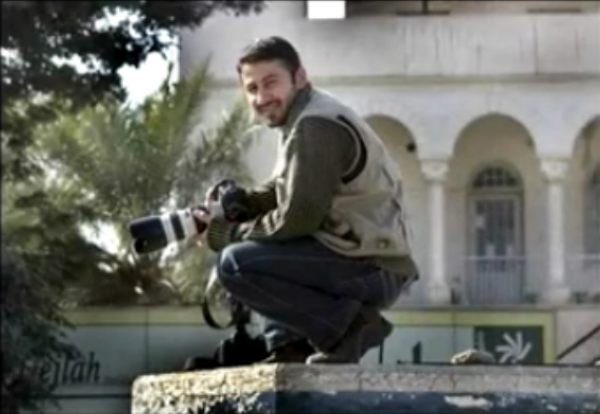
Still of Namir Noor-Eldeen, a 22-year-old war photographer, from WikiLeaks' Collateral Murder video
This originally appeared on TomDispatch.

Anyone who would like to witness a vivid example of modern warfare that adheres to the laws of war — that corpus of regulations developed painstakingly over centuries by jurists, humanitarians, and soldiers, a body of rules that is now an essential, institutionalized part of the U.S. armed forces and indeed all modern militaries — should simply click here and watch the video.

Wait a minute: that’s the WikiLeaks “Collateral Murder” video!  The gunsight view of an Apache helicopter opening fire from half a mile high on a crowd of Iraqis — a few armed men, but mostly unarmed civilians, including a couple of Reuters employees — as they unsuspectingly walked the streets of a Baghdad suburb one July day in 2007.

Watch, if you can bear it, as the helicopter crew blows people away, killing at least a dozen of them, and taking good care to wipe out the wounded as they try to crawl to safety.  (You can also hear the helicopter crew making wisecracks throughout.) When a van comes on the scene to tend to the survivors, the Apache gunship opens fire on it too, killing a few more and wounding two small children.

The slaughter captured in this short film, the most virally sensational of WikiLeaks’ disclosures, was widely condemned as an atrocity worldwide, and many pundits quickly labeled it a “war crime” for good measure.

But was this massacre really a “war crime” — or just plain-old regular war? The question is anything but a word-game. It is, in fact, far from clear that this act, though plainly atrocious and horrific, was a violation of the laws of war.  Some have argued that the slaughter, if legal, was therefore justified and, though certainly unfortunate, no big deal. But it is possible to draw a starkly different conclusion: that the “legality” of this act is an indictment of the laws of war as we know them.

The reaction of professional humanitarians to the gun-sight video was muted, to say the least.  The big three human rights organizations — Human Rights Watch (HRW), Amnesty International, and Human Rights First — responded not with position papers and furious press releases but with silence.  HRW omitted any mention of it in its report on human rights and war crimes in Iraq, published nearly a year after the video’s release. Amnesty also kept mum.  Gabor Rona, legal director of Human Rights First, told me there wasn’t enough evidence to ascertain whether the laws of war had been violated, and that his organization had no Freedom of Information Act requests underway to uncover new evidence on the matter.

This collective non-response, it should be stressed, is not because these humanitarian groups, which do much valuable work, are cowardly or “sell-outs.”  The reason is: all three human rights groups, like human rights doctrine itself, are primarily concerned with questions of legality.  And quite simply, as atrocious as the event was, there was no clear violation of the laws of war to provide a toehold for the professional humanitarians.

The human rights industry is hardly alone in finding the event disturbing but in conformance with the laws of war.  As Professor Gary Solis, a leading expert and author of a standard text on those laws, told Scott Horton of Harper’s Magazine, “I believe it unlikely that a neutral and detached investigator would conclude that the helicopter personnel violated the laws of armed conflict. Legal guilt does not always accompany innocent death.”  It bears noting that Gary Solis is no neocon ultra. A scholar who has taught at the London School of Economics and Georgetown, he is the author of a standard textbook on the subject, and was an unflinching critic of the Bush-Cheney administration.

War and International “Humanitarian” Law

“International humanitarian law,” or IHL, is the trying-too-hard euphemism for the laws of war.  And as it happens, IHL turns out to be less concerned with restraining military violence than licensing it.  As applied to America’s recent wars, this body of law turns out to be wonderfully accommodating when it comes to the prerogatives of an occupying army.

Here’s another recent example of a wartime atrocity that is perfectly legal and not a war crime at all. Thanks to WikiLeaks’ Iraq War Logs, we now know about the commonplace torture practices employed by Iraqi jailers and interrogators during our invasion and occupation of that country.  We have clear U.S. military documentation of sexual torture, of amputated fingers and limbs, of beatings so severe they regularly resulted in death.

Surely standing by and taking careful notes while the Iraqi people you have supposedly liberated from tyranny are getting tortured, sometimes to death, is a violation of the laws of war.  After all, in 2005 General Peter Pace, then Chairman of the Joint Chiefs of Staff, publicly contradicted his boss Secretary of Defense Donald Rumsfeld by commenting into a live mike that it is “absolutely the responsibility of every American soldier to stop torture whenever and wherever they see it.” (A young private working in Army Intelligence named Bradley Manning, learning that a group of Iraqi civilians handing out pamphlets alleging government corruption had been detained by the Iraqi federal police, raised his concern with his commanding officer about their possible torture.  He was reportedly told him to shut up and get back to work helping the authorities find more detainees.)

As it turned out, General Pace’s exhortation was at odds with both official policy and law: Fragmentary Order 242, issued by Donald Rumsfeld’s Pentagon, made it official policy for occupying U.S. troops not to interfere with ongoing Iraqi torture.  And this, according to some experts, is no violation of the laws of war either. Prolix on the limits imposed on the acts of non-state fighters who are not part of modern armies, the Geneva Conventions are remarkably reticent on the duties of occupying armies.

As Gary Solis pointed out to me, Common Article 1 of the Fourth Geneva Convention assigns only a vague obligation to “ensure respect” for prisoners handed over to a third party.  On the ground in either Iraq or Afghanistan, this string of words would prove a less-than-meaningful constraint.

Part of the problem is that the laws of war that aspire to restrain deadly force are often weakly enforced and routinely violated. Ethan McCord, the American soldier who saved the two wounded children from that van in the helicopter video, remembers one set of instructions he received from his battalion commander: “Anytime your convoy gets hit by an IED, I want 360 degree rotational fire.  You kill every [expletive] in the street!”  (“That order,” David Glazier, a jurist at the National Institute for Military Justice, told me, “is absolutely a war crime.”)  In other words, the rules of engagement that are supposed to constrain occupying troops in places like Afghanistan and Iraq are, according to many scholars and investigators, often belittled and ignored.

Legalized Atrocity

The real problem with the laws of war, however, is not what they fail to restrain but what they authorize.  The primary function of International Humanitarian Law is to legalize remarkable levels of “good” military violence that regularly kill and injure non-combatants.  IHL highlights a handful of key principles: the distinction between combatant and civilian, the obligation to use force only for military necessity, and the duty to jeopardize civilians only in proportion to the military value of a target.

Even when these principles are applied conscientiously — and often they aren’t — they still allow for remarkable levels of civilian carnage, which the Pentagon has long primly (and conveniently) referred to as “collateral damage,” as if it were a sad sideline in the prosecution of war.  And yet civilian deaths in modern war regularly are the central aspect of those wars, both statistically and in other ways.  Far from being universally proscribed, the killing of high numbers of civilians in a battle zone is often considered absolutely legal under those laws.  In the pungent phrase of Professor David Kennedy of Harvard Law School, “We should be clear — this bold new vocabulary beats ploughshares into swords as often as the reverse.”

The relative weakness of the laws of war when it comes to preventing atrocities is not simply some recent debasement perpetrated by neoconservative Visigoths.  Privileging the combatant and his (it’s usually “his”) prerogatives has been the historical bone marrow of those laws.  In the Vietnam War, for instance, the declaration of significant parts of the South Vietnamese countryside as “free-fire zones,” and the “carpet bombing” of rural areas by B-52s carrying massive payloads were also done under cover of the laws of war.

IHL has certainly changed in some respects.  A century ago, the discourse around the laws of war was far more candid than today.  Jurists once regularly referred to “non-uniformed unprivileged combatants” simply as “savages” and the consensus view in mainstream scholarly journals of international law was that a modern army could do whatever it wanted to such obstreperous, lawless people (especially, of course, in what was still then the colonial world).  On the whole, the history of IHL is a long record of codifying the privileges of the powerful against lesser threats like civilians and colonial subjects resisting invasion.

Even though the laws of war have usually been one more weapon of the strong against the weak, a great deal of their particular brand of legalism has seeped into antiwar discourse. One of the key talking points for many arguing against the invasion of Iraq was that it was illegal — and that was certainly true.  But was the failure to procure a permission slip from the United Nations really the main problem with this calamitous act of violence?  Would U.N. authorization really have redeemed any of it?  There is also a growing faith that war can be domesticated under a relatively new rubric, “humanitarian intervention,” which purports to apply military violence in precise and therapeutic dosages, all strictly governed by international humanitarian law.

Here is where the WikiLeaks disclosures were so revealing.  They remind us, once again, that the humanitarian dream of “clean warfare” — military violence that is smoothly regulated by laws that spare civilians — is usually a sick joke.  We need to wean ourselves from the false comfort that the law is always on the side of civilians.  We need to scrap our tendency to assume that international law is inherently virtuous, and that anything that shocks our conscience — that helicopter video or widespread torture in Iraq under the noses of U.S. soldiers — must be a violation of this system, rather than its logical and predictable consequence.

Let’s be clear: what killed the civilians walking the streets of Baghdad that day in 2007 was not “war crimes,” but war.  And that holds for so many thousands of other Afghan and Iraqi civilians killed by drone strikes, air strikes, night raids, convoys, and nervous checkpoint guards as well.

Regulatory Capture

Who, after all, writes the laws of war?  Just as the regulations that govern the pharmaceutical and airline industries are often gamed by large corporations with their phalanxes of lobbyists, the laws of war are also vulnerable to “regulatory capture” by the great powers under their supposed rule. Keep in mind, for instance, that the Pentagon employs 10,000 lawyers and that its junior partner in foreign policy making, the State Department, has a few hundred more.  Should we be surprised if in-house lawyers can sort out “legal” ways not to let those laws of war get in the way of the global ambitions of a superpower?

It’s only fair that the last words on the laws of war go to Private Bradley Manning, now sitting in a prison cell in Ft. Leavenworth, Kansas, awaiting court-martial for allegedly passing troves of classified material to WikiLeaks, documents that offer the unvarnished truth about the Afghan War, the Iraq War, and Guantánamo.  They are taken from the instant-message chatlogs he wrote under the handle of “bradass87” to the informant who turned him in.  The young private saw very clearly what so many professors and generals take pains to deny: that the primary function of the laws of war is not to restrain violence, but to justify it, often with the greatest lawyerly ingenuity.

(02:27:47 PM) bradass87: i mean, we’re better in some respects… we’re much more subtle… use a lot more words and legal techniques to legitimize everything…

(02:28:19 PM) bradass87: but just because something is more subtle, doesn’t make it right

To stay on top of important articles like these, sign up to receive the latest updates from TomDispatch.com here.

Manning, Washington’s favorite scapegoat

The only civilian casualties D.C.'s warmongers ever talk about are the hypothetical ones "caused" by WikiLeaks

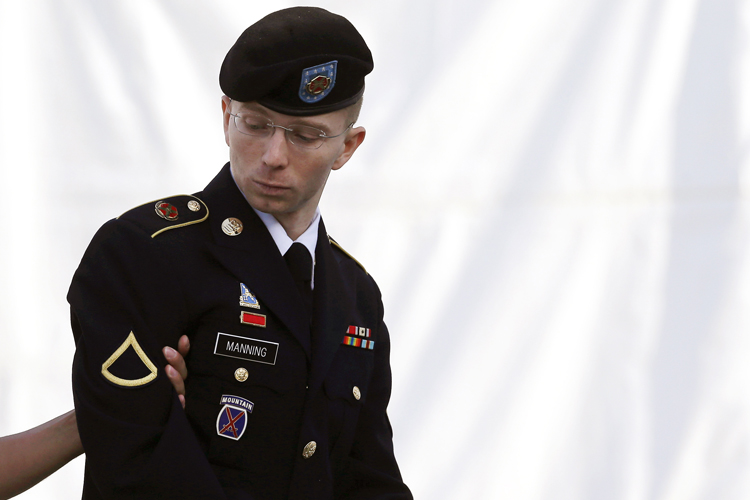
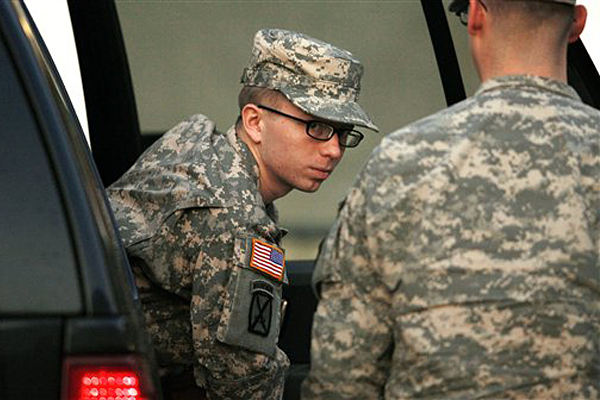
Army Pfc. Bradley Manning is escorted from a security vehicle to a courthouse in Fort Meade, Md., Monday, Dec. 19, 2011, for a military hearing (Credit: AP/Patrick Semansky)
This originally appeared on TomDispatch.

Who in their right mind wants to talk about, think about or read a short essay about… civilian war casualties? What a bummer, this topic, especially since our Afghan Iraq and other ongoing wars were advertised as uplifting acts of philanthropy: wars to spread security, freedom, democracy, human rights, gender equality, the rule of law, etc.

A couple hundred thousand dead civilians have a way of making such noble ideals seem like dollar-store tinsel. And so, throughout our decade-long foreign policy debacle in the Greater Middle East, we in the U.S. have generally agreed that no one shall commit the gaucherie of dwelling on (and “dwelling on” = fleetingly mentioned) civilian casualties. Washington elites may squabble over some things, but as for foreigners killed by our numerous wars, our Beltway crew adheres to a sullen code of omertà.

Club rules do, however, permit one loophole: Washington officials may bemoan the nightmare of civilian casualties — but only if they can be pinned on a 24-year-old Army private first class named Bradley Manning.

Pfc. Manning, you will remember, is the young soldier who is soon to be court-martialed for passing some 750,000 military and diplomatic documents, a large chunk of them classified, to the website WikiLeaks. Among those leaks, there was indeed some serious stuff about how Americans dealt with civilians in invaded countries. For instance, the documents revealed that the U.S. military, then the occupying force in Iraq, did little or nothing to prevent Iraqi authorities from torturing prisoners in a variety of gruesome ways, sometimes to death.

Then there was that gun-sight video — unclassified but buried in classified material — of an American Apache helicopter opening fire on a crowd on a Baghdad street, gunning down a dozen men, including two Reuters employees, and injuring more, including children. There were also those field reports about how jumpy American soldiers repeatedly shot down civilians at roadside checkpoints; about night raids gone wrong both in Iraq and Afghanistan; and a count of thousands of dead Iraqi civilians, a tally whose existence the U.S. military had previously denied possessing.

Together, these leaks and many others offered a composite portrait of military and political debacles in Iraq and Afghanistan whose grinding theme has been civilian casualties, a fact not much noted here in the U.S. A tiny number of low-ranking American soldiers have been held to account for rare instances of premeditated murder of civilians, but most of the troops who kill civilians in the midst of the chaos of war are not tried, much less convicted. We don’t talk about these cases a lot either. On the other hand, officials of all types make free with lusty condemnations of Bradley Manning, whose leaks are luridly credited with potential (though not actual) deaths.

Putting Lives in Danger

“[WikiLeaks] might already have on their hands the blood of some young soldier or that of an Afghan family,” said Admiral Mike Mullen, then Chairman of the Joint Chiefs of Staff, on the release of the Afghan War Logs in July 2010. This was, of course, the same Admiral Mullen who had endorsed a major escalation of the war in Afghanistan, which would lead to a tremendous “surge” in casualties among civilians and soldiers alike.  Here are counts — undoubtedly undercounts, in fact — of real Afghan corpses that, at least in part, resulted from the policy he supported: 2,412 in 2009, 2,777 in 2010, 1,462 in the first half 2011, according to the U.N. Assistance Mission to Afghanistan.  As far as anyone knows, here are the corpses that resulted from the release of those WikiLeaks documents: 0. (And don’t forget, the stalemate war with the Taliban has not budged in the period since that surge.)  Who, then, has blood on his hands, Pfc. Manning — or Admiral Mullen?

Of course the admiral is hardly alone. In fact, whole tabernacle choirs have joined in the condemnation of Manning and WikiLeaks for “causing” carnage, thanks to their disclosures.

Robert Gates, who served as secretary of defense under George W. Bush and then Barack Obama, also spoke sternly of Manning’s leaks, accusing him of “moral culpability.” He added, “And that’s where I think the verdict is ‘guilty’ on WikiLeaks. They have put this out without any regard whatsoever for the consequences.”

This was, of course, the same Robert Gates who pushed for escalation in Afghanistan in 2009 and, in March 2011, flew to the Kingdom of Bahrain to offer his own personal “reassurance of support” to a ruling monarchy already busy shooting and torturing nonviolent civilian protesters. So again, when it comes to blood and indifference to consequences, Bradley Manning — or Robert Gates?

Nor have such attitudes been confined to the military. Secretary of State Hillary Clinton accused Manning’s (alleged) leak of 250,000 diplomatic cables of being “an attack on the international community” that “puts people’s lives in danger, threatens our national security, and undermines our efforts to work with other countries to solve shared problems.”

As a senator, of course, she supported the invasion of Iraq in flagrant contravention of the U.N. Charter. She was subsequently a leading hawk when it came to escalating and expanding the Afghan War, and is now responsible for disbursing an annual $1.3 billion in military aid to Egypt’s ruling junta whose forces have repeatedly opened fire on nonviolent civilian protesters.  So who’s been attacking the international community and putting lives in danger, Bradley Manning — or Hillary Clinton?

Harold Koh, former Yale Law School dean, liberal lion and currently the State Department’s top legal adviser, has announced that the same leaked diplomatic cables “could place at risk the lives of countless innocent individuals — from journalists to human rights activists and bloggers to soldiers to individuals providing information to further peace and security.”

This is the same Harold Koh who, in March 2010, provided a tortured legal rationale for the Obama administration’s drone strikes in Pakistan, Yemenand Somalia, despite the inevitable and well-documented civilian casualties they cause.  So who is risking the lives of countless innocent individuals, Bradley Manning — or Harold Koh?

Much of the media have clambered aboard the bandwagon, blaming WikiLeaks and Manning for damage done by wars they once energetically cheered on.

In early 2011, to pick just one example from the ranks of journalism, New Yorker writer George Packer professed his horror that WikiLeaks had released a memo marked “secret/noforn” listing spots throughout the world of vital strategic or economic interest to the United States. Asked by radio host Brian Lehrer whether this disclosure had crossed a new line by making a gratuitous gift to terrorists, Packer replied with an appalled yes.

Now, among the “secrets” contained in this document are the facts that the Strait of Gibraltar is a vital shipping lane and that the Democratic Republic of the Congo is rich in minerals. Have we Americans become so infantilized that factoids of basic geography must be considered state secrets? (Maybe best not to answer that question.)  The “threat” of this document’s release has since been roundly debunked by various military intellectuals.

Nevertheless, Packer’s response was instructive.  Here was a typical liberal hawk, who had can-canned to the post-9/11 drumbeat of war as a therapeutic wake-up call from “the bland comforts of peace,” now affronted by WikiLeaks’ supposed recklessness.  Civilian casualties do not seem to have been on Packer’s mind when he supported the invasion of Iraq, nor has he written much about them since.

In an enthusiastic 2006 New Yorker essay on counterinsurgency warfare, for example, the very words “civilian casualties” never come up, despite their centrality to COIN theory, practice and history.  It is a fact that, as Operation Enduring Freedom shifted to counterinsurgency tactics in 2009, civilian casualties in Afghanistan skyrocketed.  So, for that matter, have American military casualties.  (More than half of U.S. military deaths in Afghanistan occurred in the past three years.)

Liberal hawks like Packer may consider WikiLeaks out of bounds, but really, who in these last years has been the most reckless, Bradley Manning — or George Packer and some of his pro-war colleagues at the New Yorker like Jeffrey Goldberg (who has since left for the Atlantic Monthly, where he’s been busily clearing a path for war with Iran) and editor David Remnick?

Centrist and liberal nonprofit think tanks have been no less selectively blind when it comes to civilian carnage. Liza Goitein, a lawyer at the liberal-minded Brennan Center at NYU Law School, has also taken out after Bradley Manning.  In the midst of an otherwise deft diagnosis of Washington’s compulsive urge to over-classify everything — the federal government classifies an amazing 77 million documents a year — she pauses just long enough to accuse Manning of “criminal recklessness” for putting civilians named in the Afghan War logs in peril — “a disclosure,” as she puts it, “that surely endangers their safety.”

It’s worth noting that, until the moment Goitein made this charge, not a single report or press release issued by the Brennan Center has ever so much as uttered a mention of civilian casualties caused by the U.S. military. The absence of civilian casualties is almost palpable in the work of the Brennan Center’s program in  “Liberty and National Security.” For example, this program’s 2011 report “Rethinking Radicalization,” which explored effective, lawful ways to prevent American Muslims from turning terrorist, makes not a single reference to the tens of thousands of well-documented civilian casualties caused by American military force in the Muslim world, which according to many scholars is the prime mover of terrorist blowback.  The report on how to combat the threat of Muslim terrorists, written by Pakistan-born Faiza Patel, does not, in fact, even contain the words “Iraq,” “Afghanistan,” “drone strike,” “Pakistan” or “civilian casualties.”

This is almost incredible, because terrorists themselves have freely confessed that what motivated their acts of wanton violence has been the damage done by foreign military occupation back home or simply in the Muslim world.  Asked by a federal judge why he tried to blow up Times Square with a car bomb in May 2010, Pakistani-American Faisal Shahzad answered that he was motivated by the civilian carnage the U.S. had caused in Iraq, Afghanistan and Pakistan. How could any report about “rethinking radicalization” fail to mention this?  Although the Brennan Center does much valuable work, Goitein’s selective finger-pointing on civilian casualties is emblematic of a blindness to war’s consequences widespread among American institutions.

American Military Whistleblowers

Knowledge may indeed have its risks, but how many civilian deaths can actually be traced to the WikiLeaks revelations?  How many military deaths?  To the best of anyone’s knowledge, not a single one.  After much huffing and puffing, the Pentagon has quietly denied — and then denied again — that there is any evidence at all of the Taliban targeting the Afghan civilians named in the leaked war logs.

In the end, the “grave risks” involved in the publication of the War Logs and of those State Department documents have been wildly exaggerated.  Embarrassment, yes. A look inside two grim wars and the workings of imperial diplomacy, yes. Blood, no.

On the other hand, the grave risks that were hidden in those leaked documents, as well as in all the other government distortions, cover-ups and lies of the past decade, have been graphically illustrated in aortal red. The civilian carnage caused by our rush to war in Iraq and by our deeply entrenched stalemate of a war in Afghanistan (and the Pakistani tribal borderlands) is not speculative or theoretical but all-too real.

And yet no one anywhere has been held to much account: not in the political class, not in the military, not in the think tanks, not among the scholars, nor the media.  Only one individual, it seems, will pay, even if he actually spilled none of the blood. Our foreign policy elites seem to think Bradley Manning is well-cast for the role of fall guy and scapegoat. This is an injustice.

Someday, it will be clearer to Americans that Pfc. Manning has joined the ranks of great American military whistleblowers like Dan Ellsberg (who was first in his class at Marine officer training school); Vietnam War infantryman Ron Ridenhour, who blew the whistle on the My Lai massacre; and the sailors and marines who, in 1777, reported the torture of British captives by their politically connected commanding officer. These servicemen, too, were vilified in their times. Today, we honor them, as someday Pfc. Manning will be honored.

To stay on top of important articles like these, sign up to receive the latest updates from TomDispatch.com here.

Continue Reading Close

Why Bradley Manning is an American hero

If the private did leak documents, his only "crime" is pushing the U.S. back to our tradition of transparency

Bradley Manning

We still don’t know if he did it or not, but if Bradley Manning, the 24-year-old Army private from Oklahoma, actually supplied WikiLeaks with its choicest material — the Iraq War logs, the Afghan War logs, and the State Department cables — which startled and riveted the world, then he deserves the Presidential Medal of Freedom instead of a jail cell at Fort Leavenworth.

President Obama recently gave one of those medals to retiring Secretary of Defense Robert Gates, who managed the two bloody, disastrous wars about which the WikiLeaks-released documents revealed so much. Is he really more deserving than the young private who, after almost ten years of mayhem and catastrophe, gave Americans — and the world — a far fuller sense of what our government is actually doing abroad?

Bradley Manning, awaiting a court martial in December, faces the prospect of long years in prison. He is charged with violating the Espionage Act of 1917. He has put his sanity and his freedom on the line so that Americans might know what our government has done — and is still doing — globally. He has blown the whistle on criminal violations of American military law. He has exposed our secretive government’s pathological over-classification of important public documents.

Here are four compelling reasons why, if he did what the government accuses him of doing, he deserves that medal, not jail time.

1: At great personal cost, Bradley Manning has given our foreign policy elite the public supervision it so badly needs.

In the past 10 years, American statecraft has moved from calamity to catastrophe, laying waste to other nations while never failing to damage our own national interests. Do we even need to be reminded that our self-defeating response to 9/11 in Iraq and Afghanistan (and Pakistan, Yemen, and Somalia) has killed roughly 225,000 civilians and 6,000 American soldiers, while costing our country more than $3.2 trillion? We are hemorrhaging blood and money. Few outside Washington would argue that any of this is making America safer.

An employee who screwed up this badly would either be fired on the spot or put under heavy supervision. Downsizing our entire foreign policy establishment is not an option. However, the website WikiLeaks has at least tried to make public scrutiny of our self-destructive statesmen and -women a reality by exposing their work to ordinary citizens.

Consider our invasion of Iraq, a war based on distortions, government secrecy, and the complaisant failure of our major media to ask the important questions. But what if someone like Bradley Manning had provided the press with the necessary government documents, which would have made so much self-evident in the months before the war began? Might this not have prevented disaster? We’ll never know, of course, but could additional public scrutiny have been salutary under the circumstances?

Thanks to Bradley Manning’s alleged disclosures, we do have a sense of what did happen afterwards in Iraq and Afghanistan, and just how the U.S. operates in the world. Thanks to those disclosures, we now know just how Washington leaned on the Vatican to quell opposition to the Iraq War and just how it pressured the Germans to prevent them from prosecuting CIA agents who kidnapped an innocent man and shipped him off to be tortured abroad.

As our foreign policy threatens to careen into yet more disasters in Yemen, Pakistan, Somalia, and Libya, we can only hope that more whistleblowers will follow the alleged example of Bradley Manning and release vital public documents before it’s too late. A foreign policy based on secrets and spin has manifestly failed us. In a democracy, the workings of our government should not be shrouded in an opaque cloud of secrecy. For bringing us the truth, for breaking the seal on that self-protective policy of secrecy, Bradley Manning deserves the Presidential Medal of Freedom.

2: Knowledge is powerful. The WikiLeaks disclosures have helped spark democratic revolutions and reforms across the Middle East, accomplishing what Operation Iraqi Freedom never could.

Wasn’t it American policy to spread democracy in the Middle East, to extend our freedom to others, as both recent American presidents have insisted?

No single American has done more to help further this goal than Pfc. Bradley Manning. The chain reaction of democratic protests and uprisings that has swept Egypt, Libya, Bahrain, Syria, Yemen, and even in a modest way Iraq, all began in Tunisia, where leaked U.S. State Department cables about the staggering corruption of the ruling Ben Ali dynasty helped trigger the rebellion. In all cases, these societies were smoldering with longstanding grievances against oppressive, incompetent governments and economies stifled by cronyism. The revelations from the WikiLeaks State Department documents played a widely acknowledged role in sparking these pro-democracy uprisings.

In Egypt, Tunisia, Bahrain, and Yemen, the people’s revolts under way have occurred despite U.S. support for their autocratic rulers. In each of these nations, in fact, we bankrolled the dictators, while helping to arm and train their militaries. The alliance with Mubarak’s autocratic state cost the U.S. more than $60 billion and did nothing for American security — other than inspire terrorist blowback from radicalized Egyptians like Mohammad Atta and Ayman al-Zawahiri.

Even if U.S. policy was firmly on the wrong side of things, we should be proud that at least one American — Bradley Manning — was on the right side. If indeed he gave those documents to WikiLeaks, then he played a catalytic role in bringing about the Arab Spring, something neither Barack Obama nor former Secretary of Defense Robert Gates (that recent surprise recipient of the Presidential Medal of Freedom) could claim. Perhaps once the Egyptians consolidate their democracy, they, too, will award Manning their equivalent of such a medal.

3: Bradley Manning has exposed the pathological over-classification of America’s public documents.

“Secrecy is for losers,” as the late Senator and United Nations Ambassador Daniel Patrick Moynihan used to say. If this is indeed the case, it would be hard to find a bigger loser than the U.S. government.

How pathological is our government’s addiction to secrecy? In June, the National Security Agency declassified documents from 1809, while the Department of Defense only last month declassified the Pentagon Papers, publicly available in book form these last four decades. Our government is only just now finishing its declassification of documents relating to World War I.

This would be ridiculous if it weren’t tragic. Ask the historians. Barton J. Bernstein, professor emeritus of history at Stanford University and a founder of its international relations program, describes the government’s classification of foreign-policy documents as “bizarre, arbitrary, and nonsensical.” George Herring, professor emeritus at the University of Kentucky and author of the encyclopedic From Colony to Superpower: A History of U.S. Foreign Policy, has chronicled how his delight at being appointed to a CIA advisory panel on declassification turned to disgust once he realized that he was being used as window dressing by an agency with no intention of opening its records, no matter how important or how old, to public scrutiny.

Any historian worth his salt would warn us that such over-classification is a leading cause of national amnesia and repetitive war disorder. If a society like ours doesn’t know its own history, it becomes the great power equivalent of a itinerant amnesiac, not knowing what it did yesterday or where it will end up tomorrow. Right now, classification is the disease of Washington, secrecy its mania, and dementia its end point. As an ostensibly democratic nation, we, its citizens, risk such ignorance at our national peril.

President Obama came into office promising a “sunshine” policy for his administration while singing the praises of whistleblowers. He has since launched the fiercest campaign against whistleblowers the republic has ever seen, and further plunged our foreign policy into the shadows. Challenging the classification of each tightly guarded document is, however, impossible. No organization has the resources to fight this fight, nor would they be likely to win right now. Absent a radical change in our government’s diplomatic and military bureaucracies, massive over-classification will only continue.

If we hope to know what our government is actually doing in our name globally, we need massive leaks from insider whistleblowers to journalists who can then sort out what we need to know, given that the government won’t. This, in fact, has been the modus operandi of WikiLeaks. Our whistleblower protection laws urgently need to catch up to this state of affairs, and though we are hardly there yet, Bradley Manning helped take us part of the way. He did what Barack Obama swore he would do on coming into office. For striking a blow against our government’s fanatical insistence on covering its mistakes and errors with blanket secrecy, Bradley Manning deserves not punishment, but the Presidential Medal of Freedom.

4. At immense personal cost, Bradley Manning has upheld a great American tradition of transparency in statecraft and for that he should be an American hero, not an American felon.

Bradley Manning is only the latest in a long line of whistleblowers in and out of uniform who have risked everything to put our country back on the right path.

Take Daniel Ellsberg, leaker of the Pentagon Papers, a Pentagon-commissioned secret history of the Vietnam War and the official lies and distortions that the government used to sell it. Many of the documents it included were classed at a much higher security clearance than anything Bradley Manning is accused of releasing — and yet Ellsberg was not convicted of a single crime and became a national hero.

Given the era when all this went down, it’s forgivable to assume that Ellsberg must have been a hippie who somehow sneaked into the Pentagon archives, beads and patchouli trailing behind him. What many no longer realize is that Ellsberg had been a model U.S. Marine. First in his class at officer training school at Quantico, he deferred graduate school at Harvard to remain on active duty in the Marine Corps. Ellsberg saw his high-risk exposure of the disastrous and deceitful nature of the Vietnam War as fully consonant with his long career of patriotic service in and out of uniform.

And Ellsberg is hardly alone. Ask Lt. Colonel (ret.) Darrel Vandeveld. Or Tom Drake, formerly of the National Security Agency.

Transparency in statecraft was not invented last week by WikiLeaks creator Julian Assange. It is a longstanding American tradition. James Madison put the matter succinctly: “A popular government, without popular information, or the means of acquiring it, is but a prologue to a farce or a tragedy; or, perhaps both.”

A 1960 Congressional Committee on Government Operations report caught the same spirit: “Secrecy — the first refuge of incompetents — must be at a bare minimum in a democratic society… Those elected or appointed to positions of executive authority must recognize that government, in a democracy, cannot be wiser than the people.” John F. Kennedy made the same point in 1961: “The very word ‘secrecy’ is repugnant in a free and open society.” Hugo Black, great Alabaman justice of the twentieth-century Supreme Court had this to say: “The guarding of military and diplomatic secrets at the expense of informed representative government provides no real security for our Republic.” And the first of World-War-I-era president Woodrow Wilson’s 14 Points couldn’t have been more explicit: “Open covenants of peace, openly arrived at, after which there shall be no private international understandings of any kind but diplomacy shall proceed always frankly and in the public view.”

We need to know what our government’s commitments are, as our foreign policy elites have clearly demonstrated they cannot be left to their own devices. Based on the last decade of carnage and folly, without public debate — and aggressive media investigations — we have every reason to expect more of the same.

If there’s anything to learn from that decade, it’s that government secrecy and lies come at a very high price in blood and money. Thanks to the whistleblowing revelations attributed to Bradley Manning, we at least have a far clearer picture of the problems we face in trying to supervise our own government. If he was the one responsible for the WikiLeaks revelations, then for his gift to the republic, purchased at great price, he deserves not prison, but a Presidential Medal of Freedom and the heartfelt gratitude of his country.

To stay on top of important articles like these, sign up to receive the latest updates from TomDispatch.com here.

Continue Reading Close

Why Bradley Manning is a patriot, not a criminal

An opening statement for the defense of Pfc. Manning

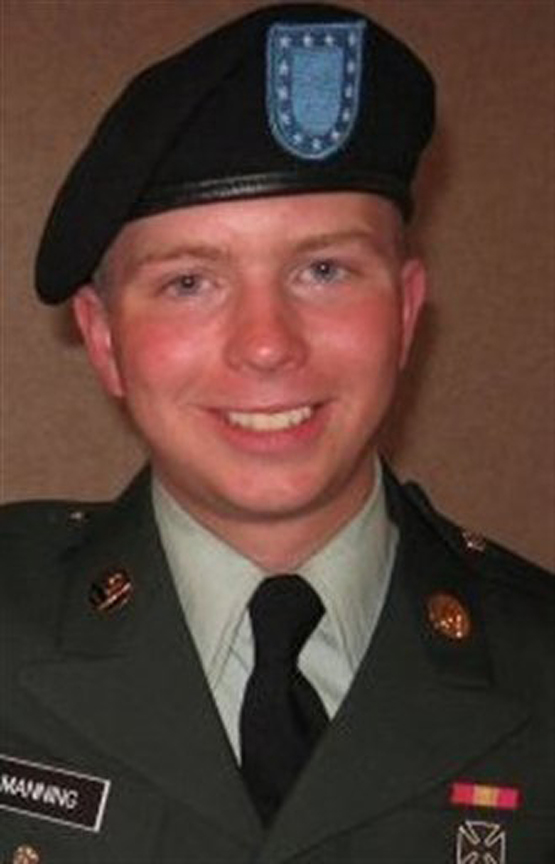
FILE - This undated file photo obtained by The Associated Press shows Bradley Manning, the U.S. Army private suspected of being the source of some of the unauthorized classified information disclosed on the WikiLeaks website. In a statement Saturday, Jan. 8, 2011, WikiLeaks said U.S. investigators had gone to the San Francisco-based Twitter Inc. to demand the private messages, contact information and other personal details of WikiLeaks founder Julian Assange, Manning and other supporters. (AP Photo, File)(Credit: AP)

This piece originally appeared on TomDispatch.

Bradley Manning, a 23-year-old from Crescent, Oklahoma, enlisted in the U.S. military in 2007 to give something back to his country and, he hoped, the world.

For the past seven months, Army Pfc. Manning has been held in solitary confinement in the Marine Corps brig in Quantico, Virginia. Twenty-five thousand other Americans are also in prolonged solitary confinement, but the conditions of Manning’s pre-trial detention have been sufficiently brutal for the United Nations’ Special Rapporteur on Torture to announce an investigation.

Pfc. Manning is alleged to have obtained documents, both classified and unclassified, from the Department of Defense and the State Department via the Internet and provided them to WikiLeaks. (That “alleged” is important because the federal informant who fingered Manning, Adrian Lamo, is a felon convincted of computer-hacking crimes. He was also involuntarily committed to a psychiatric institution in the month before he levelled his accusation. All of this makes him a less than reliable witness.) At any rate, the records allegedly downloaded by Manning revealed clear instances of war crimes committed by U.S. troops in Iraq and Afghanistan, widespread torture committed by the Iraqi authorities with the full knowledge of the U.S. military, previously unknown estimates of the number of Iraqi civilians killed at U.S. military checkpoints, and the massive Iraqi civilian death toll caused by the American invasion.

For bringing to light this critical but long-suppressed information, Pfc. Manning has been treated not as a whistleblower, but as a criminal and a spy. He is charged with violating not only Army regulations but also the Espionage Act of 1917, making him the fifth American to be charged under the act for leaking classified documents to the media. A court-martial will likely be convened in the spring or summer.

Politicians have called for Manning’s head, sometimes literally. And yet a strong legal defense for Pfc. Manning is not difficult to envision. Despite many remaining questions of fact, a legal defense can already be sketched out. What follows is an “opening statement” for the defense. It does not attempt to argue individual points of law in any exhaustive way. Rather, like any opening statement, it is an overview of the vital legal (and political) issues at stake, intended for an audience of ordinary citizens, not Judge Advocate General lawyers.

After all, it is the court of public opinion that ultimately decides what a government can and cannot get away with, legally or otherwise.

Opening Statement for the Defense of Bradley Manning, Soldier and Patriot


U.S. Army Private First Class Bradley Manning has done his duty. He has witnessed serious violations of the American military’s Uniform Code of Military Justice, violations of the rules in U.S. Army Field Manual 27-10, and violations of international law. He has brought these wrongdoings to light out of a profound sense of duty to his country, as a citizen and a soldier, and his patriotism has cost him dearly.

In 2005, General Peter Pace, Chairman of the Joint Chiefs of Staff, told reporters: “It is absolutely the responsibility of every U.S. service member [in Iraq], if they see inhumane treatment being conducted, to try to stop it.” This, in other words, was the obligation of every U.S. service member in Operation Iraqi Freedom; this remains the obligation of every U.S. service member in Operation Enduring Freedom in Afghanistan. It is a duty that Pfc. Manning has fulfilled.

Who is Pfc. Bradley Manning? He is a 23-year-old Private First Class in the U.S. Army. He was raised in Crescent, Oklahoma (population 1,281, according to the last census count). He enlisted in 2007. “He was basically really into America,” says a hometown friend. “He was proud of our successes as a country. He valued our freedom, but probably our economic freedom the most. I think he saw the U.S. as a force for good in the world.”

When Bradley Manning deployed to Iraq in October 2009, he thought that he’d be helping the Iraqi people build a free society after the long nightmare of Saddam Hussein. What he witnessed firsthand was quite another matter.

He soon found himself helping the Iraqi authorities detain civilians for distributing “anti-Iraqi literature” — which turned out to be an investigative report into financial corruption in their own government entitled “Where does the money go?” The penalty for this “crime” in Iraq was not a slap on the wrist. Imprisonment and torture, as well as systematic abuse of prisoners, are widespread in the new Iraq. From the military’s own Sigacts (Significant Actions) reports, we have a multitude of credible accounts of Iraqi police and soldiers shooting prisoners, beating them to death, pulling out fingernails or teeth, cutting off fingers, burning with acid, torturing with electric shocks or the use of suffocation, and various kinds of sexual abuse including sodomization with gun barrels and forcing prisoners to perform sexual acts on guards and each other.

Manning had more than adequate reason to be concerned about handing over Iraqi citizens for likely torture simply for producing pamphlets about corruption in a government notorious for its corruptness.

Like any good soldier, Manning immediately took these concerns up the chain of command. And how did his superiors respond? His commanding officer told him to “shut up” and get back to rounding up more prisoners for the Iraqi Federal Police to treat however they cared to.

Now, you have already heard what the Chairman of the Joint Chiefs of Staff had to say about an American soldier’s duties when confronted with the torture and abuse of prisoners. Ever since our country signed and ratified the Geneva Conventions and the Convention against Torture, it has been the law of our land that handing over prisoners to a body that will torture them is a war crime. Nevertheless, between early 2009 and August of last year, our military handed over thousands of prisoners to the Iraqi authorities, knowing full well what would happen to many of them.

The next time Pfc. Manning encountered evidence of war crimes, he took a different course of action.

On the Secret Internet Protocol Router Network (SIPRNet) shared by the Departments of Defense and State Manning soon found irrefutable evidence of possible war crimes, including a now-infamous “Collateral Murder” video in which a U.S. Apache helicopter mowed down some 18 civilians, including two Reuters journalists, on a street in Baghdad on July 12, 2007. The world has now seen and been shocked by this video which Reuters is alleged to have had in its possession but had not yet made public. Manning is alleged to have leaked it to the whistleblower site WikiLeaks in April 2010.

Manning also found a video and an official report on American air strikes on the village of Granai in Afghanistan’s Farah Province (also known as “the Granai massacre”). According to the Afghan government, 140 civilians, including women and a large number of children, died in those strikes. He is alleged to have released that video as part of a tranche of some 92,000 military documents relating to our escalating war in Afghanistan — already the longest war our nation has ever fought — and Pakistan, where the war is steadily spreading. Manning is also alleged to have released to WikiLeaks some 392,000 documents regarding the Iraq War, many of which relate to the torture of prisoners, as well as some 251,000 State Department cables.

Now, in your judgment of Bradley Manning, please know that the stakes are indeed high, but not in the feverish way our political and media elites have been telling you from nearly every newspaper, channel, and website in the land. We will want you, a true jury of Manning’s military peers, to ask a few questions about what’s really been going on in this trial — and in this country. After all, when we reward lawyers in the Justice Department who created memos that made torture legal with federal judgeships and regular newspaper columns, while locking lock up a whistle-blowing private, you have to ask: What country are we now living in?

This trial couldn’t be more important or your judgment more crucial. The honor of our country is very much at stake in how you decide. When we let the aerial slaughter of civilian noncombatants pass without comment or review, when a reported 92 children die from an American air strike on an Afghan village and 18 civilians are shot dead on a Baghdad street without the slightest accountability, except when it comes to locking up the private who ensured that we would know about these acts — let me repeat — the honor of your country and mine is at stake and at risk. Not the security of your country, though the prosecution will claim otherwise, but the honor of our country, and especially the honor of our military.

Pfc. Bradley Manning is one soldier who has done his duty. He has complied with it to the letter. Now you must do your duty as members of this jury and as soldiers.

Our Whistleblower Laws Protect Pfc. Manning

The prosecution will surely tell you that none of our existing whistleblower protection laws, interpreted narrowly, apply to Bradley Manning.

I say otherwise, and so will the experts we will call to the stand. You will hear from legal expert Jesselyn Radack, an attorney and former whistleblower who was purged, punished, and then vindicated for her courageous acts of disclosing illegal wrongdoing inside the Bush administration’s Department of Justice. Ms. Radack will explain to you why and how Bradley Manning is well protected by our current laws. After all, the Whistleblower Protection Act is designed to protect a government employee who exposes fraud, waste, abuse, or illegality to anyone inside or outside a government agency, including a member of the news media. This is well supported by case law. (See Horton v. Dept. of Navy, 66. F3d 279, 282 (Fed. Cir. 1995)]. Isn’t that exactly what Pfc. Bradley Manning has done?

As a fallback argument, the prosecution is sure to suggest that WikiLeaks is not a real media entity in the way that the New York Times is. Any one of you who has ever gotten the news and information from the Internet knows otherwise.

The prosecution will also be eager to inform you that the Military Whistleblower Protection Act (MWPA) does not apply here. We, however, will prove to you that the act applies with great and particular force to Pfc. Manning. For one thing, the MWPA not only allows an even wider array of government officials to make disclosures of classified information, it also broadens the scope of what kinds of disclosure a soldier can make. It expressly allows disclosures of classified information by members of the armed forces if they have a “reasonable belief” that what is being disclosed offers evidence of a “violation of the law,” “an abuse of authority,” or “a substantial danger to public safety.” In other words, the purpose of the Military Whistleblower Protection Act is to protect soldiers just like Pfc. Manning who report on improper — or in this case, patently illegal — activities by other military personnel.

Now, there is no strict precedent, the prosecution will claim, for any of our whistleblower protection laws to apply to Pfc. Manning. But as we will make clear, there is no contrary precedent either. That’s because we’ve never seen a whistleblower disclosure as massive, vivid, and horrific as this one. We are in uncharted territory. If the plain language of these whistleblower protection laws is unclear, legal convention dictates that we look at the laws’ intent. Clearly Congress meant, and legislative history supports this, for the whistleblower protection laws to protect whistleblowers, not — as this administration seems to think — to prosecute them.

The progress of our common law is prudent, it is incremental, it is slow. But our common law is not dead. It does progress. Whether the common law will take that small step forward in the case of Pfc. Manning is your duty to decide. And your decision will have repercussions.

For if you convict Bradley Manning, then you are also clearing the way to try and possibly convict Army Specialist Joseph Darby, the whistleblower who leaked the Abu Ghraib photos and thereby ended acts of torture and abuse that were shaming our military and our nation. Now, Specialist Darby did not leak the photos of this disgrace up the chain of command or to the Army Inspector General as our whistleblower law envisions. Instead, he leaked it straight to the Army Criminal Investigative Division, and this path is not strictly what our whistleblower laws allow. Was Spc. Joseph Darby doing his duty as an honorable soldier when he exposed the torture and abuse at Abu Ghraib? Or was he just trying to damage the United States? Your verdict on Bradley Manning could reopen that question, and answer it anew.

If you convict Bradley Manning, you will also potentially be convicting the father of Army Specialist Adam Winfield. In February 2010, Winfield informed his father, Christopher Winfield, a marine veteran, via Facebook, of a homicidal “Kill Team” at Forward Operating Base Ramrod in Kandahar Province, Afghanistan, that was murdering civilians. Winfield’s father tried to sound the alarm via phone calls to the Army Inspector General’s 24-hour hotline, to Senator Bill Nelson, and even to members of his son’s command unit in Fort Lewis.

Both father and son went beyond the “proper” channels to stop the murder of innocent Afghan civilians. Spc. Winfield is now on trial for possible complicity in the “kill team” murders, but no charges have been filed against his father. Tell me, then: Is Winfield’s father guilty of damaging his country because he tried to warn the Army about a homicidal “kill team” in the ranks? Whether you like it or not, whether you care to or not, this is something you will decide when you render your judgment on Bradley Manning’s actions.

The Espionage Charges

The most outlandish entries on the overachieving charge sheet are those stemming from the Espionage Act of 1917. After all, Pfc. Manning is just the fifth American in 94 years to be charged under this archaic law with leaking government documents. (Of the five, only one has been convicted.)

The Espionage Act was never intended to be used in this way, as an extra punishment for citizens who disclose classified material, and that is why the government only carts it out when its case is exceptionally desperate.

In order for Espionage Act charges to stick, it is required that Pfc. Manning had the conscious intent — take note of that crucial phrase — to damage the United States or aid a foreign nation with his disclosures. Not surprisingly, given this, you are going to hear the prosecution spare no effort to portray the release of these cables as the gravest blow to America’s place in the world since Pearl Harbor.

I hope you’ll take this with more than a grain of salt. For where is the staggering fallout from all the supposed bombshells in these leaked documents? Months after the release of the State Department cables, not a single American ambassador has been recalled. Secretary of Defense Robert Gates, who commands far more budget and power than the Secretary of State, publicly insists that these leaks — the Iraq War logs, the Afghan War Logs, and the diplomatic cables — have not done any major harm. “Now I’ve heard the impact of these releases on our foreign policy described as a meltdown, as a game-changer and so on,” said Gates. “I think those descriptions are fairly significantly overwrought.” Significantly overwrought? “Every other government in the world knows the United States government leaks like a sieve,” he added, “and it has for a long time.”

So what happened to the biggest blow to American prestige since the 1968 Tet Offensive in Vietnam? And keep in mind that the Secretary of Defense is by no means the only official pooh-poohing the hype about the WikiLeaks apocalypse. One former head of policy planning at the State Department looked at the cables, shrugged, and said that the documents hold “little news,” and that they are “unlikely to do long-term damage.” A senior Pentagon spokesperson, Colonel David Lapan, confessed to reporters last September that there is zero evidence any of the Afghan informers named in the leaked documents have been injured by Taliban reprisals. Tell me, where is the Armageddon that this 23-year-old private has supposedly loosed on our American world?

Of course, there’s no denying that some members of our foreign policy elite have been mightily embarrassed by the State Department cables. Good. They deserve it.

Their fleeting embarrassment is nothing compared to the shame they have brought down on our country with their foolish deeds over the past decade, actions that range from the reckless and incompetent to the downright criminal. It’s no secret that America’s standing in the world has been severely damaged in these years, but ask yourself: Is this because of recent disclosures of civilian deaths and war crimes –most of which are surprising only to Americans — along with diplomatic tittle-tattle?

I suggest to you that the damage to our nation, which couldn’t be more real, has come not from the disclosures of a young private, but from our foreign policy elite’s long pattern of foolish and destructive actions. After all, the invasion and occupation of Iraq have cost rivers of blood. The price tag for our current foreign wars has now officially soared above the trillion-dollar mark (and few doubt that, in the end, the real cost will run into the trillions of dollars). And don’t forget, the invasion of Iraq has inspired new waves of hatred and distrust of our country overseas, and has provided an adrenaline boost for Islamic terrorists.

Needless to say, our political, military, and media elites have not lined up to take responsibility for this series of self-inflicted wounds. Before they try to pin a nonexistent catastrophe on Pfc. Manning, they ought to take a long, hard look in the mirror and think about the real damage they’ve done to our nation, the world, and not least the overstretched, overstrained U.S. military.

Just imagine: if only someone like Bradley Manning had leaked conclusive documentation about Saddam Hussein’s supposedly deadly but nonexistent arsenal of weapons of mass destruction, the excuse for our invasion of Iraq. Such a disclosure would have profoundly embarrassed Washington’s foreign policy elite and in the atmosphere of early 2003, the media would undoubtedly have called for that whistleblower’s head, just as they’re doing now.

Such a leak, however, would have done a powerful load of good for our nation. Four thousand four hundred and thirty-six American soldiers would not be dead and thousands more would not be maimed, wounded, or suffering from PTSD. At the very least, more than 100,000, and probably hundreds of thousands, of Iraqi civilians would still be living. These are the consequences of policy-making by a secretive government that wants the American people to know nothing, and a media that is either unable or unwilling to do its job and report on facts, not government spin.

You all are old enough to have noticed that the health of our republic and the reputations of our ruling elites are not one and the same. In the best of times, they overlap. The past 10 years have not been the best of times. Those elites have led us into disaster after disaster, imperiling our already breached national security, straining our ruinous finances, and tearing to shreds our moral standing in the world. Don’t try to blame this state of affairs on Private Bradley Manning.

The Nuremberg Principles Mean Something in Our Courts

Our soldiers have a solemn duty not to obey illegal orders, and Pfc. Manning upheld this duty. General Peter Pace’s statement on a soldier’s overriding duty to stop the torture and abuse of prisoners, whatever his or her orders, is not just high-minded public relations; it’s the law of the land. More than 50 years ago, U.S. Army Field Manual 27-10 incorporated the Nuremberg Principles, among them Principle IV: “The fact that a person acted pursuant to an order of his government or of a superior does not relieve him from responsibility under international law, provided a moral choice was in fact possible to him.” This remains the law of our land and of our armed forces, too.

I suspect the prosecution will have other ideas. They will tell you that the Nuremberg Principles are great stuff for commencement addresses, but don’t actually mean anything in practical terms. They will tell you that the Nuremberg Principles are of use only to the Lisa Simpsons of the human-rights industry.

But know this: some 400,000 of your fellow soldiers died in the Second World War for the establishment of those principles. For that reason alone, they are something that you in the military ought to treat with the utmost seriousness.

And if the judge or prosecutor should tell you that the Nuremberg Principles don’t mean a thing in our courts, they would be flat wrong. Courts have taken the Nuremberg Principles to heart before, and more and more have done so in the past few years. In 2005, for example, Judge Lieutenant Commander Robert Klant took note of the Nuremberg principles in a sentencing hearing for Pablo Paredes, a Navy Petty Officer Third Class who refused redeployment to Iraq, and whose punishment was subsequently minimized.

Similarly, at his court martial in 2009, Sergeant Matthis Chiroux justified his refusal to redeploy to a war that he believed violated both national and international law, and was backed up by expert testimony on the Nuremberg Principles. The court martial granted Sgt. Chiroux a general discharge.

A long line of Supreme Court cases, from Mitchell v. Harmony in 1851 all the way back to Little v. Barreme in 1804, established that soldiers have a duty not to follow illegal orders. In short, it is a matter of record and established precedent that these Nuremberg Principles have meant something in our courts. Yours will not be the first court martial to apply these principles, fought for and won with American blood, nor will it be the last.

Whistleblowers Are Patriots Who Sacrifice for Their Country

Whistleblowers who attempt to rectify the disastrous policies of their nation are not criminals. They are patriots, and eventually are recognized as such. Bradley Manning is by no means the first American to serve his country in such a way.

Today, Daniel Ellsberg is famous as the leaker of the Pentagon Papers, a secret internal history ordered up by Secretary of Defense Robert McNamara himself that candidly recounted how a series of administrations systematically lied to the nation about the planning and prosecution of the Vietnam War. Ellsberg’s massive leak of these documents helped end that war and bring down a criminal administration. How criminal? Midway through Ellsberg’s trial in 1973, the Nixon administration offered the judge overseeing his treason trial the directorship of the FBI in an implicit quid pro quo, a maneuver of such brazen corruption as to shame any banana republic. The judge dismissed all the government’s charges with prejudice and now Daniel Ellsberg is a national hero.

Those born after a certain date may be forgiven for assuming that Ellsberg was some long-haired subversive of an “anti-American” stripe. In fact, he had been, like Bradley Manning, a model soldier.

At the Marine Corps Basic School in Quantico, Virginia, Ellsberg graduated first in a class of some 1,100 lieutenants. He served as a platoon leader and rifle company commander in the Marine 2nd Infantry Division for three years, and deferred his graduate studies so he could remain on active duty with his battalion during the Suez Crisis of 1956. (You will note that deferring graduate school in order to stay on active military duty is the exact opposite of what so many of our recent, and current, national leaders did in those decades.) After satisfying his Reserve Officer commitment, Ellsberg was discharged from the Corps as a first lieutenant, and leaving the military went on to a distinguished career in government.

Daniel Ellsberg was a model Marine, and later a model citizen. His courageous act of leaking classified information was only one more episode in a consistent record of patriotic service. When Ellsberg leaked the Pentagon Papers he did so out of the profoundest sense of duty, knowing full well, just like Bradley Manning today, that he might spend the rest of his life in jail.

Ellsberg calls Pfc. Manning his hero and he is a tireless defender of the brave Army private our government has locked away in solitary.

Vandals trash things without a care in their hearts, but real patriots like former Lt. Ellsberg and Pfc. Manning do their duty knowing that the privilege of living in a free society does not always come cheap.

“Frankly and in the Public View”: The American Tradition of Diplomacy

Today, Ellsberg himself is lionized, even by the U.S. government, as a national hero. The State Department recently put together a traveling roadshow of American documentary films to screen abroad, and front and center among them is an admiring movie about Ellsberg and the Pentagon Papers. But then it is only appropriate that the government recognize Ellsberg and his once-controversial disclosures as part and parcel of the American tradition.

After all, demands for more open and transparent diplomacy are as American as baseball and Hank Williams. World War I-era President Woodrow Wilson himself insisted on the abolition of secret treaties as part of his 14 points for the League of Nations; in fact, it’s the very first point: “Open covenants of peace, openly arrived at, after which there shall be no private international understandings of any kind but diplomacy shall proceed always frankly and in the public view.”

How can foreign policy be democratic if the most serious decisions and facts — alliances, death tolls, assessments of the leaders and governments we are bankrolling with our tax dollars — are all kept as official secrets? The “Bricker Amendment” was an attempt by congressional Republicans in the 1950s to require Senate approval of U.S. treaties, in large part to open up public debate about foreign affairs. The late Senator Daniel Patrick Moynihan, a Democrat who served as representative to the U.N. for Republican President Richard Nixon, was also a severe critic of government secrecy and the habitual over-classification of state documents. These American statesmen knew that if foreign policy is crafted in secret, without the oxygen and sunlight of vigorous public debate, disaster and dysfunction would result.

For the past 10 years, we have had exactly such disaster and dysfunction as our foreign policy. Our leaders have plunged us into a dark world of secrecy and lies. Tell me: Is this Private Bradley Manning’s fault?

Let me be clear as I bring this opening statement to a close: for all the complexities this case holds, your job will in the end prove a simple and basic one. It’s your task not to let our leaders, or the prosecution, pin the horrendous state of affairs into which this country has been thrown on Pfc. Manning. I am confident that you will see him for the patriot he is, a young man with a moral backbone whose goal was not self-aggrandizement or profit or even attention and glory. His urge was to shine a bright light on his own country’s wrongdoing and, in that way, bring it, bring us, back to our nobler national traditions.

It is Pfc. Manning, not our fearless national leaders, who has sacrificed much to restore the rule of law and a minimal level of public oversight to American foreign and military policy. “Frankly and in the public view“: this once would have been called a reasonable description of the American character, something that set us apart from the Austro-Hungarian Empire, Otto von Bismarck’s Prussia, or Imperial Japan. Whether our government has any responsibility to conduct its affairs frankly and in the public view in 2011 and beyond — this is something else you will decide in your judgment on Pfc. Manning.

As soldiers, you know well that most Americans have insulated themselves from the last decade’s foreign-policy disasters. Even as we spend a trillion dollars on foreign wars, our taxes are cut. If you’re making decent money, the odds are it’s not your kids, grandchildren, brothers, or sisters who are off fighting, killing, and dying in our foreign wars. Most Americans, thanks in part to the media, have little idea of what you and your peers have lived through, the weight you have shouldered.

This is not true of Pfc. Bradley Manning. He came face to face with this disaster. He saw, and participated in, the roundup of Iraqi civilians to be tortured by their own national police force. Tell me honestly: Was this what Operation Iraqi Freedom was supposed to accomplish? Is this why you, his jury of peers, enlisted in the military?

Pfc. Manning saw this misery and rampant illegality with his own two eyes, and then, online, he discovered more of the same — much, much more — and he did something about it, knowing full well the penalty. “I wouldn’t mind going to prison for the rest of my life, or being executed so much, if it wasn’t for the possibility of having pictures of me […] plastered all over the world press,” he confided to the informant who betrayed him. Manning knew the stakes and the risks when he leaked these documents, but still he loyally performed his duty, both to the United States Army and to his country.

As one of Manning’s childhood friends from Crescent, Oklahoma, has testified, “He wanted to serve his country.” It’s up to you to decide whether he did.

You have a duty as a fully informed jury of free citizens. You are not an assortment of rubber stamps pulled out of a judge’s desk drawer. You are as important a part of this court as the judge, prosecutor, and the accused himself.

Whichever way you decide in your verdict, you will not face the consequences Bradley Manning already endures, but your judgment will have great consequences, not just for him, but for the honor and future of the country you have taken an oath to serve.

Now, go and do your duty.


Chase Madar is an attorney in New York and a member of the National Lawyers Guild. He writes for TomDispatch, the American Conservative magazine, Le Monde Diplomatique, and the London Review of Books. (To listen to Timothy MacBain’s latest TomCast video interview in which Chase Madar explores Manning’s case and his defense, click here, or download it to your iPod here.)

Continue Reading Close

Why Gitmo justice shouldn’t shock us

A child soldier gets a taste of the American way at Guantanamo. U.S. juveniles have long suffered similar treatment

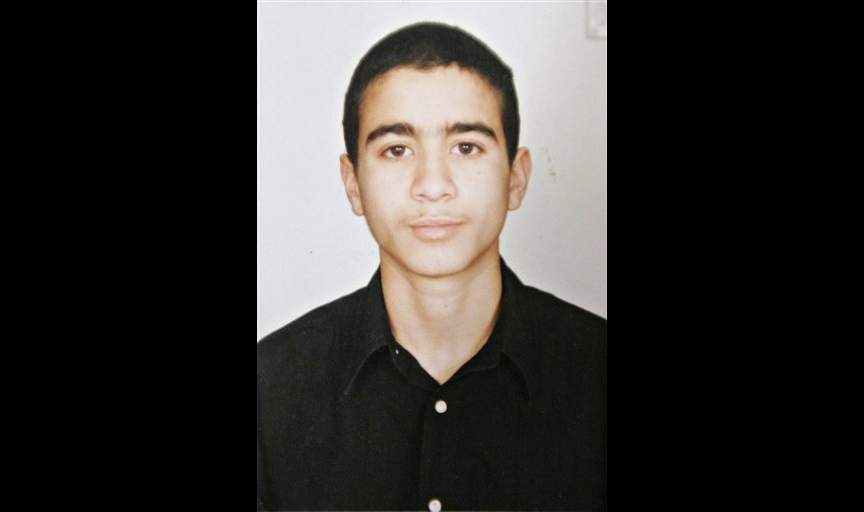
FILE - This undated file photo shows Guantanamo detainee Omar Khadr, a Canadian accused of killing an American soldier. Khadr pleaded to five charges including murder in a plea agreement with military authorities. Khadr had been facing a possible life sentence if convicted at a trial that was scheduled to start Monday, Oct. 25, 2010. (AP Photo/Canadian Press) NO SALES(Credit: Anonymous)

When I was down in Guantánamo a few months ago, a veteran German journalist let it slip that she didn’t much care for the place. “This,” she confided in me, and many of the other journalists there as well, “is the worst place I have ever visited in my entire career.”

It’s not hard to see why my superlative-loving friend felt this way: we were covering the case of Omar Khadr, a 15-year-old Canadian captured after a firefight with U.S. forces outside Kabul in July 2002, tortured and interrogated for a few months at Bagram Air Base in Afghanistan, then transported to Guantánamo. He just reached a plea agreement that will avoid a trial before a military commission at Gitmo for five “war crimes.” Four of them, freshly invented for the occasion, are not recognized as war crimes in any other court on the planet. (Khadr pled guilty to all charges and will get at least one year more at Gitmo — in solitary — then perhaps be transferred to Canada for a remaining seven years.)

Aside from Khadr and about 130 other prisoners who may one day see a trial, Guantánamo also holds 47 more War on Terror prisoners who are expected to be “detained” indefinitely without being tried at all. This was one of the radical policies of George W. Bush and Dick Cheney that is now cheerfully defended by the human rights grandees in Barack Obama’s State Department.

Gitmo and all other places without habeas corpus rights are indeed dismal places — and there is certainly something disgusting about the first conviction of a child soldier since World War II. All the same, I couldn’t help but wonder if my vehement Kollegin had ever visited a homegrown federal prison like the one in Terre Haute, Indiana (whose maximum security wing was copied down to the smallest detail at Gitmo’s Camp 5), or even your run-of-the-mill overcrowded state lock-up, the kind you pass on the highway without even noticing that you’ve done so, or one of the crumbling youth detention facilities in New York State which, as we lawyers who have represented youth offenders know, are hellish.

Such prisons may lack the exotic setting of Gitmo’s Camp Delta, but they should not be forgotten. At the risk of sounding boosterish, it so happens that a great many of America’s unsung domestic prisons also routinely abuse inmates, Guantánamo-style, are unable or unwilling to prevent inmate rape, employ long-term, sustained solitary confinement (which gives waterboarding a run for its money), and in actual practice are often beyond the rule of law. Confessions, true or false, obtained through violence and threats, aren’t restricted to Guantánamo either. They are not all that hard to find in our contiguous 48 states. And for the rest of our prison system, where are the outraged German journalists?  Why are no British “law lords” calling the federal supermax in Florence, Colorado, a “legal black hole” as law lord Johan Steyn termed Guantánamo?

Alas, in so many ways Guantánamo is not the exception but far closer to the rule of our criminal justice system, and the case of Omar Khadr, rather than being an anomaly of the War on Terror, is in all too many ways positively all-American. To be sure, taking a child soldier you’ve captured in a foreign land, whose interrogation entailed stringing him up half-naked in a five-foot-square cell with wrists chained to the bars at eye level and a hood clamped tightly over his face, then prosecuting him for “murder” because he allegedly tossed a grenade on a foreign battlefield, does present some legal issues that don’t ordinarily come up in Spokane or Chillicothe.

But Gitmo, a “betrayal of American values”?  Would that it were!  Alas, for nearly every grisly tabloid feature of the Khadr case, you can find an easy analog in our everyday criminal justice system. In a sense, much of our War on Terror has proven a slightly spicier version of our “normal” way of doing criminal justice. Using the case of Omar Khadr, let’s take this step by step.

Child Soldiers and Juvenile Offenders

The Khadr case should have been a bit queasy-making for us Americanos. Hasn’t there been a surge of concern for child soldiers in book clubs and church groups across the land?  Turns out, however, that this long-distance compassion goes up in smoke at closer range. The second a child soldier points his gun at an American, not another African, it’s adiós victimized child, hello hardened terrorist.

The hypocrisy in all this is less flaming than it may appear. After all, clemency for youth offenders, be they child soldiers or just local kids, runs against the American grain these days. If we routinely prosecute children even younger than 15 as adults — and we do — why should a foreign child soldier be any different?

In fact the U.S. even has a few dozen inmates doing life without parole for acts committed when they were 13 or 14, and most of these sentences were mandatory rather than the prerogative of a particularly nasty judge. (Some small progress: Last May in Graham v. Florida the Supreme Court decided that juveniles can get life without parole only if there’s homicide involved.) Overall, the U.S. has in recent years had precious little mercy for its children, or anyone else’s. 

Coercive Interrogation of Minors

Back in May, the Gitmo press corps gasped when Khadr’s “Interrogator Number One,” Joshua Claus, described the veiled threats of rape he wielded at Bagram Prison to try to break the young prisoner. If Khadr should fail to cooperate, Claus told him, he would meet the same fate as another young (and imaginary) Afghan detainee who was supposedly sent to a U.S. penitentiary and raped to death in a shower room by “neo-Nazis, and four big black guys.”  Claus, a court-martialed detainee abuser, had been the leader of the final interrogation of a mistakenly imprisoned Afghan taxi driver who was beaten to death by American guards at Bagram in 2002. Before receiving a rather light sentence in the case, Claus pledged his full cooperation with the Khadr prosecution, and he kept his part of the bargain with visible enthusiasm.

As it happens, Claus’s veiled threats of rape and violence to a minor would not have been that uncommon in domestic interrogation rooms. “From the stories I’m familiar with, threats like that are a pretty garden-variety police interrogation tactic,” says Locke Bowman, legal director of the MacArthur Justice Center at Northwestern University.

With youths, it’s not that much of a challenge to get a false confession, even without the threat of or actual physical violence being brought to bear, as the case of Marty Tankleff in Long Island shows, not to mention the seven and eight year-old boys from the Englewood neighborhood of Chicago who, in the summer of 1998, “confessed” to murdering a girl for her bicycle. Even after DNA evidence from semen found on the corpse was matched to an adult serial sex offender, the Chicago Police Superintendent at first refused to exonerate them. The State’s Attorney might well have prosecuted the boys, too, if the entire South Side of Chicago hadn’t threatened to explode.

Torture

Okay, but what about torture?  We bemoan with great feeling that America has “become” a state that uses torture. Alas, this, too, is not so new, nor has it ever been limited to foreign insurgents (be they Comanche, Filipino, or Vietnamese) or suspected terrorists. Take, for example, the former high-ranking Chicago police detective Jon Burge who, over a 20-year career, enhanced his interrogations with mock executions, suffocation, electroshocks, pistol-whipping, and yes, a form of waterboarding. All this was uncovered in 2002 in an epic special investigation which led to the reexamination of more than 100 cases, several overturned convictions, multiple Governor’s pardons and the usual massive lawsuits against the Chicago Police Department. Because the statute of limitations for Burge’s crimes had run out, the disgraced police officer was convicted this past June for perjury and obstruction of justice. He currently awaits sentencing.

Routinized Prison Abuse

As for routinized prison abuse, Bagram and Abu Ghraib have regularly been described as one-off aberrations, but the origins of such brutality are not hard to spot in our treatment of prisoners at home. This continuity is personified by Charles Graner, the ringleader of the Abu Ghraib torture. He had fittingly been a guard at maximum-security State Correctional Institute-Greene in southwestern Pennsylvania, itself subject to a major prisoner-abuse scandal in the late 1990s which got several guards fired, though not Graner.

Fact is, the abuse and/or torture of prisoners, though far from systematic, is not all that uncommon in many American prisons. What came out in the Abu Ghraib photos is, according to the (increasingly busy) United States program of Human Rights Watch, not so different from the abuse and brutality of many of our own stateside lock-ups.

In New York, for instance, a state task force convened by Governor David Paterson in 2008 deemed the entire youth detention system “broken.”  The official report found that guards throughout the system regularly used “excessive force” on youth inmates, sometimes breaking bones and shattering teeth.

Prison abuse here at home can be just as fatal as at Bagram. In New York, an emotionally disturbed 15-year-old died in 2006 after corrections officers pinned him face down on the ground. (Remember, at Bagram the interrogators tried to make young Khadr talk by threatening to send him to an American prison, which they apparently considered at least as threatening as anything Afghanistan had to offer.)

This is not lost on lawyers representing Gitmo detainees. “I might well advise a client to take ten years in the communal wing of Guantánamo over three years in solitary at the supermax in Florence,” says Shayana Kadidal, senior managing attorney at the Guantánamo Global Justice Initiative at the Center for Constitutional Rights. Attorney Joshua Dratel, who took part in the very successful defense of Gitmo detainee David Hicks, told me recently that he thought the worst American-run prison is not Guantánamo’s Camp Delta, but rather the Metropolitan Correctional Center in lower Manhattan. And yet, somewhat mysteriously, New Yorkers are more likely to know about the brutality of Gitmo and Abu Ghraib than the fatal abuse and abysmal prison conditions in their own state.

To be sure, in significant ways Gitmo and the CIA’s various global “black sites” were significantly worse. First, the use of torture has been far more widespread at Bagram, Abu Ghraib, Guantánamo, and the other secret prisons established in the Bush years than at home. In addition, the government has also made the decision to imprison some detainees without trial for the duration of what has often been described as a “multigenerational” global war on terror. Even those prisoners with habeas rights have had trouble getting release orders granted by the judiciary enforced. Half a dozen Guantánamo prosecutors — prosecutors, mind you, not defense lawyers — have quit in disgust with the whole process, offering harsh words about the structural flaws which tilt the system towards securing convictions at the expense of impartial justice.

In important ways, however, our domestic justice system is no better. Darrell Vandeveld is a former Guantánamo prosecutor. He resigned in a crisis of conscience in 2009. He was also once a public defender in San Diego where he found that many defendants were able to get only a semblance of justice.  ”Most of the defendants’ rights were honored only in the breach. It’s an overburdened system that has only become worse. Comparable to Gitmo?  No doubt.”  Vandeveld, who now heads the public defender office in Erie, Pennsylvania, stresses that, while the outrages are not identical, they are comparable.

Legal Black Holes, At Home and Abroad

Gazing into Gitmo’s black hole can also easily provoke disturbing reflections on the rule of law in wartime America. As another lawyer remarked 2,000 years ago while his republic was degenerating into empire, “Inter armas silent leges” (in time of war, the laws fall silent).

Keep in mind that the Global War on Terror — a name the Obama administration has demurely dropped without dropping the war that went with it — is by no means the only war deforming our justice system. For the past three decades, the War on Crime and the War on Drugs have been in full fury, becoming ever less metaphorical as budgets for police and prisons skyrocket, and then skyrocket some more. These domestic crackdowns have come with much martial rhetoric and political manipulation of fear and anger, clearing a wide path for the excesses of that Global War on Terror. By overburdening the criminal courts and prison system to a hitherto unimaginable degree, these “wars” also created legal black holes where the rule of law is notional at best.

Take the Prison Litigation Reform Act of 1995, which made it nearly impossible for inmates to sue prison authorities, and has put thousands of Americans beyond the reach of any kind of juridical authority. According to Bryan Stevenson, a peerless capital-defense litigator and executive director of the Equal Justice Initiative in Montgomery, Alabama:

U.S. prison officials have obtained greater and greater discretion to send someone to solitary confinement for years; to force people into their cells naked, without meals; to inflict punitive measures without any possibility of outside intervention. It’s often a closed system whose managers have all the authority, especially at our supermax facilities. They function in many ways like Guantánamo.

Gitmo and Bagram were well within our capabilities before 9/11. Yes, it’s true that Bush administration officials and pundits told us with excitement about how, in our counterattack on al-Qaeda, “the gloves were coming off.” For a great many Americans already in U.S. prisons, however, those gloves had never gone on to begin with.  This raises some vexing questions about how we budget our indignation. It is not at all clear why violent interrogations, abuse, and torture should be more scandalous when they happen overseas than in Chicago.

What explains this collective Jellybyism? Is it because so many of our domestic inmates, especially in the regions where national opinion is produced, are African American and Latino, whereas most of our professional social reformers in the nonprofit sector are white and Asian?  Is it because most of our elite public-interest lawyers and white-shoe pro bono advocates come out of a top half-dozen law schools where they most likely got a nice taste of well-tended federal courts, but little if any exposure to our overburdened state criminal courts?  Is it just too depressing to think about our crumbling, overstrained criminal justice system in Guantánamo-like terms?  Does compassion fatigue for those atrocities closest at hand always set in first, and hardest?  Whatever the reasons, the gaping legal black holes in our domestic justice and penal system have acquired the seamless invisibility of an open secret.

It is no coincidence that most of the American intellectuals who have pointed out these domestic precursors to the Global War on Terror — journalists like Margaret Kimberley and Bob Herbert, and law professor James Forman, Jr. — are African American. Black Americans, whose overall incarceration rate today is probably higher than that of Soviet citizens at the peak of the gulag, have had ample reasons over the centuries, and now as much as ever, to doubt the fundamental fairness of American justice. When advocates compare the military tribunals unfavorably to “the Cadillac version of justice” that U.S. citizens supposedly get (which was how one Gitmo defense attorney described America’s domestic courts), it is simply baffling to those aware of how our system actually works.

In fact, the ho-hum familiarity of much of the War on Terror’s nastiness may help explain why so many Americans view what’s gone on at Gitmo with a shrug, and often respond to the liberal shock and horror with exasperation. This has been going on right here for decades, where have you been?

Prosecuting a 15-year-old for “murder” with the help of a little torture and some threats of rape may not be the kind of thing we want show German journalists. They’ll just get upset. They lack the context. But we Americans really have no right to claim that we’re shocked, shocked. We got used to this kind of thing a long time ago. The prosecution of former child soldier Omar Khadr has been nothing, in other words, if not all-American.

Continue Reading Close
www.salon.com/writer/chase_madar/index.html