Christopher R Walker

Ohio to put prisoners down like dogs, literally

As more and more EU countries ban the exportation of crucial execution drugs, states begin to take drastic measure

  • more
    • All Share Services

Ohio to put prisoners down like dogs, literallySan Quentin Death Chamber

The Ohio Department of Rehabilitation and Correction announced Tuesday that it will use pentobarbital, a common anesthetic used by veterinarians to euthanize pets. Oklahoma also adopted the drug last year, conducting three executions since the reformulation. But Oklahoma uses a three-drug cocktail — Ohio will be a trendsetter in making sole use of pentobarbital for execution.

Triple-murderer Frank Spisak will be the last Ohio inmate executed using the old drug,  hard-to-find sodium thiopental, on Feb. 17. The March execution of Johnny Baston, convicted for a 1994 Toledo killing, will be the first execution using the new drug.

Sodium thiopental, previously used by both states, has been in increasingly short supply. Hospira Inc., which produced the drug until recently, halted production last week due to increased scrutiny from officials in Italy, where the drug is manufactured. Members of the Italian parliament issued an order in order to ensure that sodium thiopental manufactured in that country was not being used in executions. Hospira then discontinued sale of the drug, since it only has production capability at its facilities in Italy.

Meanwhile, England recently banned the exportation of sodium thiopental for use in execution — and its media seems determined to root out violators. Several states, including California, face impending shortages of their own. As more and more Western countries follow suit, U.S. prison officials must look to manufacturers in India for its execution — or merely continue to put prisoners down like dogs.

Democrats discuss repeal debate language

Democrats contemplate branding: "No Care" sounds way cornier than "Patients' Rights Repeal," but it's shorter

  • more
    • All Share Services

Last week, Greg Sargent reported that Democratic leadership plans to brand the GOP repeal of the Affordable Care Act as “The Patients’ Rights Repeal Act.” Immediately, media critics like David Kurtz jumped on the length of the name as evidence that their efforts are doomed to failure — and that emergency help should be flown in from Madison Avenue.

Predictably, the Democrats are scrambling and scattering. Greg Sargent reports that a number of Democrats, concerned specifically about the length of the proposed name, are suggesting an alternative: “No Care.”

“No Care” is probably the stupidest slogan ever, since it doesn’t actually evoke anything. But is the original proposal really too long? It’s worth noting that “Repealing the Job-Killing Health Care Law Act” doesn’t exactly roll off the tongue either. But the thing that stands out is the use of the expression “job-killing.” Strategists like pollster Frank Luntz have been advising Republicans for years about how to select exactly the right words to move the attitudes of voters — and Republicans have had enough message discipline to take this advice.

Length need not be a problem. In the end, people will probably just say “Patients’ Rights Repeal” anyway. And that’s starting to get a little snappy. But, more important, with “Patients’ Rights Repeal Act” Democrats have finally found a slogan — perhaps by accident — that competes on the same level.

The key is to elicit an emotional response from the listener by activating the mental networks related to the specific words and concepts you choose. The most famous example is Frank Luntz’ “death tax” — used to this day as a Republican alternative to “estate tax.” The reason this slogan works is, quite simply, that everyone dies.

Looking at “Patients’ Rights Repeal” through the same lens, its power is obvious: rights are central in American values; and everyone will one day be a patient. You can be damn sure that an American wants his rights when it comes time to be a patient. I’d bet a month’s salary that “Patients’ Rights Repeal” polls better than “No Care.” Any takers?


Continue Reading Close

Study: Conservatives have larger “fear center”

University College London researchers say brains of the right-leaning have big amygdala, small anterior cingulate

  • more
    • All Share Services

Study: Conservatives have larger

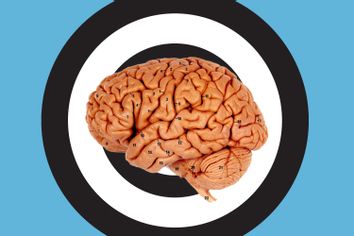
A study to be published next year at University College London suggests that conservative brains are structured differently than the brains of other people. The investigation, led by Geraint Rees, focused on 92 individuals in the U.K. — 90 students and two members of Parliament.

Specifically, the research shows that people with conservative tendencies have a larger amygdala and a smaller anterior cingulate than other people. The amygdala — typically thought of as the “primitive brain” — is responsible for reflexive impulses, like fear. The anterior cingulate is thought to be responsible for courage and optimism. This one-two punch could be responsible for many of the anecdotal claims that conservatives “think differently” from others.

Since only adults were included in the investigation, researchers were unable to determine if cerebral physiology drives politics or if political beliefs change the brain. A previous University of California study suggests the former is possible, isolating a so-called “liberal gene” — the neurotransmitter DRD4 — responsible for an increased receptiveness to novel ideas.

Predictably, conservatives have jumped on both studies as an indication of their biological superiority. Across the right-leaning blogosphere and twitterverse, DRD4 was cited as the underlying cause of the “mental illness” known as liberalism; and some conservative tweeters have even tried to claim that the enlarged amygdala just means that conservatives “have bigger brains.” Of course, the first claim begs the question, and the second ignores the shrunken anterior cingulate.

While the extent of the differences is still unclear, the biology of politics has begun to confirm that those differences are real.

Continue Reading Close

Home for the holidays: Soldier reunions

Get your hankies ready: Our favorite videos of soldiers returning home to their families

  • more
    • All Share Services

Home for the holidays: Soldier reunionsA solider greets his family at the airport earlier this December.

America’s military families often spend the holiday season the way they do the remainder of the year: away from their loved ones. But for a lucky few, there’s a hard-won homecoming. The emotional impact of the returning soldier has been depicted by everyone from Norman Rockwell to Oliver Stone, but with today’s flip phones and camcorders, families can record the moment themselves. The Web is flooded with these home-shot reunions, but no site is as thorough as Welcome Home Blog, which contains hundreds of these teary embraces. A quick shot of good feelings in the midst of two tough ongoing wars, the site gets thousands of daily visitors.

“Everyone knows that feeling, of finally seeing someone that they love come home,” says UNC-Wilmington student Chase Holfelder, who started Welcome Home blog in May 2010 after a clip he posted went viral. Holfeder doesn’t know anyone in the military; he’s simply filling a need no one else had, and videos are sent in by military families all over the world. The joy of watching the clips, he says, “transcends political stance. It doesn’t matter what you think about the wars.”

We’ve compiled some of the most heartwarming clips from this holiday season below. Whether you’re home for the holidays — or wish you were (or weren’t, for that matter) — it’s hard not to get choked up watching these clips.

An emotional airport reunion:

A surprise from Afghanistan for Mom:

A sailor meets his mom at her hospital job:

A soldier and his dad conspire to surprise Mom at the airport:

A Marine comes home for Thanksgiving dinner:

Sisters celebrate a November reunion:

A soldier reunites with her dad:

An airman drops in on his mom:

The family dogs greet their favorite soldier:


Continue Reading Close

Flash mobs spread holiday cheer

Twitter allows Christmas carolers to plan spontaneous performances and to surprise shoppers; or to overwhelm them

  • more
    • All Share Services

Since the advent of mobile social networking tools, such as SMS text, flash mobs have been popping up all over the place. In Philadelphia earlier this year, they threatened to grow out of control as throngs of teens swamped shoppers on South Street and elsewhere. But, elsewhere, these spontaneous affairs have often showcased street theater and other aspects of public crowd-sourced creativity.

This phenomenon has gone mainstream this Christmas with emergent caroling invading libraries and overwhelming malls. These impromptu events have been seen across the country in recent days. Often the performance of choice is the “Hallelujah Chorus” but offerings include “Jingle Bells” and other seasonal favorites. 

On Monday, when a flash mob descended on the Roseville Galleria, near Sacramento, Calif., the mall became so crowded that it required evacuation after reports of “pops” and “shifting” on the upper level.

Meanwhile, hipsters decry the increasing fore-knowledge brought to the process by aggregating sites such as Twitter. While widespread knowledge resulted in an overloaded California mall, it also has caused the cancellation of a similar event in Washington, D.C., when the stealth was spoiled by a local newspaper and website. Event co-organizer Melanie Spring says they ”were pretty much like, forget it,” once the element of surprise had been ruined.

Continue Reading Close

What does NASA’s new life-form discovery mean?

Scientists' announcement of a new form of microbe raises questions about extraterrestrial life. An expert explains

  • more
    • All Share Services

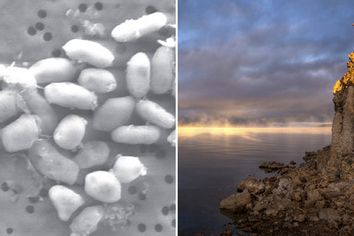
What does NASA's new life-form discovery mean?GFAJ-1 grown on arsenic, left, and the Mono Lake Research area

In a much anticipated press conference yesterday afternoon, NASA astrobiologists announced the discovery of an amazing new kind of microbes, which extend the boundaries of what we may rightly call life. According to the press release, “NASA-funded astrobiology research has changed the fundamental knowledge about what comprises all known life on Earth.” Discovered in Mono Lake, an extremely salty and alkaline body of water near Yosemite National Park in California, the microorganism is the first known specimen to substitute arsenic for phosphorus in its cell components, and has raised questions about what the discovery means for extraterrestrial life.

To find out what it really means, we called Robert Shapiro, a professor of chemistry at New York University who has written extensively about life’s origins on earth and its potential existence in outer space.

What does this mean for the discovery of life in our solar system or universe?

Not much, except that people may need to broaden their perspectives, and that we should be less “Terracentric” as we seek out new forms of life. Mostly, this discovery adds a new extremophile [organism that lives in an extreme environment] to our inventory — it pushes the boundaries out a little farther. The grand prize would be to discover an independent origin of life: life with its very own chemistry. Such a discovery wouldn’t just say that evolution is robust, it would say that life is abundant. But this discovery doesn’t do that: These organisms are not completely different in their chemical makeup from what we already know.

From what I can tell, the microbes prefer to live “normally” but may insert arsenic as a substitute for phosphorus when conditions demand it — arsenic can play the same role that phosphorus would play under normal circumstances. This is a great novelty. Arsenic is bigger and heavier than phosphorus, and its compounds are less stable. These organisms would not have done this unless they didn’t have any other choice. Just like Dr. Gerald Joyce, who was quoted in the New York Times today, I feel sorry for these creatures. Their living conditions are horrible — their environment would be poisonous to most other life on Earth.

Are there any lessons about where to focus our search for extraterrestrial life?

Broader searches are better searches. I always marveled at how parochial the searches were that focused on existing genetic assumptions. Hopefully, these findings will shift attention at NASA from [Jupiter moon] Europa — where life may be more familiar, but trapped under a deep ice cap — to [Saturn moon] Titan — where surface life could exist, but conditions are most hostile to traditional life-forms.

That said, it does reinforce Paul Davies’ “Shadow Biosphere” theory that suggests we may be missing major strains of life right here on Earth — either in places traditionally deemed too hostile to life or maybe even right under our noses. An obvious question, then, would be to ask how alternate forms of life could have escaped our notice all this time. Some argue that carbon life may have  evolved from mineral life with no carbon of its own, and one could imagine experiments to test this hypothesis. You could simply introduce a carbon-free broth to a carbon-free environment, for example, and see what grows. Or as some people suggest, there could be benefits to testing radioactive environments.

You mentioned that arsenic is poisonous. Are there any industrial applications of these critters that spring to mind?

No, there’s no obvious industrial applications. It just shakes up our thinking about what’s possible.

So what’s the takeaway, then?

It’s an exciting time for risky ideas. Let’s try them. If one in 10 or one in 100 work, wow!

Continue Reading Close

Page 1 of 2 in Christopher R Walker