Craig Offman

$1.4 million sight unseen

Steven Spielberg and Pocket Books paid big money for a manuscript they hadn't read.

In November, Pocket Books snapped up the rights to “If Only It Were True,” a novel by French author Marc Levy. The book concerns a San Francisco architect who falls for a comatose woman who holes up in his home. The price tag? One million four hundred thousand dollars.

Although the 38-year-old Levy, who began the book in 1998, was little known, he had one major advocate: Steven Spielberg. Shortly before Pocket bought “True,” DreamWorks snapped up the film rights. The price tag? Two million dollars.

It’s hard to fault Pocket’s logic. When the most powerful director in Hollywood plans to turn one of your books into a movie — even if it won’t come out for a while — you’ve got a built-in publicity campaign whose budget humbles the traditional book promotion budget.

What Pocket may not have known is that DreamWorks — along with several other studios that were interested in “True” (including Fox 2000 and Universal) — bid on the basis of a two-page English synopsis; no one at the company ever actually read the untranslated and, at the time, still unpublished book.

Assuming perhaps that Spielberg’s taste was infallible, no one at Pocket read the book either.

To be fair, Pocket had no English version of the novel to read. As with the film studios, publishing houses had to base their decision on the strength of an English synopsis — in this case an eight-page pricis — and what French they could glean from the original novel.

In the case of Pocket, no one in the house could read the French original, so senior editor Greer Kessel Hendricks passed the manuscript to a French-reading journalist friend of editorial director Linda Marrow’s. “We had someone read the French version aloud to us,” said Pocket spokeswoman Melinda Mullen.

Inside sources say that Marrow’s friend read the book and gave it an enthusiastic approval; the house then gave the book a green light.

“True” debuted in France in January, and it appeared that Pocket had indeed hooked a big fish. The book began selling briskly, and still is: More than 200,000 copies have been sold in its native tongue, and the rights have been sold to 28 countries.

Unfortunately, the American release of “True” isn’t quite the succhs fou its publisher hoped for.

Since hitting U.S. shelves on May 3, “If Only It Were True” has yet to capture the esprit of the American public. Ingram, the nation’s largest book distributor (it usually ships from 10 to 20 percent of a book’s print run), had sold 1,122 copies as of May 26, with 8,473 copies still on hand.

These statistics don’t bode well for a novel with a first print run of 100,000 copies. As of May 31, the book weighs in at 827 on Amazon.com’s sales ranking.

Meanwhile, Pocket has embarked on an expensive eye-wringing ad campaign in the New York Times. “If you loved ‘The Horse Whisperer,’” a recent ad began, “if you couldn’t put down ‘The Notebook,’ if you stayed up all night with ‘Sleepless in Seattle,’ ‘If Only It Were True’ will leave you spellbound.”

Despite the hype, Levy’s book has repelled a few critics.

Publishers Weekly declared that it “reads more like a draft of a screenplay.” Kirkus Reviews seems to concur: “Levy’s prose is no better than his plotting: his informational sentences display almost no sense of the urgencies of language or strivings for expression.” The June 2 issue of Entertainment Weekly gives the book a C minus. One dissenter: Glamour, whose June issue calls it “summer’s most romantic read.”

Compare this critical response with another much-covered foreign debut, “White Teeth,” the novel by Britain’s Zadie Smith.

Smith’s title enjoyed major Michiko Kakutani kudos in the April 25 New York Times, in which the literary critic hailed Smith as “a writer who at the age of 24 demonstrates both an instinctive storytelling talent and a fully fashioned voice that’s street-smart and learned, sassy and philosophical all at the same time.” Released five days after Levy’s novel, “White Teeth” has outsold its French competitor nearly four times over, with year-to-date sales of 6,468. Ingram has only 684 copies left, with 1,330 copies on reorder.

Of course, Pocket will probably have the last laugh when Spielberg gets around to making the film. Unfortunately, that may take a while. In March, Variety reported that Ron Bass would shape the script. But no actors have been attached to the movie, which is supposed to begin production at the end of the year.

Spielberg’s press spokesman, Marvin Levy (no relation to the book’s author), confirms that Spielberg still plans to produce a film version of the novel. “He paid a lot of money for this,” Levy said. “It’s not going to sit on the shelf.”

Peons rejoice!

The book business gives its infamously low-paid assistants a raise.

The plummy days of publishing may have gone the way of the two-martini
lunch, but one hallowed literary tradition remains: the underpaid assistant.

At least it used to.

Random House Inc., the parent company of Random House, Doubleday and
Knopf, among other houses, recently announced that it would boost starting
salaries for editorial assistants from $25,000 to $30,000, effective July 1,
just in time to buy a bus ticket to their wealthier friends’ summer shares.

In what may be an industry-wide revolution, other houses appear to be
following.

Last week, Penguin Putnam raised its entry-level pay — from $22,000 to
$25,000. “We’re not high rollers now,” says one Penguin assistant, “but
every little bit helps.”

Simon & Schuster may also give a boost to its booty call. “We’re looking at
what we can do to stay competitive,” allows corporate spokesman Adam
Rothberg. Holtzbrink — the corporate parent of St. Martin’s Press, Henry Holt
and Co. and Farrar, Straus & Giroux — confirmed that it too is considering an
increase.

Lindy Hess, director of the Radcliffe Publishing Course — the six-week boot camp best known for
transforming a hopeful crop of lit majors into coffee-fetchers every August –
is relieved by the trend. “It’s a great thing for the industry,” she says, adding
that — competition permitting — entry pay could rise “to $25[,000] or
$27,000.”

Hess believes there has been a “dramatic” shift in the entry-level market this
past year. She suggests the publishing wage hike is a much-belated reaction
to those irritating dot-com dollars — a phenomenon corroborated by several
assistants. “I have five friends who left publishing for dot-coms,” says Chris
Min, who works in Doubleday’s editorial department. “They’re getting paid in
the 40s.”

In a city where the average studio rents for $1,463 a month, the $5,000
raise (about $3,700 after taxes) may not make a significant difference. “It will
probably help pay for groceries. I’m scraping the bottom of the barrel as it
is,” says Angela Wu, an assistant at href="http://www.randomhouse.com/nanatalese/">Nan A.
Talese/Doubleday. “It’ll help people not to feel so abused and overworked.”

Random House Inc., which is owned by Bertelsmann AG, announced its
wage largess via company-wide e-mail. Several staffers report that the
reception to the news — which many had already read about in that week’s
issue of Publishers Weekly — was more relief than elation: “It wasn’t like,
look, you’re going to be rich,” says one Random House assistant. “It was
more like, it’s about time.”

Continue Reading Close

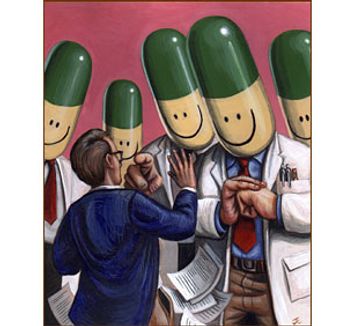
Prozac indignation

How a little-known Harvard clinician needled sleeping giant Eli Lilly

On a Friday afternoon last month, Dr. Joseph Glenmullen, author of “Prozac Backlash: Overcoming the Dangers of Prozac, Zoloft, Paxil, and Other Antidepressants with Safe, Effective Alternatives,” left his office at Harvard University Health Services to visit New York. While he was away, two men from Eli Lilly & Co., the pharmaceutical company that produces Prozac, paid his office an unscheduled visit. Given what Glenmullen writes about the drug, he assumed they weren’t there for his autograph.

Eli Lilly maintains that the visit was a routine sales call to the clinic. One of the representatives even left a card. But whatever the reason for Eli Lilly’s call, the Indianapolis giant has loomed large in the psychiatrist’s life since his harshly critical look at the long-term effects of antidepressants was published April 5.

Lilly representatives and other critics have slammed the book as misleading and lacking in scientific rigor. A company letter to an Indianapolis reporter called it “the work of a storyteller, not a scientist” and concluded that it was “a fear-mongering publication.” The book has also grabbed the attention of ABC’s “20/20,” which interviewed Glenmullen and Eli Lilly representatives for a segment on antidepressants. The segment, taped last month, has yet to air. Some speculate that the delay is linked to the network’s relationship with Lilly, which has been a prime-time advertiser on ABC since early April when the book was released.

Glenmullen argues that his critics’ objectivity is tainted by the fact that many of them receive money from Lilly. But even some researchers who have no connection with Lilly — who have, in fact, been harsh critics of Prozac and other antidepressants — have problems with Glenmullen’s book. Two major researchers have accused him of simply recycling their ideas without acknowledgment.

Glenmullen is a 49-year-old Harvard Medical School graduate and untenured clinical psychiatry instructor at Harvard University. He says he first noticed the side effects of antidepressants on his patients in private practice 10 years ago, but his research on the subject has never appeared in any medical journal.

His 338-page book, begun in 1996, relies on dozens of studies from medical journals, magazine articles, FDA documents and Glenmullen’s own clinical experience to chronicle the dangers of Prozac-type antidepressants and suggest alternative therapies.

Some of the side effects he enumerates — sexual dysfunction, weight gain and tremors — have been well documented. “The fact is that any drug, and certainly all of the antidepressants, have side effects,” says Dr. Harvey Ruben, the director of continuing education for the department of psychiatry at Yale University.

What has raised eyebrows is Glenmullen’s statistics. “Prozac Backlash” says that the selective seratonin reuptake inhibitors, or SSRIs, in Prozac lead to sexual dysfunction in 60 percent of all users. Prozac’s packaging, by contrast, asserts that that 2 to 5 percent of users will suffer such problems. (Eli Lilly now maintains a figure in the 20-30 percent range and plans to update its literature.)

Glenmullen also suggests another long-term side effect of antidepressants: suicide. He estimates that between 1 and 3 percent of his patients became suicidal on antidepressants, a percentage experts consider serious. He also believes Eli Lilly has suppressed this information.

The Boston Globe recently published an internal Lilly document that revealed that the company was aware that akathisia — a severe agitation that can lead to suicide — occurs in at least 1 percent of users. It also mentions that the patent documentation for a new version of Prozac, R-fluoxetine, says the update will not produce such existing side effects as suicidal thoughts, self-mutilation and akathisia (listed as “one of [Prozac's] more significant side effects” in the patent). The patent is assigned to Marlborough, Mass., pharmaceutical company Sepracor, which will co-produce the drug with Lilly.

Lilly, however, claims that the Food and Drug Administration gives Prozac a clean bill of health in that regard. “In 1991, a panel of experts appointed by the FDA found no credible evidence of a causal link between the use of antidepressant drugs, including Prozac, and suicidal or violent behavior,” the company said in a statement. The FDA still stands by its conclusions.

An estimated 28 million people in this country, almost one in 10 Americans, use antidepressants. Not surprisingly, Glenmullen’s claims have caused a huge uproar in the mental health community: If his figures are correct, nearly 17 million people suffer from SSRI-related sexual dysfunction.

Yet Glenmullen does not advise patients to stop using SSRIs. “I’m not a Prozac foe,” Glenmullen told Salon. He claims he harbors no animus against either the drug or Eli Lilly, but only for doctors who use Prozac as a panacea. “I’m a foe of it being over-prescribed, used trivially, and of patients not being warned of side effects or offered alternatives.” He advocates the use of antidepressants for patients with moderate to severe symptoms. He does, however, suggest that patients with mild depression consider other alternatives, such as St. John’s Wort (an herbal remedy that itself has recently been under siege for its lack of conclusive effect).

The new criticism of Prozac comes at an awkward moment for Eli Lilly. Though Prozac remains the company’s bestselling drug, it has encountered declining sales over the past year largely because of increased competition from rival drugs such as Zoloft, manufactured by Pfizer. In the first quarter of 2000, Prozac sales rose a scant 1 percent to $596.2 million. (Despite anemic sales growth, the figure represents roughly a quarter of Eli Lilly’s total revenue, an extraordinary sales percentage for a single product.) With Sepracor, Lilly plans to market R-fluoxetine before Prozac’s patent runs out in 2002.

Eli Lilly marketing and communications associate Laura Miller notes that her company initially became concerned when Glenmullen claimed, in the publicity package from the book’s publisher, Simon & Schuster, that antidepressants “may effect a chemical lobotomy.” But Eli Lilly refuses to respond to any specific charges in “Prozac Backlash.”

“It’s full of anecdotes that will frighten people off their medication,” says Miller. “It’s a disservice to patients.”

The company’s official statement on the book is this: “We stand by the safety and efficacy of Prozac … No one should stop, or start, taking Prozac — or any other prescription medication — without physician supervision.”

Other mental-health professionals echo Lilly’s criticisms. “The truth about depression and its treatment is just the opposite of what the book claims,” Mike Faenza, CEO of the National Mental Health Association, writes in his association’s PR Newswire. “We’re concerned that people may decide against seeking appropriate treatment for this serious illness after hearing about this book.”

Tom Richardson, president of the Washington state chapter of the National Alliance for the Mentally Ill, wrote a negative review of the book in the April 14 edition of the Seattle Times. “The book is suggesting we all take St. John’s Wort,” he says.

NMHA and NAMI both receive significant funds from Eli Lilly, which refers journalists to the organizations for information. NMHA, in Alexandria, Va., receives around $1 million in funding. In its April 11 statement condemning “Prozac Backlash,” it describes itself as “the country’s oldest and largest nonprofit organization addressing all aspects of mental health and mental illness.” It never discloses that Eli Lilly is one of its principal contributors.

“We get some funding from them for public education and advocacy work,” says NMHA spokesman Patrick Cody. “The bulk of our money comes from the federal government.” When pressed about a potential conflict of interest about criticizing the book, Cody denied that there was a problem. “We’re not selling these antidepressants,” he says.

NAMI, in Arlington, Va., received $2.87 million from Lilly between 1996 and 1999. Spokesman Bob Carolla didn’t see any conflict. “As a matter of policy, we don’t endorse or recommend any treatment,” he said. Carolla added that the money the association received was for unrestricted education grants.

Eli Lilly also referred journalists seeking medical opinion on “Prozac Backlash” to Drs. Jerrold Rosenbaum and Anthony Rothschild. Rosenbaum, associate chief of psychiatry at Massachusetts General Hospital and a professor at Harvard Medical School, serves on Eli Lilly’s board of advisors, as well the boards of several other pharmaceutical companies. He explains that they only pay him to visit them for a day or two and cover his expenses. “With psychopharmacology, this is unavoidable,” says Rosenbaum. “I have a strong conflict of interest. This is my life.” (Rosenbaum, who discloses his position freely, adds that he asked Lilly to stop giving out his name as a critic of the book.)

Doctors are bound to disclose their affiliations when they submit an article to a medical journal, or when they deliver a speech. But if a reporter wants to know if a physician is on an advisory board, or if he or she is being paid by a pharmaceutical company, the reporter must ask. When it comes to a physician’s motivations for supporting or slamming a book, lack of disclosure has become a prevalent problem. “This is becoming very common. It’s difficult to see who’s being supported,” says Nicholas Regush, a medical reporter at ABC who also writes a medical column for abc.com.

According to some, accusations from paid critics are standard procedure in medical publishing. Dr. Peter Breggin, author of “Talking Back to Prozac: What Doctor’s Won’t Tell You about Today’s Most Controversial Drug,” calls Eli Lilly “the stormtroopers of the drug industry,” adding that MNHA and NAMI “are in the pocket of Eli Lilly.” Breggin, who has been an expert witness in several lawsuits involving antidepressants, said that the company “tells untruths about their critics.” Though he was paid by various states for his testimony, he claims he was not compensated by a pharmaceutical company for his services.

Thomas J. Moore, a medical researcher who helped Glenmullen with the book, said he himself has been the target of Eli Lilly campaigns to tarnish him. He’s not surprised by the reception to Glenmullen’s book. “If you publish material like that, you’ll be discredited.”

As troubling as these conflicts sound, they are still distractions from the central issue: Glenmullen’s research and his credibility. Indeed, Glenmullen’s credentials have been called into question. Skeptics wonder why he never published in any medical journals. Rosenbaum told an Indianapolis Star reporter than in the decades of his Harvard affiliation, he had never heard of Glenmullen, an observation that has been echoed by Eli Lilly.

“I’m especially qualified,” Glenmullen responds, “because I’m someone whose research is not funded by pharmaceutical companies.”

But other experts who claim no affiliation with Eli Lilly are also skeptical, if not infuriated. “When you take all the side effects the author claims can occur, it sounds like it’s the worst agent ever made for man,” says Yale’s Ruben. “I hope that this book doesn’t have wide popularity because it frightens people who are on the medication and doing well with it.”

Ruben is also skeptical about conflict-of-interest claims. “All the major researchers are on the boards of major scientific companies,” he observes. “The companies need people they don’t own to advise them on their drugs. They aren’t paying a huge amount to anyone.”

Right now, criticism may be the least of Glenmullen’s problems. Aside from the charges that “Prozac Backlash” is “anecdotal” — a derisive way of saying that the book lacks scientific rigor — some doctors have charged that Glenmullen used their work out of context, or worse, did not credit them.

In a statement distributed by Eli Lilly, University of Massachusetts professor of psychiatry Dr. Anthony Rothschild claims that the book is “misleading” and observes that “Dr. Glenmullen bolsters many of his own arguments and proves his hypotheses by borrowing liberally from others’ work, including my own.” According to Glenmullen, Rothschild also has ties to Lilly (Rothschild did not respond for comment).

Dr. Peter D. Kramer, author of “Listening to Prozac,” says that Glenmullen “grossly misrepresents me” and “uses me as a straw man.” Glenmullen, however, disagrees. “Dr. Kramer seems to be confused with the message of his own book,” he says.

Breggin makes a more startling accusation: “To a great extent, he simply takes ideas that I developed in two or three other books, doesn’t credit them, and cites new sources to confirm them. He takes an area in which I have been a central figure for 12 years and acts like I don’t exist.”

Glenmullen responds that “‘Prozac Backlash’ is coming out six years after Dr. Breggin’s book and goes way beyond it.”

Simon & Schuster dismisses the plagiarism accusations. “We stand behind the book 100 percent,” says S&S publisher David Rosenthal.

To make matters worse, some suggest Glenmullen is simply courting controversy to stir up sales. His critics have mentioned that, as a clinical instructor, Glenmullen isn’t paid. And being a part-time doctor at Harvard’s health services isn’t likely to be especially lucrative. Glenmullen, who also has a private practice, dismissed the speculation, saying that it doesn’t address the research in his book.

But critics like Rosenbaum see cynicism, even in the title of Glenmullen’s book. “His publisher is exploiting this issue,” says Rosenbaum. “If this book were called ‘SSRI Backlash,’ it wouldn’t sell.”

As Eli Lilly tinkers with Prozac 2.0, the pharmaceutical company continues to advertise for Prozac on network television. Lilly ran a glossy prime-time ad campaign for Prozac on ABC early last April. Around the same time, “20/20″ began shooting its investigative segment on the side effects of antidepressants. ABC would not provide a broadcast date. “We don’t schedule until a day or two in advance,” says ABC spokeswoman Dahlia Roemer.

The FDA has not done a comprehensive study of Prozac since its report nine years ago that ruled out any connection with suicide. Spokeswoman Susan Cruzan explains that the agency is on top of the problem. “It’s looked into all the time. We inspect companies every two years,” she says. “Pharmaceutical companies are obliged by law to report the side effects of their drugs to the FDA; part of the agency’s inspection includes an examination of how the company keeps their records.”

The FDA also monitors MedWatch, a program that allows professionals and patients to report any negative side effects. In other words, the FDA may be vigilant, but hardly proactive in this particular issue.

Meanwhile, unlike Glenmullen’s medical critics, the mainstream press is welcoming the book with open arms.

“In Glenmullen’s view, 75 percent of people on SSRIs can either go off the drug or dramatically reduce their dose. In any case they should read this book,” concludes the New Yorker.

“While his accounts of his own experience with patients is helpful, Glenmullen’s most valuable contribution is his reporting on what little monitoring has been done,” Publishers Weekly points out.

While the side-effect controversy continues to play out, the story has the unintended consequence of making Elizabeth Wurtzel appear prescient. Her 1993 bestseller “Prozac Nation” provides the following wisdom: “I can’t help feeling that anything that works so effectively, that’s so transformative, has got to be hurting me at the other end, maybe sometime down the road.”

Continue Reading Close

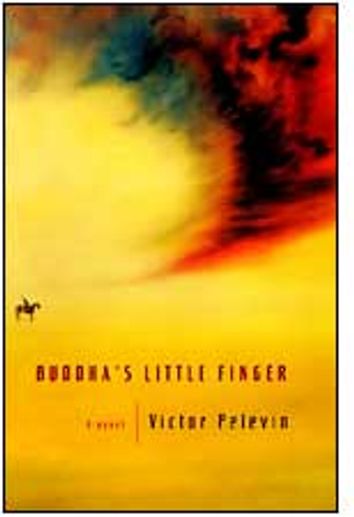
“Buddha's Little Finger” by Victor Pelevin

In a novel by turns shabby, sexy and visionary, the Russian virtuoso captures post-perestroika Moscow in all its weirdness.

As astounding as it is frustrating, “Buddha’s Little Finger” is Victor Pelevin’s shabby, messy but often visionary take on his native Russia. A surreal collection of the drugged-out dreams of three patients in a Moscow mental ward in the early 1990s, the novel relies less on narrative thrust than it does on satirical vignettes that are alternately biting and toothless.

“Buddha’s Little Finger” mostly follows the (imagined) adventures of 26-year-old Pyotr Voyd, who thinks that he is suffering flashbacks from the Russian civil war. In Voyd’s mind, he is a Mauser-carrying poet and revolutionary who wields a mighty pen and argues about the philosophy of death with his commander, the real-life Red Army hero Vasily Ivanovich Chapaev. “Is it my inflamed consciousness that creates the nightmare,” Voyd asks, “or is my consciousness itself a creation of the nightmare?”

That question gives some idea of Pelevin’s method — he slips in and out of reality with little warning. As in his 1997 collection, “The Blue Lantern and Other Stories,” Pelevin plays with the line between dream and reality both in content and in form. But while he writes in an absurd, fantastic style inherited from Nikolai Vasilievich Gogol and Mikhail Bulgakov, he sometimes overreaches and winds up with sophomoric parody. In the novel’s weakest satirical vision, a male patient named Maria imagines himself as a woman hanging off the wing of an airplane piloted by Arnold Schwarzenegger. (“He nodded and gave a broad smile,” Maria recalls, “and the sun glinted on his teeth.”)

But another patient’s vision (a set piece excerpted in the “Russia” issue of Granta last year) strikes a perfect balance between Pelevin’s Zen Buddhist preoccupations and his incisive observation of post-perestroika Moscow in all its absurd bleakness. A patient named Serdyuk imagines that he has endured an all-night interview with Kawabata, a Japanese businessman with a penchant for Buddhism, sake and coarse prostitutes. “All these crazy rituals they have,” Serdyuk thinks. “Where do they find the time to make all those televisions?” During the meeting, Serdyuk is appointed “assistant manager for the Northern Barbarians”; toward the close, the two men discover that a rival company has bought theirs out. They become despondent, and Kawabata suggests that ritual suicide may be their only honorable response to this indignity. Serdyuk doesn’t really see any reason to go on with his Moscow life:

The world that the Japanese was preparing to quit — if by “world” we mean everything a man can feel and experience in his life — was certainly far more attractive than the stinking streets of Moscow that closed in on Serdyuk every morning to the accompaniment of the songs of Filipp Kirkirov.

And so he commits seppuku.

Translator Andrew Bromfeld is astonishingly sensitive to Pelevin’s shifting tones, which vary from the high formality of Socratic dialogue to the coarse colloquialism of Moscow gangster talk. Despite Pelevin’s obvious talent for speech, though, his most persuasive weapons are description and metaphor. When Voyd tries to seduce a Bolshevik machine-gunner, for example, he laments the limits of passion: “I knew that it would be as pointless to reach out to her with lustful hands as it would be to attempt to scoop up the sunset in a kitchen bucket.”

Voyd reaches a similar (if less artful) conclusion when he observes that “the approach to the goal is superior to the goal itself.” Passages like that may appeal mainly to the crystal-bead set, but when it’s not so Siddhartha-like, “Buddha’s Little Finger” is definitely pointing in the right direction.

Continue Reading Close

Benetton says ciao to Toscani

The Italian fashion company outgrows its longtime creative genius.

Benetton SPA announced that it has severed an 18-year relationship with advertising guru and photographer Oliviero Toscani. “It was by mutual agreement,” said Mark Major, the company’s U.S. spokesman.

In a statement issued last Saturday — muted in its praise — the Treviso, Italy, clothing company saluted Toscani “for his fundamental contribution to a new advertising concept.” It also stated that Fabrica, the creative think tank once headed by Toscani and affiliated with Benetton, would take over as the company’s main communications arm. Fabrica produces Benetton’s in-house magazine, Colors, and has produced many of Benetton’s most controversial campaigns, including the recent anti-death penalty series, “We, On Death Row.”

Benetton and Toscani, who is creative director at Talk magazine, have picked an indelicate time to announce the departure. The $20 million campaign, which ended in March, depicted convicted killers in their prison garb without mentioning their victims. The ads precipitated a civil suit from the state of Missouri and the loss of a major client, Sears, Roebuck and Co. The California State Assembly called for a boycott of Benetton products.

Despite the contentious campaign, Benetton denies that Toscani’s departure is related to the “Death Row” ads. “We’ve known that Mr. Toscani was looking for an opportunity to do something different,” Major said. Indeed, a friend said that Toscani has been discussing a move and wants his teenage children to grow up in the United States. The source also observed that Toscani would have had a difficult time with Fabrica in its revamped role. “Toscani is his own person and anyone will recognize that he walks to his own drum.”

Toscani could not be reached for comment, although he said in the Benetton announcement, “[I]t’s good to have the courage to end something that has been fantastic and still have the enthusiasm to take on new projects.”

Earlier this year, Toscani described his relationship to founder Luciano Benetton in papal proportions. “Can you imagine Michelangelo doing a church without the pope? Doing a painting in the Sistine Chapel without putting in Christ.”

Continue Reading Close

Sweet-talker to the stars signs book, film deals

The voice that charmed Hollywood's men goes public.

Miranda Grosvenor,” an elusive Louisiana resident who enchanted some of Hollywood’s leading men with her sweet telephone talk, may not show her face in public any time soon. But the life story of this mystery woman — whose real name is Whitney Walton — will soon enjoy major multimedia exposure.

A Baton Rouge social worker who became acquainted with many celebrities when she lived in New York in the early ’70s, Walton later engaged in late-night phone conversations with such stars as Billy Joel, Warren Beatty, Quincy Jones and Richard Gere, often telling them that she was a Tulane University student and a model on the side.

MGM is about to ink a high-six-figure deal for the screen rights to Walton’s upcoming Cliffstreet/HarperCollins memoir. Tribeca Films — owned by one of “Grosvenor’s” earliest phone friends, Robert De Niro — will produce the film. Industry insiders report that De Niro will also direct the movie, although a spokesman for De Niro denies the rumor. Last month, the New York Post reported that MGM also made a low-six-figure deal to buy the rights to an article about her, written by “Barbarians at the Gate” coauthor Bryan Burrough, that appeared in the December Vanity Fair. The total option package has cost MGM close to $1 million.

Last month, HarperCollins also paid close to $1 million for the book itself after a peek at Walton’s three-page proposal, which it received with a copy of the Vanity Fair article. Now the audio rights — more crucial in the case of Walton’s story than for other books — are up for grabs. “It could be one of the more important audios,” says Walton’s editor, Diane Reverand.

Since it was Walton’s celebrated phone technique that made her the confidante of so many luminaries, her agent, Dean Williamson, is hoping to use her voice as a marketing tool for the memoir. Walton will produce an audiobook that will feature “Miranda” reading a few chapters of the book. “She’s a real mystery, and I wanted readers to get used to her voice,” says Williamson, who has an exuberant confidence in his client’s verbal skills. “She’s not just a person,” says Williamson, “she’s a state of mind.”

Williamson said that earlier this year, he hired a private detective to track down Walton, but she rebuffed him for three months. Finally, she relented and decided to tell her life story. Williamson hopes that the audiobook will appear several weeks before the release of the memoir, which will be published in March.

Continue Reading Close

Page 1 of 22 in Craig Offman