Damien Cave

Wall Street’s worst nightmare

Does New York Attorney General Eliot Spitzer really want to clean up the stock market, or just make himself look good?

  • more
    • All Share Services

Wall Street's worst nightmare

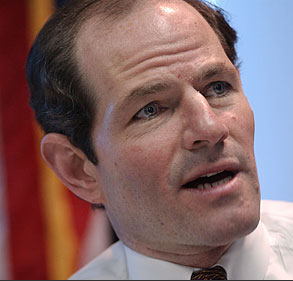
Eliot Spitzer spent two years working on mergers and acquisitions for a white-shoe corporate law firm. He borrowed millions of dollars from J.P. Morgan to finance his successful 1998 campaign to be New York’s attorney general. He lives in a Fifth Avenue apartment worthy of Gordon Gekko. He’s even claimed that all his friends are either investment bankers or the lawyers who represent them.

But these gilded connections haven’t kept the born-and-bred New Yorker from ripping into the nation’s financial giants like an armor-piercing bullet. While Congress and the SEC’s Harvey Pitt dither in the face of widespread corporate malfeasance, Spitzer is a busy man. You could call him the nation’s toughest corporate cop. He’s certainly the most feared man on Wall Street.

Spitzer’s crusade first attracted public attention in April, when the Princeton- and Harvard-educated prosecutor announced that his investigation into analysts’ stock-buying recommendations had turned up a smoking gun. E-mails from within the investment banking firm Merrill Lynch proved that analysts privately slammed stocks that they were publicly praising. Their behavior reflected a classic conflict of interest. Merrill Lynch was afraid to antagonize clients who were filling its coffers with millions of dollars of investment banking fees.

Merrill Lynch never admitted guilt, but in May the firm settled for $100 million and agreed to change the way its analysts did business. Other firms soon followed suit. The attorney general’s office continues to pursue several investment houses for additional conflict-of-interest violations, and on Sept. 30 Spitzer upped the ante. His office sued the former top officials of five telecommunications companies, arguing that they gave investment banking business to Citigroup in exchange for shares of hot IPO companies, which they would then “spin,” or sell immediately, for windfall profits.

Will Spitzer’s high-profile crusade result in long-term change? Some critics argue that Spitzer, rumored to be angling for the 2006 New York governor’s race, cares more for publicity than anything else. No Chinese wall separating research from investment banking has been established as a result of Spitzer’s actions, and Merrill’s seemingly large settlement amounts to but a fraction of its annual revenue.

Spitzer has also given up his lone-wolf ways, agreeing on Oct. 3 to work with the Securities and Exchange Commission and the National Association of Securities Dealers on a “swift and appropriate resolution” to Wall Street’s ethical lapses. But is working hand-in-hand with Harvey Pitt’s industry-friendly SEC the best way to wage war on Wall Street?

Salon asked Spitzer about reforming Wall Street, his role and his office’s plans for the future.

You’ve recently launched a series of lawsuits that aim at the practice of giving hot IPO shares to CEOs. How do these cases fit into your previous focus on bogus recommendations by analysts?

The issues are interrelated to the extent that part of the larger structure there had to do with analysts pumping stocks for investment banking business coming in, and as part of the structure, the CEOs of the companies that brought the business in did indeed receive the hot stock allocations.

Until recently, you were working alone. Why did you decide to join forces with the SEC and other federal regulators?

I don’t think anybody would dispute that it is better policy if we can all work together, whether it be the stock exchange, the NASD, my office or the SEC. I think we all understand that there is an obligation to try to bring some uniformity and regularity of practice to this area. So whatever substantive disagreements there may be, we have to make a serious effort to work those through and come up with a common set of standards.

But you’ve complained about the [SEC's] lack of action in the past. Are you convinced that they’ve turned over a new leaf?

First, I think they’re acting, at this point, aggressively. I’m not going to get into the business of taking back anything I said before; I wouldn’t do that. I think those were appropriate comments at the time. But I think there are also different phases in this process. The first phase was to frame the problems through investigations, demonstrate the magnitude of the problem. Then there comes a moment when you have to try to resolve it; and trying to resolve this issue can’t be done unilaterally, while making cases can be … The natural evolution of this was that there was going to be a moment when the parties had to come together.

The $100 million settlement with Merrill has struck some critics as a great deal for Merrill, particularly in light of their proximity to Enron. Why did you settle instead of pursuing the case and maybe putting some people in jail?

Everything in due course. We’re now looking at the Merrill settlement from the vantage point of October. On April 8, when I raised the issues on Merrill and provided the proof, everyone said, that can’t be true, that’s wild. The point of the Merrill settlement was to begin the process of structural change. The $100 million in your statement is correct. It’s objectively a large sum of money, but it’s not a large sum of money to Merrill. But the structural change that we initiated with Merrill was the important point. Breaking the logjam in the debate about the relationship between analysts and investment bankers was more important than exacting an extra pound of flesh.

Are you looking only at Wall Street, or is the scope of a possible solution broad enough to include all public companies or investment houses?

The entities we’re dealing with in an effort to figure out how to restructure some of these problems are primarily the largest investment banking houses. That doesn’t mean that the solution won’t have a direct impact if regulations are promulgated on all investment banking houses, large or small. But certainly the entities that have been most involved, because we’ve been taking a look at their practices and because they’ve been working with us to come up with solutions, have been the largest investment banking houses.

What about finding a way to make executives pay? Is this going to happen?

Absolutely. That’s why we filed the case last week. It is an effort to disgorge from the CEOs their ill-gotten gains. I think it’s an important part of it. Not only is it a matter of simple equity, but also in terms of deterrence and the way people act down the road. There will be both civil litigation designed to get disgorgement and some of these guys are going to jail. There’s no question about it.

I’m tempted to ask who but I suppose you won’t tell me …

We could create our own little marketplace with bidding on who will end up rooming with whom, but I don’t think I should get into that.

What about market forces? In July, several pension funds called on brokerage firms to follow your conflict-of-interest rules. Is this the kind of reaction you were hoping for, and could this kind of market solution be enough?

Richard Moore [the sole trustee of the North Carolina Public Employees Retirement System] called and asked me if I would help him do that. In fact, I was on the phone with Richard this morning, because as the rules go beyond the Merrill settlement, the question is what he should do to best keep the pension-fund pressure on the [investment] houses. This is getting equity involved, which is critical whether it’s the pension funds or the other institutional shareholders — it’s their money. That’s not regulation; it’s just equity flexing its muscle, saying, We have a role. Hopefully that will be the long-term and important check, more than anything government does.

But I don’t think the institutions alone are likely to effect the changes we need. They’re certainly part of the answer. If we in government do what we can do and should do, and move with some alacrity, then I think the shareholders can move in thereafter and continue to apply pressure.

When I spoke to Joseph Stiglitz, author of “Globalization and Its Discontents,” he argued that the root of all the corporate malfeasance arrived in the mid-’90s with the rise of stock options as a means of compensation. He argued that it provided too much incentive for short-term measures designed to boost stock prices at the expense of long-term corporate health. Would you agree with that?

I won’t disagree with Joe Stiglitz, one of the brighter guys anyone could encounter. I think [compensation in the form of stock options] was one of the causative factors that led to what I call “the imperial CEO” who ran roughshod over traditional limitations on corporate governance. But I don’t think it was the only cause. There was a more generic breakdown in corporate governance. Boards failed to participate, audit committees failed to ask probing questions. Auditors became clients of the CEO, who tried to portray everything in the most favorable light rather than remaining true to the objective of transparency, simplicity and clarity. Institutional shareholders became even more passive than they had been traditionally and that meant that that check on the CEO disappeared. And then the investment houses, who were traditionally one of the marketplace checks on corporate behavior, were seduced into this unholy alliance with the CEO. So I think you had a breakdown all across the chain of corporate governance.

At what point did you decide to get involved, and why? After all, financial cases are typically started by the SEC.

We have bureaus that have done all sorts of interesting cases and not interesting cases — but the jurisdiction is enormous. It’s everything from civil rights to antitrust to consumer, healthcare, Internet, etc. Securities regulation is one of them. And as I do routinely, I sat down with the bureau chiefs and asked, What can we do that’s going to be more useful? Where can we use our jurisdiction to have a significant impact on protecting investors or workers or whoever it may be? And this was an issue that had been out there for a while. Journalists had been out there covering it, writing about it, but not much had been done from a governmental perspective. So we said, maybe we can do something here.

Your critics say that you’re bringing these cases to draw attention for a run for governor in 2006.

Look, you can’t stop people from speculating about what my motives might be. I can’t stop them, but they’re wrong, and as long as they can’t fault either the facts or the theory of what we’re doing, then I’ll just leave it to others to speculate as to why I’m doing what I’m doing. They’re wrong, but what more can I say?

What you’re doing with these Wall Street cases and other cases you’ve brought against Midwest polluters and gun manufacturers has been described as attorney-general activism. You’ve argued in the past that this trend is an attempt to fill in gaps left through deregulation, but do you ever worry, for instance, that you’ve opened up a Pandora’s box in which any A.G. with an agenda can make life miserable for those he disagrees with? What if a conservative A.G. starts suing abortion providers?

You’re mixing issues. Multiple layers of prosecutorial authority does not mean that the law can be or should be inconsistent. But multiple layers of regulatory authority — which can enforce existing laws — is something we have always had. That doesn’t mean that state law can be inconsistent with federal law. Of course it can’t be. It can be more demanding in certain cases but not inconsistent. But what we certainly have is the capacity for state, local and federal authorities to all prosecute the same theories. Look at the BCCI case, which is perhaps the largest bank-fraud case in history. [Robert] Morgenthau, the Manhattan district attorney, brought that because federal officials walked away from their obligation. They didn’t want to do it. So this is the structure we’ve always had and it’s served the public very well.

How do you see this playing out? Ten years from now, what will American business look like?

I think Wall Street will not only come back, it will be stronger because there will be a better ethical foundation to some of what had been wrong. That doesn’t mean there won’t be different problems of a different sort. Every 10 or 15 years, there has been a different sort of problem that emerges. It’s not because Wall Street is any better or any worse; it’s just the nature of these relationships and how they work over time. Different problems emerge that have to be dealt with.

And what about you? Where do you hope to be in 10 years?

Working on my backhand.

Panic in the sheets

Abstinence crusaders are exploiting fears of a mysterious virus to scare teens away from having sex.

  • more
    • All Share Services

Panic in the sheets

Dr. Patricia Sulak, wearing a wireless microphone and a plain dark suit, strides across an auditorium stage in Copperas Cove, Texas, and describes in graphic detail the contagious, oozing and occasionally deadly viruses that are the consequences of adolescent sex. The hourlong lecture — given that day to a rapt audience of 800 local school district employees — covers everything from pregnancy to AIDS, but one topic in particular seems to grab the doctor’s attention: human papillomavirus, or HPV.

In the first 10 minutes of her lecture, she mentions the sexually transmitted disease three times, and HIV only once. She shows graphic pictures of people with HPV infections but no photographs of anyone with AIDS. And when she speaks at length about HPV, in a slight Ross Perot drawl that cements the impression that she’s a straight shooter, Sulak seems to revel in the virus’ frequency and effects.

“How many people know that human papillomavirus is the most common sexually transmitted disease and that it causes cervical cancer?” she asks. Then she offers a handful of factoids: “Fifty percent of sexually active women have been infected … In one study, 90 percent of sexually active adolescents were infected with HPV … Even if a small percentage develops problems, so many people are infected that we have a huge health problem in this country.”

Even more frightening, Sulak says, is the fact that HPV can’t be prevented through safe sex. Because it thrives on the skin in the genital area, HPV can be passed on even if condoms are worn. The only way to keep the public safe from this dangerous virus, Sulak argues, is through long-term monogamy.

And there, in the name of public safety, is Sulak’s agenda. Along with being a doctor and a professor of medicine at Texas A&M University, Sulak is also the founder of Worth the Wait, a popular abstinence-education program that seeks “to educate adolescents and adults on the consequences of teen sexual activity.”

Thus, for Sulak, HPV is worth emphasizing not just because it’s dangerous but also because it seems to puncture the myth that condoms can keep you safe. That is the key idea that Sulak hammers home, and the one that hundreds of abstinence-education programs now preach with zeal. Indeed, while HPV was largely unheard of only a decade ago, it’s now the social conservatives’ STD du jour, a part of nearly every abstinence curriculum, lecture and Web site — “the No. 1 weapon we have,” says Leslee Unruh, founder of the Abstinence Clearinghouse, a network of abstinence educators.

In fact, the jury’s still out on the actual health threat posed by HPV and the efficacy of condoms to prevent it. Medical research is inconclusive. But in the absolute-minded, black-and-white world of the sex-fearing conservative right, uncertainties are an easily avoided hurdle. Abstinence-only advocates are using nothing less than the threat of death to prevent young people from engaging in sex, with or without a condom. For people like Unruh, who calls HPV “the silent killer,” and President Bush — who plans to increase abstinence-only education funding by $50 million — agenda trumps scientific complexity. The scare tactic — with its potential for reducing condom use and a concomitant increased risk of HIV and unwanted pregnancies — is their chosen strategy, regardless of public-health implications.

Sulak, who insists that she has only a medical, apolitical agenda, is actually one of the abstinence movement’s more moderate activists. Other anti-sex programs employ far more frightening scare tactics to make HPV seem as horrific as AIDS. Some falsely claim that HPV is also known as genital warts, ignoring the fact that most HPV cases never lead to warts. Other groups, like the Heritage Foundation, simply call the virus nothing less than “the deadly HPV” — even though more than 99 percent of the people who contract HPV never die from it. Some legislators, including Rep. Billy Tauzin, R-La., have even begun questioning whether condom packages ought to carry a warning label saying that they don’t prevent HPV, “the cause of nearly all cervical cancers.”

I first discovered HPV about a year ago — not from politicians but through personal experience, when my ex-girlfriend told me she had contracted the virus. She had no idea whether I was the source, or whether it was the boyfriend she dated between our first and second attempts to stay together. But regardless, she told me that I’d better make sure that my new girlfriend had a pap smear. “If you were infected, you may not have known it,” she said. “But you can pass it on even if you don’t have symptoms.” (In fact, according to most studies, 80 to 95 percent of HPV cases disappear without symptoms.)

I immediately panicked. HPV — What the hell is that? I asked. What are the effects and how scared should I be?

My questions were hardly unique. There are more than a hundred strains of the virus, and an estimated 75 percent of sexually active people contract one of them at some point; about 20 million people in the United States have genital HPV infections at any given moment; and every year, about 5.5 million people become infected, according a 2000 Centers for Disease Control report. And yet, few of those who have to deal with HPV understand its significance. The CDC has found that healthcare providers rarely know how it relates to cervical cancer, and one national survey even found that more than 7 out of 10 American women had never heard of HPV.

How could we all be so ignorant?

Much of the problem stems from HPV’s understudied status. The virus isn’t new; doctors have known for decades that HPV exists. But until recently, researchers couldn’t scrutinize the virus closely because they couldn’t find a way to grow it outside the body. “The explosion of knowledge occurred after the mid-’80s, when technology let us simply clone the virus instead of growing it,” said Dr. Keerti Shah, professor of public health at Johns Hopkins University.

The most important findings related to cancer. Several studies done in the mid-’90s showed that HPV was frequently present in patients with precancerous and cancerous cells in the cervix. In 1996, a 13-member panel of scientists at the National Institutes of Health reviewed the studies and officially confirmed that “carcinoma of the cervix is causally related to infection with the human papillomavirus (HPV).” The report also questioned the utility of condoms, noting that “the data on the use of barrier methods of contraception to prevent the spread of HPV are controversial but do not support this as an effective method of intervention.”

The combination — cancer plus suspected condom failure — changed HPV forever. Suddenly, HPV was medically and politically significant. Politicians began to notice its existence, college students feared its spread, and sex educators rushed to include it in their curriculums.

Abstinence advocates — funded for the first time to the tune of $50 million in the 1996 welfare reform bill — led the way. “We’ve been talking about it for four or five years,” says Unruh, whose organization is affiliated with several hundred abstinence-education programs throughout the country. “Most every abstinence-education provider is going to talk about STDs, and they will always talk about HPV.”

Comprehensive sex educators — those who speak about abstinence and birth control — also began including HPV in their curriculums about five years ago. But the virus has never become a dominant part of the programs. Most of the organizations in charge of comprehensive sex ed have rejected the way that abstinence educators use HPV “as a wedge to try and discourage condom use — to say having sex is deadly,” says Elizabeth Cavendish, legal director at NARAL, the National Abortion and Reproductive Rights Action League. Instead, they focus on other clear and more immediate dangers. “The big-ticket item is AIDS, and there is no question that condoms protect against HIV,” Cavendish says. “The other big-ticket item is pregnancy, and there’s no question that condoms prevent against pregnancy.”

Doctors and public health advocates say that HPV is also too complex and unknown to justify the kind of attention given to it by most abstinence educators. It’s true, as studies have shown, that HPV is related to cancer and genital warts, that it can be passed through skin-to-skin contact, and that it’s common. But these facts tend to raise more questions than they answer. When does a positive HPV test lead to cancer or genital warts? What are the risk factors for HPV infections that persist? Do condoms offer any protection against the spread of the virus, and if so, how much? Is there an effective form of therapy?

Those are the unanswered questions cited by the CDC as key challenges to understanding and eradicating the virus. There are no clear answers to any of them, despite the increased interest in HPV from medical researchers. Nor are they the only queries that doctors want to figure out.

Jim Rothenberger, the Morse alumni distinguished teaching instructor of public health at the University of Minnesota, says that at least three more questions need to be answered before HPV can be taught within a nonpolitical framework. “What percentage of infections actually do go on from basic infection to a disease stage where you can see something? Does it really leave the body, or does it simply hide somewhere like chicken pox? And can we get a vaccine out there?”

Liberal sex educators tend to admit that the uncertainty exists. “The hard thing for us and a lot of people is that it’s still being studied,” says Tamara Kreinin, president of the Sexuality Information and Education Council, a sex-education nonprofit. “Speaking clearly about it is a hard thing.” But the abstinence-only crowd, with its focus on absolutes and its disdain for relativism, continues to emphasize only the facts that line up with its mantra of abstinence.

Today’s abstinence programs wrap themselves in a cloak of medical accuracy. Sulak stresses that she’s only giving kids the often overlooked facts about condom failure. Unruh points out that kids aren’t hearing “the truth about HPV.” And when I clicked through an interactive CD-ROM sent by the National Physicians Center, an abstinence nonprofit run by doctors, I was greeted by the conservative radio host Dr. Laura Schlessinger, who informed me that “my friends at the National Physicians Center have provided medically accurate information.”

Most of the medically focused abstinence programs (as opposed to the more religious curriculums that courts are beginning to bar from federal funding) use citations from established medical journals. But every one of them, in varying degrees, brings a conservative ideology to the analysis and to the choice of data emphasized. Comprehensiveness is nowhere to be found. Organizations like Sulak’s “Worth the Wait” avoid the uncomfortable fact that for every study showing HPV’s dangers or condoms’ lack of usefulness, there seems to be another suggesting more nuanced conclusions.

For example, one of the documents most often mentioned by the abstinence education movement is a 2001 NIH report on condoms, which supposedly shows that, according to Sulak, “there’s no scientific data showing that condoms prevent HPV.” Other organizations make similar claims about the report. Unruh simply calls it “devastating” to those who favor safe-sex education.

But actually, the report argues that condoms do in fact “afford some protection in reducing the risk of HPV-associated diseases.” Independent studies confirm these findings. The CDC, while acknowledging that abstinence is the best way to prevent HPV, also stresses that condoms reduce the virus’ spread.

“Condoms don’t necessarily protect against external spread of genital warts, but if you’re trying to prevent cervical cancer, condoms clearly help,” says Rothenberger at the University of Minnesota.

Neither Sulak’s lecture (which I watched on video), nor the Abstinence Clearinghouse, nor the “Prescriptions for Parents” CD-ROM from the National Physicians Center mention these findings, which are widely accepted in the medical community. They also fail to point out that the NIH condom report begins by pointing out that latex condoms can effectively reduce the transmission of HIV/AIDS, an STD that has killed nearly 500,000 Americans in the past 20 years, far more than those who have died from cervical cancer.

The right-wing spin doesn’t stop there, either. Students, teachers and parents who attend abstinence lectures or read their curriculums probably won’t be told that warts are typically a minor problem that can be easily treated with topical ointments. While cervical cancer is serious, resulting in death in 30 percent of cases, the 15,700 America women who contract it each year could avoid the disease through proper screening, according to the National Cancer Institute. “Cervical cancer is preventable,” says Shah at Johns Hopkins. “You could eliminate it from the world with regular pap smears.”

Sulak says that she’s trying to focus on the primary point of prevention. If kids stay away from sex, they’re going to be safe. But not even abstinence may be able to stop the spread of HPV. The virus thrives in the skin, not just the genitals. “We’re getting more and more evidence that HPV can be spread through fingers,” says Rothenberger. “It’s beginning to look like it’s possible to get HPV even if you don’t have sex.”

Sulak, Unruh and most other abstinence educators argue that they’re not trying to ignore these studies and others that cast doubt on their assertions. Sulak in particular stresses that she’s making every possible effort to be scientifically accurate. “It’s not that I’m against contraception,” she says, noting that she often prescribes birth control for her patients. “It’s just that I’m against what kids are being told about safe sex.”

And yet, under the guise of accuracy, Sulak’s lecture leaves the distinct, incorrect impression that sex is as dangerous with condoms as without, and that HPV is a problem that’s nearly as urgent as AIDS. Other curriculums and videos, such as “No Second Chance” — a video that equates premarital sex with death — may go further, but at what point do such distinctions matter?

Each abstinence-education curriculum, even the most moderate, “is a political program with an agenda,” says Kreinin at the Sexuality Information and Education Council. It’s politics masquerading as science, experts say.

“I spent years arguing with individuals who focus on the supposed science of [condoms'] limited efficacy, and I stopped doing it because it’s just biased,” says Dr. Robert Johnson, director of adolescent and young adult medicine at the New Jersey Medical School and a board member of Physicians for Reproductive Choice and Health. “Once you have biases in science, you don’t have science at all.”

Continue Reading Close

“The Money Shot” by Laura Grindstaff

The producers of daytime TV talk shows must woo wife beaters, drug addicts and other scum as guests. Their reward? Being treated like bottom-feeding slime by a public that laps it up.

  • more
    • All Share Services

When considering the worst job on earth — the least rewarding, most exhausting, evil, cruel and unusual daily punishment ever, the kind of job that would make me want to hammer a meat thermometer into my own temple — I’ve always thought of mining. To get paid nearly nothing to spend all day in a dark, hot, malodorous hole, only to die young of silicosis or worse — no profession, I figured, could possibly prompt as many screams of occupationally inspired terror.

But lo and behold, Laura Grindstaff, a sociology professor at the University of California at Davis, has managed to throw my conclusion into doubt. Her new book, “The Money Shot: Trash, Class and the Making of TV Talk Shows,” convincingly makes the case that TV talk-show producers have the worst gig going.

These people spend their days and nights wooing and catering to the most difficult members of society, everyone from drug addicts to wife beaters to the emotionally disturbed. They work crazy long hours, make less money than their prime-time peers, and are generally treated by the public and the guests themselves as the bottom-feeding, slime-oozing slugs of American culture. It’s no wonder, Grindstaff argues, that “the emotional labor required of producers in securing emotional displays from guests leaves them wondering two things: how much longer can I do this? And, should I be doing this at all?”

Of course, inspiring sympathy for producers is hardly Grindstaff’s primary purpose. She spent more than a year working at two unnamed TV talk shows, one on the trashier end of the spectrum, the other more respected, and her book is a broad ethnographic account of the experience. It’s also, she writes, a treatise on the way that daytime talk shows “both challenge and reinscribe long-standing hierarchies between high and low culture, expert and ordinary knowledge, and the ways in which these hierarchies are related to social especially class inequality.”

This is all true, but academic goals aside, the book mainly reads like an intelligent insider’s account of the sensational sausage factory called daytime TV. It’s a credit to Grindstaff’s skills as an interviewer, observer and writer that the first impression you come away with is not a dry and professorial one, but rather a personal one. She fosters a sense of empathy with the shame of those who toil in the trenches of trash. Indeed, what sets Grindstaff apart from most media critics who have addressed the genre is her ability to walk the line between stinging critique and enthusiastic rave. She never revels in the stink of daytime TV, nor does she offer a paternalistic indictment (à la William Bennett) or a liberal acquittal (see Barbara Ehrenreich). Instead, she set out to understand rather than to judge, to grasp how producers, guests and experts combine to form thunderous emotional climaxes — the “money shots” of the title — every day. Despite some occasionally arid writing, Grindstaff largely succeeds.

She begins by humanizing producers, who do things like insist on dressing guests in provocative clothes because, Grindstaff argues, they are both creators of the genre’s sensationalistic focus and slaves to the competitive need for high ratings. From there, Grindstaff moves on to the guests. Their ideas, motivations and flaws are all profiled in anecdotal detail. Why would someone willingly appear on a show whose premise is “Transsexuals Attack!” or “Mom, why did you abuse me?” What possible satisfaction can they get from announcing to the nation that they, say, slept with their sister’s husband or can’t live without a man? Do they have regrets? Those are just a few of the questions that Grindstaff poses, and the answers turn out to be surprising.

For example, the assumption that guests appear on talk shows simply because they selfishly enjoy the attention, or because they are manipulated into appearing, seems to be without merit. It’s not uncommon to find guests who are extremely goal oriented: people like Anitra, a guest on a “Dysfunctional Families” segment of “The Jenny Jones Show,” who says she went on the show “because my girlfriend said, ‘If you get national attention to your case, maybe your sister will leave you alone’”; or Nancy, a guest on a show about “Abusive Relationships,” who figured, “If I was going to be involved in this issue of, uh, battered women’s syndrome, then why not? [Daytime talk] would be a good arena for me to get into.”

Most people who go on talk shows are also far more media savvy than generally assumed. They often know how they’re expected to perform and have no problem complying. They tend to leave feeling no more exploited by producers than anyone else who has had their thoughts turned into a sound bite in a newspaper or TV news story — and many are hardly ignorant about how their appearance will be perceived by the culture at large. In the words of one woman, a drug addict who agreed to be confronted by her children for a show called “My Mom Needs Help”: “I knew that I might be humiliated, but I was pretty excited about going.”

If that kind of statement seems strange to us, Grindstaff suggests, it’s only because we refuse to admit that media exposure of any kind can bring rewards. For some guests, like Nancy, talk shows offer the chance to “get the word out” on an issue like abusive relationships. For others, an episode of afternoon schlock provides a free vacation to wherever the show is filmed or the chance to confront a relative or friend in an environment where the person can’t or won’t run away from The Painful Truth.

For every guest who winds up suing a talk show, or worse (in 1996, Warner Bros. was sued for negligence after a gay man on “The Jenny Jones Show” revealed his crush on a co-worker and was later shot by the other man), there are hundreds who say they got what they wanted out of the experience. Some, like Charlotte, who had been duped by a bigamist, even appear on several shows in a row “as a way to turn a bad situation to her advantage,” Grindstaff writes.

This is not to say that freaks have been banished from the airwaves. People with serious problems — such as Casey, a crack-addicted bisexual male prostitute and pimp who appeared on “The Jerry Springer Show” to confront his wayward niece, a prostitute herself — can always be found on afternoon television on one show or another. And, yes, just as you suspected, some of those guests are faking it. Many of those charlatans, including one who brags to Grindstaff about his ability to get on “all the 3 o’clock shows,” manipulate producers whenever they can.

But for the most part “guests who desire television exposure want to leave a mark on the world, however small or fleeting or disdained,” Grindstaff writes. And who are we to condemn them for that? When “the desire to leave a mark is surely common to all classes and strata of society,” she argues, guests don’t deserve to be criticized for living out their dream on daytime TV.

And yet, Grindstaff argues, even if guests deserve more respect, even if the average producer can’t be labeled a contemporary Mephistopheles, talk shows shouldn’t be declared harmless. Claims that viewers imitate the shows’ violence and dysfunction have been greatly exaggerated, Grindstaff writes, but ultimately, “there are serious problems with talk shows.” She feels that they simplify and distort reality while taking advantage of society’s ills.

As the final third of “The Money Shot” demonstrates, every talk show, from “Oprah” to “Jerry Springer,” elevates emotion over information, confrontation over rational debate. Experts are shunted to the side or added as an afterthought, like square intellectual croutons, while guests regularly leave the studios disappointed. Some even end up with emotional, legal or physical scars. Vince, the bigamist who took advantage of Charlotte and several other wives, for example, suffered a string of obscene phone calls from people who saw him on TV, and he remains convinced that he received harsher treatment in court because of his appearance on the show.

The result, according to Grindstaff, is a solidification of class stereotypes. Each show, in varying degrees, reinforces preconceptions of class, encouraging us to think that the poor blather on about their problems, lie, fight, cheat and do drugs, while those in the middle and upper classes know better. Grindstaff seems most bothered (and surprised) by the fact that the producers are unaware “of the role that the genre itself plays in constructing the lower class as something for which it is difficult to feel anything but disdain.”

It’s a matter of bias. Talk-show staffers associate dramatic confrontation and extreme social problems with their guests, who are described by one producer as “white trash, black trash, Hispanic — any kind of, like, low-caliber people.” And rather than let ordinary people’s stories define whether this is in fact the case, they simply reject those who don’t fit the stereotype. The thoughtful, the articulate, the calm — all those members of the lower classes are jettisoned for their hopped-up counterparts. Ratings, not reality, rule.

What Grindstaff tries to emphasize, however, is that talk shows simply reflect societal prejudices. The shows are not the root cause of the dramas played out on their stages. So, while talk shows are imperfect, “there are serious problems with the ‘respectable’ media too, and even more serious problems with society at large,” Grindstaff writes. “It is therefore important not to scapegoat talk shows for the activities and practices common to the media more generally or to use talk shows (or the media more generally) as a way of not talking about society’s most pressing social problems.”

In other words, talk shows amplify our problems, but they’re not nearly as bad as the problems themselves. That may in fact be true; Barbara Ehrenreich and others have also argued that talk shows are not our culture’s most egregious evil. Nonetheless, I still think I’d rather be a newspaper reporter than TV talk-show producer. And when faced with the possibility of working in a job that depends on getting people to fight, scream and bare all before the cameras, I might even prefer to be underground — digging out coal.

Continue Reading Close

Forbidden thoughts about 9/11

From gloating about getting off work to enjoying the "country road" ambience of lower Manhattan to hating on-the-make firemen: A spectrum of improper responses to the terror attacks.

  • more
    • All Share Services

Forbidden thoughts about 9/11

Black smoke, orange flames, falling bodies and crashing planes. Our brains are branded with the images of Sept. 11 — and our public selves are programmed to say the right things about them. But what did we really think when we first confronted this colossal event? What seditious words arose, never to be articulated in polite company? And when the smoke had cleared, replaced by a fog of analysis, grief, patriotism and hero worship, we selected our official opinions with care. What did we really believe? What forbidden thoughts did we keep to ourselves?

The outpouring of expression began just hours after the World Trade Center towers collapsed. One year after the trauma, that flow is cresting with the publication of dozens of books, many of them meant to help put the events and our emotional reactions into perspective. Among the more reflective tomes are those that attempt to act as records of our thoughts, feelings and actions at the time of the tragedy and immediately after. Many of them do an admirable job.

Dean E. Murphy’s “September 11: An Oral History,” for example, contains dozens of compelling personal stories: everyone from traumatized firemen to heroic survivors to those who rushed to the towers in search of lost relatives is represented, often in searing, literary detail. The fact that each person’s story was dictated rather than interpreted by the author testifies to the power of the tragedy — and, perhaps, to the brilliance of Murphy’s interviewing and editing.

But even though Murphy’s contribution stands out as one of the more enlightening commemorative books, it doesn’t necessarily cover the full range of our response. Like so many of the other books now on shelves — with titles like “Out of the Blue,” “Men of Steel” and “Strong of Heart” — Murphy’s oral history treats 9/11 as a devastating tragedy that led only to pain and sadness, or heroism and bravery. It is not a complete record of our reactions, but rather (as the book jacket claims) “a tribute to the spirit of cooperation and the outpourings of empathy that marked that day for so many people in the United States and abroad.”

What Murphy and many other authors miss is the fact that cooperation and empathy were not the only emotions of the day; they were simply the publicly expressed emotions of the day. Many of us didn’t just feel sad or angry or proud in the face of the day’s horrors — or when President Bush and the media requested it. We also felt indifferent, confused, selfish, annoyed and, in some cases, even happy or excited. We had thoughts that we couldn’t explain or control, thoughts we didn’t express, except perhaps in whispered conversations.

A few rebellious thinkers with access to the media actually unleashed their forbidden thoughts, electrifying and infuriating a tender and almost universally righteous public. Some of these blurters issued contrite retractions, a few held firm in the face of public denunciation, sure to earn footnotes in future histories of the events.

All these forbidden thoughts are sometimes painful or mortifying to hear. Many could be accurately described as disgraceful. But they emerged from our mental ether, and they deserve to be part of the record of that day and its aftermath. They are necessary evils to be countenanced in an honest analysis of the time. They keep us from creating a distorted, overly sentimental picture of our national reaction to disaster. And perhaps, as in therapy, these are the most useful thoughts to confront as we attempt to recover from the violence of the day.

We asked friends, colleagues, acquaintances and strangers to share the thoughts about Sept. 11 that they had — or heard — and tried to hide. Surely there are many more, and we invite readers to contribute theirs by e-mail to forbidden@salon.com. For now, we offer what we have collected in the past few weeks.

“I was actually moving the week of 9/11 and I just wanted to find a way to get out of work so I could pack. When the attack happened, I was thinking, This is so cool. I can go to the dentist and still have time to get everything done.” – Ruth Wagner, 28, an editor in New York

“It’s gorgeous out. Turn the television off.” – Author Barbara Garson’s response to her husband’s phone call telling her that the towers had been attacked.

“Thank goodness they got those buildings. I’ve always hated them! They’re so ugly.” – New York woman, overheard in London on the day of the attacks

“[My boyfriend] is a surfer and when he was dismissed from work, he was stressing not about the attacks but about how to get to the beach. He left me in Manhattan to go surfing on Long Island.” – Wagner, on how her friends reacted

“We walked to [my friend's] apartment in SoHo at about 10 p.m. on Thursday the 13th. The streets below 14th were deserted of cars, and for the most part, of people. A light haze of smoke and dust hung in the air. It was still and warm and surreal. And incredibly beautiful. I wished that New York could be like that more often. How many times will the middle of Broadway feel as if it were a country back road?” – Kimberly Oliver, 33, a Manhattan marketing consultant

“Jeez, I’m a New Yorker. And now I’ll never get to go up in the Twin Towers.” – Wall Street worker, name withheld, in a bar during the week of the attacks

“Best special effects I ever saw.” – Two teens on a corner in downtown Manhattan, just hours after the collapse

“You should take a picture.” – Novelist Colson Whitehead, to his wife, while watching the towers burn with a large crowd in Brooklyn

“What a great fucking action scene.” – New York film producer, describing the attacks less than a month after they occurred

“I’m sorry to say it, but it was the most exciting day of my career in journalism. It was really fuckin’ fun.” – A New York reporter

“On the big day, my husband [a journalist] had to go to work immediately. He was covering the story all day and all night. I was sent home from work. I was glued to the television all day, dialing the numbers of all my relatives in New York (I’m from there originally), and of course getting through to no one. I was scared and alone and panicking.

“I called up my boyfriend — Do I have to use the word ‘lover’? It’s so cheesy — who was also sent home from work. We went to a local Chili’s, drank gin-and-tonics and watched the TV. Then we got a hotel room together and in between making love, we watched the events unfolding on the TV.

“So basically I used the day off as an excuse to get a hotel room with my boyfriend. But the truth is I was scared and devastated by the events and it felt right to spend it with someone I loved.

” I’ve never told anyone this and it feels great to finally let it out. Especially since I know for the rest of my life that every year when 9/11 comes I’ll think of how I spent it having sex with my secret boyfriend. I don’t regret doing it, though.” – Texas woman, name, age and occupation withheld

“I volunteered downtown for a few weeks right afterwards with a group of actors. They put me in a coffee shop. Most of the people were doing it as a social outing, a way to get publicity, a way to make themselves important. There was a lot of talking on the cell phone. There were a lot of propositions. A 21-year-old national guardsman proposed to me.

“It was there where I started to hate cops and firemen. The cops in the middle of the night were kind and friendly and appreciated the coffee and the food and the company. We all shared being freaked out together. But come daybreak? A bunch of fat cops throwing our food around because it wasn’t good enough — we didn’t have skim milk for coffee, or it wasn’t the right kind of bread.

“I’m sure some people treat service people that way, but it was beyond my comprehension — especially while they talked, not quietly, about retiring because they were making so much overtime and their pensions were based on their previous year’s earnings. All while we stood out there all night for free making them hot coffee and soup.

“And really, what’s all this shit about the fireman being heroes? That’s their job, to be heroes. That’s why they signed up. Once a month you go run into a burning building and grab a cat and the rest of the time you sit in the firehouse and play cards.

“I used to think all firemen were hot. I now think they are slimy. At least four times last October I was in a bar where a fireman was so forward and sleazy, saying things like ‘It’s been so hard. You can’t believe it’ while pawing me. I’m sure his buddy who died running into a building on fire would feel vindicated by this slimeball getting laid, but I’m not going to participate.” – Anne, 31, an advertising sales manager in New York

“I hated the New York Times profiles of all the deceased. It’s just that everyone they wrote about — all 2,000 people — were depicted as really nice, really devoted parents who came home every night at 5 p.m. to make dinner, play with the kids, never missed a soccer game, and proposed to their girlfriend in a really sweet, creative way. I would read these profiles every day and think, yeah right. Was everyone in the WTC a super amazing person? Someone who worked there must have been an asshole.” – Female reporter at a major business magazine

“‘Throw him/her in the rubble,’ became the standard response to annoying people for months to follow. Easily the worst [reaction], though, was the dramatic reenactment performed by me and two of my friends a couple of days after the attacks, but you’d kinda have to see it to believe it. Suffice it to say, when my two friends, playing the towers, were hit and collapsed, I stayed on my knees flapping my arms: Yep, Building 7 on fire. Pretty shameful.” – New York book editor, 29

“Since I tend to be self-referential, I read [the New York Times'] ‘Portraits of Grief’ — at least the early ones, the ones in September and October, when there were more details about the deaths — as object lessons in why one should never aspire to be a model employee. So here’s what I learned and took to heart:

“* Come in late — and never come in early just to make up the time if you have to leave early. (Several people died this way.)

“* Run errands on company time — preferably in the morning. (See above: That’s what saved some workers.)

“* Never come back a day early from vacation so you can take a day off in the future. (The way one mom did: She came back so she could be off for Halloween. It would have been better for her to call in sick on the 31st.)

“* After you give notice, never tell your boss you’ll stick around until they find someone (as the pastry chef for Windows on the World did). – A 46-year-old magazine editor in New York

“I know it’s not PC right now to be sick of flag waving and ‘God Bless America,’ but I really, really am. I just feel like the whole thing has been cheapened by our culture’s saturation of patriotism.” – Network news producer, 29, in New York

“Where is the acknowledgment that this was not a ‘cowardly’ attack on ‘civilization’ or ‘liberty’ or ‘humanity’ or ‘the free world’ but an attack on the world’s self-proclaimed superpower, undertaken as a consequence of specific American alliances and actions? How many citizens are aware of the ongoing American bombing of Iraq? And if the word ‘cowardly’ is to be used, it might be more aptly applied to those who kill from beyond the range of retaliation, high in the sky, than to those willing to die themselves in order to kill others.” – Susan Sontag, in the Sept. 24 issue of the New Yorker

“Former mayor Rudolph Giuliani transformed from a crazed, intolerant zealot into a sensitive and compassionate leader. Wasn’t his new subdued personality just the effect of his cancer medication?” – An editor and writer in New York who served at least 2,000 meals and helped about 600 families file relief claims between September and New Year’s

“I was upset that Bush would get an undeserved boost in popularity. I also worried that support for valuable domestic programs would be diverted to the war effort.” – 29-year-old lawyer from Arlington, Va., on her initial thoughts after the attack

“The day of 9/11, [my friend and I] spoke frequently, as we always did, being that we were inseparably close. The next day she called and said that she was walking in her neighborhood and some ‘Indians wearing saris’ were walking down the street and she spit on them — it was her patriotic duty. I was stunned. She continued to say that everyone at [her company] felt the way she did: that Indians were responsible and that they should all be sent back to their home countries.

“I tried explaining that India is predominantly Hindu and at that point they thought the terrorists were extreme Muslims from Afghanistan. She didn’t seem to care at all. Incidentally, we no longer speak.” – Soozan Baxter, a 27-year-old Indian woman, who has since moved out of New York, recalling her close friend, a graduate of Stanford University

“We should invade their countries, kill their leaders and convert them to Christianity” – Ann Coulter, in a Sept. 14, 2001, column that focused on the death of Barbara Olson, wife of the U.S. solicitor general, Ted Olson

“If I see someone come in that’s got a diaper on his head and a fan belt [wrapped] around [it], that guy needs to be pulled over and checked.” – Rep. John Cooksey, R-La., speaking to a network of Louisiana radio stations. On Sept. 20, he retracted the statement. “I chose the wrong words,” he said, according to media accounts.

“The ACLU has got to take a lot of blame for this. I really believe that the pagans, and the abortionists, and the feminists, and the gays and the lesbians who are actively trying to make that an alternative lifestyle, the ACLU, People for the American Way — all of them who have tried to secularize America — I point the finger in their face and say, ‘You helped this happen.’” –  The Rev. Jerry Falwell, in a Sept. 13 appearance on “The 700 Club.” He later apologized for making the statement.

“There is a God — Barbara Olson is dead.” – unattributed

“I sort of felt, hey, they finally caught up to us. All the dirt the U.S. has thrown finally came back around to kick us hard where it hurts.” – Dave Elsaesser, 28, a work-readiness instructor at a San Francisco nonprofit

“I had a thought, when it first happened — the kind of conspiracy thoughts that liberal college students have who studied poli sci and read too much about Nicaragua or Colombia — that maybe the Americans let it happen so that they could use it as a tool to get serious in Iraq. Then the buildings fell and all the liberal poli sci hippie stuff drained out of my body and for the first time ever I felt, kill them all. – Anne, the New York advertising sales manager previously quoted

Continue Reading Close

Imaginary infants as beacons of hope

Once again, Americans have conjured a baby boom out of a national tragedy. What better way to create a happy ending?

  • more
    • All Share Services

 Imaginary infants as beacons of hope

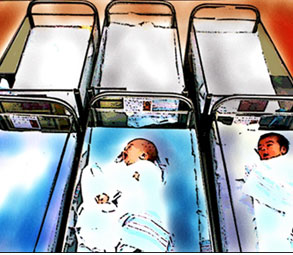
The nation is alive with the sound of crying infants and cooing parents. It’s been nearly a year since the Sept. 11 attacks, and according to the New York Times Magazine, CBS News, and the Tulsa World, among others, we are in the midst of a correspondent baby boom. Obstetricians have their hands full; maternity wards are jammed with tiny new customers. Americans all over the country — suffering from what Newsweek calls “post-traumatic sex syndrome” — have created life as a response to death. They’ve given birth to babies who constitute nothing less than a salve for our sorrow –”signs of hope in a city devastated by loss and grief,” in the words of one New York Daily News report.

But this baby boom, as healing and heartwarming as it may seem, doesn’t appear to exist. It’s true that there are couples who decided to conceive as a result of the attacks. People like Stacey Stapleton and her husband Paul — who successfully conceived after hearing fighter jets fly over their Manhattan apartment, according to an Associated Press report in November — are not exactly unique. They can be found in cities and towns all over the country. But for every couple who decided to have children in the wake of the disaster, there seems to be one or more who decided not to bring new life into an uncertain post-9/11 world, or, even more likely, simply did not see the attacks as an impetus for parenthood.

Preliminary reports from the National Center for Health Statistics (NCHS) suggest that the birthrate was essentially flat in 2001 and most demographers expect 2002 to follow a similar trajectory. If there is any change at all, history suggests that today’s teetering economy will likely lead to a slide in the birthrate as potential parents wait for rosier financial fortunes.

And even if the statistics eventually reveal that a population spike has occurred (the final figures won’t be tallied until after the end of the year), 9/11 may not be the cause. Americans have been birthing a larger collective brood for most of the last decade. The children of baby boomers in particular — as they reach childbearing age in increasingly large numbers — have led an incremental wave of family growth, with birthrates increasing by about 2 percent every year since 1994, according to NCHS statistics. Some studies done before 9/11 even predict that this so-called “echo boom” will outpace its predecessor, with more children being born in 2010 than in 1957, the peak year of the original baby boom.

Most news accounts of a post 9/11 baby boom have ignored this long-term upward trend and the argument that a weak economy leads to fewer births. Instead, hundreds of feel-good stories revolve around burgeoning bellies and fresh-faced newborns as beacons of hope. In lieu of data and its skeptical analysis, the dominant formula has relied on cheery anecdotes — a phenomenon that is timeworn in the wake of crisis.

“It’s a cultural habit,” says Kathleen Gerson, a sociologist at New York University. “[Birthrates] are watched like the stock market.”

Ever since the 1930s, in fact, Americans have conjured baby booms and busts in the wake of recessions, wars, blizzards and blackouts. Disaster, we reason with amateur zeal, begets increased intimacy, which in turn begets sex, which, with luck, yields children — innocent, untainted vessels of everything that is right with the world. And simple laws of cause and effect guarantee: The more significant the disaster, the larger the baby boom will be.

So far, no evidence seems strong enough to undercut our faith in this baby logic. Neither history, nor data, nor the efforts of a few media realists — the Chicago Tribune among the most recent — have significantly shaken our stubborn belief that babies grow like new branches from a painfully pruned nation. We are as in love with the idea of children as healers as we once were with the idea of the Internet as a money machine. It’s a birthing bubble — as fragile and subject to bursting as its cyber counterpart.

Why do we shun the truth to fuel a fantasy? Are Americans simply scrambling to create a silver lining where none exists? Or, does our abiding faith in the 9/11 baby boom reveal that we cling to the idea of national renewal out of fear that the terrorist attacks, as devastating as they were, failed to shake us out of our day-to-day melodramas? Are we reluctant to accept that seemingly life-changing attacks have failed to produce permanent change in our lives and culture?

Baby booms and busts are generally related to distinct, long-lasting changes in national fortunes. During periods of growth and employment, more babies are born; during recessions, the birthrate and fertility rate (how many babies each woman has in her lifetime) decline. During the Depression, for example, the fertility rate dropped precipitously. With unemployment around 25 percent and no sign of a recovery in sight, many families simply decided not to have children, or to postpone their family plans until the economy turned around.

“It was a very deep trough,” says John Haaga, director of domestic programs at the Population Reference Bureau, a nonprofit demographic research institute. “The birthrate dipped below the replacement rate (2.1 children per family) for the first time ever.”

That shift in the birthrate struck demographers and policymakers at the time as a sign of serious trouble. The idea that all cultures follow the same cycles of growth and decline had already entered the culture, largely through German historian Oswald Spengler and his 1918 book “The Decline of the West.” And according to Haaga, many social scientists saw a drop in fertility as proof of America’s imminent collapse into obsolescence. Fewer babies meant fewer soldiers, fewer scientists, fewer businessmen — and a more feeble nation.

After World War II, demographers and economists predicted that the slump would continue, but the economy rebounded and Americans began to give birth more often and at younger ages. In 1946, for example, more than 1 million babies were born to women between the ages of 20 and 24, an increase of nearly 30 percent from the previous year, which dwarfed growth in other age categories. In total, from 1946-1964, Americans gave birth to more than 76 million babies — the biggest baby boom in American history.

At first, the reason for the massive increase seemed obvious: Returning GIs were acting on their deferred hunger for love, sex and family. But as the boom extended into the ’50s, it was interpreted as something more significant. If a slipping birthrate pointed to a declining civilization, then, according to Spengler’s logic — which had become conventional wisdom by the ’50s — a baby boom must herald a rise to power.

In the minds of politicians, the press and the public, the boom became yet another symbol of America’s ever-expanding influence. And when historians like Arthur Schlesinger wrapped the boom into the larger story of America’s rise to superpower status, few journalists or scholars questioned — or could resist — the good news.

Haaga and other demographers, like Ron Rindfuss at the University of North Carolina, believe that the post-World-War II baby boom and the attendant fascination created a false cause-and-effect expectation: Every significant societal event, the public came to believe, would be reflected in the number of babies born. The form and length of the event hardly mattered. Earthquakes, blackouts, snowstorms and even strikes by professional athletes have all been accorded the same attention as extended wars, recessions and periods of extreme economic growth.

The idea of birthrates tracking history isn’t entirely without merit. Along with the Depression’s baby bust, and the boom after World War II, a few other examples can be used to prove that fertile Americans are not oblivious the their surrounding circumstances. One study, for example, conducted by Rindfuss in the ’70s, found that Southern white families limited their childbearing after 1954, when the Supreme Court outlawed segregation. It was, he says, a matter of fear for their childrens’ future. Whites felt threatened by the prospect of a newly integrated South, Rindfuss argued, so they reduced the size of their families in order to minimize the perceived damage.

More recently, Catherine Cohan, a sociologist at Penn State, completed a study showing the population effects of Hurricane Hugo. The 1989 storm ripped through many areas of the East Coast but Cohan focused exclusively on South Carolina, and found that that birthrates increased in the areas of the state that were most damaged by Hugo’s crushing wrath. The families who experienced the greatest degree of tragedy and displacement made friends and family more of a priority, Cohan reasoned in her report, and as a result, they had more children.

But these baby boom and bust examples stand out in the historical landscape like a set of septuplets in the hospital nursery. They are anomalies, freaks of sociological nature, say demographers. And more importantly, they are localized, not national in scope. While it may be true that a handful of events have led to localized changes in birthrates, there is no evidence that these traumas prompted national epidemics of conception.

Nonetheless, the public has taken a rarity and made it commonplace; Americans, aided and abetted by the media, have taken a small-scale event and projected it on the nation. The truth of the matter, say experts, is that long-term cultural shifts caused by things like war or immigration lead to changes in the birthrate. Most other events do not.

“I don’t know of a single documented case of a blackout or something like 9/11 leading to a baby boom,” says Rindfuss. “It’s something we can all relate to, but if you look at fertility trends for the past 25 years, there’s been very little fluctuation. We’re at about 2.1 [children per family] right now; the low was 1.7 or 1.8. If we were trading stocks, we’d say that the numbers are in a very narrow band.”

The media has generally argued that the 9/11 baby boom is a done deal. Most stories written about the alleged phenomenon have chosen to spread the rumor as if it were true. Some editors and writers have used headlines like “Out of terror, come bundles of joy,” (from the Philadelphia Daily News) or “Baby boom in terror wake” (from London’s The Mirror) to get the point across. Others, like the Washington Post, simply relied on Cohan and her Hurricane Hugo study.

To those who have been watching baby booms for years, the attention and the sloppy approach look familiar. Several other events, from hurricanes to blizzards to strikes by professional athletes, have spawned similar media reactions. And while birth statistics — which come out after the stories — typically debunk the sentimental speculation about a baby boom, few column inches or TV minutes are dedicated to setting the record straight. The myths are generally left intact; they course continuously through the culture.

The best example of this hype-infested pattern lies with the most enduring alleged baby boom of the past 50 years — the “blackout baby boom” of the mid ’60s. This pearl of a story, like the supposed baby boom of Sept. 11, centers on a one-day event in New York’s history — Nov. 9, 1965. On this day, starting at rush hour, New York and several other northeast cities lost electricity for 10 hours — more than enough time for bored or creative or sex-starved couples to conceive. And according to a series of three August 1966 articles in the New York Times — which reported a larger-than-average number of births at several area hospitals nine months after the blackout — that’s exactly what people did.

Except that they didn’t.

A comprehensive study done in 1970 by J. Richard Udry, a respected University of North Carolina demographer, revealed that the blackout caused no increase in the affected area’s birthrate. The New York Times’ reliance on doctors’ accounts — “it’s not unreasonable to assume that a lot of sex life went on” quipped one physician — proved hollow. What Udry found was that the doctors’ perceived boom was a localized deviation, not a reflection of the national, or even regional, birthrate.

And yet, despite the efforts of Haaga, Udry and others, the myth of the “blackout baby boom” continues to thrive. It’s been more than 30 years since Udry’s landmark study was published in the journal Demography. Other reports like “Babies and the Blackout: The Genesis of a Misconception” (from the September 1981 issue of Social Science Research) have confirmed Udry’s findings. But, as the New York Times noted April 7, 2002, “doctors and nurses still exchange stories of past baby boomlets after citywide blackouts, blizzards and earthquakes.” Some sociologists continue to cite the blackout boom as fact rather than fiction.

Will the alleged baby boom related to Sept. 11 also be debunked, only to remain in circulation? Or, if a boom does occur, how will it be explained? Will it be the result of gradual demographic changes or a flurry of terrorism-inspired conception?

The definitive answers to these questions won’t appear for several months — or years. But in the meantime, Cohan, for one, stands firm in the belief that at least the areas most affected by the terrorist attacks will experience a pronounced birthing bump. There’s a link, she argues, between births and geographical proximity to disaster.

“In the Hurricane Hugo study, we found an increase in births in the eastern half of South Carolina that was declared a federal disaster site, but not in the western half of the state that was not so affected,” she says. “It’s my hunch that there will be an increase in births in New York City and Washington, D.C.”

A rise in the national birthrate, Cohan argues, is less likely because those who live miles away from the disaster site suffered no disruption of their daily lives. But, she maintains, a national boom is not outside the realm of possibility. Other factors, like emotional proximity — feeling close to the event in mind rather than body — could make the boom national. “If an increase in births is related to feeling as though one’s life was threatened by the event, then we might see an increase in births elsewhere,” she says.

Other demographers aren’t convinced. They argue that one study about a hurricane can’t be relied upon for proof that a 9/11 baby boom is on the way. “Sept. 11 was a watershed event for our sense of security about the world — but not for births,” says Gerson at NYU. No one-day event, including Sept. 11, she argues, is likely to affect the birthrate.

Others experts, like Kathleen Tierney, director of the Disaster Research Center at the University of Delaware, see the 9/11 baby boom as part of American myth-making, yet another urban legend wrought by wishful thinking. We need evidence of our ability to perpetuate the species, to survive, grow, and to move on, regardless of the adversity we face. Celebration of conception and birth is a life-affirming reaction to death.

“We want to think that death is accompanied by the renewal of life, that the grave is not in the end victorious,” says John Lachs, a philosopher at Vanderbilt University. “This is the native optimism of the living, energetic animal.”

In Americans, this buoyant optimism is especially pronounced, Lachs says, “because we have powerful drives and have attained greater control over disease and death than perhaps any other nation in history.”

A baby boom also satisfies our desire for closure — and a happy ending. It invites us, or our family members or friends — anyone who is pregnant — to become part of the 9/11 story. We’ve already made family angst and social stigma the tickets to fame and fortune. Now, with the myth of the baby boom, we’re making terrorism and its effects a desirable commodity, a lock on collective immortality. We want to be hurt, affected, altered down to our sexual souls — and warmly remembered — forever. This will make us, we believe perhaps correctly, more interesting — and if the facts don’t cooperate, we ignore them.

Of course there may be nothing wrong or harmful in all of this self-centered spin. What’s wrong with wanting to be involved in a pivotal moment of our nation’s history? Isn’t belief in a baby boom, as experts like Rindfuss argue, a harmless form of comfort?

Perhaps.

But if we falsely trust that we’ve already changed, that the outcome of the attacks is literal renewal and replacement, we are less willing to admit or believe that more needs to be done. The government, we stress, ought to crack down on terrorism, and do a better job protecting its citizens. Find Osama. Make the world a safer place. We have already responded, we have done our part, we say. We’ve changed! We’re better! Haven’t you been to the nursery? Didn’t you see all the beautiful, perfect babies?

Gerson, for one, fears that a form of complacent logic has already taken root. We don’t want to bother with the heavy lifting of political or social change, she argues. And by focusing on the sheer quantity of children born, we’re giving ourselves a pass — the freedom to overlook the quality of the world they are entering.

Especially silly and sad, she argues, is the belief that the baby boom is somehow a measure of Sept. 11′s significance. Even if there are no more babies born, in New York or elsewhere in the wake of 9/11, the disaster will be remembered as meaningful, and in many ways, life-changing. We’re mistaken when we forget that “[Sept. 11] is important without overestimating its consequences,” Gerson says. The day is horrific, tragic and significant no matter what — “even if it doesn’t necessarily change everything.”

Continue Reading Close

File sharing: Guilty as charged?

New numbers on declining music sales could mean that MP3 trading really is hurting CD sales. But that still doesn't mean we should lock up the pirates.

  • more
    • All Share Services

Does MP3 file trading hurt the music industry?

It’s a question that has caused heated debate ever since Napster exploded on the scene in 1999. And as sales of recorded music have declined over the past two years, it’s a question that has taken on ever-greater importance — for the music business, Congress and music fans.

Up until recently, there has been little hard data to support anyone’s claims that file trading is hurting — or helping — music sales. But at least one researcher, University of Texas (at Dallas) economist Stan Liebowitz, author of an upcoming book (set for publication Sept. 7) titled “Rethinking the Network Economy,” is digging hard for quantitative answers.

In May, Liebowitz published a paper suggesting that the record industry would soon be seriously harmed by MP3s. But in June, by the time Salon caught up with him, he was questioning his own conclusions after having examined the numbers and finding little solid proof that file sharing was hurting CD sales.

Two months later, he’s changed his mind again. Sort of. In an insightful, yet-to-be published paper that analyzes 30 years of record sales figures, Liebowitz argues that MP3s are in fact having a significant negative effect on the CD market. He acknowledges that new data could once again lead to new conclusions, but for now, Liebowitz says, “I’ve moved somewhat closer to the record company position.”

Salon called Liebowitz at his home in Dallas to discuss his findings.

When we last spoke, you said you had yet to find proof of harm from MP3s. What’s changed?

The one big piece of evidence that I didn’t have when we talked before was a half-year year 2002 number [that appears to indicate a 9.8 percent decrease in album sales.] There has to be a caveat in here, which is that I don’t know if this number is correct. It’s a half-year number that I saw in USA Today, from SoundScan.

If it were the case that there was a 9.8 percent drop on albums, when you look at the historical record of the ups and downs of the CD industry, [that's] a bigger decline than we’ve seen in 30 years. It starts to look unusual.

How much bigger is the decline? Is it a significant drop or a slight depression?

I haven’t figured out the percentage but it’s definitely bigger than the other ones. Now, let me add another point. When we last spoke, we were talking about a 5 percent decline in sales and I said, Look, if this is a recession then a 5 percent decline isn’t so unusual. At that time, I had assumed that record sales moved with income; during a recession, you could expect fewer records to be sold. When I actually ran the numbers, with income as a variable, it had a very small impact. It was what is known as statistically significant but it was so small that you could ignore it. So in fact, you couldn’t conclude that because we’re having a recession, you might expect a 5 percent reduction in record sales. That’s the other prop I was leaning on [to show that MP3s are having an effect.] There’s evidence that something different is going on.

But assuming SoundScan’s figures are correct, your paper seems to hang on a matter of degree. If 2002 sales are down 9.8 percent, you argue, and if this continues, the decline will be the biggest in 30 years. But aren’t there other possible reasons for the decline?

I mention that there are these supposed instances of doldrums in musical creativity and you read about them from time to time. But it’s a hard thing, at the moment, to measure that.

But isn’t it possible that the intersection of several other unprecedented factors wholly independent of MP3s could be causing the decline in sales?

That’s right. It is certainly not conclusive, by any means, that there’s real damage going on from MP3s. It could be that we’re having a bit of doldrums in terms of taste; it could be that we’re all using CDs now and nothing else so since they’re a little more durable than other formats that could be part of it. But it is at least beginning to look like there is damage being caused. But remember, the original story was that there’s so much MP3 downloading going on so we should see a really big impact fairly easy. And now we’re seeing a medium impact, which still could be explained by other things — but we can’t discount the MP3 possibility.

If the record industry is somehow not able to stop the downloading, I think we’ll know by 2003. We’ll get the end of the 2002 year numbers when December’s over. We’ll see what actually happened. And I expect that by 2003, whatever’s going to happen will have happened. This is a great experiment for people who are curious about issues like this. We’ll eventually find out. So while it’s premature to say this is the smoking gun that shows that harm is there, it is certainly more indicative of harm than what had been there with just the 2001 numbers.

In your paper you argue that MP3s will create a 20 percent decline in sales. How did you get this figure?

I may be going out on a limb in trying to do that but what I’m saying is, let’s throw out the fact that cassettes are dying, because that seems to be happening on its own. If we remove that, and assume that half the computer owners have CD burners — a number that I’ve seen — you just double the decline that’s already occurred. It should be less than that because the people who would be doing the most burning would be the ones who already have the burners. So that’s where I come up with that number. That’s not the death of the industry, but it’s a severe decline.

Is this decline significant enough to justify new laws, like the Berman bill, which would give copyright owners the power to hack into people’s computers to stop copying and trading?

In my own mind, I don’t think a 20 percent decline warrants letting them override the other laws we have out there saying that you’re not supposed to tamper with people’s computers. That’s my own view.

If [file-trading] was going to kill the record industry, you could understand why the record industry would be willing to go to any lengths to get [the Berman bill] passed. They also might be willing to do that for 20 percent if they’re not paying the costs. But is society willing to impose a law like this on the public to protect the industry from a 20 percent decline?

If the industry wants to prosecute 18-year-old kids, they can make that decision. But I suspect I wouldn’t be in favor of that if the government is going to be prosecuting 18-year-old kids. You don’t want to, in my mind, create a situation in which we’re saying that a large proportion of our population are criminals unless you think that there’s some really strong reason to do that.

People can debate whether, say, criminalizing marijuana and making so many people violate the law is good or bad, but at least you have to understand what the costs and benefits are. And at least the people who are in favor of criminalizing it think it’s a terrible, terrible thing. If you’re going to do that [with file-trading], you have to ask if in fact there’s a terrible thing going on. Is a 20 percent decline enough of a problem to say that we should go after these kids? If the record industry wants to foot the bill, because they think the benefits are greater than the costs, fine. But I don’t want my district attorney spending my money going after 18-year-old kids who are downloading if it’s only going to cause a 20 percent decline in sales for the industry.

When we last spoke, you said that a key historical sign would come from whether the introduction of audiocassettes had a negative effect on music sales. Your analysis here argues that tapes had no effect on sales, and if anything, sales went up when cassettes were introduced. What makes you think MP3s will be different?

The net effect of tapes was positive. But it doesn’t mean that it wouldn’t have been more positive if people weren’t making more copies. [What is clear is that] there’s no evidence in the data that the tapes caused a decline.

MP3s wouldn’t do the same thing. The reason cassettes led to growth was that before cassettes existed, you didn’t have portable music. You couldn’t play recorded music in your car, and you couldn’t play it walking around, in a Walkman. It was the little cassette that basically allowed you to do that. To be technically correct, there were 8-track players prior to cassettes. But they didn’t have quite the same penetration. My theory as to what went on is that [the rise in cassettes] coincides almost perfectly with the penetration rate of the portable, Walkman-type of thing. So it opened up this whole new market, which overwhelmed any copying that went on.

You mention that price doesn’t matter because album prices have tracked with inflation for the last 30 years: A 10-song recording today costs as much as it did in the ’70s. This runs counter to the public perception that CDs are wildly over-priced, and I’m wondering if people think CDs are expensive because other musical components such as CD players have decreased in price, while CDs have not …

It’s possible, but the technology in creating stereos is not necessarily related to the technology used to create CDs. If you take a look at the book “Entertainment Industry Economics,” the author goes through the cost of a CD, and in his older editions, he goes through the cost of an LP or a cassette. And the majority of the cost is not the production of the actual physical item. That may go down, but the majority of the costs are the other costs: publicizing albums, finding talent. There’s no reason to think that those are going down because they’re not technology-based. The small part, technology, is 15 percent of the item and that may be going down, but it doesn’t have much of an impact. It’s really amazing how prices have tracked so closely with inflation. It’s almost as if the industry just bumps up prices with the inflation rate.

You also point out in your paper that there’s been no differentiation in price when it comes to music, which is radically different from most markets for other products, such as TVs, for example, which come in a variety of sizes and prices. Do you think the industry needs to abandon this business model? Could this be a solution to the problem of MP3s?

I don’t know if that’s necessary but one of the things that the entertainment industry has always been really good at is differentiating products. With movies, you have the theater, the tapes, the pay-per-view, the HBO, then the TV. To me, the interesting thing is that historically, the record industry hasn’t done much differentiation. What you might have expected was, say, a CD that was half the price of current high-quality CDs that just has a lower sampling rate. With MP3s, for example, when you rip a CD, you have a choice about whether you want to have CD-quality or near-CD quality or FM-radio-quality. When you’re playing music on low-quality stereos, you wouldn’t really hear the difference. So one of the things the industry could do with their downloads is have different prices. People with high-quality stereos aren’t going to want to put the low quality material on, and the people who have lower quality stereos, with speakers that are incapable of producing the frequencies that let you hear the difference, then they’ll buy the cheap ones. That would a way to broaden the market and increase their revenues. In a way it’s surprising that the industry hasn’t done that. And as they are trying to figure out their models for online sales, that would be one way of doing it.

How willing do you think the industry is to make such changes?

That depends on the individuals involved. But the fact of the matter is that if they’re too rigid, they’ll get replaced by some start-up that’s not. That much is certain. You can’t be terribly inefficient, terribly rigid and hang on.

Continue Reading Close

Page 2 of 39 in Damien Cave