David Brock

The right captures the tube

Conservative G.E. head Jack Welch tilted TV right with "The McLaughlin Group." Then a Nixon operative named Roger Ailes signed up with a new channel called Fox.

  • more
    • All Share Services

The right captures the tube

Unlike CNN’s “Crossfire,” “The Mclaughlin Group” — highly rated and closely watched during the 1980s — did not try to create the appearance of balance. The media spectrum was expanded to include the Far Right in the 1970s; yet now, a combination of the conservative biases of media executives, commercial market forces, and a ready stock of warm bodies from the subsidized right-wing message machinery was conspiring to narrow the spectrum of opinion again, only this time in reverse. Suddenly, conservatives had not only won an even berth, as on “Crossfire”; with the advent of “The McLaughlin Group,” they ruled.

At its high point, the syndicated “McLaughlin Group,” which airs on NBC and PBS affiliates nationally, had 3.5 million viewers, far more than the top-rated FOX News Channel opinion shows today. Host John McLaughlin, a former Jesuit priest, aide to Richard Nixon, and National Review alum, chose the topics, the sequencing, and his four fellow panelists. The show always pitted three or four conservatives against two or even only one liberal. Over the years, one of the liberal slots typically went to a nonideological reporter, such as the Baltimore Sun’s dyspeptic Jack Germond. Often, the “liberal” guest, usually the bumbling Morton Kondracke, then of The New Republic and now with the FOX News Channel, was booked to endorse and bestow legitimacy on conservative views.

This arrangement left Newsweek’s Eleanor Clift, the sole woman panelist, who was typecast as a screechy feminist, to fend off two or even three angry, white, conservative men. Among the regular panelists, only the liberals — not the conservatives — were trained reporters. Putting Clift and Germond — rather than liberal opinion writers — up against conservative ideologues bolstered the conservative caricature of all reporters as closet liberals; at the same time, it ensured that liberals would be more restrained and nuanced in their advocacy than their opponents.

This imbalanced and exaggerated TV picture was projected, to Washington and the nation, as if it were somehow a representative microcosm of political dialogue in the country during Ronald Reagan’s presidency, leaving the indelible misimpression that conservatism was the dominant view in the country. Meanwhile, McLaughlin’s buffoonery — his exaggerated manner, his nicknames for panelists, his reduction of politics into a game show — made conservatism seem unthreatening, and even funny. From the composition and tone of “The McLaughlin Group” panels sprang the stereotype that conservatives are entertaining, while liberals are whiny and boring — another seeming advantage engineered by the Right as the values of entertainment, rather than those of journalism, were prevailing on television.

“The McLaughlin Group” also was instrumental in establishing the now-widespread practice of “buckraking,” whereby TV pundits take their show on the paid lecture circuit and for substantial fees reenact their TV roles, playing themselves before industry and trade associations looking for the Washington “inside scoop” or after-dinner levity. Buckraking added a powerful financial incentive for pundits to “stay in character” on television and for aspiring pundits to adopt a marketable style. Belligerent, cocksure conservatives, with liberals as their compliant whipping boys, seemed the meal ticket for both sides. Often, entire panels from shows like “McLaughlin” and CNN’s “Capital Gang” go on the road, raking in tens of thousands of dollars apiece. Conservative TV pundits like George Will have taken huge fees speaking before industry groups about which they opine; the corporate market for left-wing pundits is not lucrative.

“The McLaughlin Group” plucked John McLaughlin from his relatively obscure post as National Review “Washington editor” — where, according to The New Republic, he employed ghostwriters to write under his byline — and made him one of the most influential media voices in the 1980s. When it began, the show was underwritten by the Edison Electric Institute, a front for the electric power industry with close ties to the GOP. The institute has been a client of Grover Norquist, who, in addition to his leadership of the conservative movement, has dabbled in lobbying on the side. McLaughlin had hoped to launch a conservative-slanted talk show since the mid-1970s, after raising his profile in TV appearances defending the Nixon administration and hosting a local Washington talk show with Robert Novak. He took money from a former Nixon aide to explore the idea.

In 1986, when General Electric bought NBC’s parent company, RCA, GE announced that it would become the show’s exclusive sponsor and pumped cash into promoting it nationally. The deal was struck following a meeting between McLaughlin and GE chairman Jack Welch, convened at McLaughlin’s request by President Ronald Reagan. McLaughlin already had been promoted by NBC with appearances on “Meet the Press” in the early 1980s; McLaughlin’s then-wife, Ann, was a high-level Reagan official; and Reagan himself was a fan of “The McLaughlin Group.” Reagan also had a relationship with GE, dating back to his stint as host of television’s “General Electric Theatre” in the 1950s. According to media critic Ben Bagdikian, GE had “launched Ronald Reagan as a national political spokesman by paying him to make nationwide public speeches against Communism, labor unions, Social Security, public housing, the income tax, and to augment the corporation’s support of right-wing political movements.”

Thirty years later, GE’s agenda hadn’t much changed. Known as “Neutron Jack” for his hard-charging management style, Welch, who headed GE until his retirement in 2002, was a conservative Republican; like Ted Turner’s early influence at CNN, Welch’s role in promoting McLaughlin was an example of how the Right was able to steer the political debate with the approval of top-ranked media executives. McLaughlin expanded his visibility with the GE-sponsored “One on One” syndicated interview show, and he was given a third show on CNBC when that cable network was established by GE in the 1990s. Welch used his influence over “The McLaughlin Group” to promote commentators whom he saw as up-and-coming talent, such as Reagan economics adviser Lawrence Kudlow, “economics editor” of National Review, member of the right-wing Club for Growth, and “fellow” of Newt Gingrich’s Progress and Freedom Foundation. Kudlow now has his own CNBC show, on which he was forced to apologize on air for insulting a government witness in the Martha Stewart case as “limp-wristed.”

GE funneled financial support directly into the right-wing message machinery. The company gave money to William Simon and Irving Kristol’s Institute for Educational Affairs, which funded the racist, sexist, homophobic right-wing campus newspapers; to C. Boyden Gray’s Citizens for a Sound Economy; and to the Hudson Institute, the American Enterprise Institute, and the Center for Strategic and International Studies.

In a 2002 interview on MSNBC’s “Hardball” with Chris Matthews (who got his start on television with guest appearances on The McLaughlin Group), Welch spoke openly about his political views. “And this guy came in named Ronald Reagan that they all thought was stupid and he had a pretty simple thesis and you can disagree with some of his policies or other things, but this guy got American back on track. And the country thrived …” Welch endorsed George W. Bush’s proposals for “tort reform” and for ending taxation on stock dividends, an idea heavily promoted by Kudlow on CNBC’s “Kudlow and Cramer” before the Bush administration adopted it. Welch has conceded that on Election Night 2000 — when a critical call had to be made by network officials about who had won — he was in the NBC News Control Room, one of “two or three of us cheering for George Bush.” He labeled as “crazy” unconfirmed stories that he had said, “What would I have to give you to call the race for Bush?” NBC subsequently refused to release to congressional investigators a videotape of what went on in the room. NBC followed the FOX News Channel in calling the race, wrongly, for Bush.

In the Reagan years, “The McLaughlin Group” was the new normal. Twenty years later, it would be normal up and down the cable dial. The right wing was on call 24/7, while bona fide liberals were an endangered species. Syndicated columnist and former Moral Majority official Cal Thomas got his own show on FOX, while AEI’s Ben Wattenberg got a PBS series. Until recently, the Wall Street Journal editorial board had its own hour-long weekly show on CNBC. The Journal’s Peggy Noonan and John Fund are regulars on the GE-owned MSNBC cable network. Alone among the nation’s editorial page editors, Tony Blankley of the Washington Times is a highly visible TV pundit, with a permanent berth on “The McLaughlin Group.” Time’s right-wing columnist Charles Krauthammer, who has not published a book, is a fixture on FOX News and “Inside Washington,” the D.C.-based political affairs show. Time’s left-liberal columnist Barbara Ehrenreich, a runaway best-selling author, is invisible.

GE launched CNBC in 1989. In 1991, GE made a fateful hire that shifted the entire cable news industry dramatically to the right: Republican operative Roger Ailes became president of CNBC.

Ailes entered politics working for Richard Nixon, showing the campaign how to present paid political events so that they would appear to be news, in order to manipulate public opinion about the candidate. A false warm-and-fuzzy Nixon was sold by Ailes like a “car or a can of peas,” as Joe McGinniss put it in “The Selling of the President, 1968.” Ailes’s father was an Ohio factory foreman who complained of being talked down to by corporate executives at the plant. Ailes shared with Nixon contempt for “elites” and a knack for speaking to the racial prejudices of certain lower-class white men. Discussing the addition of a panelist to a staged Nixon “Man in the Arena” forum, Ailes said: “You know what I’d like? As long as we’ve got this extra spot open. A good, mean Wallace-ite cab driver. Wouldn’t that be great? Some guy to sit there and say, ‘Awright, mac, what about these niggers?’”

Ailes, who met Nixon while working as the producer of “The Mike Douglas Show,” went to work at the Nixon White House; but his relationship with the president’s inner circle soon cooled, and Watergate dealt his career a further setback. Over the next few years, Ailes, a fine arts major who worked his way through Ohio University as a radio disc jockey, toiled in the political wilderness as a speech coach for business executives and moonlighted as an off-Broadway producer. He ran a few political races in the late 1970s before returning to television in 1981 as executive producer of Tom Snyder’s hugely successful “Tomorrow: Coast to Coast.” When Ailes took the show down-market, ratings plummeted. In 1982, the show was replaced by “Late Night With David Letterman”; once one of NBC’s biggest stars, Snyder never fully recovered. Ailes was more resilient.

By 1981, the Reagan revolution had dawned, and Ailes’s ability to craft appeals to Nixon’s disaffected cultural conservatives was to prove invaluable. Working with his second wife, Norma, a TV producer, Ailes rose to become the country’s preeminent GOP political consultant. He spoke the language of the so-called Reagan Democrats: the construction workers and housewives featured in his widely imitated ads.

Still, he was never truly a Reagan insider, and it was not until George H.W. Bush came along that Ailes finally found his horse. His relationship with Bush was cemented after he helped the vice president turn the tables in an interview about the Iran-contra affair with CBS anchor Dan Rather. Ailes prepped Bush to equate his misdoings in the scandal with a temper tantrum that the voluble Rather had once thrown on the CBS set. “Dan Rather is the most biased reporter in the history of broadcasting,” Ailes exclaimed after the interview.

Under the direction of Ailes and the late Lee Atwater, the Bush campaign questioned Democratic nominee Michael Dukakis’s patriotism, tarred him as an unfit commander in chief, and portrayed him as soft on crime. Though he claimed he had nothing to do with it, Ailes was burned in a controversy over an advertisement produced by an independent pro-Bush group that featured convicted African American murderer Willie Horton, who had committed rape after escaping from a weekend furlough program while Dukakis was governor of Massachusetts. According to Time magazine, Ailes said at the time, “The only question is whether we depict Willie Horton with a knife or without one.” Atwater said that Ailes had “two settings: attack and destroy,” yet Ailes had the temerity to call Dukakis “the dirtiest campaigner in America.”

As a result of the ugly race-baiting campaign, Ailes himself became an infamous figure; his future clients, notably Rudy Giuliani in New York City, suffered a string of defeats. Frozen out of the 1992 Bush campaign, Ailes renounced his political career and announced a return to television.

One evening a few months previous, Ailes had run into Rush Limbaugh at the posh Manhattan restaurant 21. Limbaugh’s radio show had established him as a political powerhouse, and Ailes convinced Limbaugh that a syndicated TV show was the obvious progression. Ailes became executive producer of Limbaugh’s late-night syndicated talk show. Yet once he left the segmented medium of radio, Limbaugh failed to attract a large broadcast TV audience. Something about Limbaugh did not easily translate to mainstream TV viewers or advertisers, and he eventually quit the show. In the meantime, Ailes — who had nursed resentments against the press in twenty years of dishonest political warfare — became a cable network news executive.

In the early 1990s, NBC president Bob Wright was looking for someone to take over CNBC. A friend recommended Ailes, who promptly flew to Nantucket and convinced Jack Welch that he was just the programmer NBC was looking for. Even as NBC executives offered assurances that Ailes had left politics for good, Ailes’s NBC deal allowed him to remain affiliated with the floundering Limbaugh broadcast. While serving as both CNBC’s president and Limbaugh’s producer, Ailes went on Don Imus’s radio show to promote Limbaugh’s reports of a “suicide cover-up, possibly murder,” in the death of White House counsel Vincent Foster. “The guy who’s been doing an excellent job for the New York Post [Christopher Ruddy]…for the first time on the Rush Limbaugh show said that…he did not believe it was suicide…. Now, I don’t have any evidence…. These people are very good at hiding or destroying evidence.”

Politics aside, Ailes was a talented marketer and had a keen sense of production values. In just two years at CNBC, he helped transform it from a ragtag network into the number one financial news network in the United States. During his tenure, ad sales doubled, ratings tripled, and the asset value of the channel soared from about $400 million to more than $1 billion.

While the core of CNBC was business news, NBC’s cable outlets fueled the proliferation of political talk television. Working within the confines of a mainstream cable network, Ailes seemed to resist his blunt right-wing instincts in favor of a broad political mix. Added to the roster of cable hosts that included Tom Snyder, Dick Cavett, and John McLaughlin were former Bush campaign aide Mary Matalin, former Clinton aide Dee Dee Myers, Cal Thomas, tabloid showman Geraldo Rivera, liberal actor Charles Grodin, and Ailes himself.

Yet Ailes’s attraction to entertainment and partisan opinion — often uninformed and irresponsible opinion — over hard news and information had a subtly subversive political impact. In the late 1970s, the only Washington chat shows on the air were the traditional network Sunday morning shows and PBS’s sober pair of journalism roundtables, “Agronsky & Company” and “Washington Week in Review.” In the 1980s came “The McLaughlin Group,” “Crossfire,” and “The Capital Gang.” Now came a second generation of McLaughlin knockoffs as more cable channels sprung up. As Edith Efron predicted in “The News Twisters,” if the spectrum could be expanded to equate professional journalists and Far Right ideological polemicists, if standards of discourse could be altered, if objectivity was no longer prized, if consensus could be destroyed as everything in politics was made into a “he said/she said” standoff, then the right wing would win critical political inroads.

“Confining myself to ‘McLaughlin’-like shows and ‘Capital Gang’-like shows, every single one of them, if it disappeared tomorrow, journalism would be better off,” the writer and editor James Fallows told the American Journalism Review in 1995. Fallows bemoaned the substitution of news for opinion and of solid analysis for pithy sound bites and prognostications: “The world would be better off. Government would be better off. The only people who would be worse off are the actual members of the shows.”

While turning CNBC around, Ailes’s real interest was creating a new cable channel that he vowed would become the next MTV or ESPN. The new channel was christened America’s Talking, and it was designed to reflect Ailes’s “homespun woman-by-the-hearth, man-baling-hay Midwestern rugged individualism,” according to one former producer. The shows, which Ailes created, included “Bugged!,” in which a film crew conducted man-on-the-street interviews to uncover what was “bugging” Americans; “Pork,” a call-in show about government waste and fraud; and “Am I Nuts?” on which therapists dispensed advice. None of these corny entries succeeded. The only legacy bequeathed by America’s Talking was Chris Matthews, a former Democratic political aide whom Ailes had chosen to coanchor a prime-time political gabfest.

Within NBC, it was not Ailes’s politics but, rather, his temperament that rankled. Ailes’s bond with Nixon had been instant and deep. As his colleagues described him, Ailes was paranoid and quick to abuse his power to punish perceived enemies, whom he belittled mercilessly. In late 1995, when GE was close to a deal with Microsoft to launch MSNBC, using the subscriber base of the defunct America’s Talking channel, a power struggle broke out within the senior ranks of the company. “Let’s kill the SOB!” Ailes exhorted his loyalists in discussing their approach toward a corporate competitor.

In a management reshuffling, Ailes in effect lost operational control of CNBC; when MSNBC was unveiled one month later, Ailes was given no role. Within a few weeks, he resigned. A few days after that, Ailes was appointed by Rupert Murdoch to head a new cable channel to compete with both CNN and MSNBC. It would be called the FOX News Channel.

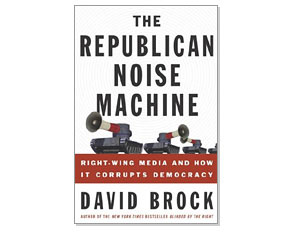
Excerpted with permission from “The Republican Noise Machine: Right-Wing Media and How it Corrupts Democracy” by David Brock. Published by Crown Books.

The mighty windbags

Thirty years ago, conservatives embarked on a plan to subvert journalism and skew America to the right. They succeeded beyond their wildest dreams.

  • more
    • All Share Services

The mighty windbags

Since defecting from the Republican Party in the latter half of the 1990s and publishing a confessional memoir in 2002, I’ve discussed my right-wing past with politicians, political activists and strategists, academic scholars, student groups, fellow writers, and hundreds of readers of my book “Blinded by the Right: The Conscience of an Ex-Conservative.” I’m rarely asked anymore why I changed, or about the baroque intricacies of the anti-Clinton movement, which I once participated in and then renounced and exposed. After a presidential election decided by the Supreme Court, the terrorist attacks on the United States on September 11, 2001, and the war with Iraq, politics has moved to a different place.

Nowadays, when I talk about “Blinded by the Right,” people want to know not how I was blinded by the Right, but how so much of the country seems to be in that position. For the first time since 1929, the Republican Party controls all three branches of government. Fewer people identify with the Democratic Party today than at any time since the New Deal. Conservatism seems the prevailing political and intellectual current, while liberalism seems a fringe dispensation of a few aging professors and Hollywood celebrities. People ask me, a former insider, how the Republican Right has won political and ideological power with such seeming ease and why Democrats, despite winning the most votes in the last three presidential elections, seem to be caught in a downward spiral, still able to win at the ballot box but steadily losing the battle for hearts and minds.

While it is not the only answer, my answer is: It’s the media, stupid.

When I say this, in a more respectful way, to folks outside the right wing, I usually get either of two responses. Those who receive their news from the New York Times and National Public Radio give me blank stares. They are living in a rarefied media culture — one that prizes accuracy, fairness, and civility — that is no longer representative of the media as a whole. Those who have heard snippets of Rush Limbaugh’s radio show, have caught a glimpse of Bill O’Reilly’s temper tantrums on the FOX News Channel, or occasionally peruse the editorials in the Wall Street Journal think I’m a Cassandra. They view this media as self-discrediting and therefore irrelevant. They are living in a vacuum of denial.

Those who understand what I mean are either members of the media itself, have read media-criticism books or Internet sites devoted to the subject, or are in the political trenches every day dealing with the media. The gap between those who recognize right-wing media power for what it is and those who don’t is wide and deep, as if they inhabit parallel universes. The gap is dangerous to democracy and needs to be closed.

When I came to Washington fresh out of college in 1986, I got a job at the Washington Times, the right-wing newspaper bankrolled by Reverend Sun Myung Moon, the Korean-born leader of a religious cult called the Unification Church. Though Moon’s paper was said to be read in the Reagan White House, nobody paid much attention to it. We were the proverbial voice in the wilderness. Considering that the paper was governed by a calculatedly unfair political bias and that its journalistic ethics were close to nil, this was a good thing. That was eighteen years ago. Today, the most important sectors of the political media — most of cable TV news, the majority of popular op-ed columns, almost all of talk radio, a substantial chunk of the book market, and many of the most highly trafficked Web sites — reflect more closely the political and journalistic values of the Washington Times than those of the New York Times. That is, they are powerful propaganda organs of the Republican Party. For our politics, this development in the media represents a structural change: a structural advantage for the GOP and conservatism, and, I believe, the greatest structural obstacle facing opponents of the right wing. I therefore think it is one of the most important political stories of the era. I have sought to tell this story in “The Republican Noise Machine: Right-Wing Media and How It Corrupts Democracy.”

I know there is a Republican Noise Machine because I was once part of it. From the Washington Times, to a stint as a “research fellow” at the Heritage Foundation (the Right’s premier think tank), to a position as an “investigative writer” at the muckraking magazine The American Spectator, and as the author of a best-selling right-wing book, I forwarded the right-wing agenda not as an open political operative or advocate but under the guise of journalism and punditry, fueled by huge sums of money from right-wing billionaires, foundations, and self-interested corporations.

By the time I said good-bye to the right wing in 1997, what was once a voice in the wilderness was drowning out competing voices across all media channels. The most influential political commentator in America, Rush Limbaugh, and his hundreds of imitators saturated every media market in the country, providing 22 percent of Americans — not only conservatives but independent swing voters — with their primary source of news. Conservatives had changed the face of the cable news business with the establishment of the top-rated FOX News Channel, a slicker broadcast version of the Moonie Washington Times. Pundit Ann Coulter and her fanatical ilk topped the best-seller lists, becoming superstars in the world of political punditry. The Spectator juggernaut — which had a circulation of three hundred thousand per month at its height in the early 1990s — had been replaced by Internet gossip Matt Drudge, who gets more than 6.5 million visitors to his site every day. Although enormous subsidies were still being pumped into right-wing media that did not turn a profit, right-wing media also had become a multibillion-dollar business, a development that powerfully affected all other commercial media.

The lies, smears, and vicious caricatures leveled against Bill and Hillary Clinton by this right-wing media, and then repeated in virtually every media venue in the country, have now been well documented, not least in “Blinded by the Right.” In that book, I compared the anti-Clinton propaganda to a virus as it seeped off the pages of the Spectator into the minds of every sentient American. My memoir ended in 2000; what I did not fully comprehend then, but what is apparent to me now as I have watched the politics of the last few years unfold, is that the virus was not Clinton-specific. In fact, it had nothing to do with the Clintons per se; rather, in different strains, it would afflict any and every political opponent of the right wing, including Al Gore, Senate Democratic leader Tom Daschle, and the mourners of Senator Paul Wellstone, every major Democrat seeking the presidency in 2004, New York Times columnist Paul Krugman, and the liberal advocacy group MoveOn.org. What we have here, as a criminal investigator might say, is a pattern.

In the 2000 presidential campaign, the Republican Noise Machine, which worked for years to convince Americans that the Clintons were criminally minded, used the same techniques of character assassination to turn the Democratic standard-bearer, Al Gore, for many years seen as an overly earnest Boy Scout, into a liar. When Republican National Committee polling showed that the Republicans would lose the election to the Democrats on the issues, a “skillful and sustained 18-month campaign by Republicans to portray the vice president as flawed and untrustworthy” was adopted, the New York Times reported. Republicans accused Gore of saying things he never said — most infamously, that he “invented” the Internet, a claim he never made that was first attributed to him in a GOP press release before it coursed through the media. Actually, Gore had said, “During my service in the United States Congress, I took the initiative in creating the Internet,” a claim that even former House Speaker Newt Gingrich verified as true.

The right-wing media broadcast this attack and similar attacks relentlessly, in effect giving the GOP countless hours of free political advertising every day for months leading up to the election. “Albert Arnold Gore Jr. is a habitual liar,” William Bennett, a Cabinet secretary in the Reagan and first Bush administrations, announced in the editorial pages of the Wall Street Journal. “… Gore lies because he can’t help himself,” neoconservative pamphleteer David Horowitz wrote. “LIAR, LIAR,” screamed Rupert Murdoch’s New York Post. The conservative columnist George F. Will pointed to Gore’s “serial mendacity” and warned that he is a “dangerous man.” “Gore may be quietly going nuts,” National Review’s Byron York concluded. The Washington Times agreed: “The real question is how to react to Mr. Gore’s increasingly bizarre utterings. Webster’s New World Dictionary defines ‘delusion’ thusly: ‘The apparent perception, in a nervous or mental disorder, of some thing external that is not actually present … a belief in something that is contrary to fact or reality, resulting from deception, misconception, or a mental disorder.’”

This impugning of Gore’s character and the questioning of his mental fitness soon surfaced in the regular media. The New York Times ran an article headlined “Tendency to embellish fact snags Gore,” while the Boston Globe weighed in with “Gore seen as ‘misleading.’” On ABC’s “This Week,” former Clinton aide George Stephanopoulos referred to Gore’s “Pinocchio problem.” For National Journal’s Stuart Taylor, the issue was “the Clintonization of Al Gore, who increasingly apes his boss in fictionalizing his life story and mangling the truth for political gain.” Washington Post editor Bob Woodward raised the question of whether Gore “could comprehend reality,” while MSNBC’s Chris Matthews compared Gore to “Zelig” and insisted, “Isn’t it getting to be delusionary?”

The well-orchestrated media cacophony had its intended effect: The election was far more competitive than it should have been — and, indeed, was decided before the Supreme Court stepped in — because of negative voter perceptions of Gore’s honesty and trustworthiness. In the final polls before the election and in exit polls on Election Day, voters said they favored Gore’s program over George W. Bush’s. Gore won substantial majorities not only for his position on most specific issues but also for his overall thrust. The conservative Bush theme of tax cuts and small government was rejected by voters in favor of the more liberal Gore theme of extending prosperity more broadly and standing up to corporate interests. Yet while Bush shaded the truth and misstated facts throughout the campaign on everything from the size of Gore’s federal spending proposals to his own record as governor of Texas, by substantial margins voters thought Bush was more truthful than Gore. According to an ABC exit poll, of personal qualities that mattered most to voters, 24 percent ranked “honest/trustworthy” first — and they went for Bush over Gore by a margin of 80 percent to 15 percent. Seventy-four percent of voters said “Gore would say anything,” while 58 percent thought Bush would. Among white, college-educated, male voters, Gore’s “untruthfulness” was cited overwhelmingly as a reason not to vote for him, far more than any other reason.

Two years after the election, Gore gave an extraordinary interview to the New York Observer that could be read as an explanation of what happened to his presidential campaign. Gore charged that conservatives in the media, operating under journalistic cover, are loyal not to the standards and conventions of journalism but, rather, to politics and party. Gore said:

“The media is kind of weird these days on politics, and there are some major institutional voices that are, truthfully speaking, part and parcel of the Republican Party. Fox News Network, the Washington Times, Rush Limbaugh — there’s a bunch of them, and some of them are financed by wealthy ultra-conservative billionaires who make political deals with Republican administrations and the rest of the media…. Most of the media [has] been slow to recognize the pervasive impact of this Fifth Column in their ranks — that is, day after day, injecting the daily Republican talking points into the definition of what’s objective as stated by the news media as a whole….

Something will start at the Republican National Committee, inside the building, and it will explode the next day on the right-wing talk-show network and on Fox News and in the newspapers that play this game, the Washington Times and the others. And then they’ll create a little echo chamber, and pretty soon they all start baiting the mainstream media for allegedly ignoring the story they’ve pushed into the zeitgeist. And then pretty soon the mainstream media goes out and disingenuously takes a so-called objective sampling, and lo and behold, these RNC talking points are woven into the fabric of the zeitgeist….”

True to form, the right-wing media greeted this factual description with yet another frenzy of repetitive messaging portraying Gore as crazy. Speaking of Gore on FOX News, The Weekly Standard’s Fred Barnes said, “This is nutty. This is along the lines with, you know, President Bush killed Paul Wellstone, and the White House knew before 9/11 that the attacks were going to happen. This is — I mean, this is conspiratorial stuff.” Also on FOX, syndicated columnist Charles Krauthammer said of Gore, “I’m a psychiatrist. I don’t usually practice on camera. But this is the edge of looniness, this idea that there’s a vast conspiracy, it sits in a building, it emanates, it has these tentacles, is really at the edge. He could use a little help.” “It could be he’s just nuts,” Rush Limbaugh said of Gore. “Tipper Gore’s issue is what? Mental health. Right? It could be closer to home than we know.” “He [Gore] said it’s a conspiracy,” Tucker Carlson said on CNN’s “Crossfire.” “I actually think he’s coming a little unhinged,” The Weekly Standard’s David Brooks, now at the New York Times, said of Gore on PBS.

As Gore’s experience demonstrated, Democrats ignore these attacks at their peril: Not only do such attacks confirm the preconceptions of Republicans but they shape the thinking of undecided voters and even of Democrats. One of the most frightening experiences I have had in recent years in talking with rank-and-file Democrats is the extent to which they unconsciously internalize right-wing propaganda. To add insult to injury, too many Democrats have a tendency to blame the victims of these smears — their own leaders — rather than addressing the root of the problem. For instance, when Senator Daschle made the factual statement that “failed” diplomacy had led to war with Iraq, right-wing media accused him of siding with Saddam Hussein. The ensuing controversy caused many Democrats to think Daschle had put his foot in his mouth.

With the right-wing media now a seemingly permanent and defining feature of the media landscape, if Democrats cut through the propaganda and win back the White House in 2004, they still face the prospect of being brutally slammed and systematically slandered in such a way that will make governing exceedingly difficult. There should be no doubt that the right-wing media’s wildings of 1993 — which led to Clinton’s impeachment four years later — will be replayed over and over again until its capacities to spread filth are somehow eradicated.

Ironically, though not coincidentally, this radical transformation of the media has been obscured by conservative charges of “liberal media bias” that are believed by the vast majority of the public, including about half of Democrats. I’m all too familiar with the claim. From my very first days at the Washington Times, I was schooled to invoke “liberal bias” to deflect attention from my own biases and journalistic lapses and as a rationale to justify my presence in the mainstream media conversation in the name of providing “balance” or “the other side.” We sold a lot of books and magazines and commanded lavish attention for our propaganda outside the right wing by using this cover story. As I showed in “Blinded by the Right,” the truth was that my work as a right-wing journalist and commentator — in particular, my American Spectator exposés on Anita Hill and the Clintons — did not deserve the attention they received. I was delivering a truckload of nonfacts, half-truths, and innuendos, not “balance” or “the other side.” What I show in “The Republican Noise Machine” is that my experience was not the exception but the rule.

The “liberal media” mantra aside, if one looks and listens closely to what the right wing says when it thinks others may not be paying attention, there should be no doubt that it has made potent political gains not despite the media but through it. Rush Limbaugh says his program has “redefined the media” and refers to the “Limbaugh echo chamber syndrome,” by which messaging originating on his show drives the twenty-four-hour news cycle. “The radical Left,” he says, “is furious that liberals no longer set the agenda in the national media.” “‘New media’ outlets pound establishment,” the Washington Times announced in an op-ed by right-wing publicist Craig Shirley. In a column explaining why the “outing” in the press of the identity of a covert CIA operative by senior Bush administration officials — a possibly criminal act committed to harm a Bush critic — did not spark a major political scandal, Tod Lindberg of the Hoover Institution explained in the Washington Times, “The media culture has changed. Conservatives and GOP partisans now have more than adequate means to offer an exculpatory counter-narrative.” When CBS announced the cancellation of a biopic that was deemed unflattering toward the Reagans, Matt Drudge appeared on MSNBC, on a show hosted by a former Republican member of Congress, to announce the “beginning of a second media century …. It was the Internet, it was talk radio, it was cable that put pressure on CBS, and heretofore, there’s never been this kind of pressure applied to one of the big titans, one of the big three.” Brian C. Anderson, writing on OpinionJournal.com, a right-wing Web site published by the Wall Street Journal, in late 2003, informed conservatives, “[w]e’re not losing anymore” and attributed this fact to a media “revolution.” “Everything has changed,” he wrote.

In a syndicated column titled “Culture War Signals,” John Leo of U.S. News & World Report argued that “a corner has been turned” in the “culture wars” with the “rise of a large crop of commentators the left has not been able to match” and “conservative gains in new media” like the FOX News Channel. Conservative New York Times columnist David Brooks has written that the conservative media have “cohered to form a dazzlingly efficient ideology delivery system that swamps liberal efforts to get their ideas out.” MSNBC’s Matthews, interviewing Bernard Goldberg, the author of an attack book on the “liberal media” titled “Bias,” got the author to agree with his view that the cable news industry — whose total news audience is growing while that of the traditional broadcast news networks is declining — is biased all right, though in favor of the right wing. According to Bill O’Reilly, “For decades, [liberals] controlled the agenda on TV news. That’s over.” In an interview with PBS, Tony Blankley, the former Newt Gingrich flack turned editorial page editor of the Washington Times and “McLaughlin Group” panelist, said:

“Starting in 1994, with the Republican election of Congress, I think Limbaugh made the difference in electing the Republican majority. In the following three elections, he made the difference holding the majority. And in 2000, in the presidential race in Florida, he was the difference between Gore and Bush winning Florida, and thus the presidency.”

Commenting on the media while interviewing Ann Coulter about her book “Treason: Liberal Treachery From the Cold War to the War on Terrorism,” right-wing radio host Sean Hannity crowed, “We’ve basically taken over!” Coulter, who has made millions off the charge of “liberal media bias” while maintaining a career as perhaps the most biased right-wing voice in the media, laughed in agreement. A young writer for Rupert Murdoch’s neoconservative Weekly Standard named Matt Labash — whom I hired into right-wing journalism at The American Spectator — was probably laughing, too, when he was interviewed by Columbia Journalism Review partner Web site JournalismJobs.com. The interviewer asked, “Why have conservative media outlets like The Weekly Standard and FOX News Channel become more popular in recent years?” In his answer, Labash conceded that conservatives reject in their own media the standards of fairness, accuracy, and unbiased coverage that they demand from the “liberal media.” He unmasked the hypocrisy at the heart of these endeavors:

“Because they feed the rage. We bring pain to the liberal media. I say that mockingly but it’s true somewhat … While these hand-wringing Freedom Forum types talk about objectivity, the conservative media like to rap the liberal media on the knuckles for not being objective. We’ve created this cottage industry in which it pays to be un-objective … It’s a great way to have your cake and eat it too. Criticize other people for not being objective. Be as subjective as you want. It’s a great little racket.”

Matt Labash’s “great little racket” is the subject of “The Republican Noise Machine.” This is a book about the explicitly right-wing media and about how mainstream media, sometimes under the direction of executives who are conservative Republicans, has succumbed to an undue conservative influence and tilt. It is about the right-wing media’s history, its reach, its appeal, its practices, its methods, and its financing. It is also about the beliefs of those who populate right-wing media and the beliefs that people derive from it. My conclusion is that right-wing media is a massive fraud, victimizing its own audience and corrupting the broader political dialogue with the tacit permission of established media authorities who should, and probably do, know better.

I argue, moreover, that the creation of right-wing media, and of the strategies by which the right wing has penetrated, pressured, co-opted, and subdued the mainstream media into accommodating conservatism, was not an accident. Once upon a time, right-wing strategists, operatives, and financiers believed that they could never win political hegemony in the United States unless they won domination of the country’s political discourse. Toward this end, a deliberate, well-financed, and expressly acknowledged communications and deregulatory plan was pursued by the right wing for more than thirty years — in close coordination with Republican Party leaders — to subvert and subsume journalism and reshape the national consciousness through the media, with the intention of skewing American politics sharply to the right. The plan has succeeded spectacularly.

The implications of this right-wing media incursion extend well beyond particular political outcomes to the heart of our democracy. Democracy depends on an informed citizenry. The conscious effort by the right wing to misinform the American citizenry — to collapse the distinction between journalism and propaganda — is thus an assault on democracy itself.

The problem is really not so much one of “bias,” to use the Right’s favored terminology, as it is where bias leads: In the biased right-wing media, among biased right-wing commentators, and in a mainstream media susceptible to right-wing scripting, it leads to verifiable journalistic malpractice, to the publication of misinformation, and to ethical malfeasance. At a deeper level, the existence and influence of the right-wing media as presently constituted is an affront to logic, rationality, and the maintenance of a shared knowledge base from which political consensus and correct public policy choices can be forged. While the right wing cleverly has achieved its greatest gains in mainstream media sectors that ostensibly present opinion — columns, TV punditry, talk radio, and books — this opinion is predicated on a raft of distortions, misrepresentations, and outright lies presented to readers and viewers as fact. To further confuse the picture, the right wing has funded an array of its own media institutions, including newspapers, magazines, Internet sites, and a cable news channel, that produce a large volume of “news” that is not only offensive and unfair but misleading and often false.

Because technological advances and the race for ratings and sales have made the wall between right-wing media and the rest of the media permeable, the American media as a whole has become a powerful conveyor belt for conservative-generated “news,” commentary, story lines, jargon, and spin. It is now possible to watch a lie move from a disreputable right-wing Web site onto the afternoon talk radio shows, to several cable chat shows throughout the evening, and into the next morning’s Washington Post — all in twenty-four hours. This media food chain moves phony information and GOP talking points — manufactured by and for conservatives, often bought and paid for by conservative political interests, and disseminated through an unabashedly biased right-wing media apparatus that follows no rules or professional norms — into every family dining room, every workplace, and every Internet chat room in America.

Equally troubling is that the cable and radio talkers who shape the national political conversation have the ability to censor news that does not serve the interests of the right wing. Every day, professional news organizations, primarily in the prestige print press, report facts, across a broad range of subjects, that are essential to an informed view of politics and policy. More often than not, these stories die on the page and never reach most Americans, owing to right-wing command of the new media “echo chamber.”

The right-wing drive for media power must also be understood as an overturning of the First Amendment, which posits that good information will drive out bad information given diversity in the marketplace of ideas. As I will show, the Right’s premeditated undermining of the media as a public trust in favor of crass commercial values, its coordinated attacks on noncommercial media, and the Republican-led drive for greater consolidation of media ownership have all but wiped out liberal and left-wing views and voices in entire sectors of the American media. Perhaps most ominous, right-wing verbal brownshirts of late have used their mighty media platforms to chill the free speech of their political adversaries and to neuter aggressive journalistic fact-finding that threatens Republican power.

My view is that unchecked right-wing media power means that in the United States today, no issue can be honestly debated and no election can be fairly decided. If California voters recall their governor in the belief that the state budget deficit is four times higher than it actually is, if Americans think Saddam Hussein was behind September 11 before hearing any evidence, if 19 percent of the public thinks it is in the top 1 percent tax bracket, if Americans view criticism of the government’s national security policies as tantamount to treason — thank the right-wing media and those who abet it.

Excerpted with permission from “The Republican Noise Machine: Right-Wing Media and How it Corrupts Democracy” by David Brock. Published by Crown Books.

Continue Reading Close